Blog
Geography Optional 2026: Key Takeaways for UPSC Mains Preparation

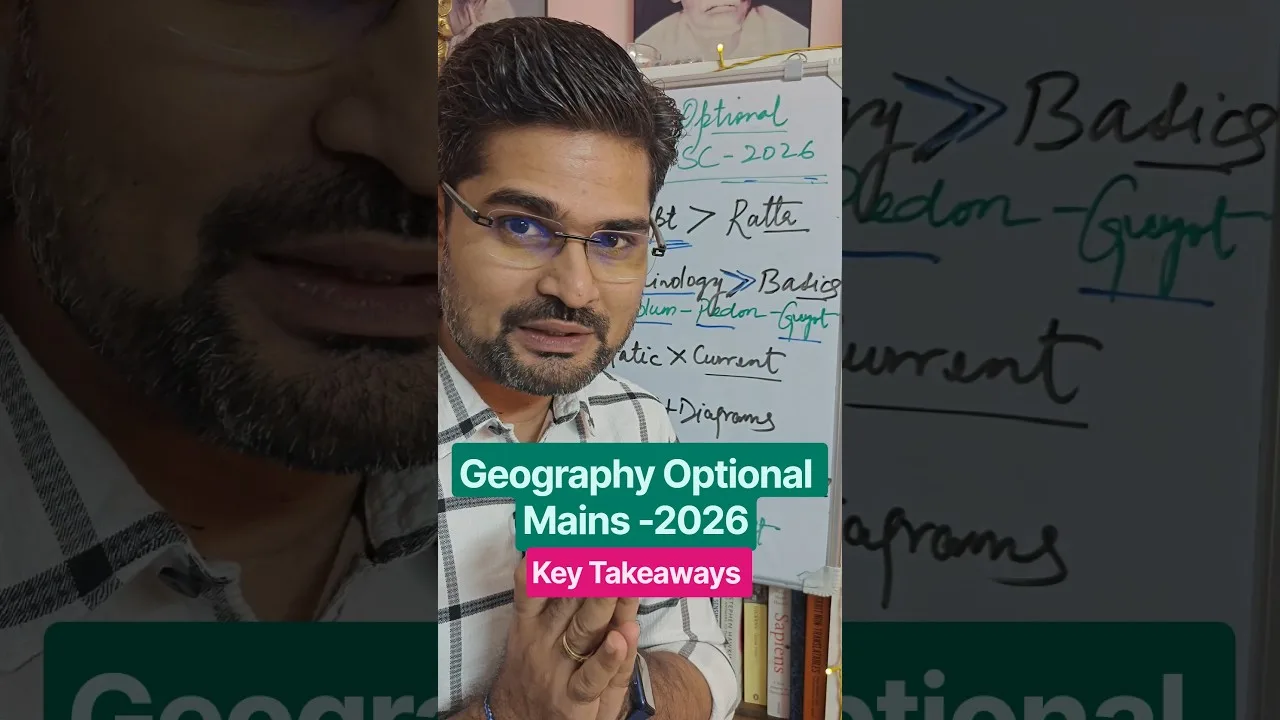
Table of Contents
- Why Geography Optional 2026 Demands a Paradigm Shift
- Conceptual Depth: The Foundation of High-Scoring Answers
- Technical Terminology: Precision as a Scoring Differentiator
- Static + Current Integration: The Hybrid Preparation Model
- Maps & Diagrams: Visual Answers Fetch 15-20% Extra Marks
- Analytical Thinking: From Description to Explanation
- Resource Strategy for Geography Optional 2026
- Paper-Wise Strategy: Paper I (Physical & Human Geography)
- Paper-Wise Strategy: Paper II (Geography of India)
- Answer Writing Framework: The GEO-STRUCT Method
- Common Pitfalls to Avoid in Geography Optional 2026 Preparation
- Revision Cycles: The 3-2-1 Protocol
- Leveraging Mentorship and Peer Learning
- Final Thoughts: Think Geographically, Score Exceptionally
Geography Optional 2026 has emerged as a definitive game-changer for UPSC aspirants, reshaping how candidates approach one of the most popular optional subjects in the Civil Services Examination. The latest pattern demands more than rote memorization—it requires conceptual depth, technical terminology mastery, seamless static-current integration, cartographic proficiency, and analytical thinking. These five pillars form the bedrock of a high-scoring strategy for Geography Optional 2026, and understanding them early can save months of misdirected effort. Aspirants who align their preparation with these evolving expectations gain a decisive edge in both Paper I and Paper II.
- Conceptual depth supersedes factual recall—examiners test understanding of processes, not just definitions.
- Technical terminology must be used precisely in answers to demonstrate subject mastery.
- Static + current integration is non-negotiable; every static topic needs contemporary relevance.
- Maps & diagrams are scoring tools—practice daily sketching with proper annotations.
- Analytical thinking transforms descriptive answers into explanatory, cause-effect narratives.
Why Geography Optional 2026 Demands a Paradigm Shift
The Union Public Service Commission has progressively raised the bar for Geography Optional 2026 by emphasizing application over reproduction. In the 2023 and 2024 Mains, questions on geomorphology, climatology, and human geography required candidates to explain mechanisms—such as the role of jet streams in Indian monsoon variability or the impact of urban heat islands on metropolitan microclimates—rather than merely listing features. This trend aligns with UPSC’s broader shift toward testing critical thinking and interdisciplinary synthesis. Aspirants must now “think geographically,” connecting physical processes to human outcomes across spatial and temporal scales.
Conceptual Depth: The Foundation of High-Scoring Answers
Conceptual depth in Geography Optional 2026 means grasping the “why” and “how” behind every phenomenon. For instance, instead of memorizing Köppen’s climate classification codes, aspirants should understand the thermodynamic principles driving climate zones—solar insolation gradients, pressure belt migration, and ocean-atmosphere coupling. When answering a question on “Climate change and its impact on Indian agriculture,” a conceptually deep response integrates radiation balance, evapotranspiration shifts, crop phenology changes, and socio-economic vulnerability indices. Standard references like Physical Geography by Savindra Singh and Climatology by D.S. Lal remain indispensable, but they must be supplemented with IPCC Assessment Reports and UPSC official notifications for syllabus updates.
Technical Terminology: Precision as a Scoring Differentiator
Examiners reward precise technical vocabulary. Terms like “isostasy,” “orographic precipitation,” “primate city,” “rank-size rule,” “carrying capacity,” and “ecological footprint” should flow naturally in answers. For Geography Optional 2026, compile a personal glossary of 300+ terms across geomorphology, climatology, oceanography, economic geography, and population geography. Practice writing 150-word answers using at least 8-10 technical terms correctly. This habit not only fetches terminology marks but also structures thinking geographically. The Dictionary of Human Geography (Johnston et al.) and Oxford Dictionary of Geography are authoritative sources for definitions.
Static + Current Integration: The Hybrid Preparation Model
No topic in Geography Optional 2026 exists in isolation. The 2024 Mains question on “River linking projects in India: feasibility and challenges” demanded knowledge of drainage patterns (static), inter-state water disputes (polity/current), environmental impact assessments (environment/current), and techno-economic viability (economy/current). Aspirants must maintain a “Current Geography Register” mapping every static syllabus topic to 3-5 recent developments (2022-2026). Sources include Yojana, Kurukshetra, Down To Earth, PIB releases, NITI Aayog reports, and Ministry of Earth Sciences publications. For example, the static topic “Soil degradation” links to current themes: UNCCD COP15 outcomes, India’s Land Degradation Neutrality targets, and the Soil Health Card Scheme’s latest phase.
Maps & Diagrams: Visual Answers Fetch 15-20% Extra Marks
Cartographic skill is a force multiplier in Geography Optional 2026. UPSC explicitly allocates marks for neat, labeled diagrams. Daily 20-minute map practice should cover: (1) India’s physiographic divisions with tectonic features, (2) Monsoon onset/withdrawal isochrones, (3) Major soil types with crop associations, (4) Industrial corridors and SEZs, (5) Population density and migration flows. Use Oxford School Atlas and Survey of India toposheets for reference. In answers, draw sketch maps even when not explicitly asked—a drainage basin diagram for a flood management question, or a Lorenz curve for regional inequality. Annotations must include scale, direction, legend, and data source citations.
Analytical Thinking: From Description to Explanation
The highest-scoring answers in Geography Optional 2026 exhibit analytical rigor. Instead of describing “Urban sprawl in Delhi-NCR,” analyze: drivers (land price gradients, transport networks, policy gaps), patterns (polycentric vs. monocentric), consequences (air quality, groundwater depletion, social segregation), and policy responses (GRAP, RRTS, Master Plan 2041). Apply frameworks like DPSIR (Driver-Pressure-State-Impact-Response) or STEEP (Social-Technological-Economic-Environmental-Political) to structure analysis. Practice previous year questions (2013-2024) under timed conditions, then self-evaluate using UPSC’s Answer Key and Model Answers released by toppers like Ira Singhal (AIR 1, 2014) and Junaid Ahmad (AIR 3, 2018), both Geography optional candidates.
Resource Strategy for Geography Optional 2026
A lean, high-yield booklist prevents resource overload. Core static texts: Certificate Physical and Human Geography (G.C. Leong), India: A Comprehensive Geography (D.R. Khullar), Models in Geography (Majid Husain), Geographical Thought (Dikshit & Dikshit). For current affairs: Monthly Geography Digest by The Geoecologist, Down To Earth magazine, and PIB Geography-related releases. Test series: Join a reputable Mains test series by October 2025 for 8-10 full-length mocks with personalized feedback. Allocate 3 hours daily (2 static + 1 current/map) for 10 months—consistency trumps intensity.
Paper-Wise Strategy: Paper I (Physical & Human Geography)
Paper I of Geography Optional 2026 carries 250 marks across geomorphology, climatology, oceanography, biogeography, environmental geography, perspectives in human geography, economic geography, population geography, settlement geography, and regional planning. Weightage analysis of 2018-2024 papers shows climatology (22%), geomorphology (18%), and economic geography (15%) dominate. Prioritize these, but neglect no topic—UPSC surprises with low-weightage topics (e.g., “Soil profile development in lateritic regions” in 2022). For each topic, prepare: (a) 3-4 page structured notes, (b) 5 key diagrams, (c) 10 technical terms, (d) 3 current linkages, (e) 2 model answers.
Paper-Wise Strategy: Paper II (Geography of India)
Paper II of Geography Optional 2026 tests applied geography: physical setting, resources, agriculture, industry, transport, trade, cultural setting, settlements, regional development, political aspects, and contemporary issues. This paper rewards India-specific data fluency. Memorize: state-wise HDI, literacy, sex ratio, cropping intensity, industrial output, mineral production (top 3 states per mineral), port traffic, and urban agglomeration populations (Census 2011 + NFHS-5 + PLFS 2022-23 estimates). Integrate schemes: PM-KUSUM (solar pumps), PM-GatiShakti (logistics), Jal Jeevan Mission (water), National Monetisation Pipeline (assets). Answers must cite latest data—”As per PLFS 2022-23, female LFPR in rural India rose to 36.6%” carries more weight than generic statements.
Answer Writing Framework: The GEO-STRUCT Method
Adopt a repeatable answer structure for Geography Optional 2026 to maximize marks per minute:
G – Geographical context (location, scale, region)
E – Explanation (process/mechanism with terminology)
O – Observations (data, trends, patterns)
S – Spatial representation (sketch map/diagram)
T – Theoretical linkage (model/theory/concept)
R – Relevance (current affair/policy/scheme)
U – Urban/rural/regional dimension
C – Challenges & solutions
T – Terminology-rich conclusion (2 lines)
Example: “Examine the role of Western Disturbances in Indian agriculture.” G: NW India, Rabi season. E: Mid-latitude westerlies, jet stream dynamics, orographic uplift over Himalayas. O: 30-40% Rabi rainfall contribution, declining trend (-15% since 1980 per IMD). S: Sketch map showing WD trajectory, precipitation belt. T: Baroclinic instability theory, Rossby waves. R: IMD’s WD forecasting upgrades, climate-resilient wheat varieties (DBW 187, DBW 222). U: Punjab-Haryana plains vs. hill agriculture. C: Groundwater over-extraction, heat terminal stress. T: “WD variability necessitates adaptive cropping systems and improved sub-seasonal forecasting.”
Common Pitfalls to Avoid in Geography Optional 2026 Preparation
Many aspirants sabotage their Geography Optional 2026 score through avoidable errors: (1) Neglecting diagrams—every 10-marker deserves a sketch; (2) Over-quoting data—use 2-3 precise figures, not data dumps; (3) Ignoring theories—Christaller, Von Thünen, Rostow, Malthus, Boserup must underpin answers; (4) Static-only preparation—zero current integration caps marks at 120/250; (5) Poor time management—practice 20-minute answers; (6) Superficial map work—vague blobs instead of annotated features; (7) Isolated topic study—geography is systemic, connect hydrology to agriculture to economy.
Revision Cycles: The 3-2-1 Protocol
Implement a structured revision calendar for Geography Optional 2026:
Cycle 1 (Months 1-6): First reading + notes + diagrams. Sundays: map practice.
Cycle 2 (Months 7-9): Second reading + current integration + test series. Weekly: 1 full paper.
Cycle 3 (Months 10-11): Third reading (notes only) + mock tests + weak area blitz. Bi-weekly: 2 full papers.
Final 30 days: 1-page cheat sheets per topic, diagram flashcards, terminology glossary, model answer bank. Sleep 7 hours, exercise daily—cognitive stamina matters.
Leveraging Mentorship and Peer Learning
Self-study for Geography Optional 2026 works, but structured mentorship accelerates progress. Platforms like The Geoecologist offer evaluated answer writing, personalized feedback, and strategy webinars by serving officers and toppers. Join a 5-member peer group for weekly answer exchange and critique—teaching reinforces learning. Participate in Geography Optional Answer Writing Challenges on Telegram/ForumIAS. Attend UPSC’s Civil Services Day lectures and National Geographical Society of India seminars for cutting-edge perspectives. Remember: geography is dynamic; your preparation must be too.
Final Thoughts: Think Geographically, Score Exceptionally
Geography Optional 2026 is not merely a subject—it is a lens to decode India’s developmental challenges and global interconnectivity. The five takeaways—conceptual depth, technical terminology, static-current integration, maps & diagrams, and analytical thinking—form an integrated framework, not a checklist. Internalize them. When you read about Joshimath subsidence, see isostasy, anthropogenic slope modification, groundwater withdrawal, and policy failure simultaneously. When you study the India-Middle East-Europe Economic Corridor, visualize plate tectonics, maritime chokepoints, trade gravity models, and geopolitical geography. This geographical imagination is what UPSC rewards. Start today. The map is not the territory—but mastering the map helps you conquer the territory of UPSC Mains 2026.
Frequently Asked Questions
The five key takeaways for Geography Optional 2026 are: (1) Conceptual depth over factual recall, (2) Precise technical terminology usage, (3) Static-current affairs integration for every topic, (4) Daily map and diagram practice with annotations, and (5) Analytical thinking using frameworks like DPSIR to structure explanatory answers.
A dedicated 10-month preparation window (3 hours daily) is recommended for Geography Optional 2026, divided into three revision cycles: first reading and note-making (months 1-6), second reading with current integration and test series (months 7-9), and final revision with mock tests (months 10-11), followed by a 30-day intensive review.
Essential books for Geography Optional 2026 include: Paper I – Certificate Physical and Human Geography (G.C. Leong), Models in Geography (Majid Husain), Geographical Thought (Dikshit & Dikshit); Paper II – India: A Comprehensive Geography (D.R. Khullar), Oxford School Atlas, and current affairs from Yojana, Down To Earth, PIB, and NITI Aayog reports.