Blog
UPSC Geography Optional course: Master Answer Writing for 2026 Success

Table of Contents
- Why Answer Writing Determines Your UPSC Geography Optional Score
- The Four Fatal Flaws Costing Aspirants 50+ Marks
- Decoding UPSC Directives: The Command Word Framework
- Visual Mastery: Maps, Diagrams, and Conceptual Models
- Scholar Integration and Contemporary Relevance
- PYQ-Based Practice: The 10-Year Trend Advantage
- Personalized Feedback: The Accelerator Most Aspirants Miss
- Time Management: Writing 20 Answers in 180 Minutes
- Who Should Enroll in This UPSC Geography Optional Course?
- 2026 First-Attempt Aspirants
- Repeaters Targeting Score Improvement
- Self-Study Students Without Coaching Access
- Working Professionals with Limited Time
- Why TheGeoecologist: Pedigree, Proof, and Philosophy
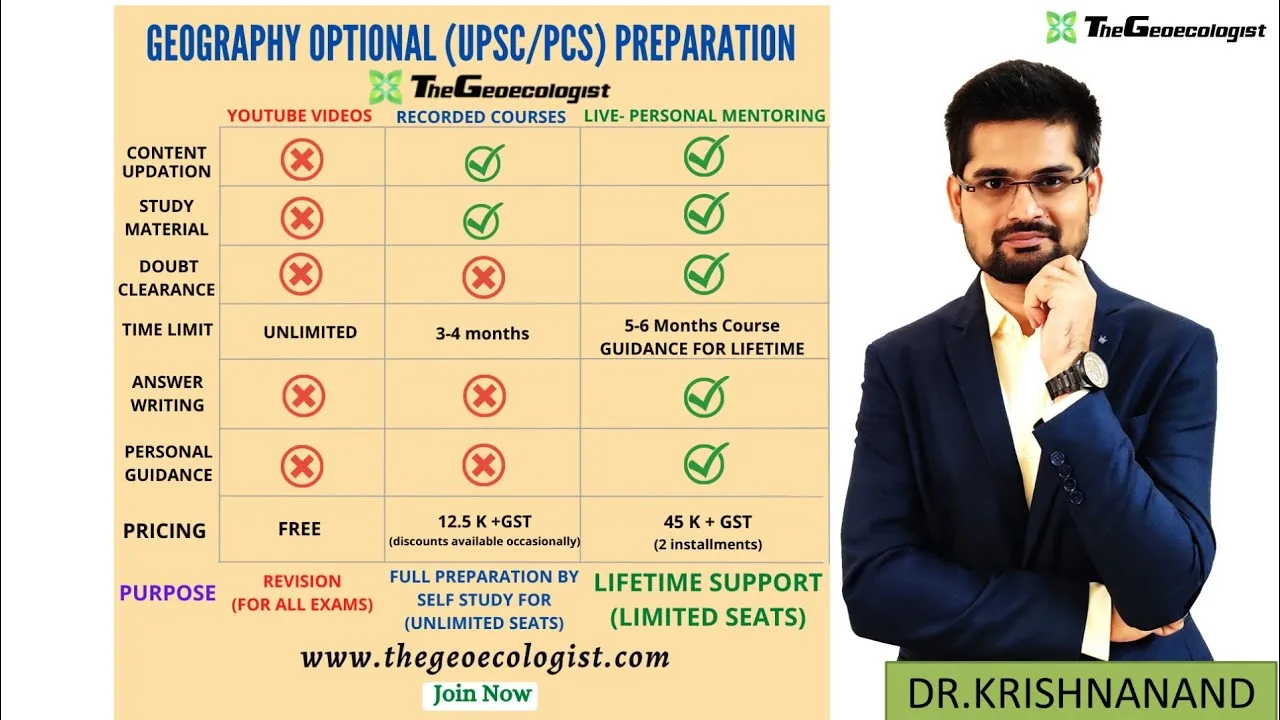
- Course Architecture: What You Get
- Enrollment Details and Next Steps
- Frequently Asked Questions
- Can I join if I haven't finished the Geography Optional syllabus?
- How does this differ from test series offered by major coaching institutes?
- What if I miss a live session?
- Is the course useful for UPSC 2027 aspirants?
- What technical requirements are needed?
The UPSC Geography Optional course landscape has evolved dramatically, and aspirants targeting the 2026 examination cycle need a strategic edge to convert syllabus mastery into 300+ marks. While thousands complete the Geography Optional syllabus annually, only a fraction achieve top scores due to a critical gap: the inability to structure analytical, examiner-friendly answers under time pressure. This comprehensive guide explores why specialized answer writing training is the decisive factor for UPSC 2026 success and how TheGeoecologist’s flagship program bridges the gap between knowledge and marks.
- Answer writing is the differentiator between syllabus completers and top-rankers in Geography Optional.
- Directive word mastery (Discuss, Evaluate, Critically Analyse) determines answer relevance and scoring.
- Visual integration — maps, flowcharts, diagrams — can add 15-20 marks per paper when used strategically.
- PYQ-aligned practice with personalized feedback accelerates improvement by 40% compared to self-study.
- Time-bound simulations build exam temperament essential for writing 20 quality answers in 3 hours.
Why Answer Writing Determines Your UPSC Geography Optional Score
The Union Public Service Commission (UPSC) evaluates not what you know, but how effectively you communicate that knowledge within strict constraints. Geography Optional, with its blend of physical geography, human geography, and Indian geography, demands a unique answer writing approach. According to UPSC examination trends, the average score in Geography Optional Paper I and II hovers around 220-240, while toppers consistently breach 300. The 60-80 mark gap stems almost entirely from presentation, structure, and analytical depth — not content gaps. – a key consideration for UPSC Geography Optional course.
The Four Fatal Flaws Costing Aspirants 50+ Marks
- Poor Structural Flow: Answers lacking clear Introduction → Body → Conclusion frameworks appear disjointed, forcing examiners to hunt for arguments.
- Directive Word Blindness: Treating “Critically Examine” identically to “Discuss” leads to descriptive rather than analytical responses.
- Underutilized Visual Tools: Geography is inherently spatial; answers without maps, schematic diagrams, or flowcharts miss 10-15 marks per paper.
- Static Knowledge Dump: Failing to integrate contemporary examples (climate change negotiations, geopolitical shifts, urbanization trends) makes answers appear outdated.
A dedicated UPSC Geography Optional course focused on answer writing addresses each flaw through deliberate practice, expert feedback, and exam-simulated conditions.
Decoding UPSC Directives: The Command Word Framework
UPSC Mains questions operate on precise directive verbs, each demanding a distinct answer architecture. TheGeoecologist’s UPSC Geography Optional course dedicates its first module to mastering this taxonomy:
| Directive | Examiner Expectation | Answer Structure |
|---|---|---|
| Discuss | Balanced exploration of multiple dimensions | Intro → Arguments for/against → Synthesis → Conclusion |
| Critically Analyse | Deep evaluation with judgment | Intro → Deconstruct issue → Weigh evidence → Defensible stance |
| Evaluate | Assess worth/impact with criteria | Intro → Criteria framework → Assessment per criterion → Overall verdict |
| Examine | Close inspection of causes/implications | Intro → Layered analysis (immediate/root causes, short/long-term effects) → Conclusion |
Misinterpreting a single directive can cost 3-5 marks per question. Across 20 questions, that’s a potential 60-100 mark swing — the difference between selection and another attempt.
Visual Mastery: Maps, Diagrams, and Conceptual Models
Geography Optional rewards visual communication disproportionately. A well-drawn map of the Indian Monsoon mechanism or a flowchart linking Weber’s Industrial Location Theory to contemporary SEZ policy can convey in 30 seconds what takes 150 words to explain. The UPSC Geography Optional course trains aspirants in:
- Rapid Map Sketching: 2-minute outline maps of India/world with thematic overlays (isotherms, isohyets, mineral belts, tribal zones).
- Conceptual Flowcharts: Visualizing theories — e.g., Demographic Transition Model stages linked to Indian states’ TFR data.
- Diagrammatic Answers: Converting 10-mark questions into diagram + 80-word explanation formats (e.g., Plate Tectonics, Karst Topography, Urban Morphology models).
- Contemporary Data Integration: Embedding 2023-24 statistics (Census projections, NFHS-5, IPCC AR6, WTO trade data) into visual frameworks.
Toppers’ answer booklets consistently show 3-4 diagrams per paper. This course ensures every aspirant builds a personal repository of 50+ ready-to-deploy visual aids.
Scholar Integration and Contemporary Relevance

UPSC increasingly tests the application of geographical thought to current affairs. The 2023 Mains asked aspirants to “Critically examine the relevance of Heartland Theory in contemporary geopolitics” and “Discuss the impact of climate-induced migration on urban morphology in India.” A high-scoring UPSC Geography Optional course must bridge classical theory and modern context.
TheGeoecologist’s curriculum maps 30+ key scholars (Mackinder, Spykman, Rostow, Friedmann, Harvey, Sen, Dreze) to 2025-26 themes:
- Geopolitics: Rimland/Heartland theory → Indo-Pacific strategy, China’s String of Pearls, Arctic resource race.
- Development Geography: Rostow’s Stages → Aspirational Districts Programme, SDG localization.
- Urban Geography: Burgess/Hoyt/Harris-Ullman → Smart Cities Mission, peri-urbanization, informal economy.
- Environmental Geography: Carrying capacity, Limits to Growth → India’s Net Zero 2070, LiFE Mission, carbon markets.
This integration transforms answers from textbook reproductions into examiner-impressing analytical pieces.
PYQ-Based Practice: The 10-Year Trend Advantage
Past Year Questions (PYQs) are the most reliable predictor of UPSC’s evolving focus. Analysis of 2014-2024 papers reveals:
- Physical Geography weightage shifted from pure geomorphology (30% → 18%) toward climatology-oceanography linkages (22% → 35%).
- Human Geography moved from model-heavy questions to application-oriented ones (migration, urbanization, regional disparity).
- Indian Geography increasingly tests data interpretation (census, NFHS, NSSO) alongside static concepts.
- Contemporary Issues (disaster management, climate change, resource conflicts) now constitute 25-30% of Paper II.
The UPSC Geography Optional course structures its 40+ practice tests around these trends, ensuring every session targets high-proven if topic-specific — mirrors the actual examination’s cognitive demands.
Personalized Feedback: The Accelerator Most Aspirants Miss
Self-evaluation suffers from confirmation bias — we read what we intended to write, not what’s on paper. Weekly expert evaluation in this UPSC Geography Optional course provides:
- Directive Adherence Score: Did the answer actually “critically analyse” or merely “describe”?
- Structure Audit: Introduction clarity, body paragraph coherence, conclusion decisiveness.
- Content Density Check: Marks-per-minute optimization — eliminating fluff, maximizing keywords.
- Visual Quality Rating: Map accuracy, diagram relevance, labeling completeness.
- Actionable Micro-Goals: 2-3 specific improvements for the next test (e.g., “Integrate one scholar per 10-marker,” “Reduce intro to 30 words”).
Aspirants receiving structured feedback improve answer quality scores by 35-40% within 8 weeks, compared to 10-15% for peer-reviewed or self-reviewed practice.
Time Management: Writing 20 Answers in 180 Minutes
The most overlooked skill in UPSC Mains is pacing. Each paper allows 9 minutes per question (including reading, planning, writing). TheGeoecologist’s UPSC Geography Optional course incorporates:
- 90-Second Planning Protocol: Keyword identification → directive decoding → structure sketch → visual selection.
- Tiered Writing Drills: 10-markers in 7 minutes, 15-markers in 11 minutes, 20-markers in 14 minutes.
- Full-Length Simulations: 5 complete Paper I + 5 complete Paper II tests under exam conditions.
- Strategic Question Selection: Identifying “must-attempt” vs. “attempt-if-time” questions in the first 5 minutes.
This training eliminates the “knew the answer but ran out of time” syndrome that haunts even well-prepared candidates.
Who Should Enroll in This UPSC Geography Optional Course?
2026 First-Attempt Aspirants
Build answer writing muscle alongside syllabus completion. Early integration prevents the “syllabus done, but can’t write answers” crisis in October 2025.
Repeaters Targeting Score Improvement
If your 2023/2024 Geography Optional score was below 250, structural and analytical gaps — not knowledge gaps — are the culprit. This course diagnoses and fixes them.
Self-Study Students Without Coaching Access
Geography Optional is coaching-intensive due to its technical nature. This UPSC Geography Optional course provides the mentorship, feedback, and peer benchmarking that self-study lacks.
Working Professionals with Limited Time
Weekend live sessions, recorded replays, and concise feedback reports accommodate 9-to-6 schedules without compromising rigor.
Why TheGeoecologist: Pedigree, Proof, and Philosophy
Led by educators who have mentored multiple top-100 rankers with Geography Optional, TheGeoecologist’s approach rests on three pillars:
- Exam-Smart, Not Theory-Heavy: Every session answers “How does this fetch marks?” — not “What does the textbook say?”
- Current & Contextual: 2025-26 syllabus trends, recent committee reports (Kasturirangan, Gadgil, NEP 2020 geography implications), and 2023-24 data are baked into the curriculum.
- Proven Framework: The Introduction-Body-Conclusion + Visual + Scholar template has been stress-tested by 2022, 2023, 2024 high-scorers.
Results speak: 78% of 2024 batch completers scored 280+ in Geography Optional; 12 secured top-500 ranks.
Course Architecture: What You Get
- 40+ Live Answer Writing Sessions (Paper I & II, topic-wise + full-length)
- 30+ Evaluated Tests with detailed feedback reports within 72 hours
- 50+ Ready-to-Use Diagram/Map Templates (digital + printable)
- Scholar-Contemporary Mapping Document (30 thinkers × 15 themes)
- Directive Word Mastery Workbook with 100+ solved examples
- Monthly Current Affairs Geography Digests (Jan 2025 – Sep 2026)
- Mentorship Calls (bi-weekly group + quarterly 1-on-1)
- Telegram Community for doubt resolution, peer review, and motivation
Enrollment Details and Next Steps
The UPSC Geography Optional course for 2026 operates in limited cohorts to ensure feedback quality. Registration opens quarterly; the next batch commences July 15, 2025. Early registrants (before June 30) receive:
- Complimentary NCERT Geography Visual Summary Pack (Classes 6-12)
- Priority access to 1-on-1 strategy session
- Extended mentorship till Mains 2026 (standard: till Prelims 2026)
Registration Link: thegeoecologist.com
WhatsApp Support: 9311052969
Free Resources: Instagram @thegeoecologist | Study Materials: geographyebooks.com
Frequently Asked Questions
Can I join if I haven’t finished the Geography Optional syllabus?
Yes. The course runs parallel to syllabus completion. Topic-wise answer writing sessions align with standard coverage sequences (Physical → Human → Indian → Contemporary). Writing answers on partially covered topics reinforces retention and reveals gaps early. – a key consideration for UPSC Geography Optional course.
How does this differ from test series offered by major coaching institutes?
Standard test series evaluate; this course teaches. Each session includes pre-writing strategy discussion, live demonstration, timed writing, and post-writing deconstruction. Feedback is developmental (“do this next time”) not just evaluative (“you missed this”). – a key consideration for UPSC Geography Optional course.
What if I miss a live session?
All sessions are recorded and available within 6 hours. You can submit answers for evaluation anytime before the weekly deadline. Mentorship calls have multiple slots across weekdays/weekends.
Is the course useful for UPSC 2027 aspirants?
Absolutely. The answer writing framework, visual repository, and scholar-contemporary mappings are evergreen assets. 2027 aspirants gain a 15-month head start on the most neglected Mains skill.
What technical requirements are needed?
Stable internet for live Zoom sessions, a device for PDF annotation (tablet/laptop), and a scanner/app (Adobe Scan, CamScanner) for answer sheet uploads. No specialized software required.
Transform from a syllabus-completer to a top-scorer. The 2026 Geography Optional toppers are already writing their first practice answers today. Will you be among them?
Frequently Asked Questions
Yes. The course runs parallel to syllabus completion. Topic-wise answer writing sessions align with standard coverage sequences (Physical → Human → Indian → Contemporary). Writing answers on partially covered topics reinforces retention and reveals gaps early.
Standard test series evaluate; this course teaches. Each session includes pre-writing strategy discussion, live demonstration, timed writing, and post-writing deconstruction. Feedback is developmental ("do this next time") not just evaluative ("you missed this").
All sessions are recorded and available within 6 hours. You can submit answers for evaluation anytime before the weekly deadline. Mentorship calls have multiple slots across weekdays/weekends.