
Blog
Manoj Kumar Bharati UPPSC: Rank 5 Success Story & Preparation Strategy

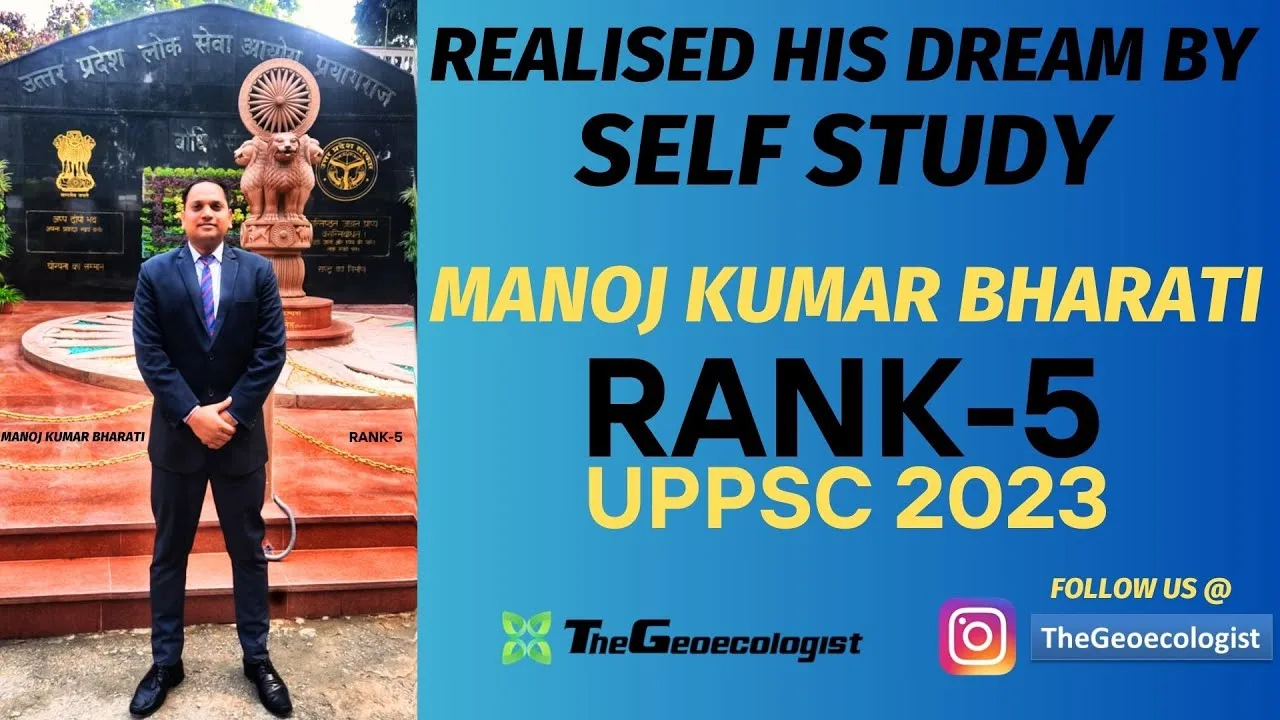
Table of Contents
- Who Is Manoj Kumar Bharati? Background and Motivation
- Understanding the UPPSC Examination Landscape
- Why Geography Became His Strategic Stronghold
- TheGeoecologist's Role in Shaping a Rank 5 Strategy
- Deconstructing the Preparation Timeline: A Phase-Wise Approach
- Key Pillars of Manoj Kumar Bharati's UPPSC Success
- 1. Mentorship Over Material Hoarding
- 2. Answer Writing as a Daily Habit, Not a Pre-Exam Ritual
- 3. Current Affairs as a Lens, Not a List
- 4. Test Series as Diagnostic Tools, Not Scorecards
- 5. Mental Resilience and Routine Discipline
- Geography Optional: The Scoring Differentiator
- Uttar Pradesh Specific Preparation: The Home Advantage
- Lessons for Future UPPSC Aspirants
- TheGeoecologist: Scaling Quality Geography Education
- Conclusion: Your Rank Awaits Your First Step
Manoj Kumar Bharati UPPSC Rank 5 achiever has become a beacon of inspiration for thousands of civil service aspirants across Uttar Pradesh and India. The announcement of the Uttar Pradesh Public Service Commission (UPPSC) 2023 final results marked a defining moment in the journey of this dedicated candidate, whose strategic preparation and unwavering perseverance culminated in a historic top-five finish. His success story is not merely about clearing one of India’s most competitive state-level examinations; Manoj Kumar Bharati UPPSC is a masterclass in disciplined study planning, resource optimization, and the transformative power of expert mentorship. As aspirants analyze the UPPSC 2023 results, Manoj Kumar Bharati’s name stands out as a testament to what structured guidance—particularly from platforms like TheGeoecologist—can achieve when combined with self-driven effort.
- Manoj Kumar Bharati UPPSC Rank 5 in 2023 demonstrates the power of strategic preparation over rote learning.
- Geography mastery through TheGeoecologist’s specialized courses played a pivotal role in both Prelims and Mains.
- Integration of current affairs with static syllabus topics gave a decisive edge in answer writing.
- Regular test series participation and personalized mentorship refined time management and presentation skills.
- Consistency, revision cycles, and mental resilience were non-negotiable pillars of his daily routine.
Who Is Manoj Kumar Bharati? Background and Motivation
Before diving into the preparation strategy, Manoj Kumar Bharati UPPSC is essential to understand the person behind the rank. Manoj Kumar Bharati UPPSC topper hails from a modest background where education was valued as the primary vehicle for social mobility. His early academic years were marked by a keen interest in social sciences, particularly geography and environmental studies. This inclination naturally aligned with the demands of the UPPSC examination, where Geography features prominently in both General Studies papers and as an optional subject. Unlike many aspirants who begin preparation immediately after graduation, Manoj spent initial years understanding the exam pattern, analyzing previous year papers, and identifying his strengths and weaknesses. This diagnostic phase—often overlooked—allowed him to craft a preparation roadmap tailored to his learning style, rather than blindly following generic topper strategies.
Understanding the UPPSC Examination Landscape
The Uttar Pradesh Public Service Commission conducts the Combined State/Upper Subordinate Services Examination annually to recruit officers for various Group A and Group B posts in the state bureaucracy. The three-stage process—Preliminary Examination, Main Examination, and Personality Test—demands a unique blend of factual accuracy, analytical depth, and administrative aptitude. The Preliminary stage comprises two objective papers: General Studies I (covering history, geography, polity, economy, environment, and current affairs) and General Studies II (CSAT, qualifying in nature). The Mains examination is descriptive, consisting of eight papers including four General Studies papers, one Essay paper, two Optional subject papers, and one General Hindi paper. Manoj Kumar Bharati UPPSC Rank 5 holder recognized early that cracking this exam requires not just knowledge accumulation but the ability to reproduce that knowledge under strict time constraints in a structured, examiner-friendly format.
Why Geography Became His Strategic Stronghold
Geography occupies a disproportionately high weightage in the UPPSC syllabus. From physical geography and climatology in General Studies Paper I to human geography, regional planning, and disaster management in General Studies Paper III, Manoj Kumar Bharati UPPSC permeates multiple papers. For Manoj Kumar Bharati UPPSC preparation, choosing Geography as the optional subject was a calculated decision. Manoj Kumar Bharati UPPSC offered syllabus overlap with General Studies, scientific scoring potential through diagrams and maps, and a logical framework that resonated with his academic temperament. However, mastering Geography for UPPSC is not merely about memorizing NCERTs; it demands conceptual clarity on geomorphological processes, climatological phenomena, and contemporary geographical issues like climate change, urbanization, and resource conflicts. This is where TheGeoecologist’s pedagogy—rooted in conceptual teaching rather than fact-dumping—became a game-changer.
TheGeoecologist’s Role in Shaping a Rank 5 Strategy

When Manoj Kumar Bharati UPPSC aspirant enrolled in TheGeoecologist’s flagship Geography course, he was seeking more than video lectures. He needed a structured ecosystem that could bridge the gap between textbook theory and exam-oriented application. The platform’s comprehensive offerings—detailed video lectures by experienced educators, interactive doubt-solving sessions, current affairs integration with core syllabus topics, and rigorous test series with personalized answer evaluation—provided exactly that. In his own words, “TheGeoecologist’s tailored guidance and in-depth study materials were instrumental in clarifying concepts and boosting my confidence. Their focus on integrating current affairs with geographical theories gave me an edge in both prelims and mains.” This endorsement highlights a critical success factor: the alignment of coaching methodology with the evolving demands of the UPPSC examination, which increasingly tests application over recall.
Deconstructing the Preparation Timeline: A Phase-Wise Approach
Manoj Kumar Bharati UPPSC preparation journey can be deconstructed into four distinct phases, each with specific objectives and deliverables. Understanding this phased approach can help current aspirants benchmark their own progress and identify gaps.
Phase 1: Foundation Building (Months 1–6)
The first six months were dedicated exclusively to building a rock-solid foundation. Manoj completed multiple readings of NCERT textbooks from Classes 6–12 for History, Geography, Polity, Economy, and Science. Simultaneously, he enrolled in TheGeoecologist’s basic Geography course to develop conceptual clarity on physical and human geography topics. This phase was characterized by passive learning—reading, listening, and understanding—without the pressure of answer writing. He maintained a daily study log, tracking hours spent per subject, and ensured a minimum of 10–12 hours of focused study daily. Weekly revision slots on Sundays prevented knowledge decay. No mock tests were attempted during this phase; the goal was conceptual completeness, not performance metrics.
Phase 2: Integration and Application (Months 7–12)
The second phase marked the transition from input to output. Manoj Kumar Bharati UPPSC candidate began integrating current affairs with static topics using TheGeoecologist’s monthly current affairs compilations, which were tagged to specific syllabus points. He started writing one full-length answer daily, alternating between General Studies and Geography optional. TheGeoecologist’s answer evaluation program provided detailed feedback on structure, content, presentation, and time management. This feedback loop was critical—it transformed his answers from descriptive narratives to analytical arguments supported by data, diagrams, and case studies. He also joined the platform’s Prelims test series, attempting one full-length test weekly and spending equal time on error analysis. Each incorrect answer was categorized (conceptual gap, factual error, misreading, guesswork) and addressed systematically.
Phase 3: Mains Intensive Preparation (Months 13–18)
Post-Prelims, the focus shifted entirely to Mains answer writing. Manoj Kumar Bharati UPPSC Rank 5 achiever treated every day as a simulated exam day. He wrote two full-length General Studies papers and one Optional paper weekly under strict timed conditions. TheGeoecologist’s Mains test series, with its comprehensive model answers and video discussions, became his primary revision tool. He developed a repository of 200+ standardized introductions, conclusions, diagrams, and case studies for recurring themes—federalism, disaster management, agricultural reforms, urban governance, and climate resilience. Special attention was given to Uttar Pradesh-specific topics: state geography, socio-economic indicators, government schemes, and regional issues, which carry significant weightage in UPPSC Mains. Essay preparation involved writing one essay weekly on philosophical, administrative, and contemporary themes, with peer review and mentor feedback.
Phase 4: Revision and Interview Readiness (Months 19–24)
The final phase was characterized by high-density revision and personality test preparation. Manoj Kumar Bharati UPPSC topper condensed his notes into one-page mind maps per topic for last-minute recall. He participated in TheGeoecologist’s interview guidance program, which included mock interviews with retired bureaucrats, subject experts, and psychologists. The panel focused on situational judgment, ethical dilemmas, administrative decision-making, and communication skills. Manoj also prepared a detailed DAF (Detailed Application Form) analysis document, anticipating questions on his hometown, educational background, hobbies, and optional subject. Regular newspaper reading (The Hindu, Indian Express) continued with a focus on editorials, government reports, and Uttar Pradesh-specific developments. Physical fitness and meditation were incorporated to manage pre-interview anxiety.
Key Pillars of Manoj Kumar Bharati’s UPPSC Success
1. Mentorship Over Material Hoarding
A common trap for aspirants is accumulating endless PDFs, books, and test series without completing any. Manoj Kumar Bharati UPPSC Rank 5 holder avoided this by committing to a single trusted ecosystem—TheGeoecologist—for Geography and current affairs integration. He supplemented this with standard references (Laxmikanth for Polity, Spectrum for Modern History, Ramesh Singh for Economy) but never juggled multiple sources for the same topic. This discipline prevented decision fatigue and ensured depth over breadth. TheGeoecologist’s mentorship model, where educators are accessible for doubt resolution and strategic guidance, provided accountability that self-study alone cannot.
2. Answer Writing as a Daily Habit, Not a Pre-Exam Ritual
Most aspirants start answer writing a month before Mains. Manoj Kumar Bharati UPPSC topper wrote over 500 answers before the actual examination. This volume built muscle memory for structuring answers within word limits, incorporating keywords, drawing schematic diagrams, and concluding with forward-looking statements. TheGeoecologist’s evaluation framework—assessing answers on introduction quality, body structure, content relevance, diagram usage, and conclusion effectiveness—gave him a quantifiable improvement trajectory. He tracked his average score per paper monthly, targeting a 10–15% improvement each cycle.
3. Current Affairs as a Lens, Not a List
Memorizing 12 months of current affairs magazines is neither feasible nor effective. Manoj Kumar Bharati UPPSC achiever used TheGeoecologist’s tagged current affairs modules, where each news item was linked to a static syllabus topic. For instance, a news report on the Ken-Betwa river linking project was studied under “Inter-state water disputes” (Polity), “River linking projects” (Geography), and “Bundelkhand water crisis” (UP-specific). This multidimensional tagging enabled him to retrieve relevant examples instantly during the exam. He maintained a digital notebook (OneNote) with tags for quick revision.
4. Test Series as Diagnostic Tools, Not Scorecards
Many aspirants obsess over test series ranks. Manoj Kumar Bharati UPPSC Rank 5 holder viewed every test as a diagnostic tool. After each TheGeoecologist mock, he spent 3–4 hours analyzing: Which topics were weak? Which question types caused confusion? Was time management optimal? Did presentation meet examiner expectations? He maintained an “Error Register” categorizing mistakes by root cause. This register became his most valuable revision asset in the final month. The platform’s All-India ranking provided competitive benchmarking, but his primary competition was his previous self.
5. Mental Resilience and Routine Discipline
The psychological toll of a 2-year preparation cycle is underestimated. Manoj Kumar Bharati UPPSC topper followed a non-negotiable daily routine: wake at 5:30 AM, meditation (20 min), exercise (30 min), study blocks (3×3 hours with breaks), light reading before sleep. He avoided social media entirely during study hours, using app blockers. Weekly off-days prevented burnout. He joined a peer accountability group of 4–5 serious aspirants for weekly progress reviews. TheGeoecologist’s community forums provided additional motivation through success stories, strategy webinars, and doubt-resolution threads. This ecosystem effect—being part of a community with shared goals—sustained momentum during low phases.
Geography Optional: The Scoring Differentiator
For Manoj Kumar Bharati UPPSC Rank 5, Geography optional contributed significantly to his final merit. Manoj Kumar Bharati UPPSC’s scientific nature allows precise, diagram-rich answers that examiners reward. TheGeoecologist’s optional course covered the entire syllabus—Geomorphology, Climatology, Oceanography, Biogeography, Human Geography, Economic Geography, Regional Planning, and Contemporary Issues—with equal emphasis on theory and application. Special modules on map work, thematic mapping, and GIS applications gave him an edge in Paper II. He prepared 50+ standardized maps (physiographic divisions, climate regions, soil types, population density, industrial corridors, transport networks) that could be reproduced in 3–4 minutes during the exam. Model answers for previous year questions (2013–2022) were memorized as templates. This preparation translated into a high optional score, widening his margin over competitors who relied solely on General Studies.
Uttar Pradesh Specific Preparation: The Home Advantage
UPPSC places unique emphasis on Uttar Pradesh’s geography, history, economy, polity, and current affairs. Manoj Kumar Bharati UPPSC aspirant leveraged his domicile advantage by preparing a dedicated “UP Dossier” covering: physiographic divisions (Gangetic Plain, Bundelkhand, Terai), major rivers and irrigation projects, cropping patterns, mineral resources, industrial corridors (Noida-Greater Noida, Lucknow-Kanpur, Varanasi), demographic profile, social indicators, government schemes (Kisan Samman Nidhi, Mission Shakti, ODOP), Panchayati Raj system, and recent administrative reforms. TheGeoecologist’s UP-specific modules and monthly state current affairs compilations were primary sources. He also studied the Uttar Pradesh Economic Survey and Budget highlights for data-backed answers. This targeted preparation ensured 40–50 marks in GS papers that many non-domicile aspirants miss.
Lessons for Future UPPSC Aspirants
The Manoj Kumar Bharati UPPSC success blueprint offers actionable takeaways for every serious aspirant:
- Start with syllabus deconstruction: Map every topic to sources, weightage, and question trends before buying a single book.
- Choose mentorship wisely: A platform like TheGeoecologist that offers integrated teaching, testing, and evaluation reduces fragmentation.
- Write from Day 1 of Phase 2: Answer writing is a skill; it requires 6–8 months of deliberate practice to master.
- Current affairs must be tagged: Untagged current affairs are noise. Tagged current affairs are ammunition.
- Tests are for learning, not scoring: Error analysis > Rank. Maintain an error register religiously.
- Optional subject is a force multiplier: Choose based on interest, overlap, and scoring potential—not peer pressure.
- State-specific preparation is non-negotiable: For state PSCs, 20–25% marks come from state-specific topics.
- Health and mindset are preparation components: Burnout kills more attempts than difficult questions.
TheGeoecologist: Scaling Quality Geography Education
Behind Manoj Kumar Bharati UPPSC Rank 5 stands TheGeoecologist, a platform founded on the principle that quality geography education should be accessible, structured, and exam-oriented. Founded by Krishna Kumar, a seasoned geography educator with over a decade of UPSC/State PSC mentoring experience, TheGeoecologist has evolved from a YouTube channel into a comprehensive learning ecosystem. Its paid online courses feature detailed video lectures, interactive doubt-solving sessions, current affairs integration, test series with personalized evaluation, and mentorship programs. The platform’s YouTube channel (TheGeoecologist YouTube Channel) offers free lectures, strategy videos, and motivation for aspirants at every stage. For personalized guidance, aspirants can connect via WhatsApp (9311052969) or email (krishna.geography@gmail.com). The community extends to Instagram (@thegeoecologist) for daily updates and motivation. As TheGeoecologist continues to produce toppers like Manoj Kumar Bharati, it reinforces the belief that with the right guidance, the path to civil services becomes navigable.
Conclusion: Your Rank Awaits Your First Step
Manoj Kumar Bharati UPPSC Rank 5 is not an anomaly; it is a reproducible outcome of disciplined strategy, expert mentorship, and relentless execution. His journey from an aspirant analyzing syllabus to a top-ranked officer illustrates that the UPPSC examination, despite its competitiveness, rewards those who prepare smartly, not just hard. TheGeoecologist’s role in providing the structural scaffolding—conceptual clarity, answer writing rigor, current affairs integration, and psychological support—demonstrates how the right platform can amplify individual effort. For every aspirant reading this, the message is clear: the rank you dream of is not reserved for the lucky or the genius. It is earned by those who show up daily, write answers when they don’t feel like it, analyze mistakes without ego, and persist when results are invisible. Manoj Kumar Bharati did it. With TheGeoecologist by your side, you can too. Visit TheGeoecologist today to explore courses, test series, and mentorship programs tailored for UPPSC 2024 and beyond. Your journey to the top begins with a single decision—make it today.
Frequently Asked Questions
Manoj Kumar Bharati is a UPPSC 2023 topper who secured Rank 5 in the Combined State/Upper Subordinate Services Examination conducted by the Uttar Pradesh Public Service Commission.
TheGeoecologist provided comprehensive Geography courses, current affairs integration, test series with personalized answer evaluation, and mentorship that strengthened his conceptual clarity and answer writing skills for both Prelims and Mains.
He followed a phased approach: foundation building with NCERTs and TheGeoecologist's basic course, integration phase with daily answer writing and tagged current affairs, Mains intensive with full-length timed tests, and final revision using mind maps and mock interviews.