Blog
UGC NET Geography Cutoff: June 2026 Expected Marks

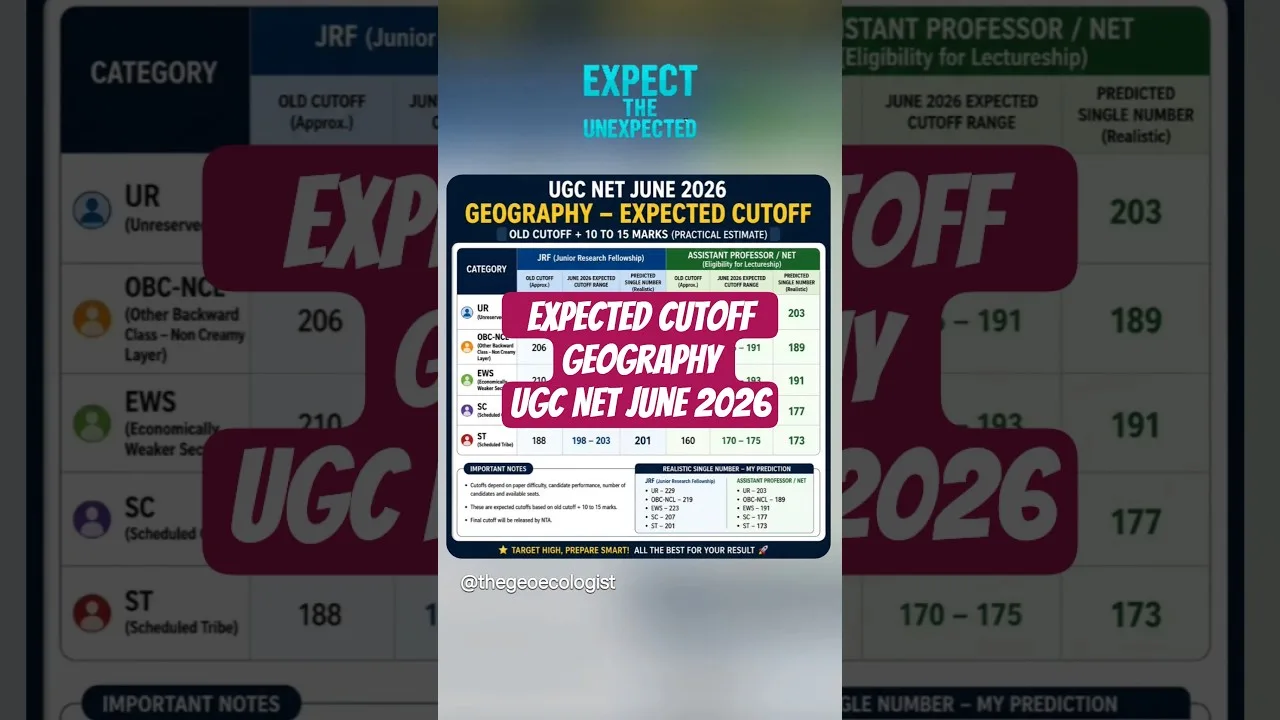
Table of Contents
Predicting the UGC NET Geography Cutoff for the June 2026 cycle is a critical task for aspirants aiming for Junior Research Fellowship (JRF) or Assistant Professor positions. As the National Testing Agency (NTA) continues to evolve its examination patterns, understanding the shifting trends in scoring is essential for effective preparation. This detailed analysis provides a realistic estimate based on historical data and current competitive trends in the subject of Geography.
Key Takeaways
- JRF Targets: Expect a significant upward trend in marks for the Unreserved category.
- Assistant Professor Targets: Cutoff scores are projected to be lower than JRF but remain highly competitive.
- Trend Analysis: A projected 10–15 mark increase from previous years is expected due to rising competition.
- Disclaimer: These numbers are estimates for self-assessment and not official NTA figures.
Understanding the UGC NET Geography Cutoff Trends
The landscape of the National Eligibility Test is constantly changing. For students pursuing a career in academia or research, the UGC NET Geography Cutoff serves as the ultimate benchmark for success. When we analyze the June 2026 session, we must look at the intersection of paper difficulty and the increasing number of candidates appearing for the exam.
In recent years, the competition for the JRF has intensified. This is largely due to the growing number of graduates specializing in physical and human geography. As the complexity of questions in Paper 1 (General Paper on Teaching and Research Aptitude) and Paper 2 (Geography) increases, the UGC NET Geography Cutoff reflects a high standard of academic proficiency. For the June 2026 session, we anticipate that the scoring threshold will rise as students become more adept at tackling conceptual questions.
Projected JRF Cutoff Marks for June 2026
For those aiming for the prestigious Junior Research Fellowship, the margin for error is extremely slim. Based on our mathematical modeling of previous years’ data, we have estimated a 10–15 mark upward movement in the UGC NET Geography Cutoff for the JRF category. This shift is a direct result of the higher accuracy rates seen in recent cycles.
Our realistic single-number prediction for the JRF category is as follows:
- Unreserved (UR): 229
- OBC-NCL: 219
- EWS: 223
- SC: 207
- ST: 201
Aspirants should use these figures as a target range. If your mock test scores are consistently hitting these marks, you are on the right track to secure a fellowship. Remember, the UGC NET Geography Cutoff for JRF is always higher because the number of available slots for research positions is limited compared to the total number of qualified candidates.
Assistant Professor Cutoff Estimates
While the JRF is the most sought-after, the Assistant Professor qualification is the cornerstone of a teaching career. The UGC NET Geography Cutoff for Assistant Professor roles is typically lower than the JRF requirements, but the gap is narrowing. As the NTA refines the exam structure, the distinction between these two categories becomes a matter of precision.
Here is the estimated score requirement for the Assistant Professor role in the June 2026 Geography cycle:
- Unreserved (UR): 203
- OBC-NCL: 189
- EWS: 191
- SC: 177
- ST: 173
When preparing for these exams, it is vital to consult authoritative sources like the official NTA website for any updates regarding exam patterns or syllabus changes. The UGC NET Geography Cutoff is highly sensitive to the difficulty level of the paper. If the paper is exceptionally difficult, the cutoff may drop; conversely, an easier paper will push the UGC NET Geography Cutoff significantly higher.
Factors Influencing the UGC NET Geography Cutoff
Several variables determine the final results. You cannot rely solely on a single prediction without understanding the mechanics of the exam. The following factors are the primary drivers of the UGC NET Geography Cutoff:
- Paper Difficulty: A shift toward more analytical or application-based questions in Geography can lower the overall scores.
- Candidate Performance: As the quality of preparation improves across India, the average score rises, pushing the UGC NET Geography Cutoff up.
- Number of Qualified Candidates: The NTA often has a fixed number of seats for JRF. If more students score high marks, the cutoff must rise to accommodate only the top performers.
- Subject-wise Competition: Geography is a highly competitive subject. The density of high-scoring students in this specific discipline affects the UGC NET Geography Cutoff differently than in other humanities subjects.
Strategic Preparation for Geography Aspirants
To beat the UGC NET Geography Cutoff, your preparation must be multifaceted. You cannot simply memorize facts; you must understand the spatial relationships and theories that define the discipline. Whether you are studying Geomorphology, Climatology, or Economic Geography, your focus should be on conceptual clarity.
We recommend following a structured study plan that includes regular revision and multiple rounds of mock tests. Tracking your progress against the estimated UGC NET Geography Cutoff can help you identify which areas need more attention. Are you struggling with statistical methods? Or perhaps human geography theories? Addressing these gaps early is the only way to ensure you stay above the UGC NET Geography Cutoff threshold.
Conclusion: Setting Your Target
In conclusion, the June 2026 cycle is expected to be highly competitive. While the UGC NET Geography Cutoff estimates provided here—UR JRF at 229 and UR Assistant Professor at 203—are not official, they serve as excellent benchmarks for your self-assessment. Treat these numbers as your minimum target. Aim higher to account for any unforeseen difficulty in the examination paper.
Stay focused, stay disciplined, and keep your eyes on the goal. The journey to becoming a professor or a researcher begins with mastering the subject matter and understanding the competitive landscape of the UGC NET Geography Cutoff.
Frequently Asked Questions
Based on current trends, the expected JRF cutoff for the Unreserved category is approximately 229 marks.
Focus on conceptual clarity in both physical and human geography, practice previous year papers, and aim for scores above the expected cutoff thresholds.
No, these are realistic estimates based on historical trends and are intended for student self-assessment only.