Blog
August Losch Market Areas: Understanding Lösch’s Model for UPSC and Geography Students

August Losch Market Areas is a foundational concept for anyone studying settlement geography, especially UPSC CSE aspirants and undergraduate geography students. Understanding this model helps decode how markets organize spatially across regions. This article unpacks the theory, shows how to evaluate its applications, and highlights why Dr. Krishnanand’s Simplified Settlement Geography e‑book is the go‑to resource for mastering the topic.
- August Losch Market Areas explains the hexagonal pattern of market regions and its relevance to urban planning.
- The model integrates economic, geographic, and transportation factors to predict settlement distribution.
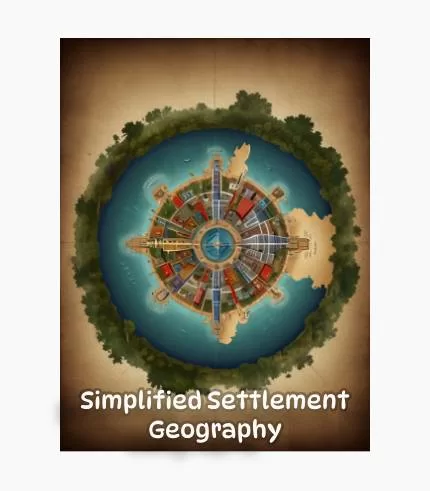
- Dr. Krishnanand’s Simplified Settlement Geography e‑book provides clear diagrams and point‑wise explanations of Lösch’s framework.
- The e‑book aligns with the CBCS syllabus, making exam preparation efficient and focused.
- Practical buying steps and digital access ensure instant study material for UPSC candidates.
What Is August Losch Market Areas? (Definition and Historical Context)
The term “August Losch Market Areas” refers to the spatial analysis developed by German economist August Lösch in his seminal work “The Economics of Location.” This model builds on earlier central place theories (like Christaller’s) but introduces a profit‑maximizing approach that results in a hexagonal lattice of market areas. August Lösch’s Wikipedia page provides detailed biographical and theoretical background. For students, grasping August Losch Market Areas is crucial because it directly addresses how different settlements compete and coexist in a region, a theme repeatedly examined in UPSC geography questions.
The Three‑Tier Structure of Market Areas

Within August Losch Market Areas, settlements are organized into three tiers: the central market town, intermediate markets, and peripheral villages. The central town offers high‑order goods and services, drawing customers from a large catchment area. Intermediate markets provide mid‑range products, serving smaller but still significant zones. Peripheral villages focus on low‑order, everyday items, catering to localized demand. This hierarchical arrangement ensures efficient resource distribution and reflects real‑world patterns observed across India and globally. Scholars often cite this structure when analyzing rural‑urban interaction, making it a staple for any geography curriculum.
Factors Shaping Market Area Boundaries
August Losch Market Areas are not static; they evolve based on transportation networks, population density, purchasing power, and physical geography. Improved road connectivity can shrink the boundaries of a peripheral market while expanding the reach of a central market. Similarly, natural barriers like mountains or rivers can fragment market areas, leading to overlapping zones or isolated enclaves. Understanding these variables helps students predict how market areas might shift in response to infrastructure projects or demographic changes. The model also incorporates technological advancements, which can alter consumer behavior and thus reshape market boundaries over time.
How to Apply August Losch Market Areas in Exam Preparation
When preparing for UPSC or any geography examination, applying August Losch Market Areas concepts is best done through diagrammatic practice. Sketch hexagonal market lattices, label central and peripheral settlements, and annotate the influencing factors discussed above. This visual approach reinforces theoretical knowledge and improves recall during the exam. Additionally, linking the model to current Indian urbanization trends—such as the rise of smart cities and regional market integration—demonstrates practical relevance and can earn extra marks for analytical depth. The Simplified Settlement Geography e‑book by Dr. Krishnanand offers exactly such diagrammatic clarity, with point‑wise highlighted descriptions and illustrative maps that simplify complex ideas.
Why Simplified Settlement Geography E‑Book by Dr. Krishnanand Is the Ideal Resource
Dr. Krishnanand’s Simplified Settlement Geography e‑book is specifically crafted for UPSC CSE aspirants, undergraduates, and geography enthusiasts who need a concise yet comprehensive guide. The content is aligned with the prescribed CBCS syllabus, ensuring that every chapter directly supports exam preparation. The book’s hallmark is its point‑wise highlighted descriptions, complemented by diagrams, maps, and images that bring August Losch Market Areas to life. Readers appreciate how the e‑book breaks down intricate spatial theories into digestible sections, making self‑study efficient. Moreover, the digital format guarantees immediate access, allowing students to dive into the material without waiting for physical delivery.
Because the e‑book covers the entire spectrum of settlement geography—including the evolution of settlements, classification, and morphology—it serves as a one‑stop reference. When you need to understand how August Losch Market Areas integrates with other models like Christaller’s central place theory, the e‑book provides comparative charts and clear explanations. This depth of coverage is why the Simplified Settlement Geography e‑book consistently ranks as a bestseller among geography resources.
Practical Steps to Purchase and Use the E‑Book
Acquiring Dr. Krishnanand’s Simplified Settlement Geography e‑book is straightforward. Visit the product page at geographyebooks.com/product/simplified-settlement-geography and select the digital version. The price of 249 makes it an affordable investment for serious aspirants. After purchase, you will receive an instant download link, enabling you to start reading on your laptop, tablet, or e‑reader within minutes. The e‑book’s searchable PDF format allows quick reference during revision sessions, and the built‑in bookmarks help you navigate directly to chapters covering August Losch Market Areas.
To maximize benefit, pair the e‑book with practice questions from past UPSC papers. Highlight sections that discuss market area boundaries, transportation influences, and hierarchical structures. Regular review of these highlighted notes will cement your understanding and boost confidence during the exam. The e‑book’s portability ensures you can study anywhere, whether on a commute or during a study break, making it an indispensable tool for mastering settlement geography.
Frequently Asked Questions About August Losch Market Areas
Q1: How does August Losch Market Areas differ from Christaller’s central place theory?
A1: While Christaller’s model emphasizes uniform distribution and a strict hierarchical system, August Losch Market Areas focuses on profit maximization and allows for overlapping market zones, making it more reflective of real‑world competition.
Q2: What are the key inputs needed to draw a market area using Lösch’s model?
A2: Essential inputs include population distribution, transportation routes, purchasing power, and physical geography. These variables determine the shape and size of each hexagonal market area.
Q3: Where can I find reliable sources to supplement the Simplified Settlement Geography e‑book?
A3: Authoritative references such as Britannica’s entry on Settlement Geography and academic journals on economic geography provide deeper insights and case studies that complement Dr. Krishnanand’s explanations.
In summary, mastering August Losch Market Areas is essential for any geography student, and Dr. Krishnanand’s Simplified Settlement Geography e‑book offers the most concise, exam‑oriented approach to achieving that mastery.
Our Recommendation
📖 Part of our complete guide: Evolution of Geographical Thought: A Comprehensive Guide for UPSC Aspirants and Geography Enthusiasts
Frequently Asked Questions
How does August Losch Market Areas differ from Christaller’s central place theory?
While Christaller’s model emphasizes uniform distribution and a strict hierarchical system, August Losch Market Areas focuses on profit maximization and allows for overlapping market zones, making it more reflective of real‑world competition.
What are the key inputs needed to draw a market area using Lösch’s model?
Essential inputs include population distribution, transportation routes, purchasing power, and physical geography. These variables determine the shape and size of each hexagonal market area.
Where can I find reliable sources to supplement the Simplified Settlement Geography e‑book?
Authoritative references such as Britannica's entry on Settlement Geography and academic journals on economic geography provide deeper insights and case studies that complement Dr. Krishnanand's explanations.