Blog
Atolls Formation Barrier Reefs Explained: Simplified Oceanography Guide 2025

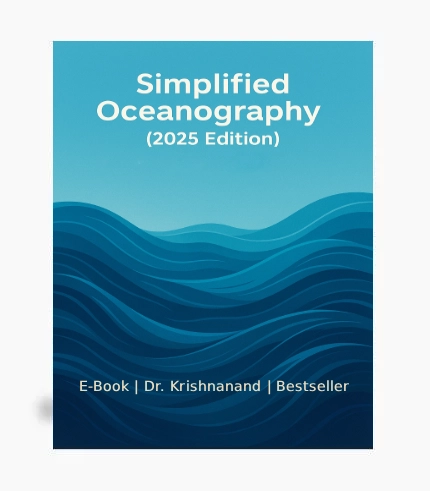

Atolls formation and barrier reefs spatial distribution represent some of the most fascinating yet challenging topics in oceanography for UPSC CSE aspirants, undergraduate geography students, and competitive exam preparers. The complexity of coral reef systems, their evolutionary stages, and global distribution patterns demand a resource that breaks down intricate marine concepts into clear, digestible content. Whether you are preparing for the UPSC mains geography optional, studying for a university oceanography course under the CBCS syllabus, or simply passionate about marine geography, finding the right study material can make or break your understanding of these critical topics.
- Atolls formation and barrier reefs spatial distribution are core topics in oceanography curricula worldwide
- Dr. Krishnanand’s Simplified Oceanography (2025 Edition) breaks down complex reef systems with diagrams and maps
- The e-book is prescribed on the CBCS syllabus for geography undergraduates
- Point-wise highlighted descriptions make revision and quick learning efficient
- Priced at ₹249, it offers exceptional value compared to bulky textbooks
- Ideal for UPSC CSE, undergraduate exams, and geography enthusiasts
Understanding Atolls Formation and Barrier Reefs Spatial Distribution
Atolls formation begins with the growth of coral reefs around a volcanic island. As the volcano gradually subsides or sea levels rise, the coral continues to grow upward, eventually forming a ring-shaped reef surrounding a central lagoon. This Darwinian theory of atoll formation, proposed in 1842, remains the foundational explanation taught in oceanography courses across the globe. Barrier reefs spatial distribution, on the other hand, follows coastlines at a distance separated by a lagoon, with the Great Barrier Reef off Australia being the most iconic example stretching over 2,300 kilometers.
The spatial distribution of barrier reefs is closely tied to continental shelves and tropical marine environments between 30°N and 30°S latitudes. Major concentrations appear in the Pacific Ocean around Melanesia and Micronesia, the Indian Ocean surrounding the Maldives and Lakshadweep, and the Caribbean Sea. Understanding these distribution patterns requires grasping not just biological coral growth but also geological subsidence, sea-level history, and ocean temperature thresholds that coral polyps need to survive.
Why Atolls and Barrier Reefs Matter for Geography Exams
In UPSC CSE and undergraduate geography examinations, questions on coral reef types frequently appear under oceanography and coastal geomorphology. UPSC papers have consistently tested candidates on the distinction between fringing reefs, barrier reefs, and atolls, often asking about their sequential development as described by Charles Darwin. The spatial distribution aspect adds another layer, where aspirants must map reef locations against oceanic basins, tectonic settings, and climate zones.
For CBCS-prescribed geography papers, atolls formation and barrier reefs spatial distribution are not just theoretical questions. Diagram-based questions asking students to label reef zones, explain lagoon formation, or identify reef types on maps are common. A resource that presents these concepts with clear diagrams, labeled maps, and point-wise summaries gives students a decisive edge in both objective and descriptive exam formats.
Key Exam-Focused Topics in Reef Geography
Students should master the following sub-topics: the three stages of reef evolution from fringing to barrier to atoll, the role of subsidence in atolls formation, temperature and salinity requirements for coral growth, the difference between Pacific and Indian Ocean reef distributions, and the impact of climate change on coral bleaching and reef survival. Each of these topics appears in standard oceanography textbooks and previous year UPSC questions alike.
How to Evaluate Oceanography Resources for Reef Studies
When selecting an oceanography resource, aspirants often struggle between dense academic texts that overwhelm with jargon and oversimplified guides that miss exam-relevant depth. The evaluation criteria should include: clarity of concept explanation, presence of diagrams and maps, alignment with your specific syllabus, coverage of spatial distribution patterns, and revision-friendly formatting.
Many students waste months juggling multiple resources only to find that none adequately explain the spatial distribution of barrier reefs or the step-by-step process of atolls formation. A focused e-book that consolidates these topics with visual aids eliminates the need for scattered references. Look for resources that offer labeled cross-sections of reef structures, global distribution maps, and comparative tables between reef types — elements that directly support both learning and quick revision.
Why Simplified Oceanography (2025 Edition) Fits Your Needs
Simplified Oceanography (2025 Edition) by Dr. Krishnanand addresses the exact gap that students face when studying atolls formation and barrier reefs spatial distribution. The e-book covers ocean bottom topography across all three major oceans — Atlantic, Indian, and Pacific — providing the geological context essential for understanding where and why reefs form. Chapters dedicated to ocean temperature and salinity directly support the biological understanding of coral ecosystems.
The 2025 edition incorporates updated content with point-wise highlighted descriptions that transform dense oceanographic theory into exam-ready notes. Diagrams, maps, and images are strategically placed throughout the text, making complex spatial relationships — such as the distribution of barrier reefs across the Pacific Ring of Fire or the atoll chains of the Maldives — immediately comprehensible. For UPSC CSE aspirants following the CBCS geography syllabus, this e-book serves as both a primary study text and a revision companion.
Dr. Krishnanand’s teaching approach, refined through years of classroom experience, translates into writing that anticipates student difficulties. The e-book does not assume prior mastery of marine terminology; instead, it builds understanding step by step, starting from ocean floor features and progressing to biological oceanography topics including coral reef systems. This scaffolding approach is particularly valuable for self-learners who lack classroom support.
Practical Study Guide: Using This E-Book for Reef Topics
To maximize your preparation for atolls formation and barrier reefs spatial distribution using Simplified Oceanography (2025 Edition), follow this structured approach:
Phase 1: Foundation Building (Week 1)
Read the introduction to oceanography chapter to establish context. Then move to the ocean bottom topography chapters for the Atlantic, Indian, and Pacific Oceans. Focus on understanding mid-ocean ridges, deep-sea trenches, and continental shelf configurations — these features determine where coral reefs can establish.
Phase 2: Reef-Specific Study (Week 2)
Study the chapters on ocean temperature and salinity alongside reef formation content. Create a comparison table for fringing reefs, barrier reefs, and atolls noting their formation sequence, spatial distribution, and example locations. Use the e-book’s diagrams to label reef zones and cross-sectional structures.
Phase 3: Revision and Practice (Week 3)
Use the point-wise highlighted descriptions for rapid revision. Practice drawing spatial distribution maps of barrier reefs from memory, and explain the process of atolls formation in your own words using the Darwinian subsidence theory framework.
Buying Guidance and What Makes This E-Book Stand Out
At ₹249, Simplified Oceanography (2025 Edition) delivers exceptional value for UPSC aspirants and geography students. Unlike printed textbooks that cost several times more and lack the visual integration of diagrams and maps, this e-book combines comprehensive content with a format optimized for digital reading and printing. The 2025 edition ensures that content reflects the latest syllabus updates and exam trends.
When comparing oceanography resources, consider that many standard textbooks treat coral reefs as a minor sub-topic within broader marine geography. Simplified Oceanography dedicates substantial coverage to reef systems, their formation processes, and spatial distribution patterns — directly addressing the search demand and exam requirements of students researching atolls formation and barrier reefs spatial distribution.
The e-book’s alignment with the CBCS prescribed syllabus for geography adds institutional credibility. Students can confidently use it as a primary resource knowing it covers the exact topics their university or competitive exam syllabus mandates. The combination of Dr. Krishnanand’s pedagogical expertise and the 2025 updated content makes this a reliable investment for anyone serious about mastering oceanography.
Frequently Asked Questions
Is Simplified Oceanography suitable for UPSC CSE preparation?
Yes, the e-book is specifically designed with UPSC CSE aspirants in mind. It covers ocean bottom topography, ocean temperature, salinity, and coral reef systems including atolls formation and barrier reefs spatial distribution — all topics that appear in the UPSC geography syllabus. The point-wise format and diagrams make it effective for both initial learning and revision.
Does the e-book cover the spatial distribution of reefs across different oceans?
Absolutely. The e-book includes dedicated coverage of Atlantic, Indian, and Pacific Ocean bottom topography, which provides the geological foundation for understanding where barrier reefs and atolls form. Spatial distribution patterns are supported by maps and diagrams throughout the text.
Can undergraduate geography students use this e-book for CBCS syllabus compliance?
Yes, Simplified Oceanography (2025 Edition) is prescribed on the CBCS syllabus for geography. Undergraduate students can use it as a primary textbook or supplementary resource for oceanography courses, particularly for topics related to coral reefs and marine geomorphology.
What makes this e-book different from other oceanography resources?
The combination of Dr. Krishnanand’s simplified teaching approach, point-wise highlighted descriptions, integrated diagrams and maps, and exam-focused formatting sets this e-book apart. It specifically addresses complex topics like atolls formation and barrier reefs spatial distribution in a way that standard textbooks often do not.
Is the content updated for 2025?
Yes, the 2025 edition includes updated content reflecting current syllabus requirements and recent developments in oceanography relevant to exam preparation. The e-book format allows for timely updates that printed books cannot match.
Further reading: atolls formation barrier reefs on Wikipedia
Our Recommendation
📖 Part of our complete guide: Evolution of Geographical Thought: A Comprehensive Guide for UPSC Aspirants and Geography Enthusiasts
Frequently Asked Questions
Is Simplified Oceanography suitable for UPSC CSE preparation?
Yes, the e-book covers ocean bottom topography, temperature, salinity, and coral reef systems including atolls formation and barrier reefs spatial distribution — all topics in the UPSC geography syllabus.
Does the e-book cover reef distribution across different oceans?
Yes, it includes dedicated chapters on Atlantic, Indian, and Pacific Ocean bottom topography with maps and diagrams supporting spatial distribution patterns of reefs.
Can undergraduate students use this for CBCS syllabus?
Yes, Simplified Oceanography is prescribed on the CBCS syllabus for geography and serves as both a primary textbook and revision resource for undergraduate oceanography courses.