
Blog
Weak Monsoon 2026: Climate Predictions & Impact on India

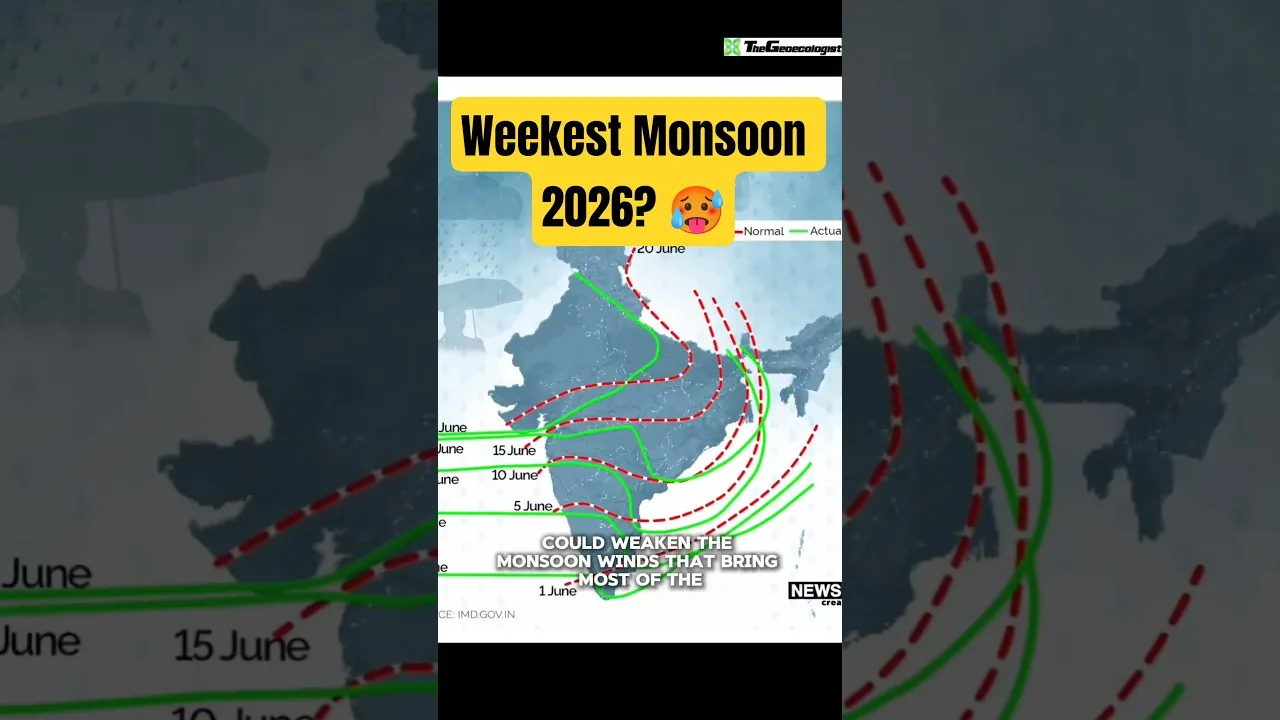
Table of Contents
- The Heartbeat of India: Why the Monsoon Matters
- Socio-Economic Stakes of a Deficit Monsoon
- Decoding the 2026 Outlook: Key Climate Drivers
- El Niño–Southern Oscillation (ENSO): The Pacific Puppeteer
- Indian Ocean Dipole (IOD): The Regional Modulator
- Climate Change: The Background Trend
- Historical Analogues: Lessons from Past Deficit Years
- Sectoral Impact Assessment
- Agriculture and Food Security
- Water Resources and Energy
- Economy and Inflation
- Adaptation and Preparedness: From Reaction to Resilience
- Policy Interventions
- Technological and Institutional Innovation
- Conclusion: Navigating Uncertainty with Science and Strategy
The weak monsoon 2026 scenario has become a pressing concern for policymakers, farmers, and climate scientists across the Indian subcontinent. As global weather patterns continue to shift under the influence of anthropogenic climate change, the reliability of the South Asian summer monsoon — the lifeline for over 1.4 billion people — faces unprecedented uncertainty. weak monsoon 2026 examines the scientific basis for long-range monsoon forecasting, the role of ocean-atmosphere teleconnections like El Niño–Southern Oscillation (ENSO) and the Indian Ocean Dipole (IOD), and the socio-economic implications of a potential rainfall deficit in 2026.
- Climate models indicate elevated probability of below-normal rainfall during the 2026 monsoon season due to evolving Pacific and Indian Ocean conditions.
- El Niño development in late 2025 could persist into mid-2026, historically correlating with suppressed Indian monsoon rainfall.
- Indian Ocean Dipole (IOD) neutrality or negative phase would further reduce moisture transport toward the subcontinent.
- Agriculture, water security, and power generation face compounding risks if the weak monsoon 2026 forecast materializes.
- Adaptation strategies — drought-resilient crops, groundwater recharge, and early warning systems — are critical for mitigation.
The Heartbeat of India: Why the Monsoon Matters
India’s summer monsoon, spanning June to September, delivers approximately 70–80% of the country’s annual rainfall. This seasonal reversal of winds is not merely a meteorological phenomenon; weak monsoon 2026 is the heartbeat of India’s agrarian economy. Over 60% of India’s net sown area remains rainfed, making kharif (monsoon) crops — rice, pulses, oilseeds, cotton, and coarse cereals — directly dependent on timely and adequate precipitation. The India Meteorological Department (IMD) classifies monsoon performance as “normal” when rainfall falls within 96–104% of the Long Period Average (LPA) of 87 cm (1971–2020). A weak monsoon 2026 would imply rainfall below 90% of LPA, triggering drought declarations in vulnerable regions.
Socio-Economic Stakes of a Deficit Monsoon
A weak monsoon 2026 would cascade through multiple sectors. Agricultural GDP, which contributes roughly 15% to India’s total GDP but employs over 42% of the workforce, would contract. Food inflation — already volatile due to supply chain disruptions and global commodity prices — could spike by 3–5 percentage points, disproportionately affecting low-income households. Hydropower generation, accounting for ~11% of India’s installed capacity, would suffer as reservoir levels drop. In 2023, poor monsoon rainfall led to a 15% year-on-year decline in hydroelectric output, forcing increased reliance on coal-fired plants. Urban water supply systems in megacities like Delhi, Bengaluru, and Chennai — already stressed by overextraction and pollution — would face acute shortages, potentially triggering social unrest.
Decoding the 2026 Outlook: Key Climate Drivers
El Niño–Southern Oscillation (ENSO): The Pacific Puppeteer
ENSO remains the single most influential predictor of Indian monsoon variability. El Niño events — characterized by anomalous warming of the central and eastern equatorial Pacific — disrupt the Walker Circulation, weakening the monsoon trough and reducing moisture inflow. Historical analysis by the NOAA Climate Prediction Center shows that 60% of El Niño years since 1950 coincided with below-normal Indian monsoon rainfall. As of early 2025, coupled ocean-atmosphere models (CFSv2, ECMWF SEAS5, JMA) indicate a 55–60% probability of El Niño conditions persisting through boreal summer 2026. If a moderate-to-strong El Niño (Niño 3.4 index > +1.0°C) establishes by late 2025, the likelihood of a weak monsoon 2026 increases significantly.
Indian Ocean Dipole (IOD): The Regional Modulator
The IOD — often called the “Indian Niño” — measures sea surface temperature (SST) gradient between the western (Arabian Sea) and eastern (eastern Indian Ocean) poles. A positive IOD enhances monsoon rainfall by promoting convection over the western Indian Ocean and strengthening cross-equatorial flow. Conversely, a negative IOD suppresses rainfall. Current forecasts from the Australian Bureau of Meteorology and IMD suggest a neutral-to-slightly-negative IOD phase for mid-2026. Without the buffering effect of a positive IOD, the monsoon would lack a key compensatory mechanism against El Niño-induced drying, amplifying the weak monsoon 2026 risk.
Climate Change: The Background Trend
Beyond interannual variability, anthropogenic warming is altering monsoon dynamics. The IPCC Sixth Assessment Report (AR6) highlights that while total seasonal rainfall may not decline uniformly, the frequency of extreme events — both heavy rainfall days (>150 mm/day) and prolonged dry spells — has increased since 1950. A 2023 study in Nature Climate Change found that monsoon onset has delayed by ~1 week over central India since the 1970s, while withdrawal has advanced, compressing the rainy season. This “intensification of variability” means a weak monsoon 2026 would likely manifest not as uniform dryness, but as erratic distribution: devastating floods in some districts alongside agricultural drought in others — a pattern observed in 2022 and 2023.
Historical Analogues: Lessons from Past Deficit Years
Examining years with similar precursor conditions offers insight. The 2015–16 El Niño — one of the strongest on record — caused a 14% rainfall deficit, the worst since 1972. Foodgrain production fell 5%, and over 330 million people were affected by drought across 10 states. The 2009 drought (El Niño + negative IOD) saw a 22% deficit, triggering a 15% spike in food inflation. Critically, both events followed a weak monsoon the previous year (2014, 2008), creating multi-year soil moisture deficits. If 2025 monsoon performance is subpar — as early indicators suggest — the weak monsoon 2026 would compound existing hydrological stress, particularly in the Deccan Plateau, Marathwada, and Bundelkhand regions where groundwater tables have declined 1–3 meters/decade.
Sectoral Impact Assessment
Agriculture and Food Security
Kharif sowing typically begins with monsoon onset in June. A delayed or weak start forces farmers to shift to short-duration, low-yield varieties or leave land fallow. In 2023, late onset reduced paddy acreage by 5% in Punjab and Haryana. A weak monsoon 2026 would threaten rice (India is the world’s largest exporter), pulses (critical for protein security), and oilseeds (import dependence >55%). The government’s buffer stock — 55 million tonnes of rice and wheat as of January 2025 — provides a cushion, but sustained deficits would necessitate export restrictions, impacting global markets.
Water Resources and Energy
India’s 150 major reservoirs, monitored by the Central Water Commission, held 68% of live storage capacity in March 2025 — below the 10-year average of 74%. A weak monsoon 2026 would drop this below 50%, jeopardizing rabi (winter) irrigation and drinking water supply. Thermal power plants, which require cooling water, faced forced outages in 2016 and 2023 due to low river flows. The Central Electricity Authority estimates a 1% rainfall deficit reduces hydro generation by ~1.2 TWh, requiring costly coal or gas substitution.
Economy and Inflation
The Reserve Bank of India (RBI) assigns 45% weight to food in the Consumer Price Index (CPI). A 10% kharif production shortfall typically raises CPI by 50–70 basis points. With headline inflation already near the 4% target midpoint, a weak monsoon 2026 could force monetary tightening, slowing credit growth and investment. Rural wage growth — a key demand for agricultural laborers, which correlates strongly with monsoon performance, would stagnate, dampening consumption demand for FMCG, two-wheelers, and tractors.
Adaptation and Preparedness: From Reaction to Resilience
Policy Interventions
The Government of India’s Pradhan Mantri Krishi Sinchayee Yojana (PMKSY) aims to expand micro-irrigation coverage to 10 million hectares by 2026. Accelerating this, alongside Atal Bhujal Yojana for participatory groundwater management, is essential. The IMD’s Dynamic Ensemble Prediction System, operational since 2021, provides probabilistic forecasts at 12 km resolution — enabling district-level advisories. Scaling these to Gram Panchayat level via the Kisan Suvidha app and Common Service Centres can empower farmers with timely sowing decisions.
Technological and Institutional Innovation
Climate-resilient crop varieties — drought-tolerant rice (DRR Dhan 42, 43), early-maturing pigeonpea (ICPL 88039), and biofortified millets — developed by ICAR institutes, need rapid seed multiplication and distribution. Satellite-based soil moisture monitoring (ISRO’s SMAP, NASA’s GRACE-FO) combined with AI-driven yield forecasting can trigger parametric insurance payouts under Pradhan Mantri Fasal Bima Yojana before harvest failure is visible. Urban water utilities must mandate rainwater harvesting, wastewater recycling (Singapore’s NEWater model), and non-revenue water reduction — currently 30–40% in Indian cities.
Conclusion: Navigating Uncertainty with Science and Strategy
The prospect of a weak monsoon 2026 is not a deterministic prophecy but a probabilistic risk amplified by converging climate signals — a likely El Niño, neutral IOD, and the background drumbeat of global warming. While seasonal forecasts beyond 3–4 months retain inherent uncertainty, the direction of risk is clear. India’s response must transcend reactive relief toward anticipatory adaptation: integrating climate services into agricultural planning, investing in water-use efficiency, and building financial instruments that protect the most vulnerable. The monsoon has sustained civilizations for millennia; safeguarding its reliability in the Anthropocene is the defining challenge of our time. As the Wikipedia entry on Monsoon aptly notes, this system is a “complex interplay of ocean, atmosphere, and land” — and our stewardship must match that complexity.
Frequently Asked Questions
Current climate models indicate a 55–60% probability of El Niño conditions persisting into mid-2026, which historically correlates with a 60% chance of below-normal monsoon rainfall. Combined with a neutral-to-negative Indian Ocean Dipole forecast, the risk of a weak monsoon 2026 is elevated, though not certain.
El Niño warms the central/eastern Pacific, weakening the Walker Circulation and reducing the pressure gradient that drives moisture-laden winds toward India. This suppresses convection over the subcontinent, leading to delayed onset, extended dry spells, and overall rainfall deficits — as seen in 2015, 2009, and 2002.
Farmers should adopt drought-tolerant crop varieties (e.g., DRR Dhan 42/43 rice, early pigeonpea), use micro-irrigation (drip/sprinkler), follow IMD's district-level agro-advisories via the Kisan Suvidha app, and enroll in the Pradhan Mantri Fasal Bima Yojana for insurance coverage against yield loss.