Blog
Solar System Components: Complete Guide for UPSC Geography

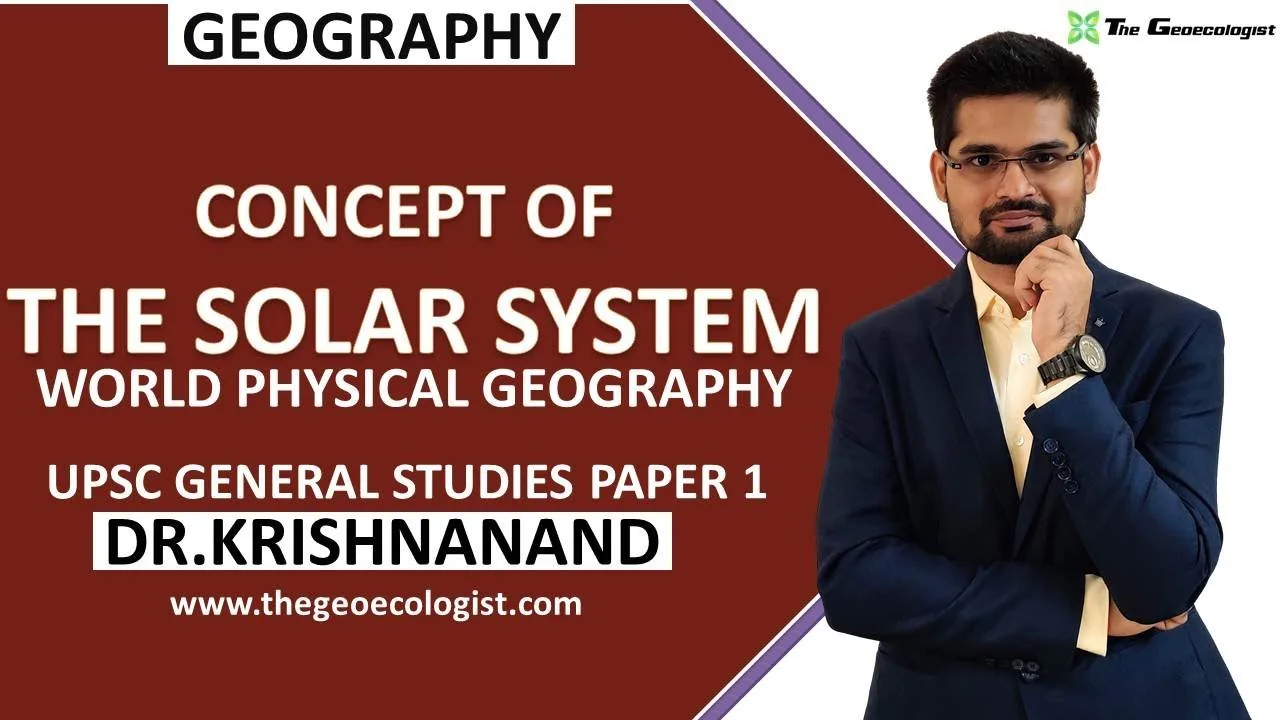
Table of Contents
- Introduction to Solar System Components
- The Sun: Heart of the Solar System
- Physical Characteristics
- Solar Structure and Activity
- Terrestrial Planets: The Inner Solar System
- Mercury: The Swift Messenger
- Venus: Earth's Twin Gone Wrong
- Earth: The Habitable World
- Mars: The Red Planet
- Jovian Planets: The Gas and Ice Giants
- Jupiter: King of Planets
- Saturn: The Ringed Wonder
- Uranus: The Sideways Planet
- Neptune: The Windy Giant
- Dwarf Planets and Small Solar System Bodies
- Pluto and the Kuiper Belt
- Ceres: The Inner Dwarf Planet
- Asteroids, Comets, and Meteoroids
- Formation and Evolution of the Solar System
- Nebular Hypothesis
- Late Heavy Bombardment and Migration
- Relevance for UPSC GS Paper-1 and Geography Optional
- Key Missions and Future Exploration
- Conclusion
The Solar System Components form the foundational chapter of World Physical Geography for UPSC General Studies Paper-1, and understanding their intricate dynamics is essential for every serious aspirant. Dr. Krishnanand, founder of TheGeoecologist, delivers a masterclass lecture simplifying these complex astronomical concepts for beginners and advanced students alike. This comprehensive guide expands on that lecture, providing detailed explanations, current scientific data, and exam-oriented insights to help you master this critical topic.
- The Solar System Components include the Sun, eight planets, dwarf planets, moons, asteroids, comets, and Kuiper Belt objects
- The Sun contains 99.86% of the total mass of the solar system
- Planets are divided into terrestrial (inner) and jovian (outer) groups based on composition
- Formation occurred approximately 4.6 billion years ago from a solar nebula
- Solar System Components carries significant weight in UPSC GS Paper-1 and Geography Optional
Introduction to Solar System Components
The Solar System Components represent a gravitationally bound system comprising the Sun and all celestial objects orbiting Solar System Components. Located in the Orion Arm of the Milky Way galaxy, approximately 26,000 light-years from the galactic center, our solar system spans an estimated 2 light-years (125,000 AU) to the outer edge of the Oort Cloud. For UPSC aspirants, Solar System Components falls under World Physical Geography in GS Paper-1, where questions frequently test conceptual clarity on planetary characteristics, orbital mechanics, and formation theories.
Dr. Krishnanand emphasizes that a systematic approach—starting from the Sun and moving outward—helps build a mental framework essential for retaining vast amounts of data. The NASA Solar System Exploration portal provides authoritative real-time data on all planetary missions, which aspirants should reference for current developments. – a key consideration for Solar System Components.
The Sun: Heart of the Solar System
Physical Characteristics
The Sun, a G2V main-sequence star, dominates the Solar System Components with 99.86% of the system’s total mass. Its diameter measures 1.39 million kilometers—109 times Earth’s diameter—and its core temperature reaches 15 million°C, enabling nuclear fusion of hydrogen into helium. The Sun’s energy output (3.828 × 10²⁶ watts) drives all planetary climates and space weather phenomena.
Solar Structure and Activity
The solar interior comprises the core (0–0.25 solar radii), radiative zone (0.25–0.7 radii), and convective zone (0.7–1.0 radii). The visible photosphere (5,778 K) exhibits granulation and sunspots—temporary magnetic flux concentrations appearing darker due to lower temperatures. The 11-year solar cycle governs sunspot frequency, with Solar Cycle 25 peaking around 2025. Above the photosphere lie the chromosphere and corona, the latter reaching millions of degrees—a phenomenon still under investigation via missions like Parker Solar Probe.
Terrestrial Planets: The Inner Solar System
Mercury: The Swift Messenger
Mercury, the smallest planet (4,879 km diameter), orbits at 0.39 AU with an 88-day year. Its 3:2 spin-orbit resonance creates 176-day solar days. Surface temperatures swing from -173°C to 427°C due to negligible atmosphere. The MESSENGER mission (2011–2015) discovered water ice in permanently shadowed polar craters—a key fact for UPSC environment questions.
Venus: Earth’s Twin Gone Wrong
Venus (12,104 km diameter) orbits at 0.72 AU with a 225-day year. Its retrograde rotation (243 days) and runaway greenhouse effect create surface temperatures of 462°C and 92-bar atmospheric pressure—96.5% CO₂. The Soviet Venera program and NASA’s Magellan mapped its volcanic surface. Understanding Venus’s climate evolution is crucial for comparative planetology questions.
Earth: The Habitable World
Earth (12,742 km diameter) at 1 AU possesses a nitrogen-oxygen atmosphere, liquid water, and a protective magnetosphere. Its 23.5° axial tilt drives seasons. The Moon (3,474 km), formed likely from a giant impact 4.5 billion years ago, stabilizes Earth’s obliquity. This unique combination makes Earth the only known abode of life—a frequent essay theme.
Mars: The Red Planet
Mars (6,779 km diameter) at 1.52 AU has a thin CO₂ atmosphere (0.6% Earth’s pressure) and evidence of ancient liquid water. Olympus Mons (21.9 km) is the solar system’s tallest volcano; Valles Marineris spans 4,000 km. Current missions—Perseverance, Curiosity, Tianwen-1—search for biosignatures. Mars colonization debates often appear in UPSC ethics and science-technology papers.
Jovian Planets: The Gas and Ice Giants
Jupiter: King of Planets
Jupiter (139,820 km diameter) at 5.2 AU contains 2.5× the mass of all other planets combined. Its hydrogen-helium composition mirrors the primordial solar nebula. The Great Red Spot—an anticyclonic storm persisting since at least 1831—spans 16,350 km. Juno mission (2016–present) reveals a fuzzy core and deep atmospheric jets. Jupiter’s 95 known moons include the Galilean four: Io (volcanic), Europa (subsurface ocean), Ganymede (largest moon, magnetic field), and Callisto (heavily cratered).
Saturn: The Ringed Wonder
Saturn (116,460 km diameter) at 9.5 AU is famous for its extensive ring system—ice particles ranging from micrometers to meters. Density (0.687 g/cm³) is less than water. Cassini-Huygens (2004–2017) discovered Enceladus’s geysers and Titan’s methane lakes. Titan (5,150 km), larger than Mercury, has a thick nitrogen atmosphere and prebiotic chemistry—making Solar System Components an astrobiology priority.
Uranus: The Sideways Planet
Uranus (50,724 km diameter) at 19.2 AU rotates on its side (97.8° axial tilt), likely from a giant impact. Its cyan color comes from methane absorbing red light. Classified as an ice giant (water, ammonia, methane ices), Solar System Components has 27 moons and faint rings. Voyager 2 (1986) remains the only visitor. Its extreme seasons (21-year quarters) offer unique atmospheric dynamics.
Neptune: The Windy Giant
Neptune (49,244 km diameter) at 30.1 AU has the strongest sustained winds (2,100 km/h). Its deep blue color also stems from methane. Triton (2,706 km), a captured Kuiper Belt object, orbits retrograde and exhibits cryovolcanism. Neptune’s discovery (1846) via mathematical prediction by Le Verrier and Adams remains a landmark in celestial mechanics.
Dwarf Planets and Small Solar System Bodies
Pluto and the Kuiper Belt
Pluto (2,377 km diameter), reclassified as a dwarf planet in 2006 by the IAU, orbits at 39.5 AU in the Kuiper Belt—a region of icy remnants beyond Neptune. New Horizons (2015 flyby) revealed mountains of water ice, nitrogen glaciers, and a thin atmosphere. Other notable Kuiper Belt dwarf planets include Eris (more massive than Pluto), Haumea (elongated, rapid rotation), and Makemake.
Ceres: The Inner Dwarf Planet
Ceres (939 km diameter) resides in the asteroid belt at 2.77 AU. Dawn mission (2015–2018) found bright spots (sodium carbonate deposits) suggesting recent cryovolcanic activity and a possible subsurface brine reservoir. Ceres bridges asteroid and comet classifications.
Asteroids, Comets, and Meteoroids
The asteroid belt (2.2–3.2 AU) contains millions of rocky bodies—remnants of planet formation disrupted by Jupiter’s gravity. Near-Earth Objects (NEOs) pose impact hazards; NASA’s DART mission (2022) successfully demonstrated kinetic deflection. Comets, originating from the Kuiper Belt (short-period) and Oort Cloud (long-period), develop comas and tails when approaching the Sun. The Wikipedia Solar System article provides an excellent summary of minor body populations and classifications.
Formation and Evolution of the Solar System
Nebular Hypothesis
The leading theory posits that 4.6 billion years ago, a molecular cloud fragment collapsed under gravity, forming a rotating protoplanetary disk. The Sun ignited at the center; dust grains accreted into planetesimals, then protoplanets. The frost line (~2.7 AU) separated volatile-rich outer planets from rocky inner planets. This concept is fundamental for UPSC geography questions on planetary differentiation.
Late Heavy Bombardment and Migration
Evidence from lunar samples indicates a spike in impacts 4.1–3.8 billion years ago—the Late Heavy Bombardment—possibly triggered by giant planet migration (Nice Model). Jupiter’s inward-then-outward migration (Grand Tack) shaped the asteroid belt and truncated Mars’s growth. These dynamic processes explain current orbital architectures.
Relevance for UPSC GS Paper-1 and Geography Optional
The Solar System Components topic appears consistently in UPSC prelims and mains. Prelims questions test factual knowledge: planetary order, unique features (e.g., “Which planet has the longest day?” — Venus), mission names, and recent discoveries. Mains questions demand analytical answers: “Compare terrestrial and jovian planets,” “Discuss the significance of water discovery on Mars,” or “Evaluate the nebular hypothesis vs. alternative theories.” Geography Optional Paper-1 (Physical Geography) requires deeper treatment of planetary geomorphology, atmospheric processes, and climatology.
Dr. Krishnanand’s pedagogical approach—linking astronomical concepts to terrestrial geography (e.g., comparing Venus’s greenhouse effect to Earth’s climate change)—exemplifies the interdisciplinary thinking UPSC rewards. Aspirants should maintain a dedicated notebook for planetary data tables, mission timelines, and diagrammatic representations of orbital configurations.
Key Missions and Future Exploration
Current and upcoming missions define the cutting edge: Europa Clipper (2024 launch) will assess Europa’s habitability; Dragonfly (2028) will explore Titan’s surface; JUICE (2023 launch) studies Ganymede, Callisto, and Europa; Mars Sample Return (2030s) aims to bring Perseverance’s caches to Earth. India’s Chandrayaan-3 (2023 success) and Aditya-L1 (solar mission) demonstrate ISRO’s growing planetary science capabilities—essential for UPSC science-technology syllabus.
Conclusion
Mastering the Solar System Components requires moving beyond rote memorization to understanding physical processes, comparative planetology, and the historical evolution of our cosmic neighborhood. Dr. Krishnanand’s lecture provides the conceptual scaffolding; Solar System Components adds the data depth and exam orientation needed for UPSC success. Regular revision, diagram practice, and tracking new discoveries via NASA, ESA, and ISRO channels will ensure Solar System Components becomes a scoring strength in GS Paper-1 and Geography Optional.
Frequently Asked Questions
The main Solar System Components include the Sun (99.86% of system mass), eight planets (Mercury, Venus, Earth, Mars, Jupiter, Saturn, Uranus, Neptune), five recognized dwarf planets (Pluto, Eris, Haumea, Makemake, Ceres), over 290 moons, millions of asteroids, comets, and Kuiper Belt objects, plus the distant Oort Cloud.
Solar System Components is a core topic in World Physical Geography for UPSC GS Paper-1. It appears in both prelims (factual questions on planetary features, missions, discoveries) and mains (analytical questions on comparative planetology, formation theories, climate evolution). Geography Optional Paper-1 requires even deeper coverage of planetary geomorphology and atmospheres.
Terrestrial planets (Mercury, Venus, Earth, Mars) are rocky, dense, smaller, closer to the Sun, with thin or no atmospheres and solid surfaces. Jovian planets (Jupiter, Saturn, Uranus, Neptune) are gas/ice giants—massive, low-density, ring systems, numerous moons, thick hydrogen-helium atmospheres, and no well-defined solid surfaces.