Blog
Red Sprite Phenomenon: Captured Over Tibet – Science, Astrophotography & Significance

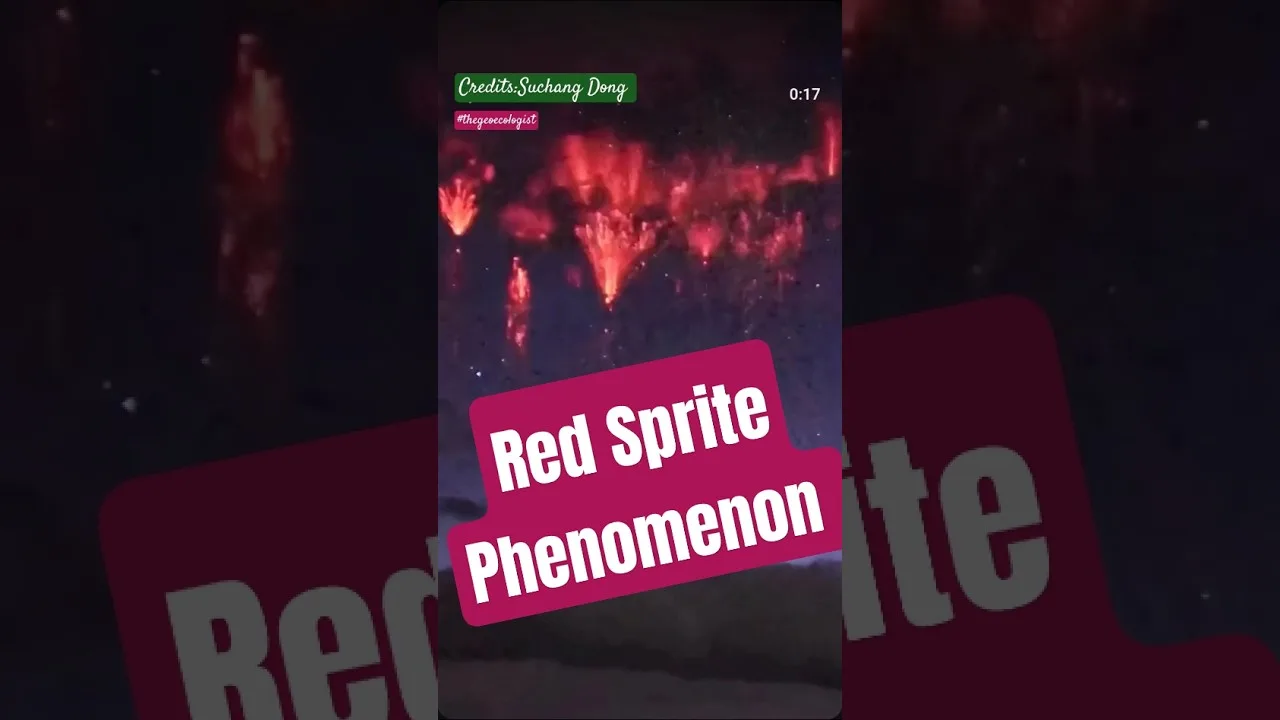
Table of Contents
Red Sprite Phenomenon has fascinated scientists and skywatchers alike for decades, offering a fleeting glimpse into the electrical dance occurring far above thunderstorms. In May 2022, a remarkable display of this elusive atmospheric spectacle lit up the skies above the Himalayas in Tibet, drawing global attention from researchers, photographers, and the public alike. This article explores the nature of red sprites, the specifics of the Tibetan event, their formation mechanisms, observational techniques, and why they matter for our understanding of Earth’s upper atmosphere.
Key Takeaways:
- The Red Sprite Phenomenon is a type of transient luminous event (TLE) occurring 40–80 km above thunderstorms.
- In May 2022, astrophotographer Shuchang Dong captured high‑frame‑rate video of numerous red sprites over Tibet, linked to a massive mesoscale convective complex.
- Red sprites are believed to result from lightning‑driven electrical discharges that excite nitrogen in the mesosphere, producing their characteristic red glow.
- Observations from high‑altitude regions like Tibet suggest that mountainous terrain can enhance the upward propagation of storm energy, influencing atmospheric chemistry.
- Continued monitoring using specialized cameras and satellite instruments helps scientists refine models of coupling between atmospheric layers.
Red Sprite Phenomenon
The Red Sprite Phenomenon belongs to a family of transient luminous events that include blue jets, elves, and halos. Unlike ordinary lightning, which travels downward or horizontally within storm clouds, red sprites propagate upward into the mesosphere and lower ionosphere. They typically appear as reddish‑orange tendrils or jellyfish‑shaped structures, lasting only a few milliseconds to a few tenths of a second. First documented visually in 1989 by scientists from the University of Minnesota, the Red Sprite Phenomenon has since been recorded by ground‑based observatories, aircraft, and space‑borne instruments such as the ISS’s Lightning Imaging Sensor.
What Are Red Sprites?
Red sprites are triggered by powerful positive cloud‑to‑ground lightning strokes that momentarily alter the electric field above the storm. The resulting quasi‑static field accelerates electrons, which collide with nitrogen molecules, exciting them to emit red light at wavelengths around 650 nm. Because the emitting region lies above the bulk of the atmosphere, the light is faint and best captured with sensitive cameras operating at high frame rates. The typical altitude range of the Red Sprite Phenomenon is 40–80 km, placing it firmly within the mesosphere, where atmospheric pressure is low enough for the emitted photons to escape relatively unimpeded.
The Tibetan Event of May 2022

On the night of May 15 2022, a vast mesoscale convective complex (MCC) developed over the Bay of Bengal and propagated northward, reaching the Tibetan Plateau. The storm system produced intense lightning activity, with peak currents exceeding 200 kA in some strokes. Astrophotographer Shuchang Dong, stationed at a high‑altitude observatory near Lhasa, used a Sony A7S III camera set to 120 fps with a fast f/1.4 lens to record the upper‑atmospheric glow. Over a span of approximately eight minutes, his footage revealed more than 30 distinct red sprite events, each exhibiting the classic carrot‑like morphology with faint halo emissions at the base.
The Tibetan Plateau, averaging over 4,500 m elevation, provides a unique vantage point for observing the Red Sprite Phenomenon. Its thin atmosphere reduces scattering, while the frequent occurrence of strong monsoonal thunderstorms supplies the necessary electrical forcing. Researchers from the Chinese Academy of Meteorological Sciences later correlated Dong’s video with ground‑based lightning detection networks, confirming that each sprite corresponded to a positive CG lightning stroke with a charge moment change exceeding 600 C·km.
How Red Sprites Form
The prevailing model for the Red Sprite Phenomenon involves three stages:
- Lightning Trigger: A powerful positive cloud‑to‑ground discharge removes negative charge from the storm’s upper region, leaving a net positive charge above the cloud.
- Quasi‑Static Field Buildup: The altered charge distribution creates a large‑scale electric field that can reach several hundred volts per meter in the mesosphere.
- Electron Acceleration and Emission: Free electrons gain energy in this field, collide with N₂ molecules, and excite them to the first positive band, emitting red photons.
The red hue arises because the nitrogen first positive band dominates the spectrum in this altitude range; other emissions (e.g., from oxygen) are weaker and often masked. The temporal profile of a sprite typically shows a rapid rise (a few microseconds) followed by a slower decay as the excited nitrogen returns to its ground state.
Observing Red Sprites: Astrophotography Techniques
Capturing the Red Sprite Phenomenon demands specialized equipment and timing:
- High Sensitivity: Cameras with large full‑frame sensors and high ISO capability (ISO 6400–25600) are preferred.
- Fast Lenses: Apertures of f/1.4–f/2.8 maximize photon collection.
- High Frame Rate: Recording at 120–240 fps allows precise measurement of sprite dynamics and reduces motion blur.
- Location: Sites above 3,000 m with low light pollution and frequent severe thunderstorms (e.g., Tibet, the Rocky Mountains, the Andes) increase success rates.
- Post‑Processing: Stacking multiple frames enhances signal‑to‑noise ratio while preserving the transient nature of each event.
In addition to ground‑based efforts, space‑borne platforms such as the NASA Goddard Lightning and Atmospheric Electricity Experiment provide global coverage, detecting sprites via their ultraviolet emissions and correlating them with terrestrial lightning maps.
Scientific Significance and Research
The Red Sprite Phenomenon observed over Tibet carries several implications:
- Atmospheric Coupling: Sprites provide a direct pathway for transferring energy from the troposphere to the mesosphere‑lower thermosphere (MLT) region, influencing neutral chemistry and potentially affecting noctilucent cloud formation.
- Energetic Particle Precipitation: The associated electric fields can accelerate electrons to relativistic energies, contributing to the flux of precipitating particles that modulate ionospheric conductivity.
- Climate Feedback: While the instantaneous energy input is small compared to solar forcing, repeated sprite events may cumulatively affect trace gas concentrations (e.g., NOₓ) in the MLT, which in turn can influence ozone chemistry.
- Seismic‑Atmospheric Links: Emerging studies suggest that large tectonic events may alter atmospheric electric fields, potentially modulating sprite occurrence—a hypothesis still under investigation.
Researchers continue to refine numerical models that couple storm electrodynamics with mesospheric chemistry. Data from the Tibetan campaign have been incorporated into the Community Ionospheric Model (CIM), improving predictions of sprite occurrence rates under varying monsoon intensities.
Future Outlook and Conclusion
The Red Sprite Phenomenon remains a captivating bridge between storm electricity and the near‑space environment. Advances in detector technology—such as back‑illuminated CMOS sensors and photon‑counting cameras—promise even higher temporal resolution, enabling scientists to resolve the microsecond‑scale streamer structures that precede the visible glow. International observing networks, including the European Sprite Observatory (ESO) and the Asian Lightning and TLE Network (ALTEN), aim to create a global sprite climatology.
In summary, the May 2022 Tibetan event not only showcased the breathtaking beauty of the Red Sprite Phenomenon but also provided a valuable dataset for understanding how mountainous terrain can enhance upward electrical coupling. Continued interdisciplinary collaboration among meteorologists, physicists, and astrophotographers will be essential to unravel the full impact of these fleeting red flashes on Earth’s atmospheric system.
Frequently Asked Questions
The Red Sprite Phenomenon is a transient luminous event that appears as a red flash above powerful thunderstorms, occurring at altitudes of 40–80 km due to excitation of nitrogen by lightning‑driven electric fields.
The Tibetan event provided high‑quality, high‑frame‑rate observations of numerous red sprites linked to a massive mesoscale convective complex, offering direct evidence of how mountain‑enhanced storms can drive energy into the upper atmosphere.
Yes, with a sensitive full‑frame camera, a fast lens (f/1.4–f/2.8), and the ability to record at 120 fps or higher, amateurs can capture sprites from dark, high‑altitude locations during strong thunderstorm activity.