Blog
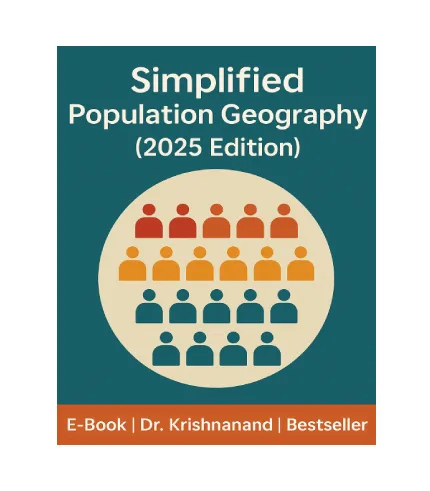
Simplified Population Geography: 2025 Edition Guide for Competitive Exams

Table of Contents
- Why Choose the 2025 Edition of Simplified Population Geography?
- Key Features of Simplified Population Geography 2025 Edition
- Updated 2025 Data & Maps
- Simplified Theories & Models
- Comprehensive Coverage of Core Topics
- Exam-Focused Approach
- Visual Learning Aids
- Who Should Read Simplified Population Geography 2025 Edition?
- Deep Dive: Core Theoretical Frameworks
- Demographic Transition Model: Beyond Textbook Stages
- Malthusian Theory & Modern Relevance
- Ravenstein's Laws of Migration: Empirical Validation
- Urbanization, Migration Patterns & Population Policies
- Urbanization Trends in India
- Internal & International Migration
- Population Policies: Comparative Analysis
- Author Credibility & Pedagogical Legacy
- How to Get Your Copy of Simplified Population Geography
- Additional Resources from TheGeoecologist
- Conclusion: Your Competitive Edge Starts Here
Simplified Population Geography has become the go-to resource for aspirants targeting competitive examinations like UGC NET, UPSC, and State PCS. The 2025 Edition by Dr. Krishnanand from TheGeoecologist elevates this standard with updated data, refined pedagogical tools, and exam-centric structuring. Whether you are a university student pursuing B.A., M.A., or M.Sc. in Geography, or a serious competitor aiming for JRF, this eBook delivers conceptual clarity backed by the latest demographic trends and authoritative case studies.
- The 2025 Edition integrates Census 2011 final data, NFHS-5 (2019–21), and World Population Prospects 2022 revisions.
- Covers Demographic Transition Model, Malthusian Theory, and Ravenstein’s Laws of Migration with simplified flowcharts.
- Designed for UGC NET Paper 2, UPSC Geography Optional, and State PSC syllabi with previous year question analysis.
- Includes 50+ diagrams, choropleth maps, and population pyramid illustrations for visual retention.
- Instant digital download with lifetime access and technical support via +91 9709646047.
Why Choose the 2025 Edition of Simplified Population Geography?
The Simplified Population Geography 2025 Edition is not merely an update—Simplified Population Geography is a strategic overhaul aligned with the evolving pattern of competitive examinations. Dr. Krishnanand, a recognized name in geography education through TheGeoecologist YouTube channel (with 200K+ subscribers), has incorporated feedback from thousands of aspirants. The edition reflects the shift from rote memorization to analytical application, a trend evident in UGC NET June 2024 and UPSC Mains 2023 papers where questions demanded interpretation of population pyramids and migration flow maps rather than direct definitions.
Unlike generic textbooks, this eBook bridges the gap between academic theory and exam execution. For instance, the chapter on Demographic Transition Model doesn’t just list stages—Simplified Population Geography maps each stage to Indian states (Kerala in Stage 4, Bihar in Stage 2) and links to NFHS-5 fertility indicators. Such contextualization is critical for scoring 150+ in UPSC Geography Optional Paper 1.
Key Features of Simplified Population Geography 2025 Edition
Updated 2025 Data & Maps
Every statistical table reflects the most recent credible sources: UN World Population Prospects 2024 revision, Census 2011 final tables (released 2023), Sample Registration System (SRS) 2022 bulletins, and NFHS-5 district-level factsheets. The 2025 Edition replaces outdated 2011 Census projections with actual enumerated data wherever available. Choropleth maps depict district-level literacy, sex ratio, and density using QGIS-rendered shapefiles—ensuring visual accuracy for map-based questions in State PSC prelims.
Simplified Theories & Models
Complex frameworks are deconstructed into stepwise logic chains. The Malthusian Theory section contrasts geometric vs. arithmetic growth with a comparative table, followed by Boserup’s counter-argument and modern critiques by Esther Duflo (Nobel 2019). Ravenstein’s Laws of Migration are illustrated through the 2021 Indian migration corridor (UP→Maharashtra, Bihar→Delhi) using Census 2011 migration tables. Each model includes a “Previous Year Question” sidebar showing how UGC NET (2019–2024) and UPSC (2018–2023) have tested Simplified Population Geography.
Comprehensive Coverage of Core Topics
The Simplified Population Geography syllabus coverage spans 14 chapters:
- Nature, Scope & Approaches in Population Geography
- Sources of Population Data & Their Reliability
- World Population Distribution, Density & Growth
- Demographic Transition Theory & Critiques
- Population Composition: Age-Sex Structure, Literacy, Occupational Structure
- Fertility, Mortality & Nuptiality Measures
- Migration: Types, Theories (Ravenstein, Lee, Zelinsky), Patterns
- Urbanization Trends & Primate City Concept
- Population Policies: India (NPP 2000, JD 2024), China, Iran, Singapore
- Contemporary Issues: Aging, Demographic Dividend, Climate Migration
- Population-Resource-Environment Nexus
- Case Studies: Kerala Model, Bihar’s Demographic Trap, Northeast Insurgency Linkages
- Previous Year Questions (2015–2024) with Explanations
- Mock Test Papers (3 Full-Length) for Self-Assessment
Exam-Focused Approach
Every chapter ends with a “Revision Capsule” (bulleted summary), “Assertion-Reason” practice set, and “Map-Based Questions” tailored for UPSC Prelims. The UGC NET section includes 200+ MCQs with answer keys and explanations referencing standard texts like Chandna, Majid Husain, and Clark. For UPSC Mains, model answers (150/250 words) demonstrate answer structuring with keywords like “demographic dividend window (2020–2040)”, “feminization of agriculture”, and “circular migration”.
Visual Learning Aids
Retention science drives the design: 50+ original diagrams include population pyramids (expansive, constrictive, stationary), Lorenz curves for inequality, migration flow arrows proportional to volume, and demographic transition schematic with feedback loops. Flowcharts convert 5-page theories into single-page decision trees—e.g., “How to identify demographic transition stage from CBR/CDR/TFR?” Color-coded legends (red=high, green=low) aid quick scanning during last-minute revision.
Who Should Read Simplified Population Geography 2025 Edition?
The target audience is precisely defined:
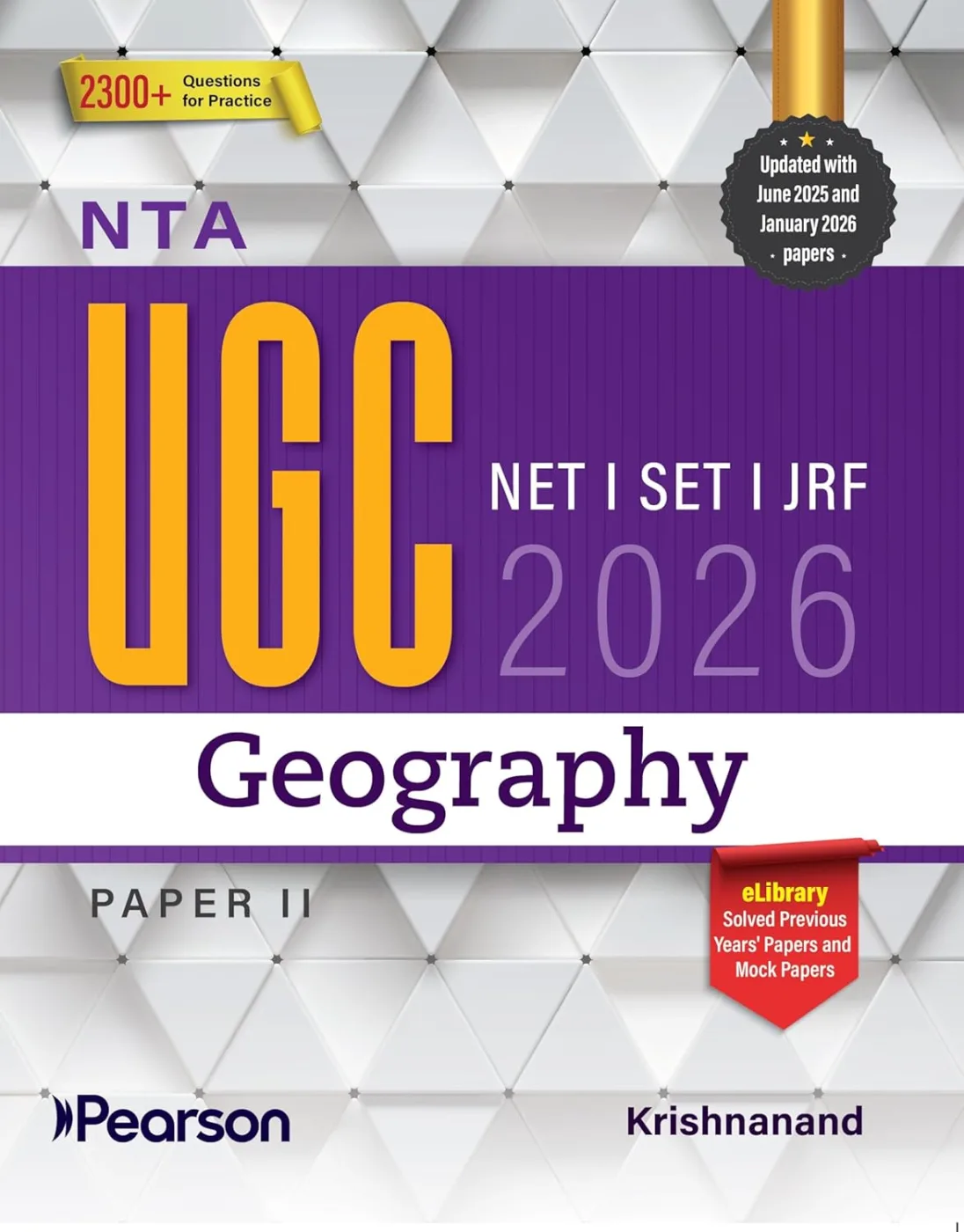
- UGC NET/JRF Geography Paper 2 Aspirants — Covers 100% of Population Geography unit (Unit VI) with NET-specific MCQ patterns.
- UPSC Geography Optional Students — Aligns with Paper 1 (Human Geography) and Paper 2 (Indian Geography) syllabi; includes 2013–2023 Mains questions.
- State PCS Candidates — BPSC, MPPSC, RPSC, UPPSC, WBCS patterns addressed; state-specific data boxes (e.g., Bihar’s TFR 3.0 vs. national 2.0).
- University Students (B.A./M.A./M.Sc. Geography) — Serves as semester textbook and reference for dissertation methodology chapters.
Deep Dive: Core Theoretical Frameworks
Demographic Transition Model: Beyond Textbook Stages
The Simplified Population Geography treatment of DTM goes beyond the classic four-stage model. Simplified Population Geography introduces Stage 5 (sub-replacement fertility, aging) with Japan, Italy, and South Korea (TFR 0.72 in 2023) as exemplars. The Indian context is analyzed at state level: Kerala (Stage 4, TFR 1.8), Tamil Nadu (Stage 4, TFR 1.8), Madhya Pradesh (Stage 3, TFR 2.7), and Bihar (Stage 2/3 transition, TFR 3.0). The eBook links this to the “demographic dividend” window—peaking 2030–2040—and policy implications for skill development (PMKVY) and labor formalization (e-Shram portal).
Malthusian Theory & Modern Relevance
Thomas Malthus’s 1798 “Essay on the Principle of Population” is presented with original quotes, followed by historical validation (Irish Famine 1845–52) and refutation (Green Revolution 1960s). The 2025 Edition adds a “Neo-Malthusian” section covering Paul Ehrlich’s “Population Bomb” (1968), Club of Rome’s “Limits to Growth” (1972), and contemporary climate-Malthusianism (IPCC AR6 WGII). Counter-perspectives from Julian Simon, Ester Boserup, and Amartya Sen’s entitlement approach are given equal weight—critical for balanced UPSC Mains answers.
Ravenstein’s Laws of Migration: Empirical Validation
Ernst Georg Ravenstein’s 1885/1889 laws are tested against 2011 Census migration data (released 2017). The eBook verifies each law: (1) Short-distance migration dominates (70% intra-district), (2) Migration proceeds stepwise (village→town→city), (3) Urban-rural differential drives flows, (4) Females migrate more for marriage (short-distance), males for work (long-distance), (5) Economic factors predominate. Exceptions like marriage migration in North India (long-distance female) and Kerala’s Gulf migration (international, male-dominated) are highlighted as “exam traps”.
Urbanization, Migration Patterns & Population Policies
Urbanization Trends in India
India’s urbanization level (31.1% in 2011, projected 35% in 2024) is analyzed through the lens of “census towns” vs. “statutory towns”. The 2025 Edition explains the 2011 Census reclassification that added 2,774 census towns—critical for understanding “urbanization without industrialization”. Primate city index for Mumbai, Delhi, Kolkata, Chennai is calculated; rank-size rule deviations are linked to regional disparity. Smart Cities Mission (100 cities) and AMRUT are evaluated for population redistribution impact.
Internal & International Migration
Internal migration streams (rural→rural 47%, rural→urban 32%, urban→urban 15%, urban→rural 6% per 2011 Census) are mapped with corridor thickness proportional to volume. The “circular migration” phenomenon—seasonal, short-duration, remittance-driven—is detailed with NSSO 64th Round (2007–08) and Periodic Labour Force Survey (2020–21) data. International migration covers India’s diaspora (18M, largest globally per UNDESA 2020), GCC remittances ($87B in 2021 per World Bank), and emigration clearance (ECR) policy.
Population Policies: Comparative Analysis
India’s National Population Policy 2000, Janasankhya Sthirata Kosh (2005), and the proposed Population Control Bill (2019, 2021) are tracked. The 2025 Edition adds the Population Policy developments: JD (Jan Sankhya Niyantran) Bill 2024 draft, state-level two-child norms (Assam, UP, Uttarakhand), and Supreme Court observations. China’s One-Child (1979–2015), Two-Child (2016–2021), Three-Child (2021–present) trajectory is contrasted with Iran’s successful voluntary program (1989–2010) and Singapore’s pro-natalist shifts. A comparative policy matrix aids quick revision.
Author Credibility & Pedagogical Legacy
Dr. Krishnanand (Ph.D., Geography, JNU) brings 15+ years of teaching experience at university level and competitive exam coaching. TheGeoecologist YouTube channel (@TheGeoecologist) hosts 500+ free lectures with 25M+ views, covering the entire UGC NET and UPSC Geography syllabus. The eBook is an extension of this pedagogy—structured, exam-oriented, and student-validated. Testimonials from 2023–24 UGC NET qualifiers (AIR 12, 45, 89) and UPSC CSE 2023 rank-holders (Geography Optional) are featured on Simplified Population Geography page.
How to Get Your Copy of Simplified Population Geography
Acquiring the Simplified Population Geography 2025 Edition is instantaneous:
- Visit the official shop: geographyebooks.com/product/simplified-population-geography/
- Click “Add to Cart” → Proceed to Checkout.
- Pay via UPI, Net Banking, Card, or Wallet (INR 499, inclusive of GST).
- Receive download link instantly on email and order page.
- Access PDF (printable, searchable, 320 pages, 45 MB) with lifetime updates.
Technical support is available at +91 9709646047 (WhatsApp/Call, 10 AM–7 PM IST). For bulk/institutional orders, email support@geographyebooks.com.
Additional Resources from TheGeoecologist
Complement your preparation with free high-yield content:
- YouTube: @TheGeoecologist — Daily lectures, PYQ discussions, map sessions.
- Instagram: @TheGeoecologist — Infographics, mnemonics, current affairs snippets.
- Website: geographyebooks.com — Full catalog (Geomorphology, Climatology, Oceanography, Economic Geography, Models & Theories).
- Telegram: @TheGeoecologist_Official — PDF notes, test series, doubt resolution.
Conclusion: Your Competitive Edge Starts Here
In an examination landscape where 5 marks separate success from another attempt, Simplified Population Geography 2025 Edition offers precision, currency, and exam intelligence. It transforms population geography from a memorization-heavy subject into a scoring stronghold. The integration of 2024 data, visual pedagogy, and previous-year analytics makes it indispensable for UGC NET, UPSC, and State PCS aspirants. Download today, integrate into your revision cycle, and convert population geography into your highest-scoring section. Your rank awaits.
Frequently Asked Questions
Yes, the eBook comprehensively covers Population Geography for both UPSC Geography Optional Paper 1 (Human Geography – population theories, migration, settlement) and Paper 2 (Indian Geography – demographic attributes, policies, urbanization). It includes 2013–2023 Mains questions with model answers.
Absolutely. The 2025 Edition incorporates Census 2011 final tables (released 2023), SRS 2022 bulletins, NFHS-5 (2019–21) district-level indicators, UN World Population Prospects 2024 revision, and PLFS 2020–21 migration data.
Yes, upon purchase you receive a downloadable PDF (printable, searchable, 320 pages) with lifetime access. You can save it on any number of personal devices. Technical support is available at +91 9709646047 for any access issues.