Blog
UGC NET Geography Cutoff: June 2026 Official Category-Wise Marks Released

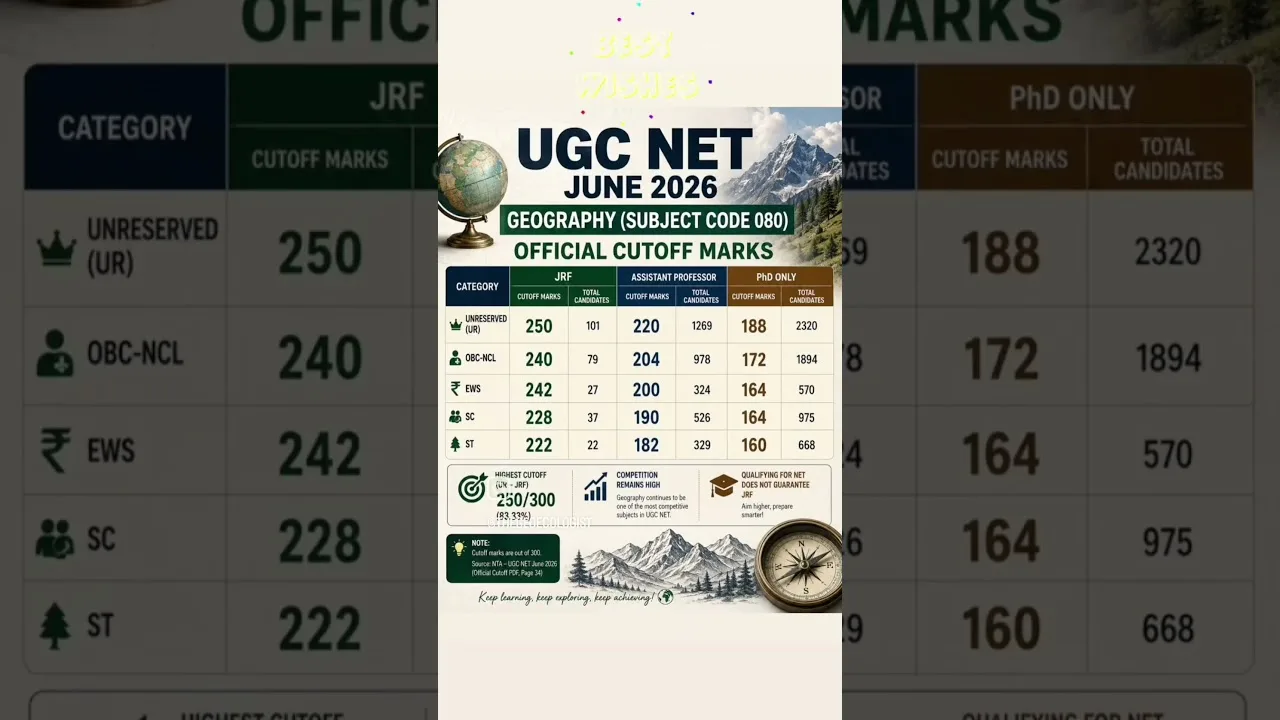
Table of Contents
- Understanding the UGC NET Geography Cutoff Structure
- Three-Tier Qualification Framework
- Category-Wise Deep Dive: UGC NET Geography Cutoff June 2026
- Unreserved (UR) Category Analysis
- OBC-NCL Category Trends
- EWS Category Positioning
- SC and ST Category Insights
- Historical Comparison: UGC NET Geography Cutoff Trends (2022-2026)
- Subject Code 080: Why Geography Remains Highly Competitive
- Interdisciplinary Appeal
- Career Versatility
- Research Funding Landscape
- Score Calculation & Normalization: How Your Marks Become the Cutoff
- Exam Pattern & Marking Scheme
- Normalization Process (NTA Method)
- Strategic Implications for June 2026 Qualifiers
- If You Cleared JRF (Score ≥ Category Cutoff)
- If You Cleared Assistant Professor Only
- If You Cleared PhD Only
- Preparation Blueprint: Targeting the Next UGC NET Geography Cutoff
- Paper I: The Differentiator (Target 70+ marks)
- Paper II: Geography Core (Target 150+ marks for JRF)
- Resource Ecosystem
- Frequently Asked Questions
- What is the validity period of UGC NET Geography qualification?
- Can I challenge the UGC NET Geography Cutoff or my score?
- How does the UGC NET Geography Cutoff compare to other subjects?
- Conclusion: Navigating Your Post-Result Journey
The UGC NET Geography Cutoff for June 2026 has been officially released by the National Testing Agency (NTA), bringing clarity to thousands of aspirants who appeared for the examination. As one of the most competitive subjects in the University Grants Commission National Eligibility Test, Geography (Subject Code 080) attracts a massive pool of candidates vying for Junior Research Fellowship (JRF), Assistant Professor eligibility, and PhD admission. This comprehensive analysis breaks down the official category-wise cutoff marks, explains what they mean for your career trajectory, and provides actionable insights for future aspirants.
- JRF Cutoff: UR 250 | OBC-NCL 240 | EWS 242 | SC 228 | ST 222
- Assistant Professor Cutoff: UR 220 | OBC-NCL 204 | EWS 200 | SC 190 | ST 182
- PhD Only Cutoff: UR 188 | OBC-NCL 172 | EWS 164 | SC 164 | ST 160
- Geography remains among the top 5 most competitive subjects in UGC NET
- Cutoffs are derived from the NTA UGC NET June 2026 Official Cutoff PDF
- Subject Code 080 witnessed over 45,000 registrations in June 2026 cycle
Understanding the UGC NET Geography Cutoff Structure
The UGC NET Geography Cutoff mechanism follows a well-defined percentile-based normalization process implemented by NTA since December 2018. Unlike raw score cutoffs of the past, the current system accounts for difficulty variations across multiple shifts through a statistical equipercentile method. This ensures fairness for candidates appearing in different slots of the Computer Based Test (CBT). The final cutoff represents the minimum normalized score required to qualify for each category and eligibility type.
Three-Tier Qualification Framework
The examination offers three distinct qualification pathways, each with its own cutoff threshold:
1. Junior Research Fellowship (JRF) + Assistant Professor
This is the most coveted category, offering both a fellowship of ₹31,000 per month (first two years) and ₹35,000 thereafter, along with eligibility for Assistant Professor positions. The JRF cutoff is invariably the highest across all categories. For June 2026, the Unreserved (UR) category required 250 marks out of 300, translating to approximately 83.33 percentile. – a key consideration for UGC NET Geography Cutoff.
2. Assistant Professor Only
Candidates who clear this cutoff become eligible for Assistant Professor positions in Indian universities and colleges but do not receive the JRF stipend. The cutoff is moderately lower than JRF — UR 220 marks (73.33 percentile) — making UGC NET Geography Cutoff accessible to a broader candidate base while maintaining academic standards.
3. PhD Admission Only
Introduced as per UGC’s 2022 regulations, this category allows candidates to use NET scores for PhD admission without Assistant Professor eligibility. The cutoff is the lowest — UR 188 marks (62.67 percentile) — reflecting its specific purpose as a research aptitude benchmark rather than a teaching eligibility test.
Category-Wise Deep Dive: UGC NET Geography Cutoff June 2026
Unreserved (UR) Category Analysis
The UR category cutoffs establish the baseline for all other categories. At 250 for JRF, 220 for Assistant Professor, and 188 for PhD Only, the differentials reveal the competitive intensity at each level. The 30-mark gap between JRF and Assistant Professor (10% of total marks) indicates that roughly the top 15-20% of qualified candidates secure JRF, while the next 25-30% qualify for Assistant Professor only.
OBC-NCL Category Trends
Other Backward Classes (Non-Creamy Layer) cutoffs show a consistent 10-16 mark reduction from UR across all three tiers: JRF at 240 (-10), Assistant Professor at 204 (-16), and PhD Only at 172 (-16). This 4-6.5% relaxation aligns with the 27% reservation mandate while maintaining meritocratic standards. The narrower gap at JRF level (10 marks vs 16 at lower tiers) suggests higher competition density among top OBC-NCL performers.
EWS Category Positioning
Economically Weaker Section cutoffs sit uniquely between UR and OBC-NCL: JRF 242 (-8 from UR), Assistant Professor 200 (-20), PhD Only 164 (-24). The wider spread at lower tiers reflects the category’s relatively recent introduction (2019) and evolving candidate pool. Notably, EWS JRF cutoff is only 2 marks above OBC-NCL despite 10% vs 27% reservation, indicating strong performance by EWS aspirants in Geography.
SC and ST Category Insights
Scheduled Caste cutoffs: JRF 228 (-22), Assistant Professor 190 (-30), PhD Only 164 (-24). Scheduled Tribe cutoffs: JRF 222 (-28), Assistant Professor 182 (-38), PhD Only 160 (-28). The progressive widening of gaps at Assistant Professor level (30-38 marks below UR) reflects the 15% and 7.5% reservation quotas respectively. However, the PhD Only category shows convergence — SC and ST both at 164 and 160, merely 24-28 marks below UR — suggesting the research aptitude baseline is more uniform across categories.
Historical Comparison: UGC NET Geography Cutoff Trends (2022-2026)
Analyzing the UGC NET Geography Cutoff trajectory over the last five cycles reveals critical patterns for aspirants:
| Cycle | JRF UR | Asst Prof UR | PhD Only UR | Registrations |
|---|---|---|---|---|
| June 2026 | 250 | 220 | 188 | ~45,000 |
| Dec 2025 | 246 | 216 | 184 | ~42,000 |
| June 2025 | 242 | 212 | 180 | ~40,500 |
| Dec 2024 | 238 | 208 | 176 | ~38,000 |
| June 2024 | 234 | 204 | 172 | ~36,000 |
The data shows a consistent upward trend of approximately 4 marks per cycle for JRF UR cutoff, correlating with rising registration numbers and improved preparation resources. The 16-mark increase over two years (June 2024 to June 2026) represents a 6.8% rise, outpacing the 25% growth in registrations. This suggests increasing competitiveness per seat, driven by better coaching penetration, digital study materials, and UGC NET Geography Cutoff’s growing popularity for academic careers.
Subject Code 080: Why Geography Remains Highly Competitive
Geography (Subject Code 080) consistently ranks among the top 5 most competitive UGC NET subjects alongside Commerce, English, Political Science, and Education. Several structural factors drive this intensity:
Interdisciplinary Appeal
Geography’s unique position bridging natural sciences (physical geography, climatology, geomorphology) and social sciences (human geography, population studies, urban planning) attracts candidates from diverse academic backgrounds — B.Sc, B.A., B.Tech, and even M.Arch graduates. This multidisciplinary inflow expands the candidate pool beyond traditional geography postgraduates.
Career Versatility
NET-qualified geographers access opportunities across academia, government research institutes (ICSSR, NCAER), planning bodies (Town & Country Planning, NITI Aayog), environmental agencies, GIS/remote sensing industry, and civil services. UGC NET Geography Cutoff’s alignment with UPSC Geography optional (chosen by ~30% of aspirants) creates a massive dual-preparation cohort.
Research Funding Landscape
Major funding agencies — UGC, ICSSR, DST, MoES — prioritize geography research in climate change, disaster management, urbanization, and water security. JRF holders in Geography enjoy strong PhD placement rates at premier institutes like JNU, DU, BHU, IITs, and IISERs, with 70%+ conversion from JRF to doctoral enrollment within 18 months.
Score Calculation & Normalization: How Your Marks Become the Cutoff
Understanding the transformation from raw responses to the final UGC NET Geography Cutoff score is crucial for strategic preparation:
Exam Pattern & Marking Scheme
- Paper I (General): 50 questions × 2 marks = 100 marks (Teaching/Research Aptitude, Reasoning, Comprehension, ICT, Higher Education)
- Paper II (Geography): 100 questions × 2 marks = 200 marks (Physical, Human, Regional, Techniques, Indian Geography)
- Total: 150 questions × 2 marks = 300 marks
- No negative marking — encourages attempting all questions
- Duration: 3 hours continuous (no sectional timing)
Normalization Process (NTA Method)
Since UGC NET is conducted in multiple shifts, NTA employs the Equipercentile Method for score normalization. The process:
- Calculate raw scores for each candidate in each shift
- Determine percentile scores within each shift
- Map percentiles to a common scale using the equipercentile formula
- Derive normalized scores (out of 300) that are comparable across shifts
- Apply category-wise cutoffs on normalized scores
This means your UGC NET Geography Cutoff qualification depends not just on absolute correct answers, but on relative performance within your shift and across all shifts. A difficult shift yields higher normalized scores for the same raw marks.
Strategic Implications for June 2026 Qualifiers
If You Cleared JRF (Score ≥ Category Cutoff)
- Immediate: Download e-certificate from NTA UGC NET official portal using application number and date of birth
- Fellowship Activation: Enroll in PhD program within 3 years (extendable by 1 year) at UGC-recognized university
- Documentation: Submit joining report, progress reports annually, and HRA claims quarterly
- Career Planning: Target top-tier universities for PhD — JNU, DU, Hyderabad, Madras, IITs — where geography departments have strong research clusters
If You Cleared Assistant Professor Only
- Eligibility Validity: Lifetime validity for Assistant Professor posts (per UGC 2018 regulation)
- Job Applications: Apply to state universities, deemed universities, private universities, and colleges
- PhD Option: Can still pursue PhD (self-funded or project-funded) and later apply for JRF-equivalent positions
- State SET/SLET: Consider appearing for State Eligibility Test for additional state-level preference
If You Cleared PhD Only
- Scope: Valid only for PhD admission in UGC-recognized universities
- No Teaching Eligibility: Cannot apply for Assistant Professor posts directly
- Upgrade Path: Reappear in next UGC NET cycle for Assistant Professor/JRF
- Research Focus: Ideal for candidates committed to research careers in institutes, think tanks, or industry R&D
Preparation Blueprint: Targeting the Next UGC NET Geography Cutoff
Based on the June 2026 UGC NET Geography Cutoff analysis, here’s a data-driven preparation strategy for upcoming cycles:
Paper I: The Differentiator (Target 70+ marks)
Paper I offers the highest ROI — 100 marks from 50 questions with generic syllabus. Toppers consistently score 70-80 here. Focus areas:
- Teaching Aptitude (10-12 questions): Bloom’s taxonomy, teaching methods, evaluation systems
- Research Aptitude (8-10 questions): Research types, methods, ethics, thesis structure
- Reading Comprehension (5-6 questions): Practice 2-3 passages daily
- Mathematical Reasoning & Data Interpretation (10 questions): High scoring with practice
- ICT, People & Environment, Higher Education (15 questions): Static GK + current affairs
Paper II: Geography Core (Target 150+ marks for JRF)
With 100 questions covering the vast geography syllabus, strategic prioritization is essential:
High-Yield Units (60-70% weightage)
- Physical Geography: Geomorphology (landforms, cycles), Climatology (circulation, monsoons), Oceanography, Biogeography — ~25 questions
- Human Geography: Population, Settlement, Economic Activities, Cultural Geography — ~20 questions
- Indian Geography: Physiography, Climate, Resources, Agriculture, Industry, Transport, Population — ~20 questions
Technical Units (20-25% weightage, high scoring)
- Geographical Techniques: Cartography, Surveying, Remote Sensing, GIS, GPS, Quantitative Methods — ~15 questions
- Regional Planning: Planning concepts, Regional development, Sustainable development — ~10 questions
Emerging Areas (5-10% weightage, increasing trend)
- Climate Change & Disaster Management
- Urban Geography & Smart Cities
- Geopolitics & Border Studies
- Environmental Geography & SDGs
Resource Ecosystem
- Standard References: Savindra Singh (Physical), Majid Husain (Human/Indian), Khullar (India), NCERT Class 11-12
- Previous Year Papers: Last 10 years (available on UGC Wikipedia page and NTA portal)
- Mock Tests: Minimum 20 full-length tests under exam conditions
- Current Affairs: Geography-related news from The Hindu, Down To Earth, Yojana, Kurukshetra (last 18 months)
Frequently Asked Questions
What is the validity period of UGC NET Geography qualification?
JRF award letter is valid for 3 years (extendable by 1 year) for PhD enrollment. Assistant Professor eligibility is valid for lifetime as per UGC’s 2018 notification. PhD Only qualification is valid for the current admission cycle only.
Can I challenge the UGC NET Geography Cutoff or my score?
NTA allows answer key challenges within a specified window (typically 2-3 days after provisional key release) for a fee of ₹200 per question. However, the final cutoff marks themselves cannot be challenged as they are statistically derived from normalized scores.
How does the UGC NET Geography Cutoff compare to other subjects?
Geography cutoffs are typically 10-15 marks higher than the UGC NET average across subjects, placing UGC NET Geography Cutoff in the top quartile of competitiveness. For June 2026, the average JRF UR cutoff across all 83 subjects was approximately 235, while Geography stood at 250.
Conclusion: Navigating Your Post-Result Journey
The release of the UGC NET Geography Cutoff for June 2026 marks a pivotal moment for over 45,000 aspirants. Whether you’ve secured JRF, Assistant Professor eligibility, or PhD Only qualification — or find yourself below the threshold — this milestone should inform your next strategic move. For qualifiers, the focus shifts to certificate download, PhD enrollment, or job applications. For those who missed the cutoff, the detailed category-wise analysis above provides a clear benchmark for the next attempt.
The upward trend in cutoffs (+16 marks in 2 years for JRF UR) signals intensifying competition, making early, structured preparation with quality resources non-negotiable. Leverage UGC NET Geography Cutoff’s interdisciplinary strength, master the high-yield units, and treat Paper I as your score anchor. The next UGC NET cycle awaits — with the right strategy, the cutoff is not a barrier but a milestone you’re designed to cross.
Source: NTA UGC NET June 2026 Official Cutoff PDF. For official notifications and certificate download, visit the NTA UGC NET portal.
Frequently Asked Questions
The UGC NET Geography Cutoff for JRF Unreserved category in June 2026 is 250 marks out of 300.
There are three qualification categories: JRF + Assistant Professor, Assistant Professor Only, and PhD Admission Only, each with separate cutoffs for UR, OBC-NCL, EWS, SC, and ST.
The official UGC NET Geography Cutoff PDF can be downloaded from the NTA UGC NET official portal at ugcnet.nta.ac.in under the 'Results' or 'Cutoff' section.