Blog
Nature of Human Geography: Scope, Branches, and What Every Student Should Know

If you have ever typed “nature of human geography” into a search bar and felt buried under academic jargon, you are not alone. Geography students at the Class 12 level, UPSC Civil Services aspirants, and undergraduate learners consistently report that the introductory chapter on the nature and scope of human geography is one of the most confusing starting points in the discipline. The terminology is dense, the debates are decades old, and most textbooks assume you already understand them.
This guide cuts through that confusion. It explains what the nature of human geography really means, why it matters, and how a purpose-built e-book can turn a frustrating topic into a confident foundation for the rest of your geography syllabus.
Key Takeaways
- The nature of human geography is defined by its focus on the relationship between human societies and their physical environment.
- It has evolved through several paradigms, from environmental determinism to possibilism, and modern cultural landscape studies.
- Understanding its scope and branches is essential for Class 12, undergraduate, and UPSC Geography Optional exams.
- A well-structured e-book like Simplified Population Geography (2025 Edition) by Dr. Krishnanand can clarify these concepts faster than fragmented online resources.
- Look for resources that use diagrams, maps, and point-wise highlights aligned with the CBCS syllabus.
What “Nature of Human Geography” Actually Means
The phrase “nature of human geography” is shorthand for a foundational question in the discipline: what is human geography, what does it study, and what methods does it use? It is a question every serious geography student encounters, whether in a Class 12 NCERT chapter, an undergraduate semester, or the UPSC Geography Optional paper.
Human geography is a major branch of geography that studies the spatial distribution of human activities, cultures, settlements, economies, and political systems across the surface of the earth. Its nature is therefore integrative, descriptive, analytical, and increasingly applied.
According to the Wikipedia overview of human geography, the discipline is concerned with understanding how humans interact with and shape the spaces they inhabit. This definition sounds simple, but it hides a long intellectual history of competing perspectives, which is why students often struggle.
The Evolution of the Nature of Human Geography
To understand the nature of human geography, you have to understand the paradigms that have shaped it. The most widely taught framework in Indian curricula identifies four major stages of evolution.
1. Environmental Determinism
In the early 20th century, scholars like Ellsworth Huntington and Ellen Churchill Semple argued that the physical environment directly determines human behavior and societal development. Climate, terrain, and resources were treated as the primary causes of cultural and economic outcomes. While this view is now considered oversimplified and often problematic, it laid the groundwork for studying human-environment relationships.
2. Possibilism
French geographer Paul Vidal de la Blache proposed a more balanced view: the environment offers a set of possibilities, but humans choose among them through culture and technology. Possibilism became the dominant paradigm in human geography for much of the 20th century and remains central to how Indian textbooks present the nature of human geography.
3. Cultural Landscape Approach
Carl Sauer, working from the Berkeley School, argued that culture is the agent, the natural area is the medium, and the cultural landscape is the result. This approach shifted attention to what humans actually do to the land: terracing hillsides, building cities, planting crops. The cultural landscape became the central object of geographic inquiry.
4. Areal Differentiation and Spatial Organization
Mid-20th-century geographers like Hartshorne emphasized that the core task of geography is to describe and explain areal differentiation, the unique character of regions. Later, a quantitative revolution reframed human geography as a spatial science concerned with patterns, networks, flows, and the location of activities.
Understanding this evolution is essential because UPSC and undergraduate exams frequently ask candidates to explain the changing nature of human geography across these paradigms.
Scope and Branches of Human Geography
The scope of human geography is vast, but it can be grouped into a manageable set of branches. Most Class 12 and undergraduate syllabi in India organize the discipline as follows.
- Social and Cultural Geography: studies of ethnicity, religion, language, and cultural practices in spatial terms.
- Population Geography: distribution, density, fertility, mortality, and migration of human populations.
- Settlement Geography: rural and urban settlements, their morphology, and functional classification.
- Economic Geography: location of agriculture, industry, trade, and services.
- Political Geography: states, borders, geopolitics, and electoral patterns.
- Historical Geography: reconstruction of past landscapes and the geography of historical events.
- Urban Geography: growth, structure, and problems of cities.
Each of these branches shares the same underlying nature: a focus on space, place, region, and the human-environment relationship. The CBSC and CBCS syllabi in India are explicitly designed around this structure, which is why any good introductory resource must cover each branch clearly.
Why Students Struggle with the Nature of Human Geography
Several recurring problems show up in student queries about the “nature of human geography class 12” and related topics.
First, the abstract philosophical debates are difficult to visualize. Concepts like determinism, possibilism, and areal differentiation are inherently theoretical, and without diagrams or worked examples, they remain vague.
Second, Indian syllabi expect students to remember definitions, geographers’ names, and the time periods of each paradigm. This makes rote learning tempting, but the marks go to students who can apply these ideas to real examples.
Third, students preparing for the UPSC Civil Services Examination need depth that goes well beyond what a single NCERT chapter can provide. They need to know how the nature of human geography relates to population geography, regional development, and contemporary issues like migration and climate displacement.
Finally, study materials are scattered. YouTube videos cover one paradigm, PDFs cover another, and a printed textbook may be out of date. The result is fragmented understanding, which is exactly what competitive exam answers cannot afford.
What to Look for in a Good Resource on the Nature of Human Geography
Whether you are a Class 12 student, a BA or BSc geography undergraduate, or a UPSC aspirant, a high-quality resource should meet several practical criteria.
Syllabus Alignment
Look for material that explicitly follows the CBCS syllabus or the NCERT Class 12 framework, plus UPSC General Studies and Geography Optional requirements. Alignment saves you the work of mapping concepts back to your exam requirements.
Visual Support
Diagrams, maps, and flowcharts make abstract paradigms like possibilism and cultural landscape studies far easier to remember. A good e-book should include visual aids, not just text walls.
Point-Wise Highlighted Descriptions
For exam preparation, point-wise highlighted text helps with both reading and revision. It also mirrors the structured answer format expected in UPSC mains.
Coverage of Both Classical and Contemporary Approaches
Any resource worth your time should cover the classical evolution (determinism, possibilism, cultural landscape, areal differentiation) as well as contemporary approaches like behavioral, feminist, and postcolonial geographies.
How Simplified Population Geography (2025 Edition) by Dr. Krishnanand Fits This Need
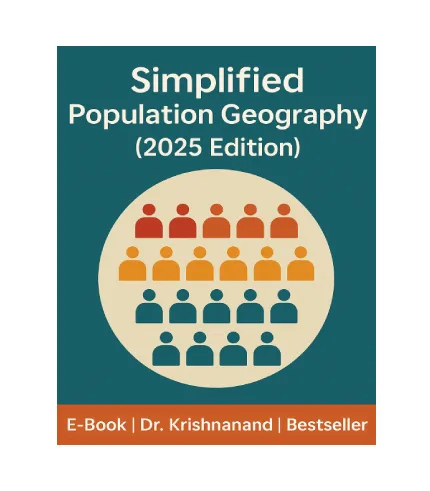
One e-book that consistently addresses these criteria is Simplified Population Geography (2025 Edition) by Dr. Krishnanand, a bestselling e-book for UPSC CSE aspirants, undergraduates, and geography enthusiasts. It is built on the prescribed CBCS syllabus in geography, which means it sits exactly where Indian students need it.
The book opens with a chapter on the Nature and Scope of Population Geography, which is a direct extension of the broader question of the nature of human geography. Population geography is itself one of the core branches, and Dr. Krishnanand’s treatment makes the connection explicit: you cannot understand population distribution, fertility, mortality, or migration without understanding the philosophical foundations of human geography itself.
What makes this e-book particularly useful is its formatting. Point-wise highlighted descriptions, supported by diagrams, maps, and images, make the otherwise dry material easier to read and easier to revise. Chapters on sources of demographic data, population size and growth, fertility, mortality, and migration, and population composition and characteristics are all directly relevant to the same cluster of syllabi that ask about the nature and scope of human geography.
For UPSC aspirants, the 2025 edition is a notable advantage because it reflects the latest census-related data updates and current demographic debates. For undergraduates, the CBCS alignment means it can serve as a primary or supplementary textbook. For Class 12 students who want to go beyond NCERT, it provides exactly the kind of depth the board exams and competitive entrance tests reward.
Practical Guidance: How to Use This Resource Effectively
Buying a good e-book is only the first step. Here is how to use it to actually master the nature of human geography and related topics.
- Start with the first chapter on Nature and Scope, and read it alongside your NCERT Class 12 textbook. Use Dr. Krishnanand’s diagrams to visualize each paradigm.
- Create a one-page summary table of the four classical approaches, the time period, the key geographer, and the core idea. This table alone can fetch multiple marks in UPSC mains.
- Move into the population chapters and link each concept back to the broader nature of human geography. For example, ask yourself how migration studies reflect the cultural landscape approach.
- Use the point-wise highlighted descriptions as answer templates. Rephrase them in your own words during practice tests.
- Revisit the diagrams before exams. Visual recall is faster than textual recall and is particularly useful for map-based questions.
- Combine the e-book with current affairs, especially the latest census releases, National Family Health Survey data, and migration reports, to produce contemporary examples that examiners value.
The price point, at ₹249, makes the e-book accessible for most students, and the digital format means you can study on a phone, tablet, or laptop without carrying a heavy printed textbook.
Final Thoughts on Mastering the Nature of Human Geography
The phrase “nature of human geography” sits at the very heart of the discipline. It is the question from which every branch, including population geography, settlement geography, and economic geography, eventually unfolds. Students who understand the philosophical evolution of the field, the scope of its branches, and the contemporary debates that shape it consistently outperform those who try to memorize isolated facts.
Choose a resource that aligns with your syllabus, uses visual aids, and explains paradigms in clear language. Simplified Population Geography (2025 Edition) by Dr. Krishnanand meets all three criteria, which is why it has become a bestseller among UPSC and undergraduate students. Used as a structured companion to your main textbook, it can transform a confusing opening chapter into a strong academic foundation.
Frequently Asked Questions
What is the nature of human geography in simple words?
The nature of human geography is the study of how human societies, cultures, economies, and political systems are distributed across space and how they interact with the physical environment. It is a branch of geography concerned with spatial patterns of human activity.
What is the difference between the nature and scope of human geography?
The nature of human geography refers to its defining characteristics, including its focus on space, region, and human-environment relationships. The scope refers to the range of topics it covers, such as population, settlement, culture, economy, and politics.
What are the major approaches in the nature of human geography?
The major approaches are environmental determinism, possibilism, the cultural landscape approach, areal differentiation, and contemporary quantitative and qualitative methods. Each approach reflects a different view of the relationship between humans and the environment.
Why is the nature of human geography important for UPSC?
UPSC Geography Optional and General Studies papers include direct questions on the nature, scope, and evolution of human geography. A clear understanding also helps you answer applied questions on population, regional development, and contemporary geographical issues.
Which e-book is best for learning population geography for UPSC?
Simplified Population Geography (2025 Edition) by Dr. Krishnanand is a bestselling e-book that follows the CBCS syllabus, uses point-wise highlighted descriptions, and includes diagrams, maps, and images to support UPSC and undergraduate preparation.
Our Recommendation
Frequently Asked Questions
What is the nature of human geography in simple words?
The nature of human geography is the study of how human societies, cultures, economies, and political systems are distributed across space and how they interact with the physical environment.
What is the difference between the nature and scope of human geography?
The nature refers to its defining characteristics, such as its focus on space, region, and human-environment relationships. The scope refers to the range of topics it covers, including population, settlement, culture, economy, and politics.
What are the major approaches in the nature of human geography?
The major approaches are environmental determinism, possibilism, the cultural landscape approach, areal differentiation, and contemporary quantitative and qualitative methods.
Why is the nature of human geography important for UPSC?
UPSC Geography Optional and General Studies papers include direct questions on the nature, scope, and evolution of human geography, and the same foundations underpin applied topics like population, regional development, and migration.
Which e-book is best for learning population geography for UPSC?
Simplified Population Geography (2025 Edition) by Dr. Krishnanand is a bestselling CBCS-aligned e-book with point-wise highlighted descriptions, diagrams, maps, and images tailored for UPSC and undergraduate geography students.