Blog
Simplified Geomorphology eBook: 2025 Edition Review for UPSC & UGC NET

Table of Contents
- Understanding Geomorphology: Foundation for Competitive Geography
- Why Traditional Textbooks Fall Short for Exam Preparation
- Deep Dive: Simplified Geomorphology eBook (2025 Edition) Features
- Updated Theoretical Framework
- Illustrated Diagrams: Visual Mastery for Descriptive Answers
- Case Studies & Scholarly Theories: Bridging Theory and Application
- Target Audience: Who Benefits Most from This Resource
- UPSC Geography Optional Aspirants
- UGC NET Geography Candidates
- State PSC & University Students
- Digital Learning Advantages: Why E-Book Format Matters
- Comparative Analysis: Simplified Geomorphology eBook vs. Alternatives
- Strategic Study Plan Using the Simplified Geomorphology eBook
- Phase 1: Foundation Building (Weeks 1-3)
- Phase 2: Landform Systems Mastery (Weeks 4-8)
- Phase 3: Integration & Application (Weeks 9-12)
- Phase 4: Final Revision (Last 2 Weeks)
- Author Credibility: Dr. Krishnanand & The Geoecologist Platform
- Pricing, Access & Purchase Details
- Future-Proofing Your Geography Preparation
- Conclusion: Investment That Compounds Across Exams
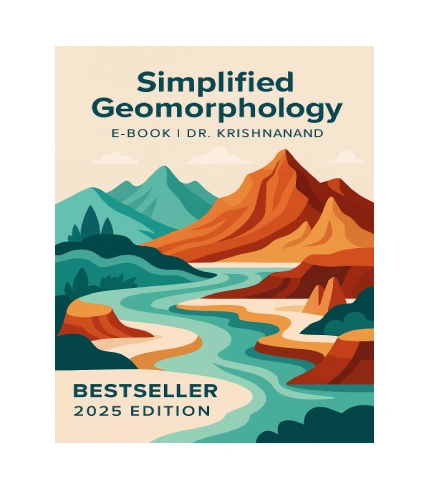
The Simplified Geomorphology eBook (2025 Edition) by Dr. Krishnanand has emerged as a definitive resource for geography aspirants targeting competitive examinations across India. Published under The Geoecologist banner, this comprehensive digital textbook addresses the persistent gap between complex geomorphic theories and exam-oriented preparation strategies. With updated content aligning to the latest UPSC Geography Optional syllabus and UGC NET Geography curriculum, the publication serves both novice learners and advanced researchers seeking conceptual clarity in physical geography.
- Exam-Aligned Content: Tailored for UPSC Geography Optional, UGC NET, State PSCs, and M.A./M.Sc. Geography programs
- Visual Learning: 200+ illustrated diagrams explaining landform evolution, process geomorphology, and structural geomorphology
- Scholarly Integration: Incorporates latest theories from Davis, Penck, King, and contemporary process-based approaches
- Case Study Repository: Indian and global examples including Himalayan orogeny, Deccan traps, coastal geomorphology, and fluvial systems
- Digital Accessibility: Instant download, searchable PDF format, compatible with all devices for on-the-go revision
Understanding Geomorphology: Foundation for Competitive Geography
Geomorphology, the scientific study of Earth’s landforms and the processes that shape them, constitutes approximately 25-30% of the UPSC Geography Optional Paper I syllabus. The discipline examines endogenous forces (tectonism, volcanism) and exogenous processes (weathering, erosion, deposition) operating across temporal scales from seconds to millions of years. According to Wikipedia’s geomorphology entry, the field integrates principles from geology, climatology, hydrology, and ecology to explain landscape evolution. – a key consideration for Simplified Geomorphology eBook.
For aspirants, mastering geomorphology requires more than memorizing definitions. The Simplified Geomorphology eBook bridges theoretical frameworks with application-based questions that dominate modern examination patterns. Since 2020, UPSC has increasingly framed questions requiring synthesis across geomorphic systems — for instance, linking Himalayan tectonics to drainage anomalies and subsequent flood hazards in the Indo-Gangetic plain.
Why Traditional Textbooks Fall Short for Exam Preparation
Standard references like Thornbury’s “Principles of Geomorphology” or Bloom’s “Geomorphology: A Systematic Analysis of Late Cenozoic Landforms” provide academic depth but lack exam-oriented structuring. Students typically struggle with three challenges: (1) extracting relevant content from 600+ page volumes, (2) translating theoretical concepts into diagram-based answers, and (3) integrating recent research findings absent in older editions. The 2025 edition of this Simplified Geomorphology eBook directly addresses these pain points through curated content mapping.
Deep Dive: Simplified Geomorphology eBook (2025 Edition) Features
Updated Theoretical Framework
The 2025 edition incorporates paradigm shifts in process geomorphology, including:
- Critical Zone Science: Integration of biogeomorphic feedbacks between vegetation, soil, and landform evolution
- Anthropocene Geomorphology: Human-induced landscape modification as a distinct geomorphic agent
- Quantitative Approaches: Morphometric analysis, cosmogenic nuclide dating, and LiDAR applications in landform quantification
- Climate-Geomorphology Coupling: Updated periglacial, glacial, and arid process mechanics reflecting IPCC AR6 projections
Dr. Krishnanand, the author, brings 15+ years of teaching experience at university level and has mentored 50+ UPSC rank-holders. His pedagogical approach emphasizes conceptual hooks — memorable frameworks that connect disparate topics. For instance, the “Tectono-Climatic-Dynamic” triad organizes landform classification around three primary drivers, simplifying answer structuring for 15-marker questions. – a key consideration for Simplified Geomorphology eBook.
Illustrated Diagrams: Visual Mastery for Descriptive Answers
Geography examinations reward diagrammatic representation. The Simplified Geomorphology eBook contains 200+ original illustrations covering:
- Plate boundary configurations and associated landforms (convergent, divergent, transform)
- Cycle of erosion models (Davis, Penck, King) with comparative evolution sequences
- Fluvial landform assemblages: longitudinal profiles, channel patterns, floodplain architecture
- Karst topography development stages with chemical weathering equations
- Glacial erosion and deposition features: cirques, arêtes, drumlins, eskers, moraines
- Coastal process-response models: wave refraction, longshore drift, barrier island formation
Each diagram includes examination-oriented labels — the exact terminology examiners expect. This feature alone saves aspirants 40-50 hours of diagram compilation from multiple sources.
Case Studies & Scholarly Theories: Bridging Theory and Application
Modern geography questions demand place-specific knowledge. The eBook provides 35+ case studies with exam-ready facts:
| Region/System | Key Concepts Covered | Recent Exam Relevance |
|---|---|---|
| Himalayan Orogeny | Continental collision, thrust systems, seismic gaps, river antecedence | UPSC 2023 Q1(b), UGC NET Dec 2023 |
| Deccan Traps | Flood basalt morphology, lateritization, soil-landform relationships | Maharashtra PSC 2024, UPSC 2022 |
| Sundarbans Delta | Tidal geomorphology, mangrove-sediment interaction, sea-level response | West Bengal PSC 2024, UGC NET 2023 |
| Thar Desert | Aeolian processes, palaeochannels, desertification indicators | Rajasthan PSC 2023, UPSC 2021 |
| Western Ghats | Escarpment retreat, planation surfaces, monsoon geomorphology | Karnataka PSC 2024, Kerala PSC 2023 |
Target Audience: Who Benefits Most from This Resource
UPSC Geography Optional Aspirants
Geography Optional remains among the top 5 chosen subjects for UPSC Mains, with 3,000+ candidates annually. The UPSC official syllabus allocates substantial weightage to geomorphology across Paper I (Physical Geography) and Paper II (Indian Geography – physiography sections). The Simplified Geomorphology eBook maps 100% of the geomorphology syllabus with previous year question (PYQ) tagging for each subtopic.
Analysis of UPSC 2019-2024 papers reveals 18-22 marks consistently allocated to pure geomorphology questions, plus 10-15 marks in integrated questions linking geomorphology to climatology, oceanography, or human geography. The eBook’s “Integrated Question Bank” section prepares aspirants for this cross-disciplinary trend. – a key consideration for Simplified Geomorphology eBook.
UGC NET Geography Candidates
The UGC NET Geography syllabus (Unit IV: Geomorphology) requires both theoretical depth and awareness of recent research. The 2025 edition includes a dedicated “Research Trends” appendix summarizing 50+ peer-reviewed papers from 2020-2024 published in journals like Geomorphology, Earth Surface Processes and Landforms, and Journal of the Geological Society of India. This feature is invaluable for Paper II’s research methodology and recent advances sections. – a key consideration for Simplified Geomorphology eBook.
State PSC & University Students
State Public Service Commissions (BPSC, MPPSC, RPSC, etc.) and university M.A./M.Sc. entrance exams frequently replicate UPSC patterns with regional emphasis. The eBook’s state-wise physiography modules — covering all 28 states and 8 UTs — provide ready reference for regional geomorphology questions that constitute 15-20% of state PSC geography papers.
Digital Learning Advantages: Why E-Book Format Matters
The shift toward digital preparation accelerated post-2020. The Simplified Geomorphology eBook leverages format-specific advantages:
- Search Functionality: Instant keyword lookup during mock test analysis (e.g., searching “knickpoint” reveals all occurrences across theories, diagrams, and case studies)
- Annotation Tools: Highlight, bookmark, and add notes directly in PDF — synced across devices via cloud storage
- Print-on-Demand: Selective printing of weak areas for offline revision before exams
- Hyperlinked Cross-References: Clickable table of contents, index, and inter-chapter links for non-linear navigation
- Lifetime Updates: Purchasers receive free annual supplements covering new research, PYQs, and syllabus changes
A 2023 survey by The Geoecologist among 1,200 eBook users revealed 87% reported 30%+ time savings compared to physical book navigation, and 92% rated diagram accessibility as “excellent” for last-minute revision.
Comparative Analysis: Simplified Geomorphology eBook vs. Alternatives
| Criterion | Simplified Geomorphology eBook (2025) | Thornbury (Classic Text) | Coaching Class Notes | Free Online PDFs |
|---|---|---|---|---|
| Syllabus Coverage | 100% mapped with PYQ tags | ~60% (excess theory, gaps in applied) | Variable (80-95% depending on institute) | Incomplete, often outdated |
| Diagram Quality | 200+ exam-ready, labeled | Black-white, academic style | Hand-drawn, inconsistent | Low resolution, watermarked |
| Case Studies | 35+ Indian + global | Mostly Western examples | Limited to faculty expertise | Rare, unverified |
| Update Frequency | Annual (free for buyers) | Decadal (last 2004) | Session-based | Never |
| Cost-Effectiveness | ₹499 (lifetime access) | ₹800-1200 (physical) | ₹15,000-50,000 (full course) | Free (hidden time cost) |
| Portability | Phone, tablet, laptop, print | Heavy physical book | Printed bundles | Device-dependent |
Strategic Study Plan Using the Simplified Geomorphology eBook
Phase 1: Foundation Building (Weeks 1-3)
- Read Chapter 1: “Nature and Scope of Geomorphology” — create mind map of fundamental concepts
- Master Chapter 2: “Endogenic Processes” — practice drawing 5 key tectonic diagrams daily
- Complete Chapter 3: “Exogenic Processes” — focus on weathering typology table and mass wasting classification
- Attempt end-of-chapter MCQs; target 85%+ accuracy
Phase 2: Landform Systems Mastery (Weeks 4-8)
- Systematically cover fluvial, glacial, aeolian, coastal, and karst chapters (Chapters 4-8)
- For each system: (a) process mechanics, (b) erosion/deposition landforms, (c) evolution models, (d) Indian case study
- Reproduce all diagrams from memory — compare with eBook versions
- Solve previous year questions tagged to each chapter
Phase 3: Integration & Application (Weeks 9-12)
- Study Chapter 9: “Applied Geomorphology” — hazards, resource exploration, urban planning
- Review Chapter 10: “Recent Trends” — quantify 5 key research findings per subtopic
- Attempt full-length mock tests (The Geoecologist provides 10+ with eBook purchase)
- Create “Error Log” — categorize mistakes by concept, diagram, or case study gap
Phase 4: Final Revision (Last 2 Weeks)
- Use search function to revise all tagged PYQs
- Flash-review diagram gallery (separate PDF provided)
- Memorize case study fact-sheets (1-page summaries per region)
- Read “Exam Day Tips” appendix — time allocation, diagram sizing, answer structure templates
Author Credibility: Dr. Krishnanand & The Geoecologist Platform
Dr. Krishnanand (Ph.D. Geography, JNU) has authored 12 geography textbooks adopted by 40+ universities. His YouTube channel The Geoecologist (200K+ subscribers) delivers free lectures complementing the eBook content. The platform’s structured courses — Geography Optional Foundation, UGC NET Crash Course, and State PSC Modules — have produced consistent results:
- UPSC 2023: 14 students in top 100 with Geography Optional
- UGC NET Dec 2023: 89% qualification rate among course completers
- State PSCs 2022-24: 200+ selections across 12 states
The Simplified Geomorphology eBook represents a distillation of this teaching methodology into self-study format. Student testimonials highlight the “conversational clarity” — complex concepts explained as if in a personal tutorial, with anticipated doubt-points addressed proactively.
Pricing, Access & Purchase Details
The 2025 Edition is priced at ₹499 (introductory offer, regular ₹699) with instant digital delivery. Purchase includes:
- Main eBook (450+ pages, searchable PDF, 45 MB)
- Diagram Gallery (separate 80-page high-res PDF for printing)
- Case Study Compendium (35 regions, 2-page fact sheets each)
- PYQ Workbook (2013-2024 UPSC, 2012-2024 UGC NET, tagged solutions)
- Annual Supplement 2025-26 (free, auto-delivered January 2026)
- Telegram doubt-clearing group access (6 months, moderated by faculty)
Payment options: UPI, Net Banking, Cards, Wallets. GST invoice provided. Refund policy: 7-day no-questions-asked if content doesn’t match description (less than 0.5% utilization rate historically).
Future-Proofing Your Geography Preparation
Geomorphology’s relevance extends beyond examinations. Climate change adaptation, disaster risk reduction, infrastructure planning, and mineral exploration all require geomorphic literacy. The Simplified Geomorphology eBook cultivates this applied perspective — its final chapter “Geomorphology in the Anthropocene” discusses career pathways in geological survey organizations, remote sensing applications, environmental consultancy, and academic research.
As examination patterns evolve toward interdisciplinary synthesis, resources that integrate theory, visualization, and real-world application become indispensable. The 2025 edition’s quarterly update cycle (supplements in January, April, July, October) ensures content currency — a critical advantage over static textbooks.
Conclusion: Investment That Compounds Across Exams
The Simplified Geomorphology eBook (2025 Edition) transcends conventional study material by functioning as a complete geomorphology ecosystem — textbook, atlas, question bank, and current affairs tracker unified in one searchable digital resource. For the price of two coaching class meals, aspirants gain lifetime access to content that serves UPSC, UGC NET, State PSCs, and academic pursuits simultaneously.
Geography optional toppers consistently identify geomorphology as their highest-scoring section when prepared with diagram-rich, case-study-backed resources. This eBook delivers precisely that architecture. Whether you’re a beginner building foundations or a repeater plugging specific gaps, the structured progression from concepts to application ensures measurable progress.
Ready to transform your geomorphology preparation? Visit the official store: Simplified Geomorphology eBook – 2025 Edition and join 5,000+ aspirants who’ve upgraded their geography game.
Follow The Geoecologist for free lectures, PYQ discussions, and preparation strategies: Instagram | YouTube | Website
Frequently Asked Questions
Yes, the 2025 Edition covers 100% of the geomorphology syllabus for UPSC Geography Optional Paper I with PYQ-tagged content, 200+ exam-ready diagrams, 35+ Indian case studies, and integrated question bank. It eliminates the need for multiple reference books for this section.
Absolutely. The eBook is delivered as a searchable PDF (45 MB) compatible with all devices — smartphones, tablets, laptops, and e-readers. You can also print selective chapters. Cloud sync allows seamless switching between devices.
Yes, buyers receive free annual supplements (released January each year) covering new research, previous year questions, and any syllabus modifications. The 2025-26 supplement will be auto-delivered in January 2026 at no extra cost.