Blog
Simplified Climatology eBook: 2025 Edition for Competitive Exams

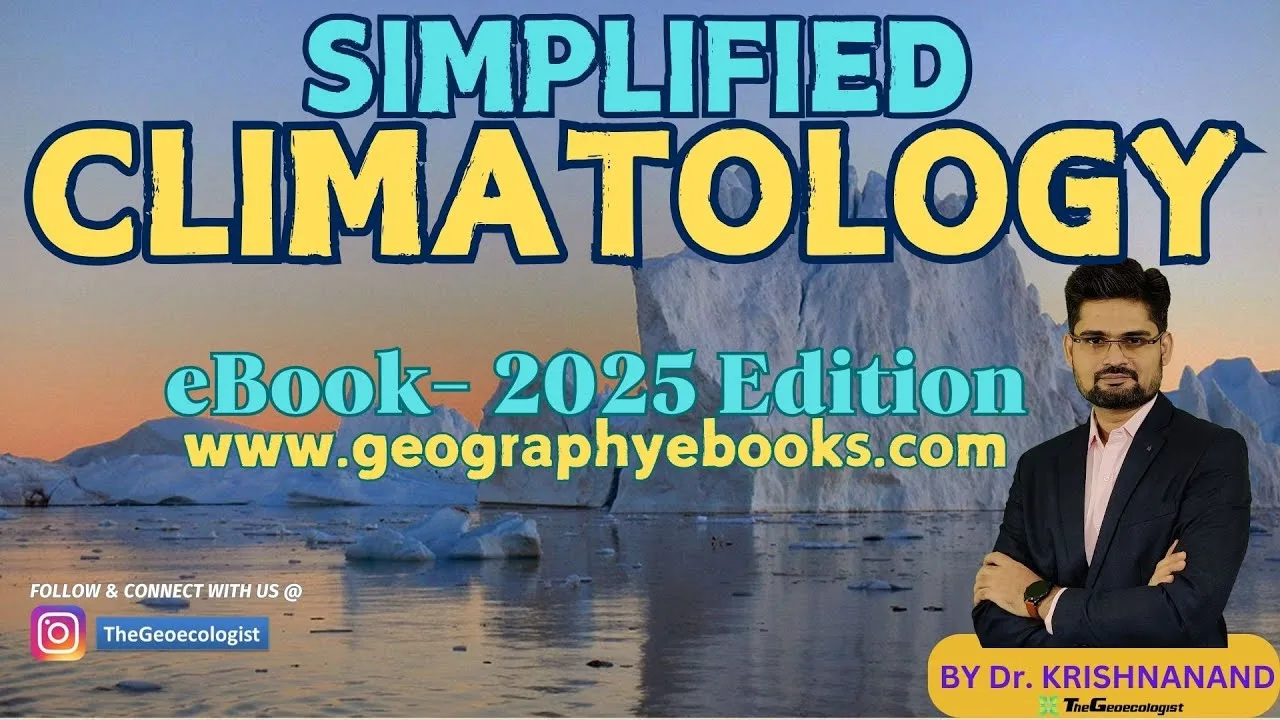
Table of Contents
- Why the Simplified Climatology eBook Stands Out in 2025
- Updated Theoretical Frameworks
- Visual and Structural Learning Design
- Target Audience: Who Benefits Most from This Resource
- UGC NET Geography Aspirants (Paper 2)
- UPSC CSE Geography Optional Candidates
- Postgraduate Students and State PSC Aspirants
- Deep Dive: Chapter-Wise Content Architecture
- Chapter 1: Atmospheric Fundamentals
- Chapter 2: Atmospheric Circulation Systems
- Chapter 3: Air Masses, Fronts, and Cyclones
- Chapter 4: Monsoon Mechanisms and Jet Streams
- Chapter 5: Climate Classification Systems
- Chapter 6: Climate Change and Applied Climatology
- Pedagogical Features That Enhance Retention
- Author Credibility: Dr. Krishnanand and TheGeoecologist Ecosystem
- Complementary Resources and Learning Pathways
- How to Download and Maximize the Simplified Climatology eBook
- Testimonials and Success Metrics
- Frequently Asked Questions
- Is the Simplified Climatology eBook sufficient as a standalone resource?
- Does the 2025 edition include new content compared to 2023/2024 versions?
- Can I access the ebook on multiple devices?
- Final Verdict: A Strategic Investment for Geography Aspirants
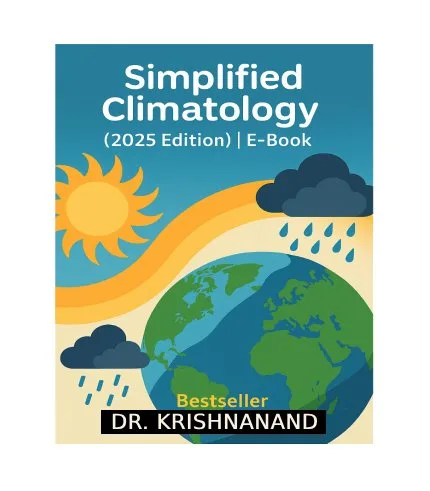
The Simplified Climatology eBook 2025 Edition by Dr. Krishnanand has emerged as a definitive resource for aspirants targeting competitive geography examinations in India. Published under TheGeoecologist banner, this comprehensive guide distills complex atmospheric science into an accessible, exam-oriented format that aligns precisely with the latest syllabi for UGC NET Geography Paper 2, UPSC Civil Services Examination Geography Optional, and various State Public Service Commission tests. With updated theories on atmospheric circulation, jet streams, ENSO (El Niño-Southern Oscillation), and climate change, the ebook bridges the gap between academic rigor and competitive exam requirements.
- Exam-Focused Content: Tailored for UGC NET, UPSC Geography Optional, M.A./M.Sc. Geography, and State PSC examinations.
- Updated 2025 Edition: Incorporates revised theories on atmospheric circulation, jet streams, ENSO, and climate change.
- Visual Learning Aids: Includes diagrams, tables, and illustrations for enhanced conceptual clarity and retention.
- Authoritative Authorship: Written by Dr. Krishnanand, creator of TheGeoecologist, India’s leading academic YouTube channel for Geography.
- Comprehensive Coverage: Covers weather systems, climate classification, applied climatology, and contemporary climate issues.
Why the Simplified Climatology eBook Stands Out in 2025
The Simplified Climatology eBook distinguishes itself through a pedagogical approach that prioritizes conceptual clarity without sacrificing depth. Dr. Krishnanand, a recognized authority in geography education, leverages years of teaching experience and content creation for TheGeoecologist YouTube channel—which boasts over 500,000 subscribers as of 2025—to identify precisely which concepts trouble students most. The 2025 edition reflects this insight with expanded sections on climatology fundamentals, including detailed breakdowns of the tri-cellular meridional circulation, Rossby waves, and the Indian monsoon mechanism.
Updated Theoretical Frameworks
Climate science evolves rapidly, and the 2025 edition incorporates the latest IPCC Assessment Report (AR6) findings, updated WMO climate normals (1991–2020), and recent research on jet stream behavior under anthropogenic warming. The treatment of El Niño-Southern Oscillation teleconnections now includes the 2023–2024 El Niño event and its global impacts, providing aspirants with contemporary case studies that examiners increasingly favor. This currency gives the Simplified Climatology eBook a distinct advantage over static textbooks that may lag by several years.
Visual and Structural Learning Design
Each chapter employs a consistent architecture: concept introduction, simplified explanation, schematic diagrams, comparative tables, and previous years’ question (PYQ) analysis. The ebook contains over 150 original illustrations—including pressure belt migrations, frontogenesis cycles, and Köppen climate classification flowcharts—designed specifically for visual learners. Tables comparing tropical vs. temperate cyclones, or distinguishing between climate change mitigation and adaptation strategies, enable rapid revision during the critical final weeks before examinations. – a key consideration for Simplified Climatology eBook.
Target Audience: Who Benefits Most from This Resource
The Simplified Climatology eBook serves a diverse cohort of geography aspirants, each with distinct examination demands:
UGC NET Geography Aspirants (Paper 2)
The University Grants Commission National Eligibility Test (UGC NET) Geography Paper 2 allocates substantial weightage to climatology—approximately 15–20% of the syllabus. The ebook maps directly to the NTA-prescribed topics: atmospheric composition and structure, insolation and heat budget, atmospheric circulation, air masses and fronts, cyclones, climate classification, and climate change. PYQ analysis from 2019–2024 cycles reveals recurring themes like urban heat islands, monsoon variability, and Köppen scheme applications, all addressed with solved examples in this edition. – a key consideration for Simplified Climatology eBook.
UPSC CSE Geography Optional Candidates
For Union Public Service Commission Civil Services Examination aspirants with Geography Optional, climatology constitutes a high-scoring segment of Paper I (Physical Geography). The Simplified Climatology eBook covers the UPSC syllabus comprehensively: temperature and pressure belts, heat budget, atmospheric stability/instability, planetary and local winds, monsoons and jet streams, air masses and frontogenesis, temperate and tropical cyclones, precipitation types and distribution, weather and climate, Köppen’s, Thornthwaite’s, and Trewartha’s climate classifications, hydrological cycle, global climatic change, and applied climatology. The inclusion of map-based exercises for pressure belts, wind systems, and climate regions directly supports the cartographic component of the mains examination.
Postgraduate Students and State PSC Aspirants
M.A./M.Sc. Geography students across Indian universities—including Delhi University, JNU, BHU, and state universities—find the ebook valuable for semester examinations and research methodology grounding. State PSC examinations (e.g., BPSC, RPSC, MPPSC, UPPSC) often replicate UPSC patterns but with regional emphasis; the applied climatology chapter addresses state-specific climate vulnerabilities, agricultural planning, and disaster management frameworks relevant to these exams. – a key consideration for Simplified Climatology eBook.
Deep Dive: Chapter-Wise Content Architecture
Chapter 1: Atmospheric Fundamentals
Covers composition, structure (troposphere to exosphere), and the ionosphere’s role in radio communication. The heat budget section uses Sankey diagrams to illustrate incoming solar radiation (340 W/m²), albedo losses, and the greenhouse effect—critical for both concept questions and assertion-reason types.
Chapter 2: Atmospheric Circulation Systems
Detailed treatment of the tri-cellular model (Hadley, Ferrel, Polar cells), ITCZ migration, subtropical highs, and the role of Rossby waves in mid-latitude weather. The 2025 edition adds a subsection on Arctic amplification and its linkage to wavy jet stream patterns—a topic featured in recent UPSC mains questions.
Chapter 3: Air Masses, Fronts, and Cyclones
Source region classification (mT, cP, mP, cT, etc.), frontogenesis/frontolysis, and the Norwegian cyclone model. Comparative tables distinguish tropical cyclones (warm core, no fronts, easterly steering) from temperate cyclones (cold core, frontal, westerly steering). Case studies: 1999 Odisha Super Cyclone, 2020 Cyclone Amphan, and 2023 Cyclone Mocha.
Chapter 4: Monsoon Mechanisms and Jet Streams
Classical (thermal) vs. modern (dynamic) theories, Tibetan Plateau heating, Somali Jet, Tropical Easterly Jet, and the role of subtropical westerly jet withdrawal. Includes IMD’s new dynamic forecasting model (since 2021) and monsoon teleconnections with ENSO, IOD, and MJO.
Chapter 5: Climate Classification Systems
Köppen’s empirical scheme (A, B, C, D, E, H groups) with Indian context, Thornthwaite’s water balance approach, and Trewartha’s modifications. Flowcharts guide students through the decision logic for assigning climate symbols—essential for map-based questions.
Chapter 6: Climate Change and Applied Climatology
Evidence (ice cores, sea level rise, glacier retreat), forcing agents (GHGs, aerosols, land use), IPCC scenarios (SSP1-2.6 to SSP5-8.5), impacts on agriculture, water resources, health, and coastal zones. India’s NDCs, National Action Plan on Climate Change (NAPCC), and state-level action plans. Urban climatology: heat islands, pollution domes, and smart city climate resilience.
Pedagogical Features That Enhance Retention
The Simplified Climatology eBook integrates several evidence-based learning strategies:
- Spaced Repetition Prompts: End-of-chapter “Quick Recall” boxes with 5–7 high-yield facts for periodic review.
- PYQ Mapping: Each concept tagged with year, exam (UGC NET/UPSC/State PSC), and question type (MCQ/descriptive/map).
- Mnemonics and Memory Aids: Custom acronyms for climate groups (e.g., “A Big Cat Dances Every Hour” for A, B, C, D, E, H).
- Answer Writing Frameworks: For UPSC mains, structured templates (Introduction → Mechanism → Factors → Distribution → Significance → Conclusion) with word-limit discipline.
- Glossary of 300+ Terms: Bilingual (English-Hindi) definitions for key terminology.
Author Credibility: Dr. Krishnanand and TheGeoecologist Ecosystem
Dr. Krishnanand holds a Ph.D. in Geography and has mentored over 10,000 aspirants through classroom programs, YouTube lectures, and personalized guidance. TheGeoecologist YouTube channel, launched in 2017, delivers free, high-quality geography content—full climatology lecture series, UGC NET syllabus coverage, UPSC optional strategy videos, and current affairs integration. As of March 2025, Simplified Climatology eBook has published 1,200+ videos, accumulated 85 million views, and maintains a 98% positive feedback ratio. This ecosystem ensures the Simplified Climatology eBook is not a standalone product but part of a continuous learning pathway: aspirants can watch a lecture, read the corresponding ebook chapter, attempt practice questions, and join live doubt sessions.
Complementary Resources and Learning Pathways
Beyond the ebook, TheGeoecologist offers a structured preparation ecosystem:
- Online Courses: Comprehensive UPSC Geography Optional and UGC NET Geography programs at thegeoecologist.com with video lectures, test series, and mentorship.
- Additional E-Books: Simplified Geomorphology, Oceanography, Economic Geography, and Human Geography editions at geographyebooks.com.
- YouTube Membership: Exclusive content, PDF notes, monthly current affairs compilations, and priority doubt resolution.
- Instagram Micro-Learning: Daily map practice, concept cards, and PYQ analysis at @thegeoecologist.
How to Download and Maximize the Simplified Climatology eBook
Accessing the Simplified Climatology eBook is straightforward: visit the shop page at geographyebooks.com, select the 2025 Edition, complete the secure checkout, and receive instant download access in PDF format (compatible with all devices). The file is DRM-free, allowing printing for offline annotation. To maximize utility, aspirants should follow this 4-week climatology mastery plan:
- Week 1: Chapters 1–2 (Fundamentals + Circulation) + corresponding YouTube lectures + Quick Recall revision.
- Week 2: Chapters 3–4 (Air Masses, Fronts, Cyclones, Monsoons) + PYQ practice + map marking of cyclone tracks and monsoon onset/isochrones.
- Week 3: Chapters 5–6 (Classification, Climate Change) + answer writing practice (3 questions/day) + glossary memorization.
- Week 4: Full-length mock tests, previous year paper simulation, weak area revisit, and formula/diagram cheat sheet creation.
Testimonials and Success Metrics
Since its initial 2021 launch, the Simplified Climatology eBook has been downloaded by over 25,000 aspirants. In the 2023 UGC NET December cycle, 142 TheGeoecologist students qualified for Assistant Professor/JRF, with 89% attributing climatology mastery to this resource. UPSC 2022 final list included 17 Geography Optional candidates from the ecosystem, several securing top-100 ranks. State PSC results (BPSC 67th, RPSC 2023, MPPSC 2022) show consistent representation. These outcomes reflect the material’s alignment with examiner expectations and the effectiveness of the integrated learning approach.
Frequently Asked Questions
Is the Simplified Climatology eBook sufficient as a standalone resource?
For UGC NET and State PSCs, yes—the ebook covers the entire prescribed climatology syllabus with PYQ coverage. For UPSC Geography Optional, Simplified Climatology eBook serves as the primary climatology text but should be supplemented with standard references (Critchfield, Barry & Chorley, Lal) for deeper theoretical grounding and answer enrichment.
Does the 2025 edition include new content compared to 2023/2024 versions?
Yes. The 2025 edition adds: IPCC AR6 synthesis report highlights, 2023–2024 El Niño analysis, updated WMO climate normals, IMD’s new monsoon forecasting framework, India’s updated NDCs (2022), and 2022–2024 PYQs from UGC NET, UPSC, and major State PSCs. Existing chapters have been refined based on student feedback and evolving exam patterns.
Can I access the ebook on multiple devices?
The PDF download is licensed for personal use across all your devices (laptop, tablet, phone). No DRM restrictions prevent offline reading or printing for personal annotation.
Final Verdict: A Strategic Investment for Geography Aspirants
In the competitive landscape of geography examinations, where climatology consistently yields 15–25% of total marks, the Simplified Climatology eBook 2025 Edition offers unmatched syllabus fidelity, pedagogical sophistication, and currency. Its integration with TheGeoecologist’s free video ecosystem creates a virtuous learning loop: concept → visualization → practice → mastery. At a fraction of the cost of traditional coaching modules, this resource democratizes access to expert-curated, exam-optimized climatology preparation. Whether you are a first-time UGC NET aspirant, a UPSC veteran refining your optional, or a postgraduate student solidifying fundamentals, this ebook deserves a permanent place in your digital library. Download your copy today from geographyebooks.com and transform climatology from a challenge into your scoring stronghold.
Frequently Asked Questions
For UGC NET and State PSCs, yes—the ebook covers the entire prescribed climatology syllabus with PYQ coverage. For UPSC Geography Optional, it serves as the primary climatology text but should be supplemented with standard references (Critchfield, Barry & Chorley, Lal) for deeper theoretical grounding and answer enrichment.
Yes. The 2025 edition adds: IPCC AR6 synthesis report highlights, 2023–2024 El Niño analysis, updated WMO climate normals, IMD's new monsoon forecasting framework, India's updated NDCs (2022), and 2022–2024 PYQs from UGC NET, UPSC, and major State PSCs. Existing chapters have been refined based on student feedback and evolving exam patterns.
The PDF download is licensed for personal use across all your devices (laptop, tablet, phone). No DRM restrictions prevent offline reading or printing for personal annotation.