Blog
Indian Geography UPSC: Complete Guide by Dr Krishnanand for 2025

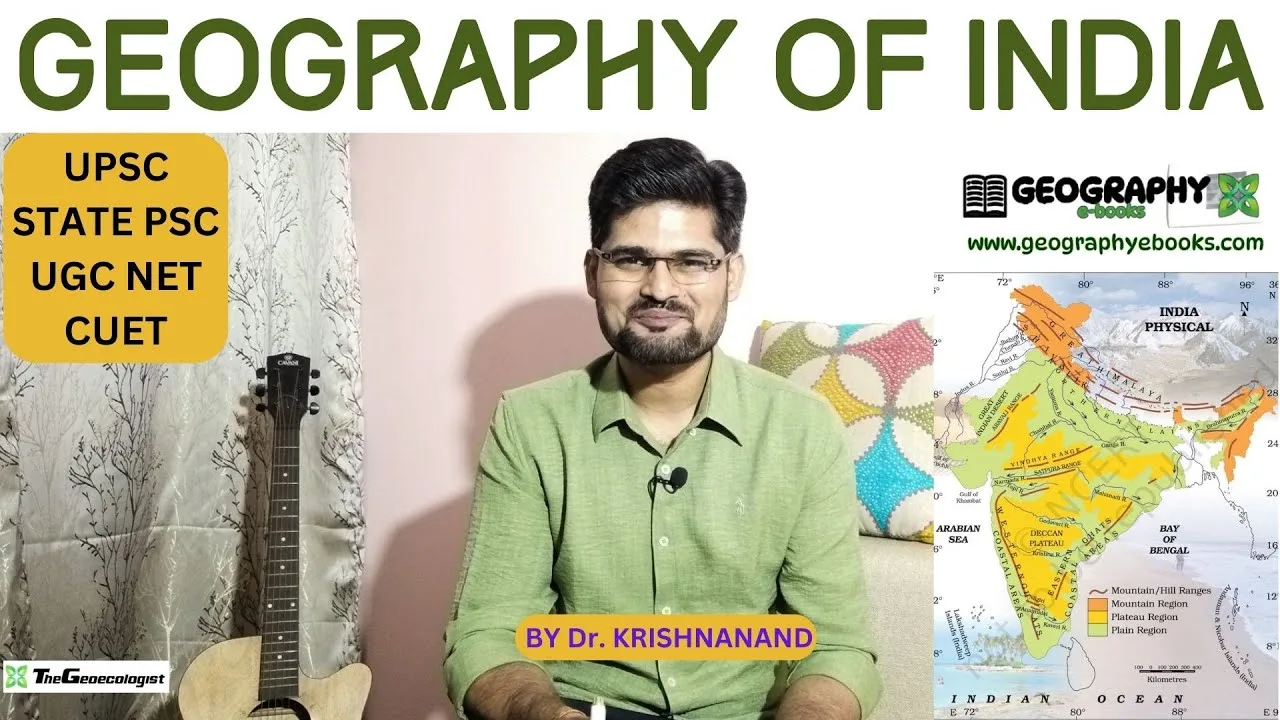
Table of Contents
- Meet the Mentor: Dr. Krishnanand — The Geoecologist
- Decoding the Lecture Series: Five Core Pillars
- 1. Physical Geography: Landforms That Define a Nation
- 2. Climate & Weather: Mastering Monsoons and Beyond
- 3. Natural Resources: Wealth Beneath the Surface
- 4. Cultural Geography: People, Patterns, and Policies
- 5. Environmental Issues: Navigating Crises
- Why Indian Geography UPSC is a Game-Changer for UPSC 2025
- Syllabus-to-Question Mapping
- Data-Driven Answer Enrichment
- Current Affairs as Static Core
- How to Maximize Learning from Indian Geography UPSC
- Official Resources to Supplement Preparation
- Conclusion
Mastering Indian Geography UPSC preparation requires a strategic blend of conceptual clarity, current affairs integration, and data-driven answer writing. Dr. Krishnanand, widely known as thegeoecologist, has curated a definitive lecture series that decodes India’s geographical tapestry for UPSC 2025 aspirants. This comprehensive guide explores how his structured pedagogy — spanning physical geography, climate systems, natural resources, cultural patterns, and environmental crises — aligns perfectly with the UPSC syllabus for both Prelims and Mains. With decades of academic expertise, Dr. Krishnanand transforms complex topics like monsoon mechanics, mineral distribution, and glacial lake outburst floods into engaging, exam-ready modules enriched with GIS maps, statistical reports, and real-time case studies.
- Syllabus Alignment: Covers GS Paper I Geography entirely and overlaps with Environment & Ecology for Prelims/Mains.
- Data-Driven Approach: Integrates India State of Forest Report, Census 2011/2024 data, and GIS mapping for answer enrichment.
- Current Affairs Integration: Links GLOFs, National Clean Air Programme, and river interlinking to real-time events.
- Visual Learning: Uses maps, infographics, and animations for better retention of physiographic divisions.
- Mentorship Access: Advanced courses on thegeoecologist.com offer personalized guidance and test series.
Meet the Mentor: Dr. Krishnanand — The Geoecologist
Dr. Krishnanand brings over two decades of teaching and research experience to Indian Geography UPSC aspirants. His YouTube channel, thegeoecologist, has become a go-to resource for competitive exam preparation, amassing thousands of subscribers who rely on his analytical rigor and visual pedagogy. Unlike conventional coaching that emphasizes rote memorization, Dr. Krishnanand focuses on connecting dots — linking the Himalayan orogeny to monsoon dynamics, or the Deccan Traps to mineral wealth and groundwater potential. His lectures are structured around the UPSC syllabus keywords, ensuring every topic maps directly to previous year questions (PYQs) and expected trends for 2025.
Decoding the Lecture Series: Five Core Pillars
1. Physical Geography: Landforms That Define a Nation
The foundation of Indian Geography UPSC lies in understanding India’s physiographic divisions. Dr. Krishnanand’s series dissects each region with tectonic, climatic, and socio-economic lenses:
- The Himalayan Mountain System: Not just a barrier but a climate regulator. Indian Geography UPSC explains how the Himalayas force monsoon winds to precipitate, sustain perennial rivers (Indus, Ganga, Brahmaputra), and host biodiversity hotspots. Aspirants learn to differentiate between the Himadri, Himachal, and Siwalik ranges — a frequent Prelims trap.
- The Indo-Gangetic-Brahmaputra Plains: Covering 7 lakh sq km, these alluvial plains support 40% of India’s population. The lectures detail soil types (Bhangar vs. Khadar), river shifting (Kosi — “Sorrow of Bihar”), and groundwater depletion in Punjab-Haryana — critical for Mains answers on water security.
- The Peninsular Plateau: The Deccan Plateau’s volcanic origin (Deccan Traps, 66 MYA) explains its rich mineral endowment — coal in Damodar Valley, iron ore in Odisha-Jharkhand, and manganese in Madhya Pradesh. The Western and Eastern Ghats’ role in orographic rainfall and biodiversity is mapped using ISRO’s Bhuvan portal data.
- Coastal Plains & Islands: India’s 7,516.6 km coastline (mainland 6,100 km + islands) is analyzed for port-led development (Sagarmala), mangrove ecology (Sundarbans — UNESCO World Heritage Site), and cyclone vulnerability (Odisha, Andhra Pradesh). The Andaman & Nicobar and Lakshadweep groups are covered for strategic importance.
2. Climate & Weather: Mastering Monsoons and Beyond
No Indian Geography UPSC preparation is complete without mastering the Indian Monsoon. Dr. Krishnanand dedicates multiple lectures to:
- Monsoon Mechanics: Differential heating, ITCZ shift, Mascarene High, Somali Jet, Tibetan Anticyclone, and ENSO (El Niño/La Niña) teleconnections. The 2023-24 El Niño impact on kharif sowing is discussed with IMD data.
- Climatic Zones (Köppen): From Am (Tropical Monsoon) in Western Ghats to BWh (Hot Desert) in Thar, each zone’s agricultural implications are linked to cropping patterns (rice in West Bengal, millets in Rajasthan).
- Extreme Weather Events: Cyclone classification (IMD scale), increasing frequency in Arabian Sea (Cyclone Biparjoy 2023), heatwave action plans (Ahmedabad model), and drought typology (meteorological, hydrological, agricultural).
- Climate Change Impacts: Glacial retreat in Hindu Kush Himalaya (HKH) — ICIMOD reports 65% faster melting since 2010 — and its implications for GLOFs (Sikkim 2023 disaster) and water security for 1.9 billion downstream users.
3. Natural Resources: Wealth Beneath the Surface
Resource geography forms a high-yield segment in Indian Geography UPSC. Indian Geography UPSC covers:
- Mineral Belts: Four major belts — North-Eastern Plateau (Chotanagpur: iron, coal, manganese), Central Belt (Chhattisgarh: bauxite, limestone), Southern Belt (Karnataka-Tamil Nadu: gold, iron), and North-Western (Rajasthan: copper, zinc, lead, petroleum). Rare earth elements (REEs) in coastal placer deposits (Kerala, Odisha) are highlighted for critical mineral security.
- Energy Resources: Coal (55% of energy mix), distribution in Gondwana (Jharia, Raniganj) vs. Tertiary (Assam, Gujarat) fields. Renewable potential: 140 GW solar (Thar, Rann of Kutch), 60 GW wind (Tamil Nadu, Gujarat), and green hydrogen mission targets.
- Water Resources: Surface water (690 BCM utilizable), groundwater (433 BCM), and the crisis of overexploitation (1,186 over-exploited blocks per CGWB 2022). River interlinking (Ken-Betwa phase I launched 2023) is analyzed for benefits vs. ecological costs.
- Forests & Biodiversity: Forest cover 21.71% (ISFR 2021), with Very Dense Forest at 3.04%. Hotspots: Western Ghats (endemic species: Nilgiri tahr, lion-tailed macaque), Eastern Himalaya, Indo-Burma, and Sundaland. Conservation frameworks: Wildlife Protection Act 1972, Forest Rights Act 2006, and CAMPA funds utilization.
4. Cultural Geography: People, Patterns, and Policies
Human geography is increasingly weighted in Indian Geography UPSC Mains. Key modules include:
- Population Dynamics: India @ 1.44 billion (UN 2024), TFR 2.0 (NFHS-5), demographic dividend window (2020-2040). Migration patterns: rural-urban (45% urban by 2030), inter-state (UP, Bihar → Maharashtra, Delhi), and international remittances ($111 billion, 2022).
- Urbanization Challenges: Smart Cities Mission (100 cities, ₹2.05 lakh crore), AMRUT 2.0, and persistent issues — slums (17% urban households), waste management (1.5 lakh MT/day), and air pollution (Delhi AQI >400 annually).
- Cultural Landscapes: Linguistic reorganization (States Reorganisation Act 1956), tribal concentration (Scheduled Areas, Fifth/Sixth Schedules), and religious diversity mapped against historical trade routes and diffusion patterns.
- Agricultural Geography: Cropping intensity (150%), Green Revolution legacy (Punjab-Haryana groundwater crisis), and shift to millets (International Year of Millets 2023), natural farming (BPKP), and PM-KISAN/DBT reforms.
5. Environmental Issues: Navigating Crises
Environment-geography overlap is a UPSC favorite. Dr. Krishnanand’s series provides policy-ready analysis:
- Air Pollution: NCAP targets 40% PM reduction by 2026 (base 2017). Graded Response Action Plan (GRAP) for Delhi-NCR, stubble burning (PUSA decomposer), and electric mobility (FAME II).
- Land Degradation: 29.3% of land degraded (ISRO 2021). Desertification in Rajasthan, Gujarat; soil erosion in Himalayas and Western Ghats. LDN (Land Degradation Neutrality) targets under UNCCD.
- Waste & Plastic: Plastic Waste Management Rules 2022 (EPR), Swachh Bharat Mission 2.0 (garbage-free cities), and circular economy initiatives.
- Climate Policy: NAPCC (8 missions), updated NDC (2022): 45% emission intensity reduction by 2030, 50% non-fossil capacity, net zero by 2070. State Action Plans (SAPCCs) and climate budgeting (Odisha, Maharashtra pioneers).
Why Indian Geography UPSC is a Game-Changer for UPSC 2025
The Indian Geography UPSC landscape demands more than textbook reading. Dr. Krishnanand’s series delivers three distinct advantages:
Syllabus-to-Question Mapping
Every lecture is reverse-engineered from UPSC PYQs (2013-2024). For instance, the 2023 Mains question on “Himalayan glacial melt and water security” is directly addressed in the GLOF module with ICIMOD data. The 2022 Prelims question on “Western Ghats vs. Eastern Ghats biodiversity” is covered through comparative endemism tables.
Data-Driven Answer Enrichment
Mains answers require authoritative citations. Indian Geography UPSC trains aspirants to embed: Census 2011/2024 projections, ISFR 2021 forest data, CGWB groundwater reports, IMD monsoon reports, NITI Aayog composite indices (SDG India Index, Water Management Index), and Economic Survey boxes. This transforms generic answers into examiner-impressing submissions.
Current Affairs as Static Core
Static geography is animated with 2023-24 developments: Sikkim GLOF (Oct 2023) → disaster management; Ken-Betwa link (Dec 2023) → federal water disputes; Lithium discovery in J&K (Feb 2023) → critical minerals; Cyclone Michaung (Dec 2023) → urban flooding in Chennai. Each event is a case study for both Prelims facts and Mains analysis.
How to Maximize Learning from Indian Geography UPSC
- Follow the Sequence: Physical → Climate → Resources → Human → Environment. This mirrors the UPSC syllabus flow and builds conceptual scaffolding.
- Make Map-Based Notes: Every lecture includes map annotations. Replicate them on outline maps — UPSC asks 3-5 map-based questions annually in Prelims.
- Integrate with Test Series: Enroll in thegeoecologist.com advanced courses for sectional tests, full-length mocks, and personalized feedback on answer writing.
- Revise via Quizzes: Follow Instagram for daily MCQs, map quizzes, and current affairs snippets tailored for UPSC.
- Cross-Link with GS III: Geography overlaps with Agriculture (cropping patterns), Environment (biodiversity), Disaster Management (cyclones, GLOFs), and Internal Security (border geography). Maintain a cross-reference register.
Official Resources to Supplement Preparation
While Dr. Krishnanand’s series is comprehensive, aspirants should periodically consult primary sources for authenticity. The official UPSC website publishes the latest syllabus, notification, and previous year papers. For authoritative geographic data, the Geography of India Wikipedia page offers a well-referenced overview of physiography, climate, and resources that can be cross-checked with government reports. Additionally, the National Portal of India provides access to ministry-wise publications (MoEFCC, MoJS, MoA&FW) that frequently form the basis of UPSC questions.
Conclusion
For UPSC 2025 aspirants, Indian Geography UPSC mastery is not a destination but a continuous process of connecting physical landscapes with human interventions and policy responses. Dr. Krishnanand’s lecture series on thegeoecologist provides the most structured, current, and exam-oriented pathway to achieve this. By blending academic rigor with visual storytelling, data integration, and mentorship access, Indian Geography UPSC transforms a vast syllabus into a manageable, high-yield preparation journey. Subscribe to Indian Geography UPSC, enroll in advanced courses, and join the community — equip yourself to decode India’s past, present, and future through the lens of geography. Your rank awaits.
Frequently Asked Questions
Yes, the series comprehensively covers the entire GS Paper I Geography syllabus and overlaps with Environment & Ecology. However, aspirants should supplement with NCERTs (Class 11-12), India Year Book, Economic Survey, and current affairs from PIB/The Hindu for holistic coverage.
Each module links static concepts to 2023-24 events — e.g., Sikkim GLOF for glacial hazards, Ken-Betwa river linking for water disputes, lithium discovery in J&K for mineral geography, and Cyclone Michaung for urban flooding. This ensures answers are both conceptually sound and contemporarily relevant.
Advanced courses, personalized mentorship, sectional tests, and full-length mocks are available on thegeoecologist.com. The YouTube channel (thegeoecologist) offers free weekly lectures, while Instagram (@thegeoecologist) provides daily quizzes and map-based practice.