Blog
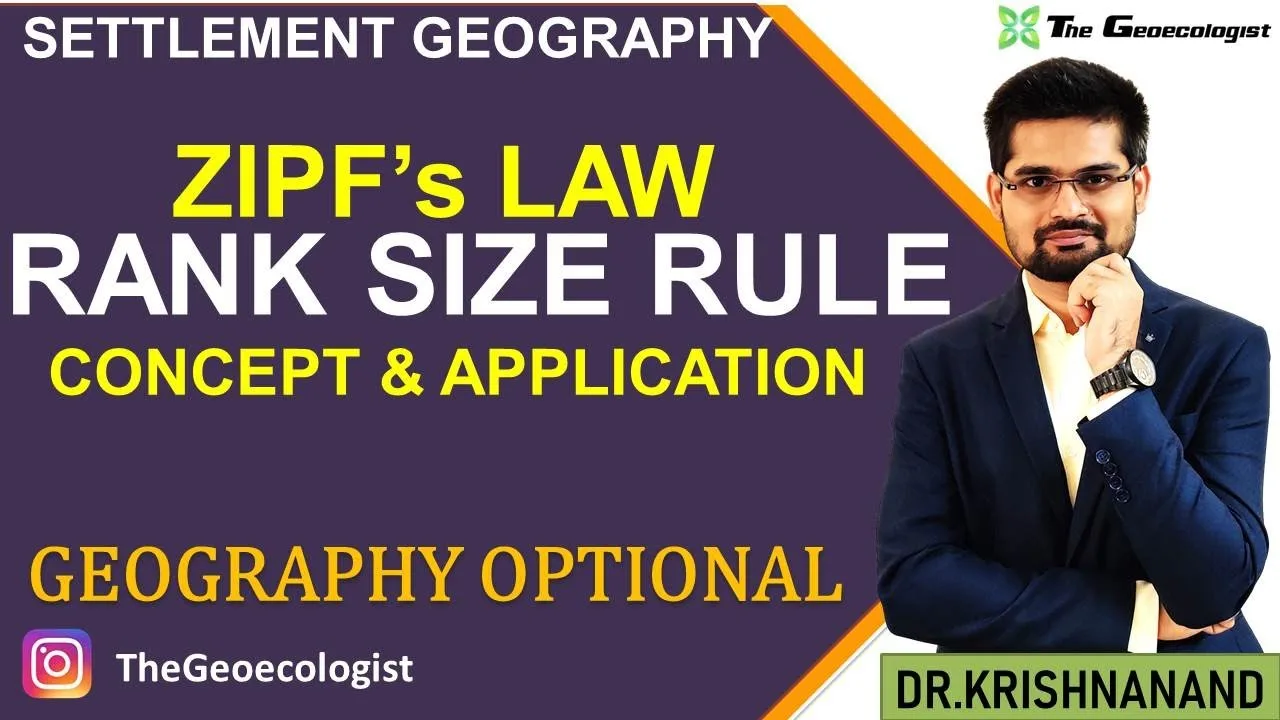
Rank Size Rule -Zipf’s Law-Settlement Geography-Geoecologist

Rank Size Rule -Zipf’s Law-Settlement Geography-Geoecologist
Understanding the Rank Size Rule and Zipf’s Law in Settlement Geography
Introduction
Settlement geography is a crucial branch of human geography that examines the distribution, structure, and hierarchy of human settlements. Among its key theoretical concepts are the Rank Size Rule and Zipf’s Law, which explain the hierarchical arrangement of settlements based on population size. These principles are particularly important for UPSC Geography Optional aspirants and geography students in general.
In this article, we will explore these concepts in detail, supported by insights from Dr. Krishnanand, founder of TheGeoecologist, whose video lectures simplify complex geographical theories for competitive examinations.
What is the Rank Size Rule?
The Rank Size Rule is a statistical observation in urban geography that describes a predictable relationship between the size of settlements and their rank in a country’s urban hierarchy. It was first proposed by George Kingsley Zipf in 1949 but was later refined by other geographers.
Mathematical Representation
The rule states that if the largest city (rank 1) has a population P, then the population of the n-th ranked city will be P/n.
Example:
- If the largest city has a population of 10 million (rank 1), then:
- Rank 2 city = 10/2 = 5 million
- Rank 3 city = 10/3 ≈ 3.33 million
- And so on…
This pattern suggests a well-balanced urban system where there is a proportional distribution of population among cities, avoiding excessive primacy (dominance of one megacity).
Significance
- Indicates a mature urban hierarchy
- Helps in regional planning and resource allocation
- Useful for analyzing urbanization patterns
However, in reality, many countries deviate from this ideal distribution due to historical, economic, and political factors.
Zipf’s Law: A Statistical Approach
Zipf’s Law is a broader statistical principle that applies to urban settlements, linguistics, and other fields. It is a more generalized form of the Rank Size Rule, describing the inverse relationship between rank and frequency (or size).
Mathematical Representation
The law states that the frequency (or population) of a city is inversely proportional to its rank:
Population (P) = ( frac{P_1}{rank^a} )
Here, P₁ is the population of the largest city, and a is a constant (typically close to 1 for an ideal distribution).
Application in Settlement Geography
- Predicts city size distributions
- Helps economists and planners assess urban growth patterns
- Used to study the “primate city” phenomenon (when one city is disproportionately larger than others, e.g., Paris in France, Bangkok in Thailand)
Comparison: Rank Size Rule vs. Zipf’s Law
| Feature | Rank Size Rule | Zipf’s Law |
|---|---|---|
| Scope | Specific to urban settlements | Applies to linguistics, economics, and more |
| Exponent (a) | Fixed at 1 (Pₙ = P₁ / n) | Variable exponent (Pₙ = P₁ / nᵃ) |
| Flexibility | Rigid formula | More adaptable to empirical data |
| Use Case | Urban hierarchy analysis | Broader statistical applications |
Relevance for UPSC and Geography Students
The Rank Size Rule and Zipf’s Law hold immense significance for:
✅ UPSC Geography Optional (Paper 1 – Settlement Geography)
✅ Urban and Regional Planning Studies
✅ Economic Geography and Development Studies
Dr. Krishnanand’s YouTube video breaks down these concepts in a simplified manner, making them easier to understand for aspirants.
For further study, you can download his Settlement Geography E-book.
Conclusion
Understanding the Rank Size Rule and Zipf’s Law helps geographers analyze urban hierarchies and predict population distributions. While these models provide a theoretical framework, real-world deviations (such as the presence of primate cities) necessitate deeper economic and historical analysis.
For more detailed insights, follow TheGeoecologist on Instagram and subscribe to their YouTube Channel for expert geography lectures.
#ranksizerule #zipflaw #settlementgeography #upscgeography #thegeoecologist
By incorporating these theories into your preparation, you can confidently tackle questions in both objective and descriptive papers of competitive examinations. Keep studying and stay tuned for more simplified geographical concepts! 🌎📚
To Download E-Books & Study Material Visit The Shop Page