Blog
Marxian Population Theory: Complete Guide for UPSC Geography Optional

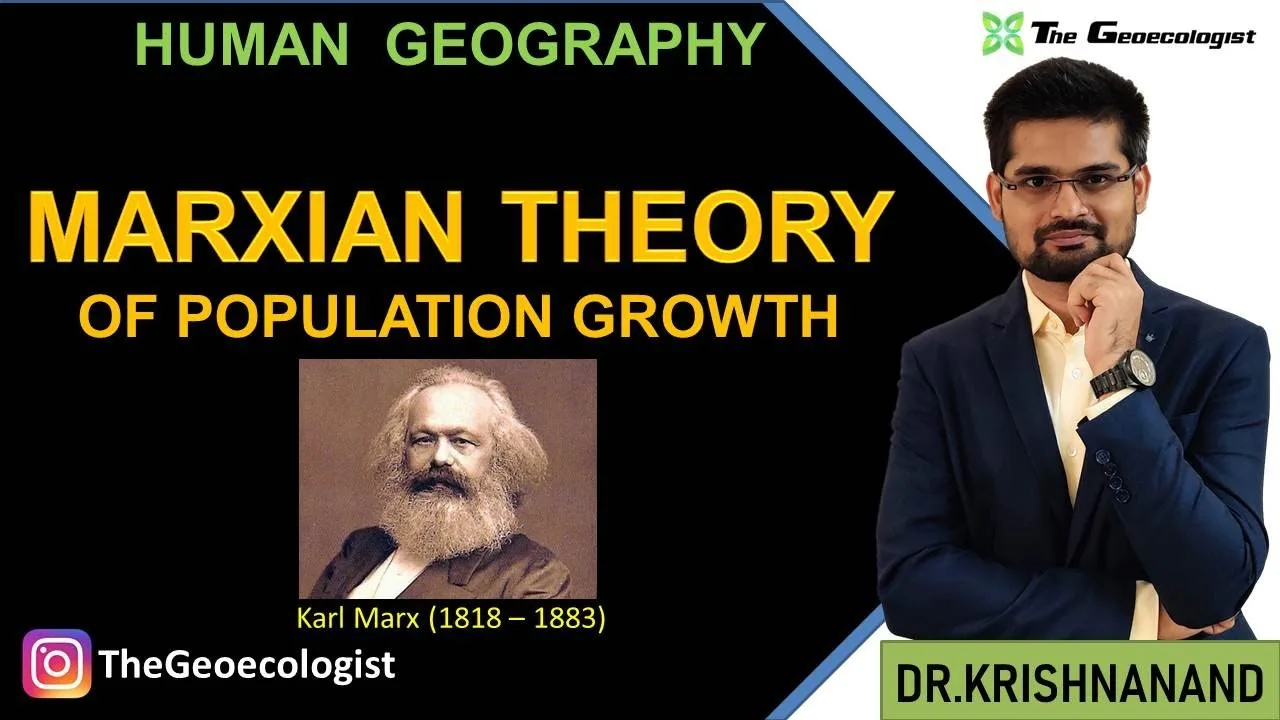
https://www.youtube.com/watch?v=examplelink
Table of Contents
- Historical Context: The Malthusian Challenge and the Marxian Response
- Core Pillars of the Marxian Population Theory
- 1. The Reserve Army of Labour: Capital's Demographic Engine
- 2. Historical Materialism and Population Dynamics
- 3. Social Relations vs. Natural Laws: The Ontological Break
- Marxian Population Theory vs. Malthusian Theory: Comparative Framework
- Neo-Marxist Extensions and Contemporary Applications
- Dependency Theory and World-Systems Analysis
- Feminist Marxist Demography
- Ecological Marxism and the Metabolic Rift
- Criticisms and Limitations of the Marxian Population Theory
- Policy Implications for India and the Global South
- Marxian Population Theory in UPSC Geography Optional: Preparation Strategy
- Conclusion
- Further Reading & Authoritative Sources
The Marxian population theory offers a radical departure from classical demographic thought by situating population dynamics within the contradictory logic of capitalism rather than biological determinism. Developed by Karl Marx and Friedrich Engels as a direct response to Thomas Malthus’s Essay on the Principle of Population (1798), this framework argues that poverty, unemployment, and apparent “overpopulation” are not natural inevitabilities but systemic outcomes of capitalist production relations. For UPSC Geography Optional aspirants, mastering the Marxian population theory is essential for answering questions on population geography, human development, and sustainable development goals (SDGs) with analytical depth.
- Core Thesis: Population problems are socially constructed under capitalism, not natural laws.
- Key Concept: The “reserve army of labour” explains unemployment as a functional requirement of capital accumulation.
- Methodology: Historical materialism links demographic trends to modes of production (feudalism, capitalism, socialism).
- Policy Implication: Structural economic transformation, not population control, resolves demographic crises.
- Contemporary Relevance: Explains global inequality, precarious labour, and ecological crisis under neoliberal capitalism.
Historical Context: The Malthusian Challenge and the Marxian Response
When Thomas Malthus published his Essay on the Principle of Population in 1798, he posited that population grows geometrically (1, 2, 4, 8…) while food supply increases arithmetically (1, 2, 3, 4…), inevitably leading to “positive checks” (famine, disease, war) and “preventive checks” (moral restraint, delayed marriage). This Malthusianism became the ideological bedrock of classical political economy, justifying the Poor Law Amendment Act of 1834 in Britain and later, population control programmes in postcolonial states.
Karl Marx and Friedrich Engels, writing in the mid-19th century, recognised that Malthus’s theory served ruling-class interests by naturalising poverty. In Capital (1867) and The Condition of the Working Class in England (1845), they developed the Marxian population theory as a structural critique. Marx wrote to Engels in 1862: “Malthus’s theory… is a libel on the human race.” The Marxian population theory reframes demographic pressure as relative surplus population — a condition manufactured by capital’s need for a flexible, disposable workforce.
Core Pillars of the Marxian Population Theory
1. The Reserve Army of Labour: Capital’s Demographic Engine
The concept of the reserve army of labour (or industrial reserve army) is the analytical centrepiece of the Marxian population theory. Marx identified three forms:
- Floating: Workers cyclically unemployed due to business cycles.
- Latent: Rural populations displaced by agricultural mechanisation, migrating to cities.
- Stagnant: Irregularly employed, casual labourers living in chronic precarity.
- Pauperised: Those unable to work (aged, disabled, orphans) sustained by minimal relief.
This reserve army disciplines the active army of employed workers, suppressing wage demands and enabling capital to expand or contract production without labour shortages. The Marxian population theory demonstrates that unemployment is not a market failure but a functional necessity for capital accumulation. As of 2023, the International Labour Organization (ILO) estimated 453 million people globally were either unemployed or underemployed — a contemporary manifestation of this structural surplus.
2. Historical Materialism and Population Dynamics
Unlike Malthus’s ahistorical “natural law,” the Marxian population theory insists that each mode of production generates its own specific law of population. Under feudalism, population pressure manifested as land scarcity and peasant subsistence crises. Under capitalism, it appears as wage-labour surplus. Marx argued that in a socialist society, where production is planned for use-value rather than exchange-value, the contradiction between population and resources would be resolved through democratic allocation and technological application freed from profit imperatives.
This historical specificity is crucial for UPSC aspirants. Questions on “demographic transition theory” often require contrasting the Eurocentric, stage-based model (Notestein, 1945) with the Marxian population theory‘s emphasis on class structure and imperialist exploitation as drivers of demographic patterns in the Global South.
3. Social Relations vs. Natural Laws: The Ontological Break
The Marxian population theory rejects biological determinism. Population growth rates, fertility behaviours, and migration patterns are shaped by:
- Wage levels and labour-market insertion
- Access to healthcare, education, and social security
- Gendered division of reproductive labour
- State population policies (natalist or anti-natalist)
- Global value chains and uneven development
For instance, India’s Total Fertility Rate (TFR) declined from 5.9 (1950) to 2.0 (2021) not due to “moral restraint” but because of female literacy gains, contraceptive access, and economic restructuring — variables the Marxian population theory reads as outcomes of class struggle and state policy, not autonomous demographic forces.
Marxian Population Theory vs. Malthusian Theory: Comparative Framework
| Dimension | Malthusian Theory | Marxian Population Theory |
|---|---|---|
| Root Cause of Poverty | Overpopulation (geometric growth) | Capitalist exploitation & unequal distribution |
| Nature of Population Growth | Natural, biological, universal | Socially constructed, historically specific |
| Food Supply Constraint | Absolute scarcity (arithmetic growth) | Artificial scarcity (profit-driven distribution) |
| Unemployment | Excess labour supply | Reserve army of labour (functional for capital) |
| Policy Prescription | Population control, moral restraint | Socialist restructuring, equitable distribution |
| Role of Technology | Limited impact on food arithmetic | Labour-displacing under capitalism; liberating under socialism |
| View on State Intervention | Minimal (laissez-faire) | Active redistribution & planning |
Neo-Marxist Extensions and Contemporary Applications
Dependency Theory and World-Systems Analysis
Scholars like Andre Gunder Frank, Immanuel Wallerstein, and Samir Amin extended the Marxian population theory to explain Third World demography. They argued that “overpopulation” in the periphery results from capitalist core-periphery relations: resource extraction, unequal exchange, and labour super-exploitation. India’s “demographic dividend” narrative, for example, is critiqued as masking the reality of informalisation — 90% of India’s workforce remains in informal employment (PLFS 2022-23), a vast reserve army sustaining global value chains.
Feminist Marxist Demography
Scholars such as Silvia Federici and Maria Mies integrate social reproduction theory with the Marxian population theory. They highlight how capitalism externalises reproductive labour (childcare, eldercare, domestic work) onto women, making fertility a site of class and gender struggle. The 2023 UNFPA State of World Population report notes that 44% of partnered women in 68 countries lack bodily autonomy — a statistic the Marxian population theory reads as evidence of patriarchal-capitalist control over reproduction.
Ecological Marxism and the Metabolic Rift
John Bellamy Foster’s “metabolic rift” concept extends the Marxian population theory to ecology. Capitalism’s drive for endless accumulation disrupts the soil-nutrient cycle (Marx’s original concern) and now the carbon cycle. The climate crisis is not caused by “too many people” but by a system that treats nature as a free gift. The IPCC Sixth Assessment Report (2023) confirms that the richest 10% of households contribute 34-45% of consumption-based GHG emissions, while the poorest 50% contribute 13-15% — validating the Marxian population theory‘s distributional lens.
Criticisms and Limitations of the Marxian Population Theory
No theory is without critique. Key limitations include:
- Underestimation of demographic autonomy: Cultural, religious, and ideational factors influence fertility independently of class structure (e.g., Iran’s fertility decline post-1989 despite Islamic governance).
- Determinism: Early formulations implied socialism automatically resolves population issues; Soviet and Chinese experiences (e.g., China’s One-Child Policy, 1979-2015) show state-socialist regimes also pursued coercive population control.
- Neglect of mortality transition: The Marxian population theory focuses on labour supply, under-theorising epidemiological transitions driven by public health advances.
- Measurement challenges: Quantifying the “reserve army” in contemporary gig economies (platform labour, zero-hour contracts) requires new methodological tools.
UPSC examiners often ask for “critical evaluation” — citing these limitations alongside strengths demonstrates balanced scholarship.
Policy Implications for India and the Global South
The Marxian population theory advocates structural reforms over technocratic fixes:
- Universal basic services: Health, education, housing, and transport as rights, not commodities.
- Labour formalisation: Extending social security to informal workers (India’s Code on Social Security, 2020 — implementation remains partial).
- Land redistribution: Addressing the latent reserve army rooted in agrarian distress (India’s average landholding: 1.08 ha, Agriculture Census 2015-16).
- Gender justice: Recognising and redistributing unpaid care work (India’s female LFPR: 37% in 2022-23, still among lowest globally).
- Ecological planning: Decoupling wellbeing from GDP growth through democratic resource governance.
These align with SDGs 1, 5, 8, 10, and 13 — a point worth emphasising in UPSC Mains answers linking population geography to sustainable development.
Marxian Population Theory in UPSC Geography Optional: Preparation Strategy
For Geography Optional Paper II (Human Geography), the Marxian population theory appears in:
- Population Geography: Theories of population (Malthus, Marx, Demographic Transition).
- Economic Geography: Labour markets, informal sector, global production networks.
- Settlement Geography: Urbanisation, slums, rural-urban migration as reserve army formation.
- Regional Planning: Backward regions as zones of surplus labour extraction.
Answer-writing tips:
- Always define “relative surplus population” vs. “absolute overpopulation.”
- Use the reserve army typology (floating, latent, stagnant, pauperised) with Indian examples.
- Contrast with Demographic Transition Theory using a table (as above).
- Cite recent data: PLFS, NFHS-5, Census 2011 (and projected 2024 figures), ILO, World Bank.
- Conclude with the Marxian population theory‘s relevance for “inclusive growth” and “just transition” discourses.
Conclusion
The Marxian population theory remains the most robust framework for understanding why, in a world producing enough food for 10 billion, 735 million people faced hunger in 2023 (FAO SOFI 2024). By exposing the social relations that produce demographic crises, it moves policy discourse from “controlling numbers” to “transforming structures.” For UPSC aspirants, internalising this perspective enables answers that are not only analytically superior but ethically grounded — recognising that behind every population statistic lies a history of class struggle, imperialist extraction, and the unfinished project of human emancipation. As Marx wrote in Critique of the Gotha Programme (1875): “From each according to his ability, to each according to his needs” — a demographic principle as relevant today as in the 19th century.
Further Reading & Authoritative Sources
- Marx, K. (1867). Capital, Vol. I, Chapter 25: “The General Law of Capitalist Accumulation.” Karl Marx — Wikipedia
- Engels, F. (1845). The Condition of the Working Class in England.
- Foster, J.B. (2000). Marx’s Ecology: Materialism and Nature.
- Bhattacharya, T. (Ed.). (2017). Social Reproduction Theory: Remapping Class, Recentering Oppression.
- Government of India. (2023). Periodic Labour Force Survey (PLFS) 2022-23.
- UNFPA. (2023). State of World Population: 8 Billion Lives, Infinite Possibilities.
- IPCC. (2023). Sixth Assessment Report, Working Group III: Mitigation of Climate Change.
Frequently Asked Questions
The Marxian population theory argues that population problems like poverty and unemployment are not caused by natural overpopulation but are structurally produced by capitalism through the creation of a 'reserve army of labour' that disciplines wages and serves capital accumulation.
Malthusian theory sees population growth as a natural, geometric process that outstrips arithmetic food supply, causing poverty. The Marxian population theory views population pressure as socially constructed under capitalism — a 'relative surplus population' created by exploitation and unequal distribution, not absolute scarcity.
Yes, the Marxian population theory is a core topic in Human Geography (Paper II). It appears in Population Geography, Economic Geography, Settlement Geography, and Regional Planning. UPSC expects aspirants to compare it with Malthusian and Demographic Transition theories, apply it to Indian data (PLFS, NFHS), and evaluate its policy implications for inclusive development.