Blog
Happiness Index -Gross National Happiness Index-Geoecologist

Happiness Index -Gross National Happiness Index-Geoecologist
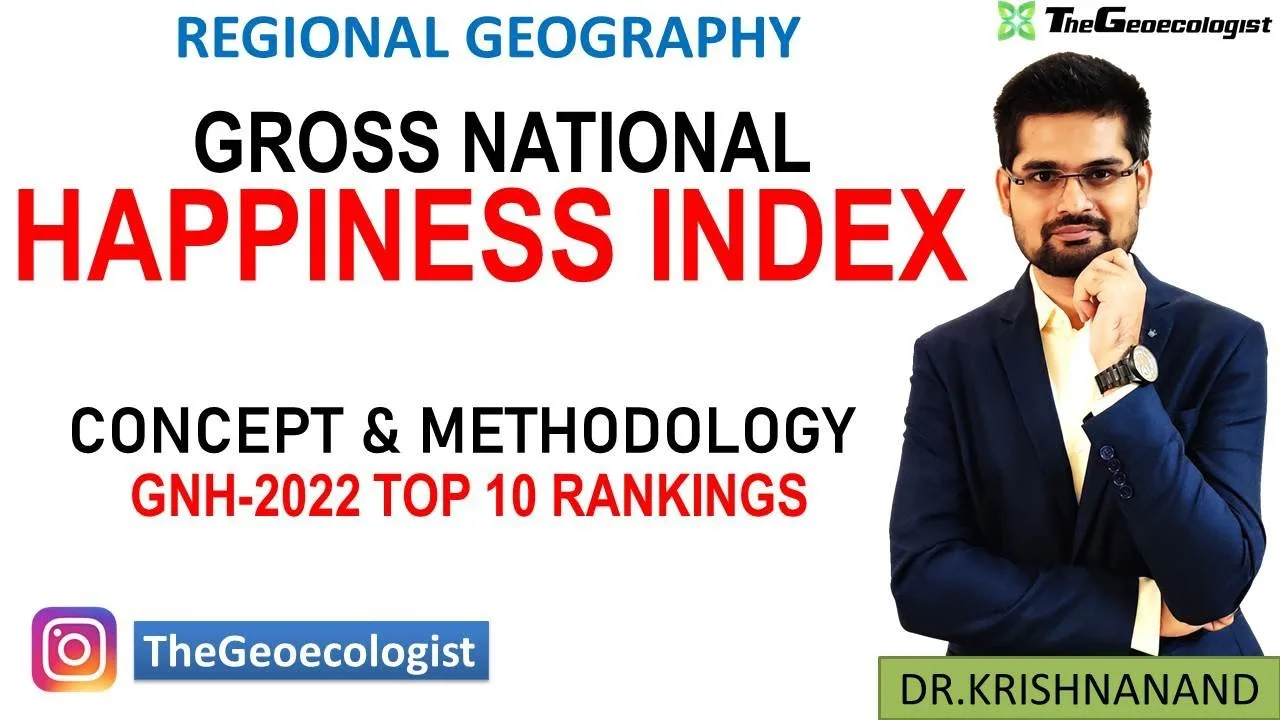
Understanding the Gross National Happiness Index: A Geoecologist’s Perspective for UPSC Geography Optional
In an era where economic indicators like GDP dominate discussions on national progress, the Gross National Happiness Index (GNH) offers a refreshing alternative by prioritizing holistic well-being. For UPSC Geography Optional aspirants and geography students, understanding the GNH Index is essential, as it integrates socio-cultural, environmental, and governance parameters into regional development strategies. This article explores the concept, relevance, and geographical implications of the GNH Index, inspired by Dr. Krishnanand’s comprehensive lecture on TheGeoecologist YouTube channel.
What is the Gross National Happiness Index?
The GNH Index, pioneered by Bhutan in the 1970s, measures national prosperity through non-material dimensions of development. Unlike GDP, which focuses solely on economic output, the GNH Index evaluates:
- Sustainable Socioeconomic Development
- Environmental Conservation
- Preservation of Cultural Values
- Good Governance
These pillars are further broken down into 33 indicators, including psychological well-being, health, education, and ecological resilience. For geography students, this framework highlights how regional disparities in resource distribution, cultural practices, and governance influence overall happiness.
Geoecologists and the GNH Index
Geoecologists play a pivotal role in analyzing the spatial and environmental aspects of the GNH Index. By studying human-environment interactions, they assess how factors like deforestation, urbanization, and climate resilience impact community well-being. For instance, Bhutan’s constitutional mandate to maintain 60% forest cover directly ties environmental health to national happiness—a concept geoecologists emphasize in sustainable regional planning.
Dr. Krishnanand, founder of TheGeoecologist, simplifies these connections in his video lecture, explaining how geographical tools like GIS and remote sensing aid in monitoring GNH indicators across regions. His insights are invaluable for UPSC aspirants aiming to link theoretical concepts with real-world applications.
Relevance to UPSC Geography Optional
The GNH Index aligns with the Regional Geography syllabus, particularly in topics like:
- Regional Development Planning: Contrasting GDP-centric models with happiness-based frameworks.
- Human-Environment Relationships: Exploring how cultural and ecological factors shape regional well-being.
- Policy Analysis: Evaluating Bhutan’s GNH-driven policies versus India’s Happiness Index initiatives.
UPSC candidates must analyze case studies, such as Bhutan’s emphasis on Buddhist values in governance or Kerala’s quality-of-life indicators, to demonstrate interdisciplinary understanding.
Why Should UPSC Aspirants Focus on the GNH Index?
- Holistic Perspective: Prepares students to critique traditional development models in essays and answer-writing.
- Current Relevance: With global shifts toward sustainable development (e.g., UN SDGs), GNH offers a conceptual foundation.
- Interdisciplinary Linkages: Connects geography with economics, sociology, and environmental science.
Dr. Krishnanand’s lecture breaks down these complexities, offering UPSC aspirants strategies to integrate GNH themes into their answers.
Conclusion
The Gross National Happiness Index redefines progress by valuing well-being over wealth—a paradigm increasingly relevant in geography and policy-making. For UPSC aspirants, mastering this topic strengthens analytical skills and provides a nuanced understanding of regional development.
Enhance your preparation by subscribing to TheGeoecologist YouTube channel and exploring detailed lectures on the GNH Index. Follow @thegeoecologist on Instagram for daily geography insights!
happinessindex #grossnationalhappiness #GNH
Join TheGeoecologist community for expert guidance and resources tailored for Geography Optional:
Website: https://thegeoecologist.com/
YouTube: THEGEOECOLOGIST
Authored with insights from Dr. Krishnanand’s lecture series on TheGeoecologist.
To Download E-Books & Study Material Visit The Shop Page