


Measuring Development-Indicators of Development-Geoecologist
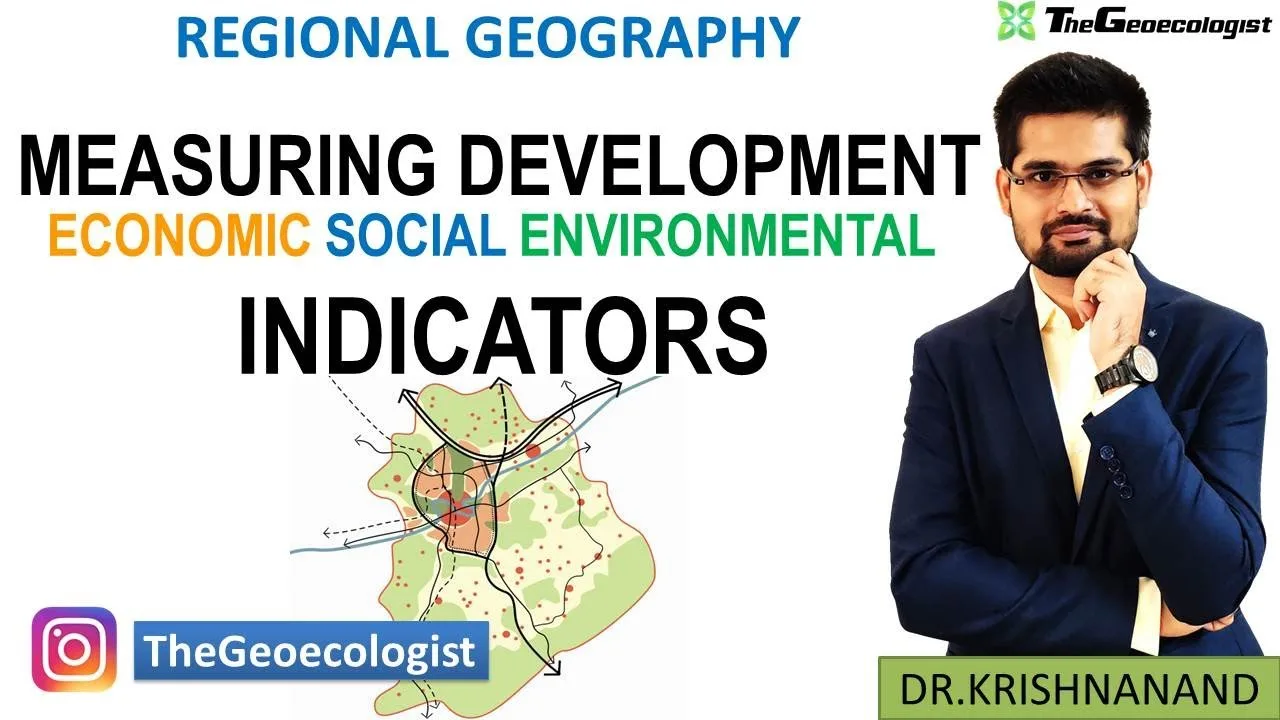
Measuring Development: A Comprehensive Analysis of Social, Economic, and Environmental Indicators
Development is a multidimensional concept that extends beyond mere economic growth to encompass improvements in quality of life, equity, and sustainability. For geography students, particularly those preparing for competitive exams like the UPSC (Geography Optional), understanding the indicators of development is crucial to analyze regional disparities and policy outcomes. This article explores the key social, economic, and environmental indicators of development, as elucidated by Dr. Krishnanand in his video lecture for TheGeoecologist, and their relevance in regional geography.
Why Measure Development?
Development measurement helps policymakers and geographers assess progress, identify inequalities, and design inclusive strategies. Traditional metrics like Gross Domestic Product (GDP) often fail to capture holistic well-being, prompting the need for composite indicators that reflect social equity, economic resilience, and environmental sustainability.
Key Indicators of Development
1. Social Indicators
Social indicators reflect the quality of life, access to basic services, and human well-being. Key parameters include:
- Education: Literacy rates, school enrollment ratios, and gender parity in education.
- Health: Life expectancy, infant mortality rate, and access to healthcare facilities.
- Gender Equality: Gender Development Index (GDI), women’s workforce participation, and political representation.
- Poverty: Human Poverty Index (HPI), multidimensional poverty indices, and access to sanitation.
Dr. Krishnanand emphasizes that social indicators highlight disparities hidden by purely economic metrics. For instance, high GDP may coexist with low literacy or gender inequality, underscoring the need for policies addressing social infrastructure.
2. Economic Indicators
Economic indicators measure wealth generation, employment, and infrastructure. Commonly used metrics are:
- GDP/GNI per capita: National income divided by population, though criticized for ignoring inequality.
- Employment Structure: Sectoral distribution (primary, secondary, tertiary) to gauge economic modernization.
- Income Inequality: Gini Coefficient and Palma Ratio to assess wealth distribution disparities.
- Industrial Growth: Investment in technology, innovation, and trade balance.
While GDP remains a benchmark, Dr. Krishnanand critiques its inability to account for informal economies or environmental costs. Composite indices like the Inequality-Adjusted HDI (IHDI) offer a more nuanced perspective.
3. Environmental Indicators
Sustainable development demands balancing growth with ecological preservation. Key environmental indicators include:
- Carbon Footprint: Per capita CO2 emissions and reliance on fossil fuels.
- Renewable Energy Usage: Share of clean energy in national grids.
- Natural Resource Management: Deforestation rates, water quality, and biodiversity loss.
- Climate Resilience: Adaptation strategies for vulnerable regions.
The Ecological Footprint and Environmental Performance Index (EPI) are vital tools to evaluate how nations balance development with planetary boundaries. Dr. Krishnanand stresses that environmental degradation often disproportionately affects marginalized communities, necessitating inclusive conservation policies.
Interconnectedness of Indicators
Development is not siloed; social progress relies on economic stability, which in turn depends on environmental health. For example:
- Climate change (environmental) exacerbates poverty (social) by reducing agricultural yields.
- Economic inequality limits access to education and healthcare, perpetuating social disparities.
- The Human Development Index (HDI), combining income, education, and life expectancy, exemplifies the integration of these dimensions.
Relevance for UPSC and Geography Students
For UPSC aspirants, mastering these indicators is essential to address questions on regional planning, sustainable development, and global inequalities. Dr. Krishnanand’s video simplifies complex concepts through case studies, such as Kerala’s high HDI despite modest GDP, or Bhutan’s Gross National Happiness index prioritizing ecology and culture over mere economic output.
Conclusion
Measuring development through social, economic, and environmental lenses enables a balanced assessment of progress. As Dr. Krishnanand concludes, geographers must advocate for policies that reconcile growth with equity and sustainability. For aspirants, integrating these indicators into answers demonstrates a comprehensive understanding of regional geography’s real-world applications.
Enhance Your Preparation with TheGeoecologist!
🔔 Subscribe to THEGEOECOLOGIST YouTube channel for detailed lectures on Geography Optional.
📱 Follow us on Instagram: @thegeoecologist
🌐 Visit our website: https://thegeoecologist.com/
#measuringdevelopment #indicatorsofdevelopment #upsc #geographyoptional #sustainability #regionalgeography
For further queries, contact Dr. Krishnanand at krishna.geography@gmail.com.
To Download E-Books & Study Material Visit The Shop Page