Blog
Geomorphic Processes Endogenic Exogenic: Complete NCERT Class 11 Guide

Table of Contents
- What Are Geomorphic Processes? Definition and Classification
- Energy Sources Driving Geomorphic Activity
- The Rock Cycle Connection
- Endogenic Processes: Building the Earth from Within
- 1. Diastrophism: Large-Scale Crustal Deformation
- 2. Volcanism: Magma Reaches the Surface
- 3. Plate Tectonics: The Unifying Theory
- Exogenic Processes: Sculpting the Earth from Outside
- 1. Weathering: In-Situ Rock Breakdown
- 2. Mass Wasting: Gravity-Driven Downslope Movement
- 3. Erosion and Deposition: The Work of External Agents
- Interaction of Endogenic and Exogenic Forces: The Dynamic Equilibrium
- Case Study: The Himalayas
- Concept of Grade and Base Level
- NCERT Class 11 Chapter 6: Exam Focus and High-Yield Topics
- CBSE Class 11 Geography (Theory + Practical)
- UPSC / State PSC / Competitive Exams
- Effective Study Resources and Strategies
- Primary Resource: NCERT Textbook
- Video Lectures: TheGeoecologist
- Authoritative Reference Websites
- Advanced Texts for UPSC Mains
- Conclusion
Understanding geomorphic processes endogenic exogenic is fundamental to mastering physical geography for CBSE Class 11 and competitive examinations like UPSC. The Earth’s dynamic surface is continuously shaped by two broad categories of forces: those originating from within the planet (endogenic) and those acting from the atmosphere and hydrosphere (exogenic). This comprehensive guide breaks down Chapter 6 of the NCERT Geography textbook ‘India Physical Environment,’ providing detailed explanations, real-world examples, and exam-oriented insights to help you build a rock-solid foundation.
- Geomorphic processes are natural mechanisms that create, modify, and destroy landforms through uplift, weathering, erosion, and deposition.
- Endogenic processes derive energy from Earth’s internal heat (radioactive decay, primordial heat) and drive plate tectonics, volcanism, and diastrophism.
- Exogenic processes are powered by solar energy and gravity, encompassing weathering, mass wasting, erosion, and deposition by agents like water, wind, and ice.
- The interplay between geomorphic processes endogenic exogenic determines the ultimate topography — endogenic forces build up, exogenic forces wear down.
- NCERT Class 11 Chapter 6 emphasizes process mechanisms, landform identification, and the rock cycle — all high-yield topics for UPSC Prelims and Mains.
What Are Geomorphic Processes? Definition and Classification
The term geomorphic processes endogenic exogenic refers to the complete suite of physical and chemical actions that sculpt the Earth’s crust. According to the NCERT framework, these processes are classified based on their energy source and location of action. The word ‘geomorphic’ itself originates from Greek roots: geo (Earth) and morphe (form), literally meaning ‘Earth-shaping.’
Energy Sources Driving Geomorphic Activity
Every geomorphic process requires energy. The classification hinges on where this energy originates:
- Endogenic energy: Radioactive decay of elements (uranium, thorium, potassium) in the mantle and crust, plus primordial heat from planetary accretion. This drives convection currents in the mantle, powering plate tectonics.
- Exogenic energy: Solar radiation (driving atmospheric circulation, hydrological cycle, temperature changes) and gravitational potential energy (driving mass movements, river flow, glacial advance).
The Rock Cycle Connection
Geomorphic processes are integral to the rock cycle. Endogenic forces bring igneous rocks to the surface through volcanism and uplift metamorphic rocks via orogeny. Exogenic processes then weather these rocks into sediments, transport them, and deposit them to form sedimentary rocks — which may later be subducted or metamorphosed, completing the cycle. The NCERT textbook illustrates this cycle with a diagram that is frequently asked in board exams. – a key consideration for geomorphic processes endogenic exogenic.
Endogenic Processes: Building the Earth from Within
Geomorphic processes endogenic exogenic classification places endogenic forces as the primary builders of major relief features. These processes operate from deep within the Earth and are responsible for creating continents, mountain ranges, ocean basins, and plateaus.
1. Diastrophism: Large-Scale Crustal Deformation
Diastrophism encompasses all processes that move, elevate, or deform large portions of the Earth’s crust. geomorphic processes endogenic exogenic is subdivided into:
- Epeirogeny (Continent-building): Broad, regional uplift or subsidence of continental masses. Example: The uplift of the Indian Peninsula and the subsidence forming the Indo-Gangetic plain.
- Orogeny (Mountain-building): Intense folding, faulting, and thrusting along plate boundaries. The Himalayas (formed ~50-55 Ma due to India-Eurasia collision), the Alps, the Andes, and the Rockies are classic orogenic belts.
- Faulting and Fracturing: Brittle failure of crustal rocks creating faults (normal, reverse, strike-slip). The East African Rift Valley is a divergent boundary example; the San Andreas Fault is a transform boundary.
2. Volcanism: Magma Reaches the Surface
Volcanism involves the extrusion of molten rock (magma) onto the surface as lava, along with pyroclastic material and gases. Key concepts for exams:
- Types of volcanoes: Shield (Mauna Loa), Composite/Strato (Mt. Fuji, Mt. Vesuvius), Caldera (Yellowstone), Flood Basalt (Deccan Traps).
- Volcanic landforms: Batholiths, laccoliths, dikes, sills (intrusive); lava plateaus, volcanic cones, craters, calderas (extrusive).
- Distribution: Pacific Ring of Fire (~75% of world’s volcanoes), Mid-Atlantic Ridge, East African Rift.
- Indian context: The Deccan Traps (66 Ma) cover ~500,000 km², one of the largest volcanic features on Earth. Barren Island (Andaman) is India’s only active volcano.
3. Plate Tectonics: The Unifying Theory
Modern understanding of endogenic processes rests on plate tectonics. The lithosphere is divided into 7 major and several minor plates moving at 2-15 cm/year. Three boundary types drive distinct geomorphic processes endogenic exogenic outcomes:
- Divergent boundaries: Seafloor spreading, mid-ocean ridges, rift valleys (Iceland, East African Rift).
- Convergent boundaries: Subduction zones (Japan Trench, Andes), continent-continent collision (Himalayas), island arcs (Japan, Philippines).
- Transform boundaries: Strike-slip faults (San Andreas, Anatolian Fault).
For authoritative data on plate movements and boundaries, refer to the USGS Plate Tectonics page.
Exogenic Processes: Sculpting the Earth from Outside
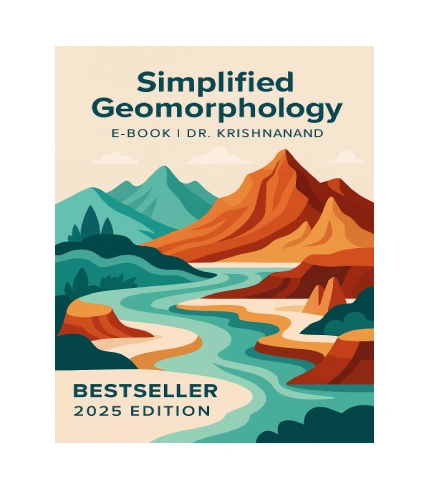
While endogenic forces build relief, geomorphic processes endogenic exogenic dynamics dictate that exogenic forces simultaneously dismantle geomorphic processes endogenic exogenic. These processes are driven by solar energy and gravity, operating at or near the surface.
1. Weathering: In-Situ Rock Breakdown
Weathering is the disintegration and decomposition of rocks in place without significant transport. geomorphic processes endogenic exogenic prepares material for erosion.
Physical (Mechanical) Weathering
- Freeze-thaw (frost wedging): Water expands ~9% on freezing, exerting ~30,000 psi pressure. Dominant in high latitudes/altitudes (Himalayas, Andes).
- Thermal expansion: Daily heating/cooling cycles cause granular disintegration (deserts like Thar, Sahara).
- Exfoliation (sheeting): Pressure release on plutonic rocks forms concentric shells (Half Dome, Yosemite).
- Salt crystallization: Coastal and arid zones; halite growth wedges grains apart.
Chemical Weathering
- Solution: Carbonic acid (H₂CO₃) dissolves limestone (karst landscapes).
- Hydrolysis: Feldspar → clay minerals (kaolinite); primary soil-forming process.
- Oxidation: Iron-bearing minerals → rust (red soils, laterite).
- Carbonation: CO₂ + H₂O → carbonic acid attacks carbonates.
Biological Weathering
- Plant roots exert pressure; lichens secrete acids; burrowing animals expose fresh surfaces.
Weathering rates depend on climate (temperature, moisture), rock type (mineralogy, structure), relief, and time. The NCERT emphasizes that chemical weathering dominates in humid tropics, physical in arid/cold regions.
2. Mass Wasting: Gravity-Driven Downslope Movement
Mass wasting (mass movement) is the transfer of rock and soil downslope under gravity. geomorphic processes endogenic exogenic bridges weathering and erosion. Classification by speed and material:
- Slow: Soil creep (mm/yr), solifluction (water-saturated soil over permafrost).
- Rapid: Earthflows, mudflows (common in Himalayas during monsoon), debris avalanches.
- Very rapid: Rock falls, rockslides, landslides (e.g., 2014 Malin landslide, Maharashtra; 2021 Chamoli disaster, Uttarakhand).
Triggering factors: heavy rainfall, earthquakes, volcanic eruptions, deforestation, construction on slopes. Mitigation includes afforestation, drainage, retaining walls, and hazard zonation mapping.
3. Erosion and Deposition: The Work of External Agents
Erosion involves acquisition and transportation of weathered material; deposition is the laying down of that material. Four primary agents:
Running Water (Fluvial Processes)
- River stages: Youth (V-valleys, waterfalls, rapids), Maturity (meanders, floodplains, alluvial fans), Old age (deltas, oxbow lakes, natural levees).
- Erosional landforms: Gorges, canyons (Grand Canyon), waterfalls (Jog Falls, Niagara), potholes.
- Depositional landforms: Alluvial fans (Kosi fan), floodplains (Indo-Gangetic plain), deltas (Sundarbans — world’s largest, Ganga-Brahmaputra), natural levees, point bars.
- Drainage patterns: Dendritic (homogeneous rock), Trellis (folded strata), Radial (volcanic cones), Centripetal (inland basins).
Groundwater (Karst Processes)
- Carbonic acid dissolves limestone along joints/bedding planes.
- Erosional: Sinkholes (dolines), swallow holes, caves, caverns (Ajanta/Ellora region), karst windows.
- Depositional: Stalactites (ceiling), stalagmites (floor), pillars, flowstones (calcium carbonate deposition).
Glaciers (Glacial Processes)
- Moving ice erodes by plucking and abrasion.
- Erosional: Cirques, arêtes, horns (Matterhorn), U-valleys, hanging valleys, fjords (Norway, New Zealand), roche moutonnée.
- Depositional: Moraines (lateral, medial, terminal, ground), drumlins, eskers, kames, outwash plains, erratics.
- Indian context: Himalayan glaciers (Gangotri, Yamunotri, Siachen) feed perennial rivers; glacial lake outburst floods (GLOFs) are rising hazards.
Wind (Aeolian Processes)
- Effective in arid/semi-arid regions (Thar Desert, Sahara, Atacama).
- Erosional: Mushroom rocks, yardangs, zeugens, deflation hollows (Qattara Depression).
- Depositional: Sand dunes (barchans, transverse, longitudinal, star), loess deposits (North China Plain, Central Europe — fertile agricultural soils).
Waves and Currents (Coastal Processes)
- Erosional: Sea cliffs, wave-cut platforms, sea arches, stacks, blowholes.
- Depositional: Beaches, spits, bars, tombolos, barrier islands, lagoons (Chilika Lake — India’s largest brackish water lagoon).
- Coastal management: Groynes, seawalls, beach nourishment; rising sea levels (~3.3 mm/yr globally per IPCC AR6) threaten low-lying coasts.
Interaction of Endogenic and Exogenic Forces: The Dynamic Equilibrium
The concept of geomorphic processes endogenic exogenic interaction is central to geomorphology. Endogenic forces create relief (positive relief: mountains, plateaus; negative relief: basins, rift valleys). Exogenic forces immediately begin reducing this relief through denudation (weathering + erosion + mass wasting + transportation).
Case Study: The Himalayas
- Endogenic: India-Eurasia convergence continues at ~40-50 mm/yr, uplifting the Himalayas ~5-10 mm/yr (GPS measurements). Seismicity is high (2015 Nepal M7.8, 2005 Kashmir M7.6).
- Exogenic: Intense monsoonal precipitation drives massive fluvial erosion (Ganga, Brahmaputra, Indus carry ~1-2 billion tonnes sediment/yr). Glacial erosion shapes high peaks. Mass wasting is rampant.
- Net effect: The Himalayas are in a state of dynamic equilibrium — uplift roughly balances denudation, maintaining high relief. Isostatic rebound compensates for erosion.
Concept of Grade and Base Level
- Base level: The lowest level to which a stream can erode (ultimate base level = sea level; local base levels = lakes, resistant rock layers).
- Graded stream: A stream in equilibrium where slope, discharge, and sediment load are balanced — no net erosion or deposition.
- Tectonic uplift (endogenic) lowers base level relatively, triggering rejuvenation (incised meanders, river terraces).
NCERT Class 11 Chapter 6: Exam Focus and High-Yield Topics
For CBSE board exams and UPSC preparation, prioritize these areas from the geomorphic processes endogenic exogenic chapter:
CBSE Class 11 Geography (Theory + Practical)
- Definitions: Geomorphic process, endogenic, exogenic, diastrophism, volcanism, weathering, mass wasting, erosion, deposition.
- Distinguish between: Folding vs. faulting; weathering vs. erosion; physical vs. chemical weathering; erosional vs. depositional landforms of each agent.
- Diagram-based questions: Rock cycle, types of plate boundaries, volcano structure, river course profiles, glacial landforms, karst topography, coastal landforms, sand dune types.
- Case studies: Himalayas (orogeny), Deccan Traps (flood basalt), Sundarbans (delta), Thar Desert (aeolian), Chilika (lagoon).
- Map work: Major plates, plate boundaries, Ring of Fire, Himalayan rivers, major glaciers, Indian deserts, coastal features.
UPSC / State PSC / Competitive Exams
- Current affairs linkage: Joshimath subsidence (2023) — tectonic + anthropogenic; Chamoli flash flood (2021) — glacial lake outburst/rock-ice avalanche; Himalayan seismicity and seismic gaps.
- Geomorphology in GS Paper I: Landform evolution (Davis, Penck, Hack), cycle of erosion, polycyclic relief, rejuvenated landscapes.
- Environment/Disaster Management: Landslide hazard zonation, floodplain management, coastal regulation zone (CRZ), glacial retreat (IPCC reports).
- Previous year questions: Often ask to explain a landform’s origin (e.g., ‘Explain the formation of the Deccan Traps’ or ‘Distinguish between stalactite and stalagmite’).
Effective Study Resources and Strategies
Mastering geomorphic processes endogenic exogenic requires a multi-modal approach. The NCERT textbook is the primary source, but supplementary resources enhance retention.
Primary Resource: NCERT Textbook
- Read Chapter 6 (‘Geomorphic Processes’) of ‘India Physical Environment’ (Class 11) line-by-line.
- Solve all in-text and end-of-chapter questions.
- Practice drawing all diagrams — they carry marks in boards and clarify concepts for UPSC Mains.
Video Lectures: TheGeoecologist
TheGeoecologist’s bilingual (Hindi-English) YouTube channel provides excellent visual explanations of complex topics like plate boundaries, weathering types, and landform evolution. The mixed-language delivery aids comprehension for students from diverse linguistic backgrounds. Visual animations of processes (e.g., subduction, meander formation, glacial erosion) bridge the gap between static textbook diagrams and dynamic reality. – a key consideration for geomorphic processes endogenic exogenic.
Authoritative Reference Websites
- Wikipedia: Geomorphology — comprehensive overview with academic references.
- USGS (usgs.gov) — real-time earthquake data, volcano monitoring, topographic maps.
- NCERT official (ncert.nic.in) — free PDF downloads, errata, supplementary material.
Advanced Texts for UPSC Mains
- Savindra Singh, ‘Geomorphology’ (standard reference).
- Majid Husain, ‘Physical Geography’.
- Goh Cheng Leong, ‘Certificate Physical and Human Geography’ (excellent for basics).
Conclusion
The study of geomorphic processes endogenic exogenic reveals the Earth as a dynamic, ever-changing system. Endogenic forces — driven by the planet’s internal heat engine — build the grand architecture of continents and mountains. Exogenic forces — powered by the Sun and gravity — tirelessly sculpt, wear down, and redistribute that architecture. Their ceaseless interaction creates the diverse landscapes we inhabit, from the towering Himalayas to the fertile Indo-Gangetic plains, from the volcanic Deccan Traps to the shifting dunes of the Thar Desert.
For students, mastering this chapter is not merely about passing exams; geomorphic processes endogenic exogenic is about developing a ‘geomorphic imagination’ — the ability to look at any landscape and read the story of its formation. Whether you are preparing for CBSE boards, UPSC, or simply nurturing a curiosity about the planet, a thorough grasp of these processes, supplemented by visual resources like TheGeoecologist’s videos and authoritative references, will serve you well. Remember: every landform is a balance sheet of construction and destruction, written in the language of geomorphic processes.
Pro tip: Create a comparative table of all landforms (erosional vs. depositional) for each agent (river, glacier, wind, wave, groundwater). This single revision tool covers ~40% of potential exam questions.
Frequently Asked Questions
Endogenic processes originate from Earth's internal heat (radioactive decay, primordial heat) and drive plate tectonics, volcanism, and mountain building. Exogenic processes are powered by solar energy and gravity, causing weathering, erosion, mass wasting, and deposition by agents like water, wind, and ice. Endogenic forces build relief; exogenic forces wear it down.
High-yield landforms include: Himalayan orogeny (fold mountains), Deccan Traps (flood basalts), fluvial landforms (waterfalls, meanders, deltas like Sundarbans), glacial landforms (cirques, U-valleys, moraines), karst topography (stalactites/stalagmites, sinkholes), coastal features (cliffs, spits, lagoons), and aeolian dunes (barchans, loess). Diagram-based questions frequently test these.
The Himalayas exemplify dynamic equilibrium: the Indian plate converges with Eurasia at ~40-50 mm/yr (endogenic uplift), while monsoon-driven rivers (Ganga, Brahmaputra) and glaciers erode ~1-2 billion tonnes of sediment annually (exogenic denudation). Isostatic rebound compensates for erosion, maintaining high relief. This interplay creates seismic hazards, landslides, and fertile alluvial plains simultaneously.