Blog
Europe Heat Waves: Why the Continent Faces Record-Breaking Temperatures

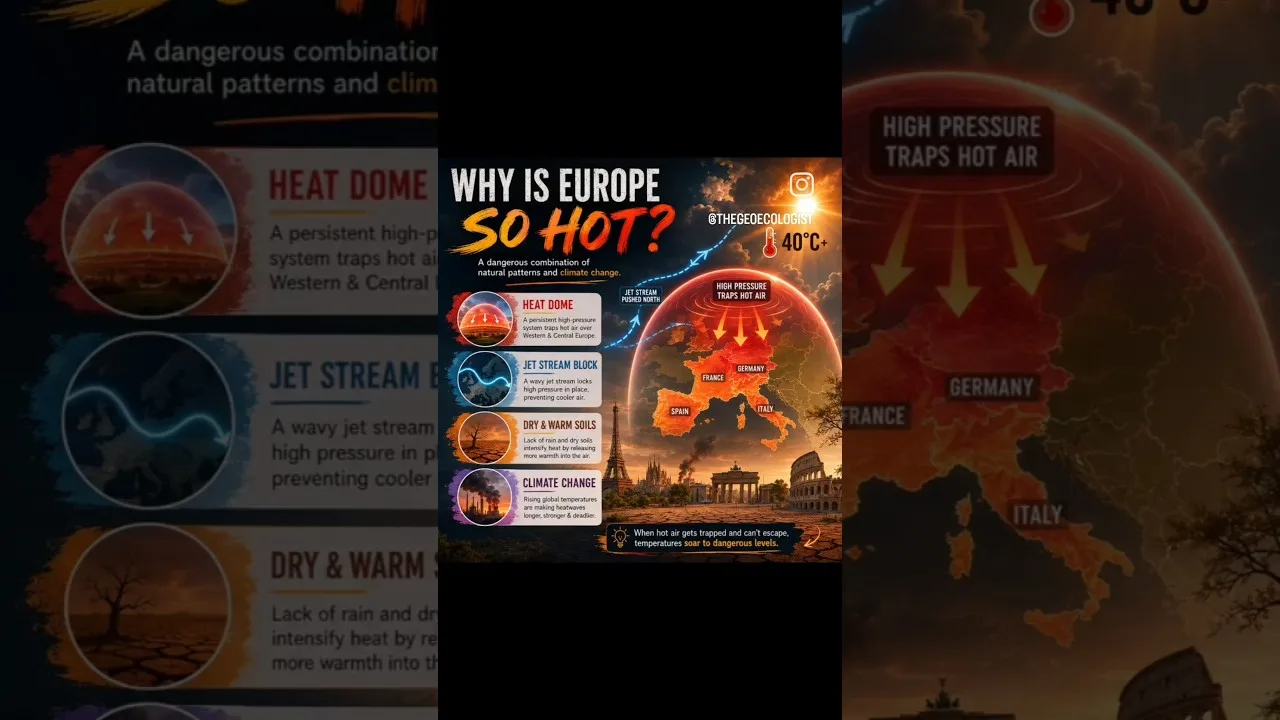
Table of Contents
- The Atmospheric Mechanics Behind Europe Heat Waves
- Heat Domes and Persistent High-Pressure Systems
- Jet Stream Patterns and Blocking Events
- Dry Soils and Land-Atmosphere Feedbacks
- Climate Change: The Force Multiplier
- Attribution Science Quantifies Human Influence
- Shifting Baselines: What Was Rare Is Now Routine
- Regional Vulnerabilities Across Europe
- Mediterranean Basin: The Epicenter
- Central and Northern Europe: Emerging Risk Zones
- Cascading Impacts: Beyond Temperature
- Wildfires and Ecosystem Damage
- Drought, Agriculture, and Water Security
- Human Health and Social Inequity
- Adaptation and Resilience: Building a Heat-Ready Europe
- Heat Health Action Plans and Early Warning Systems
- Urban Greening and Cool Infrastructure
- Agricultural Adaptation and Water Management
- Future Projections: The Trajectory of Europe Heat Waves
- CMIP6 Scenarios and Regional Downscaling
- Tipping Points and Compound Events
- Key Takeaways for Policymakers and Citizens
- Frequently Asked Questions
- What is a heat dome and how does Europe heat waves cause Europe heat waves?
- How much has climate change increased the likelihood of Europe heat waves?
- Which European regions are most at risk from future heat waves?
Europe heat waves are becoming an alarming new normal across the continent, with temperatures soaring past 40–45°C in Spain, France, Italy, and Central Europe during the summer of 2023 and again in 2024. These extreme events have triggered devastating wildfires, severe droughts, acute water shortages, and widespread disruption to daily life, agriculture, and energy infrastructure. Understanding the complex interplay of atmospheric dynamics, land-surface feedbacks, and human-induced climate change is essential for building resilience against a future where such extremes occur with increasing frequency and intensity.
- Persistent high-pressure systems (heat domes) trap hot air over Europe for weeks, preventing cloud formation and allowing solar radiation to bake the surface.
- Jet stream meandering — driven by Arctic amplification — creates blocking patterns that stall weather systems over the continent.
- Dry soils and land-atmosphere feedbacks reduce evaporative cooling, amplifying surface temperatures during prolonged dry spells.
- Human-induced climate change has made extreme heat events at least 10 times more likely in Western Europe, according to World Weather Attribution studies.
- Urban heat island effects intensify impacts in cities, where concrete and asphalt store heat and release Europe heat waves overnight.
The Atmospheric Mechanics Behind Europe Heat Waves
Heat Domes and Persistent High-Pressure Systems
A primary driver of Europe heat waves is the formation of persistent high-pressure systems, commonly called heat domes. These systems act like a lid on a pot: sinking air compresses and warms adiabatically, suppressing cloud formation and allowing uninterrupted solar radiation to heat the surface. In July 2023, a heat dome anchored over the Mediterranean basin pushed temperatures to 48.8°C in Sicily — a European record verified by the World Meteorological Organization (WMO). The longevity of these systems, often lasting 10–20 days, allows heat to accumulate progressively, with each day starting from a higher baseline.
Jet Stream Patterns and Blocking Events
The polar jet stream — a fast-flowing ribbon of air encircling the Northern Hemisphere — plays a pivotal role in steering weather systems. When the jet stream develops deep, slow-moving meanders (Rossby waves), Europe heat waves can create blocking patterns that stall high-pressure systems over Europe for extended periods. Research published in Nature Climate Change (2021) links increased jet stream waviness to Arctic amplification — the phenomenon where the Arctic warms two to four times faster than the global average. This reduces the equator-to-pole temperature gradient that drives the jet stream, making Europe heat waves more prone to meandering and blocking. A Wikipedia overview of jet stream dynamics provides further technical detail on these mechanisms.
Dry Soils and Land-Atmosphere Feedbacks
Soil moisture acts as a natural air conditioner: when soils are wet, solar energy drives evaporation rather than heating the air. During spring and early summer droughts — increasingly common in Southern and Central Europe — soils dry out early, eliminating this cooling buffer. A 2022 study in Geophysical Research Letters found that soil moisture deficits amplified the 2018 and 2019 Europe heat waves by 1.5–2.5°C in affected regions. This positive feedback loop — dry soils → less evaporation → higher temperatures → more evaporation demand → drier soils — is a critical amplifier of extreme heat.
Climate Change: The Force Multiplier
Attribution Science Quantifies Human Influence
World Weather Attribution (WWA), an international collaboration of climate scientists, has analyzed every major European heatwave since 2019. Their findings are unequivocal: human-caused climate change made the 2022 and 2023 Europe heat waves “virtually impossible” without greenhouse gas emissions. The 2022 summer heatwave, which caused over 61,000 heat-related deaths across Europe according to a Nature Medicine study, was estimated to be 2–4°C hotter due to anthropogenic warming. The Intergovernmental Panel on Climate Change (IPCC) Sixth Assessment Report (AR6) states with high confidence that “the frequency and intensity of hot extremes have increased since the 1950s, and human influence is the main driver.” For authoritative summaries, see the IPCC AR6 Working Group I report.
Shifting Baselines: What Was Rare Is Now Routine
Historical climate data from the European Centre for Medium-Range Weather Forecasts (ERA5 reanalysis) shows that summers like 2003 — once considered a 1-in-500-year event — now have a return period of roughly 1-in-30 years under current warming levels. At 2°C global warming (likely by mid-century under current policies), such summers could occur every 3–5 years. This shifting baseline means infrastructure, healthcare systems, and agricultural practices designed for 20th-century climate are increasingly maladapted. – a key consideration for Europe heat waves.
Regional Vulnerabilities Across Europe

Mediterranean Basin: The Epicenter
The Mediterranean region — including Spain, southern France, Italy, Greece, and the Balkans — bears the brunt of Europe heat waves. Its subtropical latitude, semi-arid climate, and proximity to the Sahara make Europe heat waves inherently prone to extreme heat. The region is also a climate change hotspot, warming 20% faster than the global average according to the Mediterranean Experts on Climate and Environmental Change (MedECC). Compounding risks include tourism-dependent economies strained by summer heat, water-intensive agriculture facing allocation conflicts, and dense urban populations in cities like Madrid, Rome, and Athens where heat island effects add 3–5°C to nighttime temperatures.
Central and Northern Europe: Emerging Risk Zones
Traditionally cooler regions are not immune. The 2019 and 2022 heatwaves shattered records in Germany, the Netherlands, Belgium, and the UK — where 40°C was recorded for the first time at Heathrow on July 19, 2022. These regions face unique vulnerabilities: lower prevalence of air conditioning (under 5% of UK homes have AC), building stock designed for heat retention, and populations physiologically unacclimatized to extreme heat. The 2003 heatwave caused an estimated 70,000 excess deaths across Europe, with France alone reporting nearly 15,000 fatalities — a tragedy that prompted the creation of national heat health action plans. – a key consideration for Europe heat waves.
Cascading Impacts: Beyond Temperature
Wildfires and Ecosystem Damage
Heat and drought create ideal conditions for wildfire ignition and spread. The 2022 fire season burned over 837,000 hectares in the EU — the second-worst year on record according to the European Forest Fire Information System (EFFIS). In 2023, fires in Greece (Rhodes, Corfu, Evros) forced the largest evacuations in the country’s history. Beyond immediate destruction, repeated high-severity fires convert carbon-sequestering forests into carbon sources, creating a dangerous climate feedback loop.
Drought, Agriculture, and Water Security
The 2022 drought was assessed by the Joint Research Centre (JRC) as the worst in 500 years, affecting 64% of EU territory. Crop yields for maize, soybeans, and sunflowers dropped 15–20% below the 5-year average. River levels on the Rhine, Po, and Danube fell so low that barge transport — critical for industrial supply chains — was severely restricted. Nuclear power plants in France reduced output due to insufficient cooling water, while hydropower generation across the Alps dropped sharply. These compounding stresses highlight the interconnected nature of Europe heat waves impacts across water, energy, and food systems.
Human Health and Social Inequity
Heat is the deadliest weather hazard in Europe. The elderly, those with chronic illnesses, outdoor workers, and low-income populations in poorly insulated housing face disproportionate risk. A 2023 Lancet Countdown report estimated that heat-related mortality in Europe has increased 30% over the past 20 years. Urban heat islands exacerbate this: a 2021 study found that in Paris, nighttime temperatures in dense districts remain 2.5°C higher than in surrounding parks, preventing physiological recovery during heatwaves.
Adaptation and Resilience: Building a Heat-Ready Europe
Heat Health Action Plans and Early Warning Systems
Following the 2003 catastrophe, most European countries implemented Heat Health Action Plans (HHAPs) coordinated by national meteorological services and health ministries. These systems use tiered alerts (e.g., MeteoFrance’s vigilance rouge, Spain’s AEMET alerts) to trigger public advisories, open cooling centers, check on vulnerable populations, and adjust work schedules. The WHO Europe Heat–Health Action Plan Guidance provides a framework adopted by over 20 countries. However, gaps remain: a 2022 European Environment Agency (EEA) review found that only 60% of European cities have dedicated heat plans, and coordination across health, social services, and urban planning sectors is often fragmented.
Urban Greening and Cool Infrastructure
Cities are deploying nature-based solutions to combat heat islands. Paris’s “Oasis Schoolyards” program transforms asphalt playgrounds into green, shaded, water-permeable spaces that cool neighborhoods. Milan’s “ForestaMi” aims to plant 3 million trees by 2030. Stuttgart’s “Green Corridors” channel cool air from surrounding hills into the city center. Reflective “cool roofs” and pavements, mandatory in some French and Spanish municipalities, can reduce peak surface temperatures by 10–15°C. These measures not only mitigate heat but provide co-benefits for biodiversity, air quality, and flood resilience.
Agricultural Adaptation and Water Management
Farmers are shifting to drought-tolerant crop varieties (e.g., sorghum replacing maize in southern France), adopting precision irrigation (drip systems, soil moisture sensors), and adjusting planting calendars. The EU’s Common Agricultural Policy (CAP) 2023–2027 allocates €54 billion for eco-schemes supporting climate resilience. At the basin scale, the Rhine and Danube commissions are developing low-water management plans to balance navigation, ecology, and abstraction during drought. However, demand management — reducing water use through efficiency, reuse, and pricing — remains politically challenging.
Future Projections: The Trajectory of Europe Heat Waves
CMIP6 Scenarios and Regional Downscaling
Coupled Model Intercomparison Project Phase 6 (CMIP6) projections, downscaled through EURO-CORDEX, paint a stark picture. Under SSP3-7.0 (high emissions), the number of days exceeding 35°C in Madrid could triple by 2050; in Berlin, such days could increase from 30°C) is projected to increase from 5–10 days currently to 20–40 days by 2100 in Central Europe. The Mediterranean may experience “super-heatwaves” exceeding 50°C — conditions approaching human physiological limits for outdoor activity.
Tipping Points and Compound Events
Scientists warn of compound events: simultaneous heat and drought, or heat followed by extreme rainfall on baked soils causing flash floods (as seen in Germany/Belgium 2021 and Emilia-Romagna 2023). There is also concern about Amazon and boreal forest dieback, permafrost thaw, and Atlantic Meridional Overturning Circulation (AMOC) weakening — all of which could alter European climate in non-linear ways. The World Meteorological Organization emphasizes that limiting warming to 1.5°C, per the Paris Agreement, would halve the population exposed to extreme heat compared to 2°C.
Key Takeaways for Policymakers and Citizens
- Europe heat waves are driven by a combination of heat domes, jet stream blocking, dry soil feedbacks, and the overarching force multiplier of climate change.
- Attribution science confirms human influence has made recent extremes orders of magnitude more likely and more intense.
- Impacts cascade across health, agriculture, energy, transport, and ecosystems — with the most vulnerable populations suffering disproportionately.
- Adaptation (heat plans, urban greening, water efficiency) is urgent but insufficient without rapid mitigation (emissions reduction).
- Every fraction of a degree matters: 1.5°C vs 2°C warming dramatically changes the frequency and severity of future heat extremes.
Frequently Asked Questions
What is a heat dome and how does Europe heat waves cause Europe heat waves?
A heat dome is a persistent high-pressure system that traps hot air over a region. Sinking air compresses and warms, suppressing clouds and allowing intense solar heating. When anchored over Europe for weeks, Europe heat waves creates prolonged, record-breaking heat.
How much has climate change increased the likelihood of Europe heat waves?
World Weather Attribution studies find that climate change made the 2022 and 2023 European heatwaves at least 10 times more likely and 2–4°C hotter than they would have been in a pre-industrial climate.
Which European regions are most at risk from future heat waves?
The Mediterranean basin (Spain, Italy, Greece, Balkans) faces the highest absolute temperatures and fastest warming. However, Central and Northern Europe face rapidly increasing risk due to low adaptive capacity (limited AC, heat-retentive buildings, unacclimatized populations).
Frequently Asked Questions
A heat dome is a persistent high-pressure system that traps hot air over a region. Sinking air compresses and warms, suppressing clouds and allowing intense solar heating. When anchored over Europe for weeks, it creates prolonged, record-breaking heat.
World Weather Attribution studies find that climate change made the 2022 and 2023 European heatwaves at least 10 times more likely and 2–4°C hotter than they would have been in a pre-industrial climate.
The Mediterranean basin (Spain, Italy, Greece, Balkans) faces the highest absolute temperatures and fastest warming. However, Central and Northern Europe face rapidly increasing risk due to low adaptive capacity (limited AC, heat-retentive buildings, unacclimatized populations).