Blog
Critical geopolitics international relations: Mastering UPSC Political Geography with Simplified Political Geography (2025 Edition)

Many UPSC CSE aspirants and undergraduate geography students find the topic of critical geopolitics international relations overwhelming because it blends theory, history, and contemporary events into a dense web of concepts.
- Clear grasp of core theories such as Heartland and Rimland
- Ability to link historical evolution to current global flashpoints
- Point‑wise highlights that speed up revision
- Diagrams and maps that reinforce spatial understanding
- Alignment with the latest CBCS syllabus for geography
Understanding the Core Challenges in Critical Geopolitics and International Relations
The phrase critical geopolitics international relations appears frequently in UPSC mains papers and undergraduate seminars, yet many learners struggle to connect abstract theories like Mackinder’s Heartland with real‑world case studies such as the South China Sea disputes or NATO’s eastern flank. The difficulty stems from three main factors: (1) the sheer volume of definitions and scholars to remember, (2) the lack of visual aids that show how territorial claims translate into power dynamics, and (3) the scarcity of study materials that break down each concept into bite‑sized, exam‑ready points. Without a structured guide, aspirants end up memorizing fragmented facts rather than building a coherent analytical framework, which hurts their ability to answer application‑based questions effectively.
How to Evaluate a Study Guide for Political Geography
When assessing any resource that promises to simplify critical geopolitics international relations, look for four concrete criteria. First, the guide must map directly onto the prescribed CBCS syllabus, ensuring that every unit—from the nature and scope of political geography to contemporary geopolitical flashpoints—is covered. Second, it should employ a point‑wise format with bolded keywords, enabling quick scanning during revision. Third, the inclusion of original diagrams, maps, and images is non‑negotiable; visual representation helps learners internalize spatial relationships that pure text cannot convey. Fourth, the author’s academic credibility matters; a work penned by a subject‑matter expert with teaching experience in UPSC coaching adds authority. Resources that miss any of these pillars often leave gaps that force students to supplement with multiple sources, increasing study time and cognitive load.
Why Simplified Political Geography (2025 Edition) Aligns with the CBCS Syllabus
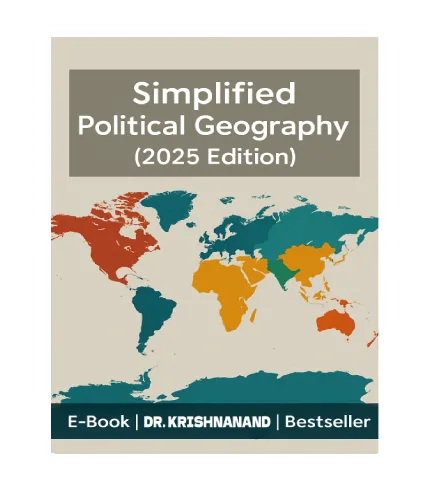
Simplified Political Geography (2025 Edition) by Dr. Krishnanand is explicitly designed to meet the CBCS requirements for undergraduate geography programmes. The table of contents mirrors the syllabus: Unit 1 explores the nature, approaches, and scope of political geography; Unit 2 traces its evolution; Units 3 and 4 dissect Heartland Theory and Rimland Theory with detailed case studies; subsequent units cover federalism, electoral geography, and contemporary issues like climate geopolitics. Each unit begins with a concise learning objective, followed by point‑wise explanations highlighted in bold, and ends with a summary box that reinforces key takeaways. This tight syllabus alignment means that when you study critical geopolitics international relations from this e‑book, you are simultaneously preparing for university exams and UPSC CSE General Studies Paper II.
Key Features: Point‑wise Highlights, Diagrams, and Maps
The standout feature of Simplified Political Geography (2025 Edition) is its layout. Every concept is broken into numbered points, with important terms such as “sovereignty,” “borderland,” and “geopolitical risk” set in bold for instant recognition. For example, the section on Heartland Theory presents Mackinder’s argument in six points, each accompanied by a mini‑map showing the Eurasian heartland, the inner crescent, and the outer crescent. Similarly, the Rimland Theory chapter uses a colour‑coded diagram to illustrate Spykman’s concept of the maritime fringe and its strategic importance. These visual aids are not decorative; they are exam‑oriented schematics that students can reproduce in answer sheets to score diagram‑based marks. Additionally, the e‑book includes over 40 original maps depicting historical treaties, current dispute zones, and electoral constituencies, making the study of critical geopolitics international relations both engaging and practically useful.
Practical Tips for Using the E‑Book in Exam Preparation
To maximise the benefit of Simplified Political Geography (2025 Edition) for mastering critical geopolitics international relations, adopt a three‑step routine. Step 1: Preliminary Scan – read the point‑wise highlights of a chapter and note the bolded terms in a notebook; this builds a keyword bank for quick recall. Step 2: Deep Dive – go through the explanatory paragraphs, sketch the accompanying diagrams from memory, and write a two‑sentence summary of each theory’s relevance to a current event (e.g., link Heartland Theory to Russia’s strategic interests in the Arctic). Step 3: Revision Loop – before attempting practice questions, revisit the summary boxes and solve at least two previous year UPSC questions related to the topic; compare your answers with the answer keys provided in the e‑book’s companion guide (if available). Repeating this loop for each unit ensures that theoretical knowledge transforms into applied analytical skill, directly addressing the demands of critical geopolitics international relations questions.
Buying Guide: What to Look for in a Political Geography E‑Book
If you are comparing options, keep the following checklist in mind. Verify that the e‑book is the latest edition (2025) to ensure inclusion of recent developments such as the Indo‑Pacific strategic shifts and the Ukraine conflict’s geopolitical repercussions. Confirm that the author holds a PhD in geography or international relations and has a track record of publishing UPSC‑oriented material—Dr. Krishnanand’s previous bestsellers in the geography e‑book series serve as a proxy for quality. Look for a sample chapter (often available on the publisher’s site) to evaluate the point‑wise style and diagram clarity. Finally, check the file format; a PDF with searchable text and adjustable font size enhances readability on tablets and laptops. When these boxes are ticked, you can be confident that the resource will effectively demystify critical geopolitics international relations and support your academic goals.
Further reading: critical geopolitics international relations on Wikipedia
Our Recommendation
📖 Part of our complete guide: Evolution of Geographical Thought: A Comprehensive Guide for UPSC Aspirants and Geography Enthusiasts
Frequently Asked Questions
What makes Simplified Political Geography (2025 Edition) suitable for UPSC CSE preparation?
The e‑book follows the CBCS syllabus, uses point‑wise bold highlights, includes original diagrams and maps, and is authored by Dr. Krishnanand, a subject‑matter expert with UPSC coaching experience, ensuring direct relevance to exam topics such as critical geopolitics and international relations.
How does the e‑book help visual learners understand theories like Heartland and Rimland?
Each theory is presented with numbered points, bolded keywords, and original colour‑coded maps or diagrams that learners can reproduce in answers, turning abstract concepts into concrete visual recall aids.
Is the content aligned with the latest undergraduate geography curriculum?
Yes, Simplified Political Geography (2025 Edition) explicitly maps to the prescribed CBCS syllabus, covering units from the nature and scope of political geography to contemporary geopolitical issues, making it ideal for both university exams and UPSC preparation.