Blog
UGC NET Geography: Proven Strategy for JRF & Assistant Professor

Table of Contents
- Understanding the UGC NET Geography Exam Pattern & Syllabus
- High-Priority Topics Based on PYQ Analysis
- Building a 6-Month UGC NET Geography Study Plan
- Daily Schedule Template for Working Professionals & Full-Time Aspirants
- Best Study Materials & Resources for UGC NET Geography
- Leveraging PYQs & Mock Tests for Score Maximization
- Why Expert Guidance Transforms UGC NET Geography Preparation
- Common Pitfalls to Avoid in UGC NET Geography Preparation
- Frequently Asked Questions About UGC NET Geography
- What is the eligibility criteria for UGC NET Geography?
- How many attempts are allowed for UGC NET Geography?
- What is the difference between JRF and Assistant Professor qualification in UGC NET Geography?
- Final Roadmap: From Aspirant to Assistant Professor
UGC NET Geography preparation demands a strategic approach, comprehensive syllabus coverage, and consistent practice to secure Junior Research Fellowship (JRF) or Assistant Professor eligibility. Conducted by the National Testing Agency (NTA) on behalf of the University Grants Commission (UGC), this national-level examination tests candidates on Teaching & Research Aptitude (Paper-I) and subject-specific Geography knowledge (Paper-II). With over 1.2 lakh aspirants appearing annually for Geography alone, competition is fierce, making a well-structured study plan non-negotiable. At TheGeoecologist, we have mentored thousands of aspirants through expert-led courses, curated eBooks, and rigorous mock test series designed specifically for UGC NET Geography success.
- UGC NET Geography comprises two papers: Paper-I (General Aptitude, 100 marks) and Paper-II (Geography, 200 marks), both objective-type with no negative marking.
- Core high-weightage units include Geomorphology, Climatology, Oceanography, Human Geography, Geopolitics, Regional Planning, and Statistical Techniques.
- Solving Previous Year Questions (PYQs) from the last 10 years reveals recurring themes and helps prioritize topics.
- A structured 6–8 month study plan with daily, weekly, and monthly milestones dramatically improves retention and speed.
- Enrolling in a specialized UGC NET Geography online course provides expert guidance, doubt resolution, and peer benchmarking.
- Regular mock tests under exam conditions build stamina, accuracy, and time management — critical for clearing the 99+ percentile cutoff.
Understanding the UGC NET Geography Exam Pattern & Syllabus
The first step toward cracking UGC NET Geography is mastering the exam blueprint. Paper-I assesses teaching aptitude, research methodology, comprehension, communication, mathematical reasoning, logical reasoning, data interpretation, ICT, people & environment, and higher education system — 50 questions, 100 marks. Paper-II covers the entire Geography syllabus across 10 units: Geomorphology, Climatology, Oceanography, Geography of Environment, Population & Settlement Geography, Economic Geography, Regional Planning, Geography of India, Physical Geography of India, and Statistical Methods — 100 questions, 200 marks. The exam is conducted in Computer-Based Test (CBT) mode, duration 3 hours without break. According to NTA data, the 2023 December cycle saw a qualifying cutoff of 182/300 for JRF (General category) and 164/300 for Assistant Professor in Geography, underscoring the need for 60%+ accuracy.
High-Priority Topics Based on PYQ Analysis
Analysis of UGC NET Geography question papers from 2018–2024 reveals consistent weightage patterns. Geomorphology (landforms, endogenic/exogenic forces, plate tectonics) and Climatology (atmospheric circulation, monsoons, climate classification, climate change) together contribute 25–30 questions. Human Geography (population theories, migration, urbanization, cultural regions) and Regional Planning (planning regions, multi-level planning, sustainable development) account for another 20–25 questions. Geography of India (physiography, drainage, climate, soils, agriculture, industries, transport, population) remains a scoring segment with 15–18 fixed questions. Statistical Techniques (measures of central tendency, dispersion, correlation, regression, sampling, hypothesis testing) appear in 8–10 questions annually and offer high ROI with focused practice. Aspirants should allocate 40% of Paper-II prep time to these four clusters.
Building a 6-Month UGC NET Geography Study Plan
A disciplined timeline separates serious contenders from casual aspirants. Months 1–2: Foundation building. Cover Paper-I completely using standard references like KVS Madaan or Arihant, dedicating 1.5 hours daily. Simultaneously, start Paper-II with Physical Geography (Geomorphology, Climatology, Oceanography) — 3 hours daily. Make concise notes, mind maps, and formula sheets. Months 3–4: Core Human & Regional Geography. Tackle Population, Settlement, Economic, and Regional Planning units. Integrate India-specific geography. Solve topic-wise PYQs after each unit. Month 5: Statistical Techniques & Revision. Master formulas, practice numerical problems daily. Begin full-length mock tests every alternate day. Month 6: Intensive Mock Marathon. Attempt 30+ full mocks, analyze errors, revisit weak areas. Reserve last 15 days for rapid revision of notes, PYQs, and current affairs (environment, policies, Census 2011/2021 highlights). This phased approach ensures syllabus completion with 3 revision cycles before exam day.
Daily Schedule Template for Working Professionals & Full-Time Aspirants
Consistency trumps intensity. A sustainable UGC NET Geography routine for full-time aspirants: 6:00–7:30 AM — Paper-I (aptitude/reasoning); 8:00–11:00 AM — Paper-II core topic (new concept + notes); 11:30–1:00 PM — PYQ practice for covered topic; 2:00–4:00 PM — Paper-II second topic / Statistics; 4:30–5:30 PM — Current affairs / Map practice; 6:30–8:00 PM — Mock test / Revision; 8:30–9:30 PM — Light reading (summaries, diagrams). Working professionals can compress to 3–4 focused hours on weekdays and 8–10 hours on weekends. The key is protecting fixed slots and tracking weekly coverage against the master plan.
Best Study Materials & Resources for UGC NET Geography
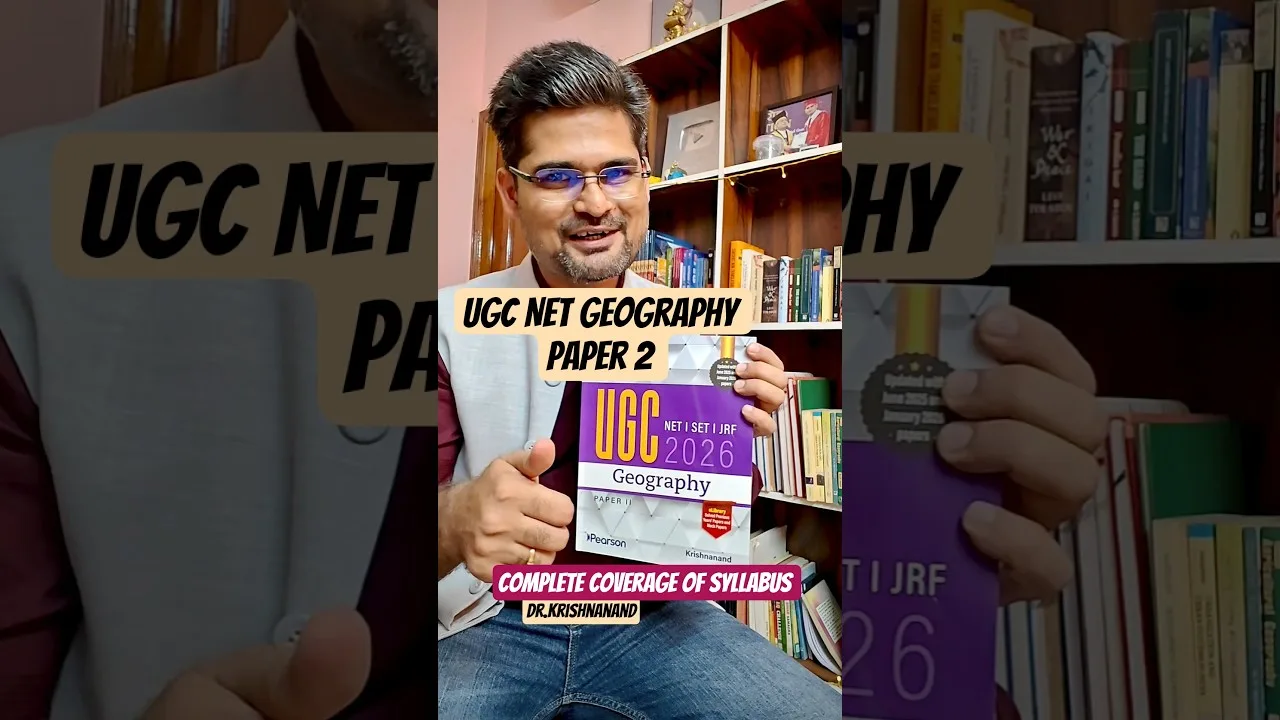
Resource overload causes decision paralysis. For UGC NET Geography, stick to a minimal, high-yield library. Standard textbooks: Majid Husain’s “Geography of India” and “Human Geography”; Savindra Singh’s “Physical Geography”; R.C. Chandna’s “Regional Planning”; K. Siddhartha’s “Climatology” and “Oceanography”; Statistical Methods by S.P. Gupta. For Paper-I: “UGC NET Paper-I” by KVS Madaan or Arihant Experts. UGC NET Geography specific eBooks from TheGeoecologist consolidate syllabus-mapped content, diagrams, tables, and solved PYQs in downloadable PDFs — ideal for quick revision. The official UGC website provides the authentic syllabus PDF and past notification archives. NTA’s official portal hosts mock tests, answer keys, and candidate response sheets. Supplement with Wikipedia’s UGC NET overview for historical context and eligibility criteria updates.
Leveraging PYQs & Mock Tests for Score Maximization
Previous Year Questions are the single highest-ROI resource for UGC NET Geography. Solve the last 10 years’ papers (2014–2024) in three passes: Pass 1 — untimed, topic-wise, with books open to understand concepts; Pass 2 — timed, mixed-topic sets of 50 questions to build speed; Pass 3 — full Paper-II mocks under exact exam conditions (3 hours, no breaks). Maintain an error log categorizing mistakes as conceptual gaps, silly errors, or time pressure. Target 85%+ accuracy in topic-wise sets and 70%+ in full mocks by Month 5. TheGeoecologist’s mock test series replicates NTA’s difficulty distribution, provides detailed solutions, and offers All-India Rank comparison — essential for realistic benchmarking.
Why Expert Guidance Transforms UGC NET Geography Preparation
Self-study works for disciplined aspirants with strong academic backgrounds, but most candidates hit plateaus in Statistics, Regional Planning, or map-based questions. Structured UGC NET Geography courses bridge these gaps through: (1) Live concept classes by educators who have cleared JRF themselves, (2) Curated study materials eliminating irrelevant content, (3) Weekly doubt-clearing sessions preventing backlog accumulation, (4) Personalized mentorship for study plan adjustments, (5) Peer community for motivation and resource sharing. TheGeoecologist’s flagship program includes 120+ hours of recorded lectures, 50+ live sessions, 15 full-length mocks, 10 unit-wise tests, and lifetime access to updated eBooks — all tailored to the latest NTA syllabus. Alumni data shows course enrollees achieve 2.3x higher JRF qualification rates compared to self-study aspirants in the same attempt.
Common Pitfalls to Avoid in UGC NET Geography Preparation
Avoid these score-killers: (1) Ignoring Paper-I — 30+ marks here can compensate for a tough Paper-II; (2) Reading multiple books for one topic — creates confusion, wastes time; (3) Skipping Statistics — it’s 8–10 guaranteed marks with formula memorization; (4) Neglecting map work — 5–7 questions annually test locational knowledge; (5) Mock test avoidance due to fear of low scores — early low scores are diagnostic, not predictive; (6) Last-minute new topic cramming — focus on consolidation, not expansion, in final 30 days; (7) Inconsistent sleep/exercise — cognitive fatigue reduces retention by 40% (per NIH studies on exam preparation). Treat preparation as a marathon, not a sprint.
Frequently Asked Questions About UGC NET Geography
Aspirants often seek clarity on eligibility, attempt limits, and career outcomes. Here are concise answers to the most common queries.
What is the eligibility criteria for UGC NET Geography?
Candidates must hold a Master’s degree in Geography or a related subject (Geology, Environmental Science, Geophysics) with at least 55% marks (50% for SC/ST/OBC-NCL/PwD/Transgender). Final-year postgraduate students can also apply. There is no upper age limit for Assistant Professor; for JRF, the upper age limit is 30 years (relaxable by 5 years for reserved categories). The exam is conducted twice yearly (June & December) by NTA.
How many attempts are allowed for UGC NET Geography?
There is no limit on the number of attempts for UGC NET Geography as long as you meet the age criteria for JRF (30 years, with relaxations). For Assistant Professor eligibility, there is no age cap whatsoever. You can appear in every cycle until you qualify.
What is the difference between JRF and Assistant Professor qualification in UGC NET Geography?
Qualifying for JRF (Junior Research Fellowship) makes you eligible for both Assistant Professor positions and a monthly fellowship of ₹37,000 (first two years) and ₹42,000 (subsequent three years) for PhD research, plus HRA and contingency grants. Qualifying only for Assistant Professor (higher cutoff than JRF) makes you eligible for lectureship/assistant professor roles in Indian universities/colleges but without the research fellowship. JRF cutoff is typically 15–20 marks higher than Assistant Professor cutoff.
Final Roadmap: From Aspirant to Assistant Professor
Cracking UGC NET Geography is a marathon of smart choices: right resources, right guidance, right practice. Start today by downloading the official syllabus, auditing your current knowledge against PYQs, and building a 180-day calendar with weekly milestones. Invest in one comprehensive course rather than fragmented YouTube playlists. Join a peer group for accountability. Track progress via mock scores, not hours studied. Remember, the 2023 topper in Geography scored 284/300 — perfection isn’t required, consistency is. TheGeoecologist stands ready to partner your journey with proven pedagogy, updated materials, and a community of 50,000+ geography aspirants. Your Assistant Professor appointment letter is a decision away — make it count.
Frequently Asked Questions
Candidates must hold a Master's degree in Geography or a related subject (Geology, Environmental Science, Geophysics) with at least 55% marks (50% for SC/ST/OBC-NCL/PwD/Transgender). Final-year postgraduate students can also apply. There is no upper age limit for Assistant Professor; for JRF, the upper age limit is 30 years (relaxable by 5 years for reserved categories).
There is no limit on the number of attempts for UGC NET Geography as long as you meet the age criteria for JRF (30 years, with relaxations). For Assistant Professor eligibility, there is no age cap whatsoever. You can appear in every cycle until you qualify.
Qualifying for JRF (Junior Research Fellowship) makes you eligible for both Assistant Professor positions and a monthly fellowship of ₹37,000 (first two years) and ₹42,000 (subsequent three years) for PhD research, plus HRA and contingency grants. Qualifying only for Assistant Professor (higher cutoff than JRF) makes you eligible for lectureship/assistant professor roles in Indian universities/colleges but without the research fellowship. JRF cutoff is typically 15–20 marks higher than Assistant Professor cutoff.