Blog
UGC NET Geography: Complete Preparation Strategy for Assistant Professor Exams


Table of Contents
- Decoding the UGC NET Geography Syllabus & Exam Pattern
- Paper 1: General Paper on Teaching & Research Aptitude (100 Marks, 50 Questions)
- Paper 2: Geography (200 Marks, 100 Questions)
- Smart Study Techniques for UGC NET Geography Mastery
- 1. Build Conceptual Clarity with Layered Reading
- 2. PYQ Analysis: Your Strategic Compass
- 3. Visual Encoding: Diagrams, Maps & Flowcharts
- Time Management & The Science of Revision
- Designing a Realistic Study Calendar
- The Three-Tier Revision Protocol
- Mock Tests: The Ultimate Feedback Loop
- Curated Booklist & High-ROI Resources for UGC NET Geography
- Essential Books (The "Do Not Skip" List)
- Authoritative Digital Resources
- Psychological Endurance: Staying Consistent Till Selection
- Final 30-Day Sprint Plan
Cracking the UGC NET Geography examination requires more than just hard work—UGC NET Geography demands a systematic, evidence-based approach tailored to the unique demands of the Assistant Professor recruitment process. Whether you are targeting the National Eligibility Test conducted by the National Testing Agency (NTA) or State Eligibility Tests (SETs) across India, a well-structured roadmap is the difference between an attempt and a selection. This comprehensive guide distills proven strategies, essential resources, and expert insights to help you master the syllabus, optimize your study timeline, and walk into the examination hall with confidence.
- Syllabus Mastery: Deep understanding of both Paper 1 (General Aptitude) and Paper 2 (Core Geography) is non-negotiable.
- Resource Selection: Stick to standard textbooks (NCERTs, Savindra Singh, Majid Husain) and avoid resource overload.
- PYQ-Centric Prep: Previous Year Questions (PYQs) are the single most reliable indicator of exam trends and weightage.
- Visual Learning: Geography is inherently visual; diagrams, maps, and flowcharts boost retention and answer accuracy.
- Revision Cycles: Implement the 24-hour, weekly, and pre-mock revision framework to combat the forgetting curve.
- Mock Test Discipline: Timed, full-length mocks build stamina, speed, and identify weak zones for targeted re-study.
Decoding the UGC NET Geography Syllabus & Exam Pattern
Before opening a single book, aspirants must internalize the structure of the UGC NET Geography exam. The test comprises two papers conducted in a single three-hour session without a break, administered as a Computer-Based Test (CBT) by the NTA.
Paper 1: General Paper on Teaching & Research Aptitude (100 Marks, 50 Questions)
This paper is common for all subjects and tests the cognitive and pedagogical readiness of a future Assistant Professor. Key units include:
- Teaching Aptitude: Methods, learner characteristics, evaluation systems.
- Research Aptitude: Research types, methods, ethics, thesis/article writing.
- Logical Reasoning & Data Interpretation: Syllogisms, Venn diagrams, graphical data analysis.
- Communication & ICT: Classroom communication, digital tools in education, MOOCs, SWAYAM.
- People, Development & Environment: Sustainability, climate change, human development indices.
- Higher Education System: Governance, polity, administration, NEP 2020 implications.
Paper 2: Geography (200 Marks, 100 Questions)
This is the domain-specific paper where subject mastery is tested. The syllabus is vast but finite, divided into four broad categories:
- Physical Geography: Geomorphology (landforms, plate tectonics, cycles of erosion), Climatology (atmosphere, pressure belts, cyclones, climate change), Oceanography (bottom relief, currents, coral reefs), Biogeography (soils, ecosystems).
- Human & Economic Geography: Population geography (demographic transition, migration), Settlement geography (rural/urban morphology), Economic activities (agriculture, industry, trade models), Political geography (boundaries, geopolitics, federalism).
- Geographical Thought & Techniques: Evolution of geographic thought (determinism, possibilism, radical, behavioural, humanistic), Quantitative techniques (statistics, sampling, hypothesis testing), Models & Theories (Von Thünen, Weber, Christaller, Rostow, Malthus).
- Remote Sensing, GIS & Cartography: EM spectrum, sensors/platforms, image interpretation, GIS data models, spatial analysis, map projections, thematic mapping.
Critical Exam Pattern Notes: All questions are Multiple Choice Questions (MCQs). There is no negative marking for incorrect answers in UGC NET and most State SETs, making intelligent guessing a viable strategy. Each correct answer carries 2 marks. The qualifying cut-off varies by category (General, OBC, SC, ST, EWS, PwD) and is determined by the NTA using a normalization procedure across shifts. – a key consideration for UGC NET Geography.
Smart Study Techniques for UGC NET Geography Mastery
1. Build Conceptual Clarity with Layered Reading
Geography concepts are interconnected. A layered approach prevents cognitive overload:
- Layer 1 – Foundation (NCERTs Class XI & XII): “Fundamentals of Physical Geography,” “India: Physical Environment,” “Fundamentals of Human Geography,” “India: People and Economy.” These provide the vocabulary and basic models.
- Layer 2 – Standard Reference Texts: Move to authoritative texts for depth. Physical Geography by Savindra Singh is the gold standard for geomorphology and climatology. Human Geography and Models in Geography by Majid Husain cover theories and human dimensions comprehensively. For Geomorphology specifics, D.S. Lal is excellent. Geographical Thought by R.D. Dixit or Majid Husain clarifies the evolution of paradigms.
- Layer 3 – Specialized & Applied: Environmental Geography by Savindra Singh, Practical Geography by K. Siddhartha for cartography/statistics, and Geography of India by Majid Husain or Khullar for regional specifics.
2. PYQ Analysis: Your Strategic Compass
Solving the last 8–10 years of PYQs (available on the official NTA UGC NET website) is not optional—UGC NET Geography is the core of preparation. Perform a topic-wise segregation:
- Create a spreadsheet with columns: Year, Shift, Topic, Sub-topic, Difficulty.
- Identify “Evergreen Topics” (e.g., Koppen’s Classification, Plate Tectonics, Central Place Theory, Remote Sensing sensors) that appear almost every year.
- Calculate weightage percentages to prioritize high-yield units (e.g., Geomorphology + Climatology often constitute ~25% of Paper 2).
- Analyze how concepts are tested: definition-based, assertion-reason, matching, statement-correctness, chronological ordering.
3. Visual Encoding: Diagrams, Maps & Flowcharts
The brain processes visuals 60,000x faster than text. For UGC NET Geography, visual encoding is a force multiplier:
- Physical Processes: Draw the cycle of erosion (Davis vs. Penck), tropical cyclone structure, ocean current systems, soil profile horizons.
- Models & Theories: Convert each model into a one-page flowchart: Assumptions → Diagram → Stages/Zones → Criticism → Modifications. Example: Von Thünen’s rings, Weber’s locational triangle, Christaller’s K-values.
- India Mapping: Practice locating physiographic divisions, river regimes, soil types, mineral belts, population density zones, and tribal concentrations on blank political/physical maps of India.
- Remote Sensing/GIS: Sketch the EM spectrum windows, sensor resolutions (spatial, spectral, radiometric, temporal), and GIS data models (raster vs. vector topology).
Time Management & The Science of Revision
Designing a Realistic Study Calendar
A typical serious aspirant needs 5–7 months of dedicated preparation (3–4 hours daily if working, 6–8 hours if full-time). Break the syllabus into:
- Short-term (Weekly): Finish one major unit (e.g., Climatology) + corresponding PYQs + 10 diagrams.
- Medium-term (Monthly): Complete one broad category (e.g., all Physical Geography) + 2 full-length mocks.
- Long-term (Final 60 Days): Exclusive revision, mock test series, weak-area plugging, Paper 1 polishing.
The Three-Tier Revision Protocol
Leverage the Ebbinghaus Forgetting Curve with spaced repetition:
- Revision 1 (R1) – Within 24 Hours: Review handwritten notes/mind maps of the day’s study. Time: 30–45 mins. Goal: Consolidate working memory to long-term memory.
- Revision 2 (R2) – End of Week (Day 7): Rapid-fire review of the week’s topics using flashcards or one-pagers. Solve 20–30 topic-wise MCQs. Time: 2–3 hours.
- Revision 3 (R3) – Pre-Mock / Final Phase: Full syllabus sweep using condensed notes (A4 sheets per topic). Simulate exam conditions with previous papers. Time: 4–5 hours per cycle.
Mock Tests: The Ultimate Feedback Loop
Join a reputable test series (online/offline) by Month 3. Schedule:
- Phase 1 (Months 3–4): 1 sectional test/week (Paper 2 units) + 1 Paper 1 test/fortnight.
- Phase 2 (Month 5): 1 full-length mock/week. Strict 3-hour window, OMR/ CBT interface practice.
- Phase 3 (Final 30 Days): 2–3 full mocks/week. Deep analysis: categorize errors as “Concept Gap,” “Silly Mistake,” “Time Pressure,” “Misreading.” Re-study ONLY “Concept Gap” topics.
Curated Booklist & High-ROI Resources for UGC NET Geography
Essential Books (The “Do Not Skip” List)
| Paper / Area | Book Title | Author / Publication | Priority |
|---|---|---|---|
| Physical Geography (Core) | Physical Geography | Savindra Singh (Prayag Pustak Bhawan) | ⭐⭐⭐ Mandatory |
| Geomorphology (Deep Dive) | Geomorphology | D.S. Lal (Sharda Pustak Bhawan) | ⭐⭐ High |
| Human Geography | Human Geography | Majid Husain (Rawat Publications) | ⭐⭐⭐ Mandatory |
| Models & Theories | Models in Geography | Majid Husain (Rawat Publications) | ⭐⭐⭐ Mandatory |
| Geographical Thought | Geographical Thought | R.D. Dixit / Majid Husain | ⭐⭐ High |
| Practical / Quantitative | Practical Geography | K. Siddhartha (Kalyani Publishers) | ⭐⭐ High |
| Environmental Geography | Environmental Geography | Savindra Singh | ⭐ Medium |
| Geography of India | Geography of India | Majid Husain / Khullar | ⭐⭐ High |
| Paper 1 (General) | UGC NET Paper 1 | KVS Madaan / Arihant / Trueman’s | ⭐⭐⭐ Mandatory |
Authoritative Digital Resources
- Free Video Lectures: TheGeoecologist YouTube Channel (Dr. Krishnanand) – topic-wise playlists aligned with syllabus.
- Official Syllabus & Notifications: University Grants Commission (UGC) Official Website – always verify the latest syllabus PDF and eligibility criteria.
- PYQ Repository: NTA UGC NET Official Portal – download authentic question papers and answer keys.
- Reference Encyclopedia: Wikipedia – University Grants Commission (India) – for historical context on NET/SET evolution and policy changes.
- GIS/RS Learning: ISRO’s NRSC Bhuvan portal, ESRI Training (free modules), NPTEL courses on Remote Sensing & GIS.
Psychological Endurance: Staying Consistent Till Selection
The UGC NET Geography journey is a marathon, not a sprint. Burnout is the silent killer of more dreams than difficulty.
- Micro-Goals, Macro-Vision: Set daily targets (“Finish 20 pages of Savindra Singh + 5 diagrams”) rather than vague goals (“Study Geography”).
- Active Recall > Passive Re-reading: Close the book, write/recite the concept. This builds neural pathways.
- Peer Accountability: Form a 3–4 member study group (online/offline) for weekly doubt sessions and mock discussions. Teaching a concept is the best test of mastery.
- Physical & Mental Hygiene: 7 hours sleep, 30 mins walk, protein-rich diet. The brain consumes 20% of body’s energy; fuel UGC NET Geography.
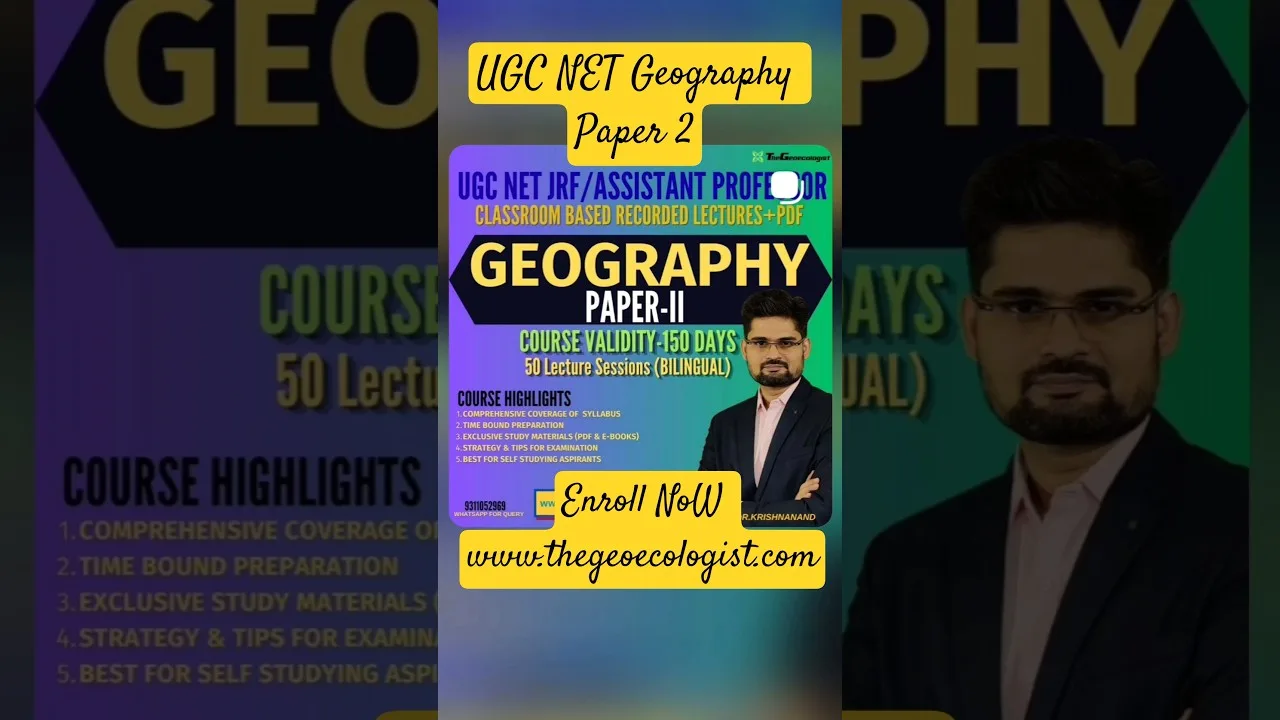
- Expert Mentorship: Follow credible educators like Dr. Krishnanand (Founder, TheGeoecologist) for strategic guidance, live sessions, and motivation. His structured courses on TheGeoecologist.com bridge the gap between syllabus and exam demand.
Final 30-Day Sprint Plan
- Days 1–10: Rapid revision of Paper 2 via condensed notes (1 unit/day). Solve 50 PYQs daily (topic-wise).
- Days 11–20: Full-length mocks every alternate day (Days 11, 13, 15, 17, 19). Deep error analysis on off-days. Polish Paper 1 (ICT, Higher Ed, Research Aptitude).
- Days 21–25: Mock every day. Focus on speed: target 100 mins for Paper 2, 50 mins for Paper 1, 30 mins buffer.
- Days 26–28: Light revision of formulae, models, map locations, RC passages. Zero new topics.
- Day 29: Relax. Light reading. Prepare documents, admit card, route plan.
- Day 30 (Exam Day): Reach center early. Deep breathing. Attempt all questions (no negative marking). Flag doubtful ones, review in buffer time.
Success in the UGC NET Geography examination is not an accident; UGC NET Geography is the inevitable outcome of disciplined execution of a proven strategy. Master the syllabus, respect the PYQs, visualize the concepts, revise scientifically, and test relentlessly. The Assistant Professor letter is waiting for you at the finish line. Stay focused, stay consistent, and claim your place in academia.
Frequently Asked Questions
A dedicated aspirant typically needs 5–7 months of consistent preparation (3–4 hours daily if working, 6–8 hours if full-time) to cover the vast Paper 2 syllabus, practice PYQs, and build mock test stamina.
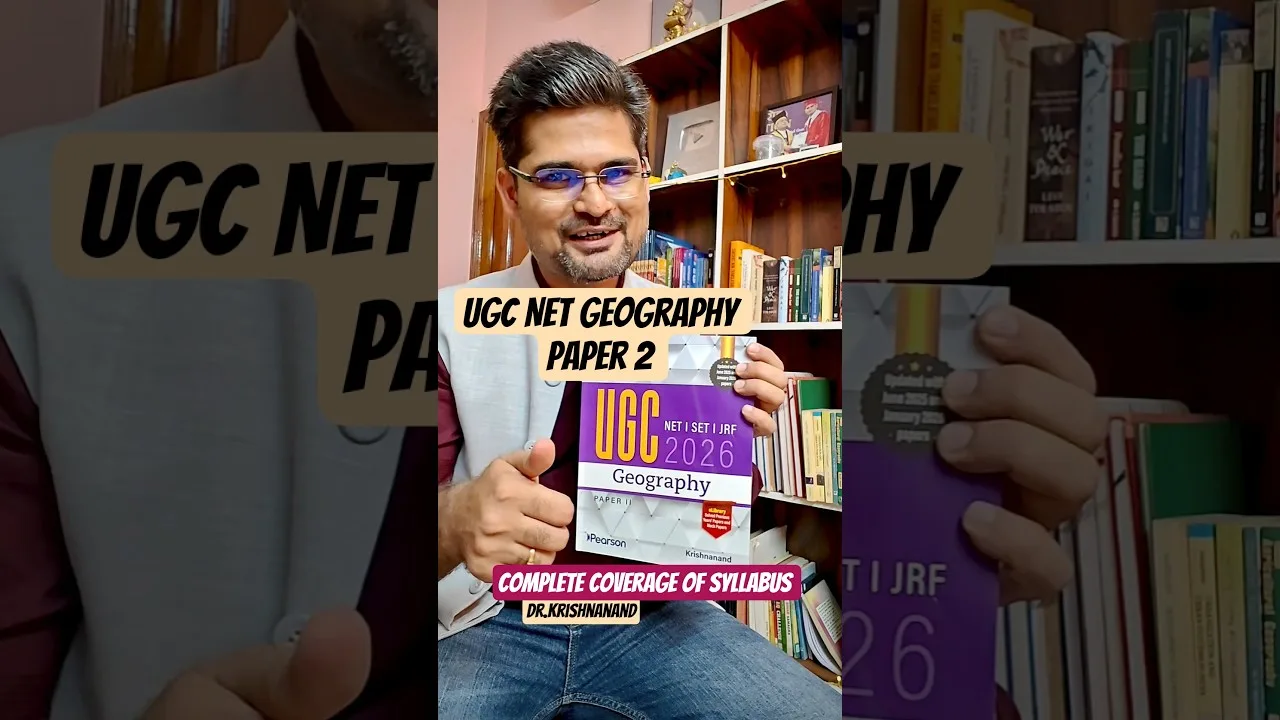
The non-negotiable core books are: Physical Geography by Savindra Singh, Human Geography & Models in Geography by Majid Husain, Geographical Thought by R.D. Dixit/Majid Husain, Practical Geography by K. Siddhartha, and NCERTs Class XI–XII for foundation.
No, there is no negative marking for incorrect answers in UGC NET (and most State SETs). Each correct answer carries 2 marks. This makes intelligent guessing on doubtful questions a viable strategy to maximize score.