Blog
TheGeoecologist Bihar Geography E-Book: Complete Guide for BPSC Aspirants

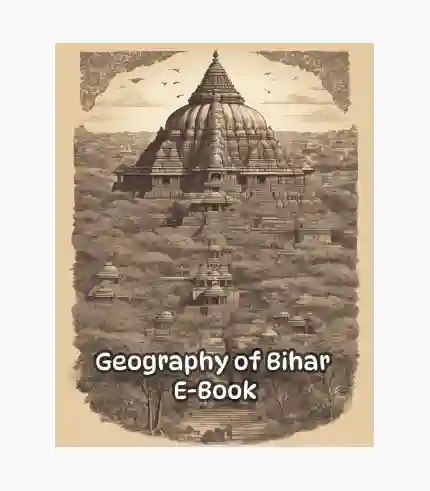
TheGeoecologist Bihar Geography E-Book has become a go-to resource for thousands of BPSC and state-level competitive exam aspirants who need a single, exam-focused reference that covers every syllabus topic without fluff. If you have ever spent hours stitching together notes from multiple books, YouTube videos, and government reports only to realize you still have gaps in river systems, agro-climatic zones, or mineral distribution, this guide is built for you.
- Covers the entire Bihar geography syllabus for BPSC, BSSC, and other state exams in one PDF.
- Structured around Dr. Krishnanand’s popular The Geoecologist YouTube lectures for seamless video–book integration.
- Includes 200+ practice questions with explanatory answers tailored to recent exam patterns.
- Updated with 2023–24 statistical data from Bihar Economic Survey and Census 2011/2021 projections.
- Instant download, offline access, and printable format for flexible study schedules.
Why Bihar Geography Is a High-Weightage Section in BPSC
Bihar geography typically accounts for 15–20 questions in the BPSC Preliminary General Studies Paper I and forms a substantial portion of the Mains GS Paper II. The syllabus spans physical features (rivers, soils, climate), human geography (population, migration, urbanization), and economic geography (agriculture, industry, mineral resources). Candidates who master this section gain a reliable 25–30 mark advantage. However, most standard Indian geography textbooks treat Bihar in a few scattered paragraphs, forcing aspirants to compile data from the BPSC official syllabus, Bihar Economic Survey, and district gazetteers — a time-consuming process that often leaves critical gaps.
What to Look for in a Bihar Geography Resource
Before investing in any study material, evaluate it against four criteria that directly impact exam performance:
- Syllabus alignment: Every topic listed in the BPSC notification must be addressed explicitly.
- Data currency: Population figures, crop production stats, and industrial indices should reflect the latest Bihar Economic Survey (2023–24) and NITI Aayog reports.
- Question integration: Theory must be paired with previous-year questions (PYQs) and expected model questions.
- Pedagogical structure: Clear headings, maps, tables, and mnemonics reduce cognitive load during revision.
TheGeoecologist Bihar Geography E-Book meets all four criteria by design, because it was created from lecture transcripts that already followed the BPSC syllabus topic-by-topic.
TheGeoecologist Bihar Geography E-Book: In-Depth Content Breakdown
The eBook is organized into five major modules, each mapping to a distinct syllabus block. Dr. Krishnanand, the author and founder of The Geoecologist YouTube channel (500K+ subscribers), brings 15+ years of teaching experience at Patna University and various coaching institutes. His lecture-first approach means every chapter reads like a classroom session — concepts are introduced, explained with Bihar-specific examples, and concluded with exam pointers.
Module 1: Physical Geography — Landforms, Rivers & Climate
This module covers the Indo-Gangetic Plain subdivisions (North Bihar Plains, South Bihar Plains, Tal & Diara lands), the Rajmahal Hills, and the Kaimur Plateau. River systems receive disproportionate attention because BPSC asks 3–4 questions annually on the Ganga, Gandak, Kosi, Bagmati, and Mahananda — their tributaries, flood patterns, and irrigation projects. The eBook includes a comparative table of all 11 major rivers with length, catchment area, and major dams/barrages. Climate section decodes the monsoon onset, withdrawal, and agro-climatic zones (Zone I–III) with rainfall distribution maps sourced from IMD.
Module 2: Natural Resources — Minerals, Forests & Water
Bihar holds 95% of India’s pyrite, significant limestone (Rohtas, Kaimur), and mica (Nawada, Gaya). The eBook lists every mineral with district-wise reserves, production trends (2018–2023), and associated industries. Forest cover data from ISFR 2023 shows 7.76% geographical area under forest — the book breaks this down by forest type (dry deciduous, moist deciduous) and protected areas (Valmiki Tiger Reserve, Bhimbandh Wildlife Sanctuary). Groundwater potential, irrigation coverage (61% net irrigated area), and the Jal-Jeevan-Hariyali mission are covered with latest government figures.
Module 3: Human Geography — Population, Settlement & Migration
Using Census 2011 and 2021 projections, this module explains Bihar’s population density (1,106 persons/km² — highest in India), decadal growth rate (25.4%), sex ratio (918), and literacy (61.8%). Urbanization trends (11.3% urban), major urban agglomerations (Patna, Gaya, Bhagalpur), and rural settlement patterns (clustered, dispersed, linear) are illustrated with district-level maps. The out-migration phenomenon — 2.5 million Bihari workers in other states per NSSO 2021 — is analyzed with push-pull factors and remittance impact on rural economy.
Module 4: Economic Geography — Agriculture, Industry & Infrastructure
Agriculture employs 74% of workforce. The eBook details cropping patterns (rice-wheat-maize), three cropping seasons, and district-wise productivity for paddy, wheat, maize, pulses, oilseeds, and commercial crops (sugarcane, jute, makhana). Industrial profile covers traditional (sugar, jute, leather) and emerging sectors (food processing, IT/ITES in Patna, textile parks). Infrastructure chapter maps National Highways (NH-19, NH-31, NH-27), dedicated freight corridors, inland waterways (National Waterway-1 on Ganga), and power generation capacity (3,500 MW thermal + renewable).
Module 5: Practice Questions & Answer Writing Framework
Each module ends with 30–40 practice questions: 15 MCQs (Prelims style), 10 short-answer (Mains 150 words), and 5 long-answer (Mains 250 words). Answers include keyword highlights, diagram suggestions, and interlinkages with current affairs (e.g., Kosi-Mechi link project, Bihar’s ethanol policy). TheGeoecologist Bihar Geography E-Book also provides a 30-day revision planner that aligns chapter completion with PYQ practice.
How to Integrate This E-Book into Your Study Plan
For a 90-day BPSC preparation window, allocate the first 45 days to module-wise reading alongside Dr. Krishnanand’s corresponding YouTube playlists (search “The Geoecologist Bihar Geography” on YouTube). Spend 20 days on mixed PYQ practice using the eBook’s question banks. Reserve the final 25 days for full-length mock tests and the 30-day revision planner. The PDF format allows annotation on tablets — highlight key stats, add sticky notes for current affairs linkages, and create one-page mind maps per module. Aspirants targeting BSSC, BPSC AE, or Bihar Police SI can follow the same structure; the syllabus overlap is 85%+.
Comparing Alternatives: Why This E-Book Outperforms General Geography Books
Standard references like “India: A Comprehensive Geography” by Khullar or “Geography of India” by Majid Husain allocate only 8–12 pages to Bihar. They lack district-level data, recent scheme analysis, and BPSC-specific question patterns. State government publications (Bihar Economic Survey, Statistical Handbook) are data-rich but unstructured for exam preparation. Coaching institute booklets are often outdated and lack answer-writing frameworks. TheGeoecologist Bihar Geography E-Book bridges this gap by curating authoritative data into an exam-ready narrative. At ₹249, it costs less than a single mock test series and delivers perpetual access.
Frequently Asked Questions
Is the eBook updated for the latest BPSC 70th notification?
Yes. The current edition incorporates syllabus changes from the 70th BPSC notification (2024), including added emphasis on disaster management (flood/drought), climate resilience, and Bihar’s SDG localization framework.
Can I access the eBook on multiple devices?
The download link allows three device activations. The PDF is DRM-free, so you can transfer it to your phone, tablet, and laptop for offline study.
Does it cover map-based questions?
Absolutely. The eBook includes 15 high-resolution maps (physical, river basins, agro-climatic zones, mineral belts, industrial corridors, NH network) with practice map-pointing exercises modeled on previous BPSC Mains questions.
For aspirants who want a single, authoritative, and exam-calibrated resource, the Unlock the Secrets of Bihar: Geography of Bihar E-Book by Dr. Krishnanand eliminates the need for fragmented note-making. Its lecture-aligned structure, current data, and integrated practice system make it the most efficient path to mastering Bihar geography for BPSC and allied exams. Download your copy today and convert geography from a liability into your highest-scoring section.
Our Recommendation
📖 Part of our complete guide: Evolution of Geographical Thought: A Comprehensive Guide for UPSC Aspirants and Geography Enthusiasts
Frequently Asked Questions
Is the eBook updated for the latest BPSC 70th notification?
Yes. The current edition incorporates syllabus changes from the 70th BPSC notification (2024), including added emphasis on disaster management (flood/drought), climate resilience, and Bihar's SDG localization framework.
Can I access the eBook on multiple devices?
The download link allows three device activations. The PDF is DRM-free, so you can transfer it to your phone, tablet, and laptop for offline study.
Does it cover map-based questions?
Absolutely. The eBook includes 15 high-resolution maps (physical, river basins, agro-climatic zones, mineral belts, industrial corridors, NH network) with practice map-pointing exercises modeled on previous BPSC Mains questions.