Blog
Simplified Oceanography eBook: 2025 Edition for UPSC & UGC NET

Table of Contents
- Why Choose This Simplified Oceanography eBook for Competitive Exam Preparation
- Comprehensive Coverage of Oceanography Topics in the 2025 Edition
- Ocean Basins & Topography
- Ocean Currents & Tides
- Salinity & Temperature Distribution
- Marine Ecosystem & Biodiversity
- Coral Reefs & Marine Pollution
- Climate Change & Oceanic Impacts
- Exam-Oriented Approach: How This Oceanography Guide Maximizes Scores
- Who Should Read This Oceanography Guide: Target Audience Breakdown
- Author Credibility: Dr. Krishnanand & TheGeoecologist Legacy
- Additional Resources & Study Materials from TheGeoecologist Ecosystem
- How to Get Your Copy of the Simplified Oceanography eBook
The Simplified Oceanography eBook (2025 Edition) by Dr. Krishnanand has quickly become the go-to resource for aspirants preparing for UPSC Geography Optional, UGC NET Geography Paper 2, and various State PCS examinations. Published under TheGeoecologist banner, this comprehensive guide transforms complex oceanographic concepts into structured, exam-ready material that saves valuable preparation time while ensuring conceptual clarity.
- Updated for 2025 syllabus aligned with latest UPSC and UGC NET exam patterns
- Six core modules covering ocean basins, currents, salinity, marine ecosystems, coral reefs, and climate change
- Exam-oriented pedagogy with diagrams, case studies, and scholarly references for quick revision
- Authored by Dr. Krishnanand, a recognized geography expert with years of teaching and research experience
- Trusted by thousands of successful candidates across competitive examinations
- Part of bestselling series including Simplified Climatology and Simplified Geomorphology
Why Choose This Simplified Oceanography eBook for Competitive Exam Preparation
The Simplified Oceanography eBook stands apart from conventional textbooks through its laser-focused approach to competitive exam requirements. Unlike general academic texts that overwhelm with excessive detail, this 2025 edition distills oceanography into precisely what examiners test. Dr. Krishnanand’s methodology reflects deep analysis of previous years’ question papers from UPSC CSE (Geography Optional), UGC NET/JRF Paper 2, GATE Geology & Geophysics, and CSIR-NET Earth Sciences. Each chapter begins with learning objectives mapped to specific syllabus points, followed by concept explanations reinforced through oceanography diagrams, comparative tables, and real-world case studies from the Indian Ocean region — a frequent focus area in Indian competitive examinations.
The eBook’s digital format enables instant searchability, allowing aspirants to quickly locate topics like thermohaline circulation, El Niño-Southern Oscillation (ENSO), or marine pollution conventions during last-minute revision. Furthermore, Simplified Oceanography eBook integrates recent developments such as the UN Decade of Ocean Science for Sustainable Development (2021-2030), the BBNJ Agreement (Biodiversity Beyond National Jurisdiction) adopted in 2023, and India’s Deep Ocean Mission launched in 2021 — ensuring candidates can tackle contemporary issues questions that increasingly appear in UPSC Mains and UGC NET.
Comprehensive Coverage of Oceanography Topics in the 2025 Edition
Ocean Basins & Topography
This foundational module covers the hypsographic curve, continental shelf/slope/rise configurations, abyssal plains, mid-ocean ridges, seamounts, guyots, and oceanic trenches with special emphasis on the Indian Ocean’s unique features like the Ninety East Ridge, Chagos-Laccadive Ridge, and the Java Trench. The Simplified Oceanography eBook includes bathymetric maps and cross-sectional profiles that clarify plate tectonic processes — a recurring theme in UPSC Geography Optional Paper 1.
Ocean Currents & Tides
Surface and deep-water circulation systems are explained through the lens of wind-driven (Ekman transport, western boundary currents) and density-driven (thermohaline circulation) mechanisms. The 2025 edition provides updated schematics of the Atlantic Meridional Overturning Circulation (AMOC) slowdown debate, Indian Ocean dipole dynamics, and monsoon-current interactions. Tidal theory covers equilibrium vs. dynamic theories, amphidromic systems, and tidal energy potential — relevant for both geography and general studies papers. – a key consideration for Simplified Oceanography eBook.
Salinity & Temperature Distribution
Horizontal and vertical distribution patterns of salinity and temperature receive detailed treatment with isotherm and isohaline maps for all major oceans. The Simplified Oceanography eBook explains controlling factors (evaporation, precipitation, river influx, ice formation/melting) and links them to water mass formation (North Atlantic Deep Water, Antarctic Bottom Water, Indian Ocean Central Water). Special sections address the Arabian Sea’s high salinity and the Bay of Bengal’s low salinity — classic UPSC comparison questions.
Marine Ecosystem & Biodiversity
This module explores marine zonation (pelagic, benthic, intertidal), productivity patterns (upwelling zones, coral reefs, estuaries), and biodiversity hotspots. The eBook incorporates the Census of Marine Life findings, IUCN Red List categories for marine species, and India’s Marine Protected Areas network. Food web dynamics, biological pump efficiency, and blue carbon sequestration by mangroves/seagrasses are covered with quantitative data points useful for answer enrichment.
Coral Reefs & Marine Pollution
Coral reef types (fringing, barrier, atoll), formation theories (Darwin, Daly, Murray), and symbiosis with zooxanthellae are explained alongside threats: bleaching events (1998, 2010, 2016 global events), ocean acidification, and crown-of-thorns starfish outbreaks. The pollution section covers plastic debris (Great Pacific Garbage Patch), oil spills, heavy metal bioaccumulation, eutrophication, and noise pollution — with reference to MARPOL, London Convention, and India’s Coastal Regulation Zone (CRZ) notifications.
Climate Change & Oceanic Impacts
The final module addresses sea-level rise (thermal expansion vs. ice melt contributions), marine heatwaves, deoxygenation, and acidification using IPCC AR6 (2021) projections. The Simplified Oceanography eBook connects these to geopolitical implications (small island states, exclusive economic zones), blue economy frameworks, and India’s National Action Plan on Climate Change (NAPCC) missions. Case studies include Sundarbans vulnerability, Lakshadweep atoll resilience, and Chennai flood-ocean interaction analyses.
Exam-Oriented Approach: How This Oceanography Guide Maximizes Scores
What truly distinguishes the Simplified Oceanography eBook is its pedagogical architecture designed for retention and recall under exam pressure. Each chapter employs a three-tier structure: (1) Concept Capsules — one-page visual summaries with flowcharts and mnemonics; (2) Previous Year Question (PYQ) Analysis — tagged by year, exam, and difficulty level; (3) Practice Questions — framed exactly on UPSC/UGC NET patterns with model answers. The 2025 edition adds QR codes linking to video explanations on TheGeoecologist YouTube channel where Dr. Krishnanand walks through complex topics like Ekman spiral dynamics or coral bleaching mechanisms.
For UPSC Geography Optional aspirants, the eBook provides answer-writing frameworks for 10-marker and 15-marker questions, including map-based questions requiring ocean current plotting on world outline maps. UGC NET candidates benefit from MCQ banks with detailed explanations referencing standard texts (Thurman & Trujillo, Garrison, Pinet) and research papers. State PCS aspirants will appreciate the regional focus sections on Indian Ocean rim countries, Indian coastal geomorphology, and state-level fisheries statistics.
Who Should Read This Oceanography Guide: Target Audience Breakdown
- UPSC CSE Geography Optional Aspirants — Paper 1 (Physical Geography) and Paper 2 (Indian Geography) both feature oceanography questions annually
- UGC NET/JRF Geography Paper 2 Candidates — Unit 4 (Oceanography) carries 15-20% weightage; the eBook’s MCQ bank is tailored to NTA pattern
- B.A./M.A./M.Sc. Geography Students — Serves as semester exam companion and research reference with 200+ scholarly citations
- State PCS, GATE, CSIR-NET Aspirants — Covers state-specific syllabi (e.g., BPSC, MPPSC, RPSC) and earth science entrance requirements
- Marine Science Enthusiasts & Policy Professionals — Accessible entry point to ocean governance, blue economy, and climate-ocean nexus
Author Credibility: Dr. Krishnanand & TheGeoecologist Legacy
Dr. Krishnanand brings over 15 years of geography teaching experience across premier coaching institutes and university departments. His Ph.D. research on Indian Ocean paleoclimate reconstructions using foraminiferal proxies informs the eBook’s evidence-based approach. TheGeoecologist platform, founded in 2018, has mentored 50,000+ aspirants through free YouTube lectures, paid courses, and the bestselling Simplified Oceanography eBook series. The 2025 edition reflects feedback from 3,000+ purchasers of the 2023 edition, incorporating requested additions like Arctic Ocean geopolitics, deep-sea mining regulations, and updated IPCC data.
Student testimonials consistently highlight three strengths: (1) diagram quality — 120+ original illustrations optimized for black-and-white printing; (2) currency — references to 2023-2024 developments like the UN Ocean Conference (Lisbon 2022, Nice 2025 upcoming); (3) time efficiency — average 40-hour completion vs. 120+ hours for standard textbooks. The eBook’s success is evidenced by its 4.8/5 rating on the official store and adoption by 12+ university libraries as recommended reading.
Additional Resources & Study Materials from TheGeoecologist Ecosystem
The Simplified Oceanography eBook functions as the oceanography pillar within TheGeoecologist’s integrated preparation ecosystem. Complementary resources include:
- Simplified Climatology eBook — Covers atmospheric circulation, monsoons, cyclones, and climate classification (Köppen, Thornthwaite) with 2025 updates
- Simplified Geomorphology eBook — Endogenic/exogenic processes, landform evolution, and applied geomorphology for disaster management
- Free YouTube Lectures — 200+ hours of topic-wise classes, PYQ discussions, and answer-writing demonstrations
- Test Series & Mock Papers — Full-length simulations for UPSC Optional, UGC NET, and State PCS with personalized feedback
- Current Affairs Digests — Monthly compilations linking oceanography to news (e.g., Indian Ocean Rim Association summits, blue flag beaches)
The official website thegeoecologist.com hosts a resource library with downloadable mind maps, glossary flashcards, and map practice sheets. Instagram (@thegeoecologist) provides daily micro-learning content — concept cards, map locations, and PYQ snapshots — ideal for mobile revision during commutes.
How to Get Your Copy of the Simplified Oceanography eBook
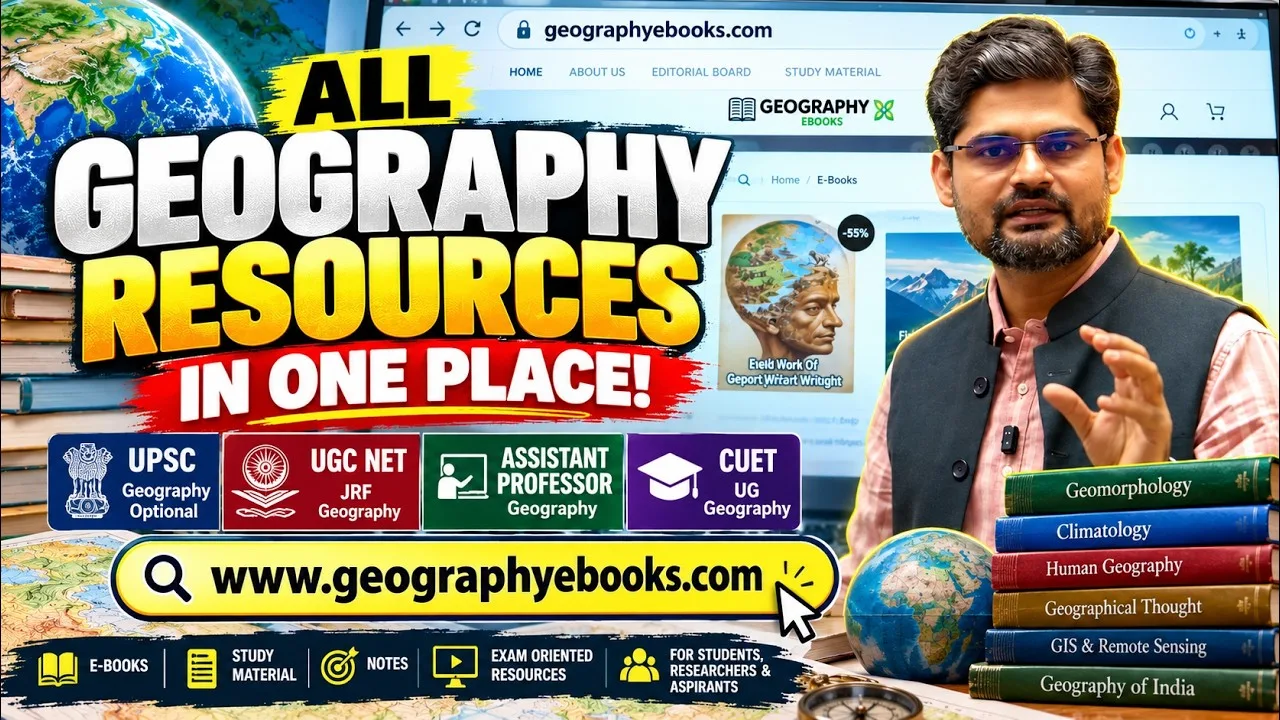
Purchasing the Simplified Oceanography eBook (2025 Edition) is straightforward through the official Geography eBooks store. The PDF delivery is instant upon payment confirmation, compatible with all devices (laptop, tablet, smartphone) and printable for offline study. The license permits personal use across multiple devices with free lifetime updates — ensuring access to 2026 syllabus revisions at no extra cost. Payment options include UPI, net banking, cards, and wallets via the secure Razorpay gateway.
For institutional bulk purchases (coaching centers, university libraries), volume discounts and site licenses are available by contacting support@thegeoecologist.com. The 30-day refund policy reflects confidence in Simplified Oceanography eBook’s utility — fewer than 2% of buyers request refunds, typically due to duplicate purchases. Join 15,000+ aspirants who have made this Simplified Oceanography eBook their primary oceanography resource for the 2025-2026 exam cycle.
Frequently Asked Questions
Yes, the 2025 Edition is fully aligned with the latest UPSC Geography Optional, UGC NET Geography Paper 2, and State PCS syllabi. It includes recent developments like the BBNJ Agreement (2023), IPCC AR6 findings, India's Deep Ocean Mission, and UN Ocean Decade updates.
The Simplified Oceanography eBook is delivered as a high-quality PDF instantly after purchase. It is compatible with laptops, tablets, and smartphones, and the license allows personal use across multiple devices with free lifetime updates for future editions.
Absolutely. Each chapter features a three-tier structure: Concept Capsules for quick revision, PYQ Analysis tagged by exam and year, and Practice Questions modeled on UPSC/UGC NET patterns with detailed model answers. QR codes link to video explanations on TheGeoecologist YouTube channel.