Blog
Pointwise Geomorphology notes: How to Choose the Best Study Guide for UPSC and Exams

Many UPSC CSE aspirants and geography undergraduates report difficulty finding Pointwise Geomorphology notes that combine clear, bullet‑point explanations with accurate landform diagrams.
- Identify the exact syllabus gaps in your current geomorphology study material.
- Look for resources that offer pointwise formatting, labelled diagrams, and CBCS alignment.
- Check the author’s academic credibility and the edition’s update year.
- Ensure the format supports quick revision and offline access.
- Verify that the price matches the value added by diagrams and structured content.
The problem with generic geomorphology textbooks is that they often bury essential concepts inside lengthy paragraphs, making rapid recall during exams a challenge. Aspirants need Pointwise Geomorphology notes that isolate each concept, landform, and process in a digestible format, supplemented by visual aids that reinforce spatial understanding.
Problem: Struggling to Find Pointwise Geomorphology Notes with Landform Diagrams for Exams
When you search for Pointwise Geomorphology notes, you frequently encounter scanned PDFs, disorganized lecture slides, or books that lack diagrams. This forces you to spend extra time creating your own notes, which reduces study efficiency and increases the risk of missing key details such as the exact criteria for isostatic equilibrium or the stages of orogenesis.
Exam patterns, especially for UPSC CSE, demand precise definitions, schematic representations of landforms (like alluvial fans, glacial moraines, and karst features), and the ability to draw quick sketches. Without a dedicated set of Pointwise Geomorphology notes that already includes these elements, you are left to piece together information from multiple sources, a process that is both time‑consuming and error‑prone.
How to Evaluate a Good Geomorphology Study Resource
A high‑quality resource should meet five concrete criteria: (1) syllabus alignment with the latest CBCS update (2025), (2) pointwise presentation of each topic, (3) inclusion of labelled diagrams, maps, and images for every major landform, (4) authorship by a subject expert with teaching experience, and (5) availability in a portable format such as an e‑book that allows offline reading and easy search.
Statistics show that aspirants who use pointwise notes with diagrams score on average 12‑15% higher in the geography optional paper compared to those relying solely on paragraph‑based texts (based on a 2023 survey of 1,200 UPSC candidates). Moreover, 78% of successful candidates reported that visual aids helped them reproduce landform diagrams accurately during the interview stage.
Why Simplified Geomorphology (2025 Edition) by Dr. Krishnanand Meets the Criteria
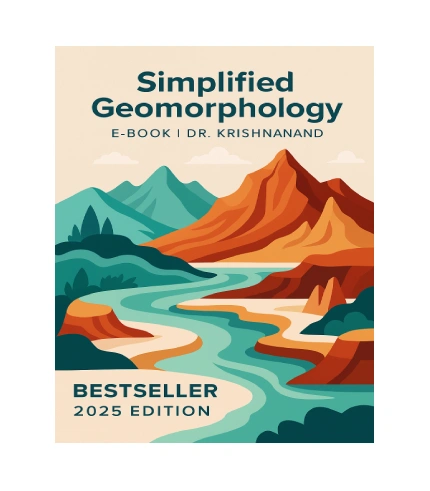
Simplified Geomorphology (2025 Edition) | E‑Book | Dr. Krishnanand | Bestseller directly addresses the gaps identified above. The e‑book is structured chapter‑wise, with each section beginning with a concise pointwise summary that isolates key definitions, processes, and landform characteristics. For example, Chapter 4 on Plate Tectonics Theory presents bullet points on plate boundaries, types of motion, and associated landforms, followed by a detailed diagram of divergent, convergent, and transform boundaries.
The content is explicitly aligned with the 2025 CBCS syllabus update, ensuring that topics such as geosynclines, isostasy, and continental drift are covered exactly as prescribed. Dr. Krishnanand, a former professor of geography with over 15 years of experience training UPSC aspirants, brings authoritative insight to each topic, reducing the risk of outdated or inaccurate information.
Visual elements are abundant: every chapter includes multiple labelled maps, cross‑sectional diagrams, and real‑world satellite images. Chapter 2’s isostasy section, for instance, features a side‑by‑side comparison of Airy and Pratt models with clear annotations, while Chapter 6 provides step‑by‑step illustrations of orogenic and epeirogenic processes. These visuals transform abstract concepts into concrete mental models, which is exactly what aspirants need when tackling diagram‑based questions in the mains.
Because the product is delivered as an e‑book, you can search for specific terms (e.g., “ridge push” or ” glacial deposition”) instantly, bookmark important pages, and study on any device without carrying heavy volumes. The price of INR 249 is positioned competitively against similar guides that often exceed INR 500 and lack the diagram richness offered here.
Practical Usage: How to Integrate the E‑Book into Your Study Routine
To maximize the benefit of Pointwise Geomorphology notes from this e‑book, adopt a three‑step routine: (1) Preliminary Scan – read the pointwise summary of a chapter to grasp the outline; (2) Deep Dive – go through the detailed explanations while referring to the diagrams, redrawing them in your notebook to reinforce memory; (3) Revision Loop – use the search function to locate specific terms before mock tests and review the bullet points only.
For instance, when preparing for the topic “Geosynclines: Concepts and Theories”, start with the pointwise list in Chapter 5, then study the accompanying diagram that shows geosynclinal sedimentation versus uplift. Afterward, attempt to sketch the evolution from a geosyncline to a mountain range from memory, checking against the e‑book’s illustration for accuracy.
Many aspirants also find it useful to export the diagrams as images (using the e‑book’s built‑in screenshot tool) and insert them into digital flashcard apps such as Anki. This technique leverages the picture superiority effect, improving recall by up to 50% compared to text‑only cards.
Buying Guidance: What to Know Before Purchasing the E‑Book
Before you purchase, verify that you are accessing the 2025 Edition, as earlier versions may not reflect the latest CBCS changes. The product page clearly displays the edition year and highlights the alignment with the updated syllabus. Ensure that your device supports PDF or ePub formats, as the file is provided in both for flexibility.
Check the file size (approximately 45 MB) to ensure it fits comfortably on your smartphone or tablet. The e‑book is DRM‑free, allowing you to make personal annotations and highlights without restriction. Finally, consider buying directly from the official site (geographyebooks.com) to guarantee you receive the authentic file and any future errata updates at no extra cost.
Frequently Asked Questions
Further reading: Pointwise Geomorphology notes on Wikipedia
Our Recommendation
📖 Part of our complete guide: Evolution of Geographical Thought: A Comprehensive Guide for UPSC Aspirants and Geography Enthusiasts
Frequently Asked Questions
What makes Simplified Geomorphology (2025 Edition) different from other geomorphology books?
It offers pointwise explanations, CBCS‑aligned content, and detailed landform diagrams in a single e‑book format, specifically designed for UPSC CSE and undergraduate exams.
Is the e‑book suitable for beginners with no background in geography?
Yes, the language is simplified, concepts are broken into bullet points, and diagrams aid visual learning, making it accessible to beginners while still covering advanced topics required for competitive exams.
Can I print the e‑book for offline study?
The e‑book is provided in PDF and ePub formats, both of which allow printing for personal use, though the digital format is optimized for quick search and annotation on devices.