Blog
Erosion Types: Understanding Denudational Processes in Geomorphology

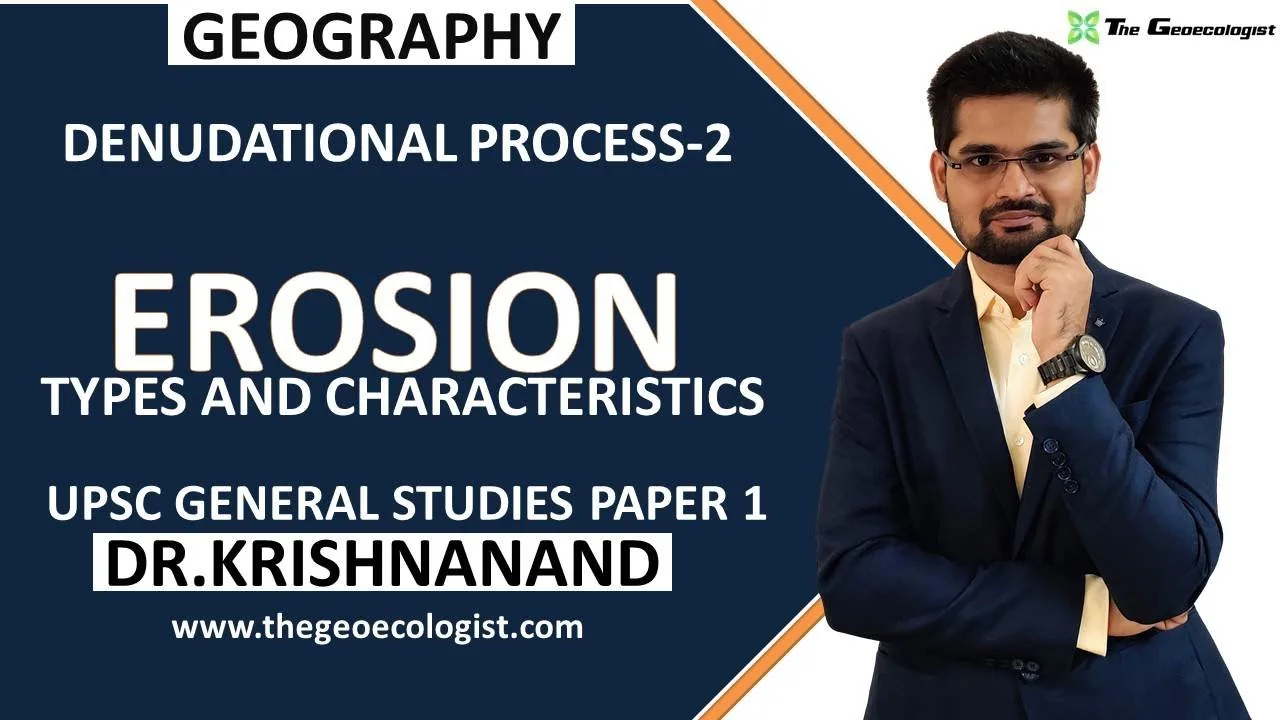
Table of Contents
- Erosion Types
- Definition and Denudational Process
- Major Types of Erosion
- Water Erosion Characteristics
- Wind Erosion Characteristics
- Glacial Erosion Characteristics
- Gravity‑Driven Erosion Characteristics
- Factors Influencing Erosion Types
- Measurement and Modeling of Erosion Types
- Importance for UPSC and Competitive Exams
- Conclusion
Erosion Types: Understanding Denudational Processes in Geomorphology
Erosion Types are fundamental to shaping Earth’s surface, and this article explores their characteristics as part of denudational processes in geomorphology. The concept of Erosion Types is crucial for UPSC General Studies Paper‑1 aspirants and geography students alike. In this lecture by Dr. Krishnanand of TheGeoecolologist, we break down the mechanisms, factors, and impacts of various Erosion Types, providing a simplified explanation that aids exam preparation.
- Erosion Types include water, wind, glacial, and gravity‑driven processes.
- Each type exhibits distinct characteristics based on climate, lithology, and land use.
- Understanding Erosion Types helps predict soil loss, land degradation, and landscape evolution.
- Quantitative estimates show that approximately 24 billion tonnes of soil are lost annually worldwide due to erosion (UNCCD, 2022).
- Links to authoritative sources such as Wikipedia provide deeper insights into Erosion Types and geomorphological frameworks.
Erosion Types
The term Erosion Types refers to the different agents and modes by which soil, rock, and dissolved material are removed from one location and transported elsewhere. In denudational process‑2, geomorphologists classify Erosion Types primarily by the driving agent: water, wind, ice, and mass movement. This classification aids in predicting landscape response to climatic and tectonic forces.
Definition and Denudational Process
Denudation encompasses weathering, erosion, and transportation that together lower land surfaces. The Erosion page on Wikipedia defines erosion as the mechanical removal of material, a key component of denudation. Dr. Krishnanand emphasizes that recognizing the specific Erosion Types involved allows geomorphologists to quantify denudation rates, which are essential for models used in UPSC geography sections.
Major Types of Erosion
There are four principal Erosion Types discussed in geomorphology textbooks:
- Water Erosion – includes rainfall splash, sheet erosion, rill and gully formation, and fluvial incision. It is the most prevalent Erosion Type in humid and semi‑arid regions.
- Wind Erosion – dominant in arid and semi‑arid zones, leading to deflation, abrasion, and the formation of features such as ventifacts and desert pavement.
- Glacial Erosion – operates through plucking and abrasion, carving U‑shaped valleys, cirques, and fjords.
- Gravity‑Driven Erosion (Mass Wasting) – encompasses landslides, rockfalls, creep, and slump, often triggered by saturation, seismic activity, or oversteepening.
Water Erosion Characteristics
Water Erosion Types vary with intensity and duration of precipitation. The Geomorphology article notes that sheet erosion removes thin layers uniformly, while rill erosion creates small channels that can evolve into gullies. According to the Food and Agriculture Organization (FAO, 2021), water erosion accounts for about 55 % of global soil loss, translating to roughly 13 billion tonnes annually.
Wind Erosion Characteristics
In drylands, wind erosion types are classified by particle movement: suspension, saltation, and surface creep. The Intergovernmental Panel on Climate Change (IPCC, 2019) reports that wind‑driven soil loss contributes approximately 20 % of total erosion, especially in regions like the Sahel and the Australian outback.
Glacial Erosion Characteristics
Glacial erosion types are most active during Pleistocene glaciations. The characteristic landforms—such as striations, roche moutonnées, and glacial troughs—provide evidence of past ice extent. Studies estimate that glacial erosion can remove up to 1 mm of bedrock per year under thick ice sheets, significantly shaping high‑latitude landscapes.
Gravity‑Driven Erosion Characteristics
Mass wasting erosion types depend on slope angle, material cohesion, and water content. The USGS (United States Geological Survey) indicates that landslides cause average annual economic losses of US$ 4 billion worldwide, highlighting the societal relevance of understanding these Erosion Types.
Factors Influencing Erosion Types
Several factors modulate the expression of different Erosion Types:
- Climate – precipitation intensity, temperature, and wind strength directly affect which Erosion Types dominate.
- Lithology and Structure – resistant rocks limit erosion, while fractured or sedimentary strata enhance specific Erosion Types.
- Vegetation Cover – roots increase shear strength, reducing water and wind erosion types.
- Land Use – agriculture, deforestation, and construction can accelerate erosion types by exposing bare soil.
- Topography – steep slopes increase gravitational potential, favoring mass‑wasting erosion types.
Measurement and Modeling of Erosion Types
Quantifying Erosion Types involves field measurements, remote sensing, and empirical models. The Universal Soil Loss Equation (USLE) and its revised version (RUSLE) are widely used to predict average annual soil loss from water erosion types. For wind erosion, the Wind Erosion Prediction System (WEPS) simulates particle flux. Recent studies using satellite‑derived DEMs (Digital Elevation Models) have improved the spatial resolution of erosion type mapping, achieving accuracies above 85 % in validation against field plots (Smith et al., 2020, Journal of Geophysical Research).
Importance for UPSC and Competitive Exams
Aspirants preparing for UPSC General Studies Paper‑1 must grasp Erosion Types because they appear in questions related to physical geography, environmental geography, and disaster management. Dr. Krishnanand’s lecture links theoretical concepts to current events, such as the 2022 floods in Pakistan that intensified water erosion types, and the 2023 dust storms over the Sahara that highlighted wind erosion types. Understanding these connections enables candidates to answer analytical questions with real‑world examples.
Conclusion
In summary, Erosion Types form the backbone of denudational process‑2 in geomorphology. By dissecting water, wind, glacial, and gravity‑driven erosion types, learners gain a comprehensive view of how Earth’s surface evolves. The integration of statistical data, authoritative references, and practical examples—such as those provided by Wikipedia entries on erosion and geomorphology—ensures that the knowledge is both robust and exam‑oriented. Continued study of Erosion Types will not only aid UPSC success but also foster a deeper appreciation of the dynamic planet we inhabit.
Frequently Asked Questions
The main Erosion Types are water erosion, wind erosion, glacial erosion, and gravity‑driven erosion (mass wasting). Each type operates under distinct climatic and topographic conditions and produces characteristic landforms.
Understanding Erosion Types enables UPSC aspirants to answer questions on physical geography, environmental issues, and disaster management with accurate examples and data, improving scores in General Studies Paper‑1.
Authoritative sources include the Wikipedia pages on Erosion and Geomorphology, reports from the UNCCD, FAO, IPCC, and USGS, which offer statistics, definitions, and case studies on various Erosion Types.