Blog
Greek Scholars(Part 2)-Geographical Thought-TheGeoecologist

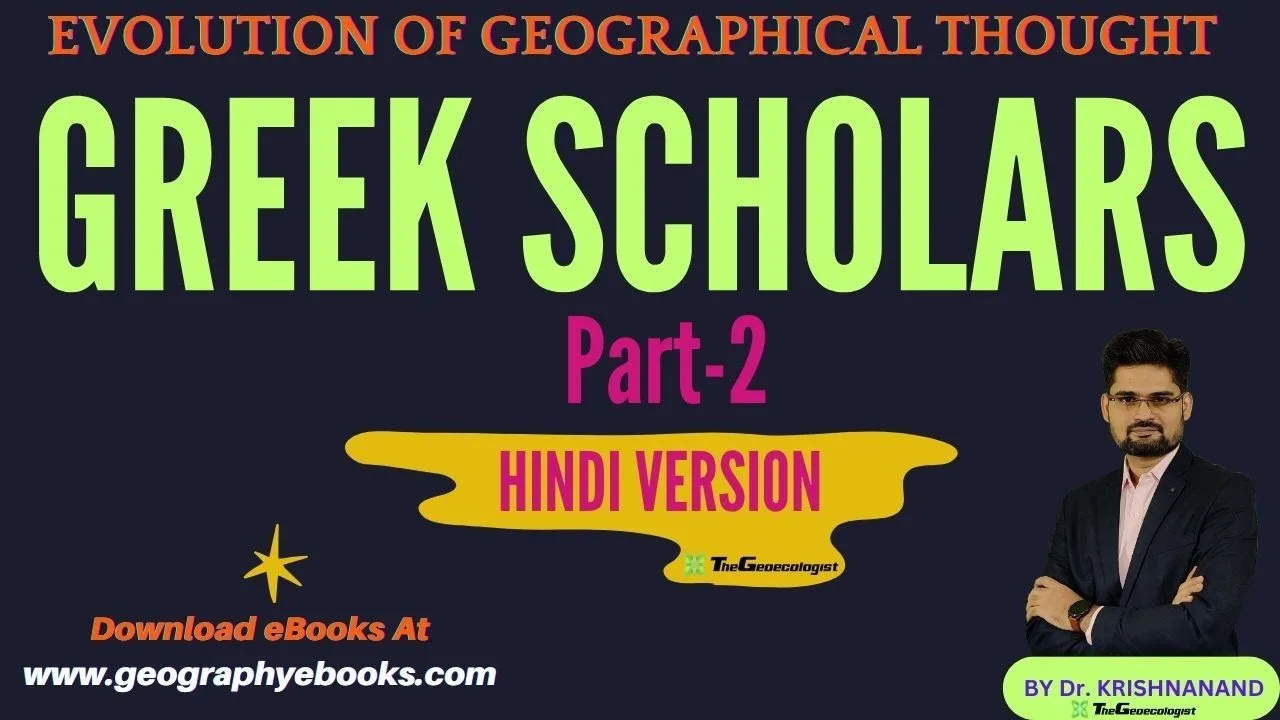
Greek Scholars(Part 2)-Geographical Thought-TheGeoecologist
Greek Scholars and Their Contributions to Geographical Thought – Part 2
Welcome back to TheGeoecologist! In this second part of our series on the Evolution of Geographical Thought, we delve deeper into the remarkable contributions of Greek scholars to the field of geography. This video is specially designed for UPSC aspirants, geography students, and beginners who wish to understand the foundations of modern geographical thinking. Let’s explore the legacy of these ancient thinkers and their enduring impact on the discipline.
Key Contributions of Greek Scholars
Eratosthenes: The Father of Geography
Often hailed as the "Father of Geography," Eratosthenes made groundbreaking contributions to the field. His most notable achievement was the accurate measurement of the Earth’s circumference. Using simple yet ingenious methods involving shadows cast by the sun, he calculated the Earth’s size with astounding precision for his time. This feat not only demonstrated the scientific approach to geography but also laid the foundation for future explorations and cartography.Hipparkus: Mapping and Astronomical Navigation
Hipparkus, a renowned astronomer and geographer, made significant strides in mapping and navigation. He introduced the concept of latitude and longitude, enabling more accurate spatial representation of the Earth. His work on celestial navigation also provided a scientific basis for understanding the Earth’s relationship with heavenly bodies, which was crucial for early explorers and navigators.- Strabo: The Geographica and Its Importance
Strabo’s magnum opus, Geographica, is one of the most comprehensive geographical works of antiquity. It compiled knowledge about the known world, describing the physical and cultural characteristics of various regions. His emphasis on the interconnectedness of geography, history, and culture provided a holistic approach to the study of the Earth. Geographica remains a vital historical and geographical resource even today.
The Scientific Approach to Geography
Greek scholars were among the first to apply a scientific approach to geography. They emphasized observation, measurement, and logical reasoning, moving away from mythological explanations. This shift laid the groundwork for modern geography, which relies on empirical data and analytical methods.
Map Construction Techniques and Spatial Analysis
The Greeks developed advanced techniques for map construction and spatial analysis. Their use of geometry and mathematics in mapping set the stage for modern cartography. These techniques not only improved the accuracy of maps but also enhanced the understanding of spatial relationships, which is a cornerstone of contemporary geography.
The Legacy of Greek Ideology in Modern Geography
The intellectual heritage of Greek scholars continues to influence modern geography. Their emphasis on systematic study, accurate measurement, and holistic understanding of the Earth’s features remain relevant. Modern geographical tools, such as GIS (Geographic Information Systems) and satellite mapping, owe their origins to the foundational work of these ancient thinkers.
Join the Geoecologist Community
🔔 Subscribe to TheGeoecologist channel for more insightful videos on geography, environmental studies, and related topics. Like, share, and comment with your thoughts on this video! Let’s continue learning and exploring the fascinating world of geography together.
📚 For additional study materials, visit our website: https://thegeoecologist.com/
📲 Follow us on Instagram: https://www.instagram.com/thegeoecologist/
🎥 Join our YouTube community for exclusive access to resources: https://www.youtube.com/channel/UC3-k-h857r2woueejagk8g/join
Thank you for watching, and stay tuned for more enriching content on the Evolution of Geographical Thought!
Greekscholars #Geographyleectures #UPSCGeography #TheGeoecologist #GeographyHistory
To Download E-Books & Study Material Visit The Shop Page