Blog
globalisation spatial restructuring: How Simplified Economic Geography (2025 Edition) Helps UPSC Aspirants Master Global Supply Chain Trends

Understanding globalisation spatial restructuring is essential for anyone studying economic geography, especially UPSC CSE aspirants who must grasp how global supply chains are reshaped by technological advances, trade policies, and regional disparities. The term captures the shifting locations of production, logistics networks, and market access that define the modern world economy. Without a clear framework, students often find themselves lost amid fragmented case studies and abstract theories, making exam preparation frustrating and inefficient.
- Learn the core drivers behind globalisation spatial restructuring and its impact on trade patterns.
- Discover how the CBCS‑aligned chapters in Simplified Economic Geography (2025 Edition) break down complex concepts into point‑wise highlights.
- Get practical tips for using the e‑book’s diagrams, maps, and summary tables to revise quickly and retain information.
- See why this resource is a bestseller among geography undergraduates and competitive‑exam candidates.
- Find clear buying guidance and access instructions to start studying immediately.
Understanding Globalisation and Spatial Restructuring of Supply Chains
The phenomenon of globalisation spatial restructuring refers to the reorganisation of economic activities across space as firms seek lower costs, proximity to markets, and advantages from agglomeration economies. According to the World Bank, global trade volumes have grown from US$ 6 trillion in 2000 to over US$ 28 trillion in 2023, reflecting deeper integration and the relocation of manufacturing to Asia, Eastern Europe, and parts of Latin America (World Bank GDP data). This shift is not random; it follows patterns explained by theories such as the new economic geography, which emphasises transport costs, economies of scale, and labour‑market pooling. For UPSC aspirants, mastering these ideas means being able to answer questions on regional disparities, special economic zones, and the impact of trade agreements like RCEP or USMCA.
Why Aspirants Struggle with Economic Geography Concepts
Many candidates report difficulty with economic geography because traditional textbooks present dense paragraphs, limited visual aids, and minimal connection to current events. The syllabus demands familiarity with topics such as factor‑cost analysis, location‑quotient calculations, and the classification of economic activities into primary, secondary, tertiary, quaternary, and quinary sectors. When learners encounter jargon like “agglomeration economies” or “footloose industries” without clear examples, retention drops. Moreover, the dynamic nature of globalisation spatial restructuring means that outdated case studies (e.g., focusing solely on 1990s textile shifts) can mislead. A resource that updates examples, uses diagrams, and ties each concept to the prescribed CBCS syllabus becomes indispensable for effective learning.
How Simplified Economic Geography (2025 Edition) Aligns with CBCS Syllabus
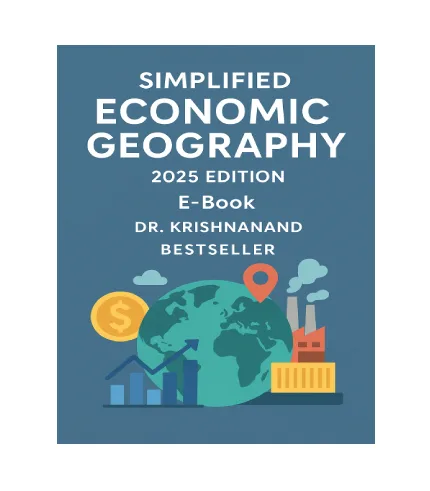
Simplified Economic Geography (2025 Edition) by Dr. Krishnanand is explicitly designed to meet the CBCS (Choice Based Credit System) curriculum for undergraduate geography programmes across Indian universities. The e‑book follows the unit‑wise structure prescribed in the syllabus, ensuring that every chapter maps directly to a required topic. For instance, Chapter 3 (“Factors affecting the location of economic activities”) covers location theories, weight‑loss/gain analysis, and agglomeration forces—exactly the concepts needed to analyse globalisation spatial restructuring. The product description highlights that the e‑book is on the prescribed CBCS syllabus, and the point‑wise highlighted descriptions, along with diagrams, maps, and images, make it more comprehensive and interesting for readers. This alignment reduces the need to cross‑reference multiple sources, saving valuable study time.
Key Chapters Covering Supply Chain Topics
Several chapters in Simplified Economic Geography (2025 Edition) directly address the mechanics of globalisation spatial restructuring:
- Chapter 4: Primary Activities – Explores agriculture, forestry, fishing, and mining, showing how resource extraction locations shift with global demand and technological change (e.g., move of rare‑earth mining to Australia and Canada).
- Chapter 5: Secondary Activities (manufacturing) – Details manufacturing industries, including the rise of electronics hubs in Vietnam and Mexico, illustrating spatial relocation driven by labour costs and trade incentives.
- Chapter 6: Tertiary Activities – Quaternary & Quinary Activities – Explains the growth of services, IT, and knowledge‑based sectors, highlighting how Bengaluru and Hyderabad have become global service centres.
- Chapter 7: Manufacturing Regions – Industrial Regions – Examines established industrial belts (e.g., Pearl River Delta, Ruhr Valley) and emerging corridors, linking them to global value chains.
Each chapter uses bullet‑point summaries, coloured maps, and concise diagrams that make it easy to visualise the spatial shifts associated with globalisation spatial restructuring. This format is especially useful for quick revision before exams.
Practical Tips for Using the E‑Book in Exam Preparation
To maximise the benefit of Simplified Economic Geography (2025 Edition) for mastering globalisation spatial restructuring, consider the following strategies:
- Active Reading: After each highlighted point, pause and ask yourself how the concept explains a real‑world example (e.g., why smartphone assembly moved from China to India). Write a one‑sentence answer in the margin.
- Map‑Based Recall: Use the maps in Chapters 4 and 7 to trace the movement of specific industries over decades. Try to redraw them from memory.
- Diagram‑Driven Explanations: The diagrams illustrating agglomeration economies or footloose industries can be reproduced in answers to score marks for clarity.
- Integrate Current Affairs: Pair the e‑book’s theoretical framework with recent news (e.g., the China‑Plus‑One strategy) to demonstrate application—a key differentiator in UPSC mains.
- Regular Self‑Test: At the end of each chapter, attempt the practice questions provided (if any) or create your own based on the bullet points.
By following these steps, the abstract notion of globalisation spatial restructuring becomes a concrete tool for answering both preliminary and mains questions.
Comparing with Other Resources
Many aspirants rely on generic geography textbooks or coaching notes that often lack the latest data on globalisation spatial restructuring. For example, a widely used reference from the early 2010s still emphasises the dominance of Western Europe in manufacturing, missing the rapid rise of Southeast Asian hubs. In contrast, Simplified Economic Geography (2025 Edition) incorporates post‑2020 trends such as supply‑chain diversification after the pandemic and the impact of the Ukraine conflict on energy‑intensive industries. The e‑book’s price of ₹ 249 is competitive compared to printed volumes that can exceed ₹ 800, and its digital format allows instant access, searchability, and portable study on smartphones or tablets. Moreover, the author’s reputation as a bestseller in the geography e‑book niche adds confidence that the content has been vetted by a large readership.
Buying Guide and Access Instructions
Purchasing Simplified Economic Geography (2025 Edition) is straightforward. Visit the product page at https://geographyebooks.com/product/simplified-economic-geography/ and click the “Buy Now” button. After completing the payment of ₹ 249, you will receive an immediate download link for the PDF e‑book, which can be saved on any device. No subscription or recurring fees are involved. Because the product is delivered digitally, you can start studying within minutes—ideal for last‑minute revision before a test or for integrating the latest updates on globalisation spatial restructuring into your answer writing practice.
Our Recommendation
📖 Part of our complete guide: Evolution of Geographical Thought: A Comprehensive Guide for UPSC Aspirants and Geography Enthusiasts
Frequently Asked Questions
What is globalisation spatial restructuring and why is it important for UPSC?
Globalisation spatial restructuring refers to the shifting location of economic activities—such as manufacturing, services, and resource extraction—driven by cost considerations, trade policies, and technological change. For UPSC aspirants, understanding this concept helps answer questions on regional disparities, industrial corridors, and the impact of global trade agreements, which frequently appear in both Prelims and Mains.
How does Simplified Economic Geography (2025 Edition) cover the topic of global supply chains?
The e‑book includes dedicated chapters on Primary, Secondary, Tertiary, Quaternary, and Quinary activities, each with point‑wise explanations, diagrams, and maps that illustrate how factors like labour costs, agglomeration economies, and trade incentives cause the spatial relocation of industries—core aspects of globalisation spatial restructuring.
Is the content of this e‑book aligned with the undergraduate geography syllabus?
Yes. Simplified Economic Geography (2025 Edition) is explicitly designed to meet the CBCS (Choice Based Credit System) syllabus prescribed for geography programmes in Indian universities, ensuring that every chapter maps directly to required topics such as location theories, economic development measurement, and industrial regions.