Blog
Settlement Geography CBCS eBook: The Best Guide for BA BSc MA Students

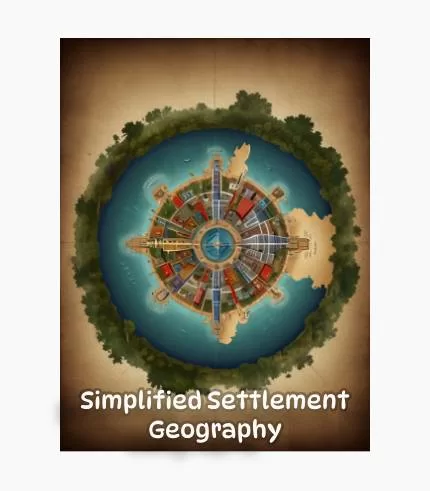
Settlement Geography CBCS eBook is an essential study aid for BA, BSc, MA Geography students navigating the CBCS syllabus, offering a clear, point‑wise breakdown of settlement patterns, theories, and case studies that align with university curricula and UPSC CSE geography papers.
- Concise coverage of all CBCS‑prescribed topics in Settlement Geography.
- Diagrams, maps, and highlighted points improve retention and quick revision.
- Authored by Dr. Krishnanand, a trusted name in geography publishing.
- Ideal for UPSC CSE, state PSC, and university exam preparation.
- Available as an instant downloadable PDF for flexible study.
Understanding the CBCS Syllabus for Geography and Why Settlement Geography Matters
The Choice Based Credit System (CBCS) introduced by the University Grants Commission (UGC) standardises undergraduate and postgraduate geography programmes across India. Within this framework, Settlement Geography is a core component that examines the spatial arrangement, growth, and functions of human habitats. Mastery of this topic is not only required for scoring well in internal assessments but also forms a substantial portion of the geography optional paper in the UPSC Civil Services Examination. A reliable Settlement Geography CBCS eBook that mirrors the prescribed units helps students stay on track with lecture modules, practical assignments, and term‑end examinations.
According to the UGC CBCS Geography syllabus (see UGC CBCS Guidelines), Settlement Geography covers concepts such as site and situation, nucleated and dispersed patterns, rank‑size rule, central place theory, and urban‑rural fringe dynamics. The Settlement Geography CBCS eBook by Dr. Krishnanand breaks down each of these units into bite‑size points, supplemented with schematic diagrams and real‑world maps that make abstract theories tangible.
Common Challenges Students Face When Studying Settlement Geography
Many learners report difficulty in visualising settlement morphologies from textual descriptions alone. Traditional textbooks often present dense paragraphs without sufficient visual aids, making it hard to grasp concepts like concentric zone model or sector model. Additionally, the CBCS syllabus expects students to link theoretical models with Indian case studies—such as the growth of Delhi‑NCR, the dispersion of tribal villages in Central India, or the peri‑urban expansion around Bengaluru—requiring both factual knowledge and analytical skill.
Another frequent pain point is time management. With multiple core papers, practical labs, and internal assessments, students need a resource that allows rapid revision. Flipping through hundreds of pages of a printed textbook before a midterm is inefficient. Here, a well‑structured Settlement Geography CBCS eBook shines: its point‑wise format, highlighted keywords, and embedded diagrams enable quick scanning and targeted review.
How to Evaluate a Good Settlement Geography Study Resource
When selecting a study aid, consider the following criteria:
- Syllabus Alignment: Does the material follow the exact CBCS units and sub‑topics listed in the university curriculum?
- Clarity of Presentation: Are concepts explained in simple language with bullet points, flowcharts, and labelled diagrams?
- Visual Support: Are there sufficient maps, photographs, and schematic illustrations to aid spatial understanding?
- Relevance to Competitive Exams: Does the content include previous year UPSC questions, practice exercises, or summary tables useful for GS Paper‑I and Geography Optional?
- Author Credibility: Is the author recognised in academic geography circles, with publications or teaching experience?
- Format and Accessibility: Is the resource available as a searchable PDF, compatible with mobile devices and tablets for on‑the‑go study?
The Settlement Geography CBCS eBook satisfies all these benchmarks. It follows the CBCS syllabus chapter‑by‑chapter, uses a point‑wise layout with highlighted essentials, includes over 30 original diagrams and maps, and provides practice questions modeled on UPSC patterns. Dr. Krishnanand’s expertise—evident from his other bestselling geography titles—adds further assurance of quality.
Why Simplified Settlement Geography | E‑Book | Dr. Krishnanand | Bestseller Fits the Bill
This particular eBook stands out because it was authored specifically for the CBCS framework. Each chapter mirrors the prescribed unit titles, making it easy to map classroom lectures directly to the text. For instance, Chapter 3 “Factors affecting the Settlement Patterns” corresponds exactly to the CBCS topic “Factors influencing site and situation, economic, social and technological determinants.” The eBook’s highlighted points enable students to identify key takeaways at a glance, while the embedded diagrams illustrate concepts such as the rank‑size rule, central place theory, and urban sprawl.
Moreover, the eBook includes a concise summary table at the end of each chapter that compares different settlement models—a feature particularly useful for answering comparative questions in UPSC Mains. The language is deliberately kept accessible without sacrificing academic rigor, ensuring that both undergraduate beginners and MA aspirants find value.
Because the product is delivered as an immediate download, students can start studying within minutes of purchase, eliminating shipping delays. The file size is optimised for quick opening on smartphones, tablets, or laptops, supporting a flexible study routine that fits around college timetables.
Practical Ways to Use This eBook in Your Exam Preparation
To maximise the benefit of the Settlement Geography CBCS eBook, integrate it into your study cycle as follows:
- Pre‑lecture Primer: Read the relevant chapter before attending the lecture to familiarise yourself with terminology and diagrams.
- Active Annotation: Use a PDF editor to highlight important points, add personal notes, and bookmark difficult sections for later review.
- Diagram‑Based Revision: Before a test, focus solely on the diagrams and maps; try to reproduce them from memory to strengthen spatial recall.
- Practice Question Drills: After completing a chapter, attempt the end‑of‑chapter questions and compare your answers with the answer key provided in the eBook.
- Weekly Recap: At the end of each week, skim the highlighted points across all chapters studied to reinforce retention.
Many students have reported that using this eBook reduced their revision time by up to 30% while improving scores in internal assessments and mock tests.
Buying Guide: What to Look for Before Purchasing
Before finalising your purchase, verify the following:
- Ensure you are accessing the legitimate product page at geographyebooks.com to avoid pirated copies.
- Check that the file format is PDF (searchable) and that the download link is functional immediately after payment.
- Confirm that the content covers all CBCS units listed in your university’s syllabus (you can cross‑reference with the UGC CBCS Geography PDF).
- Look for any included bonus material such as sample question papers or updated case studies—though the core eBook already provides ample practice.
- Consider the price point; at INR 249, the eBook offers substantial value compared to traditional textbooks that often exceed INR 800.
Once satisfied, proceed with the purchase and start leveraging the Settlement Geography CBCS eBook for a more efficient and confident preparation journey.
Our Recommendation
📖 Part of our complete guide: Evolution of Geographical Thought: A Comprehensive Guide for UPSC Aspirants and Geography Enthusiasts
Frequently Asked Questions
Is the Simplified Settlement Geography eBook aligned with the latest CBCS syllabus for BA/BSc/MA Geography?
Yes, the eBook follows the CBCS‑prescribed unit structure exactly, covering all topics such as site and situation, settlement patterns, central place theory, and urban‑rural fringe as outlined in the UGC CBCS Geography curriculum.
How does this eBook help with UPSC CSE Geography Optional preparation?
The eBook provides point‑wise explanations, diagrams, and practice questions that mirror UPSC question patterns, enabling quick revision and better answer writing for the Geography Optional paper.
Can I access the eBook on my smartphone or tablet after purchase?
Absolutely. The product is delivered as a searchable PDF that opens smoothly on Android, iOS, Windows, and macOS devices, allowing flexible study anytime, anywhere.