Blog
Geography Optional Strategy: Sonnet Jose AIR 54 UPSC 2024

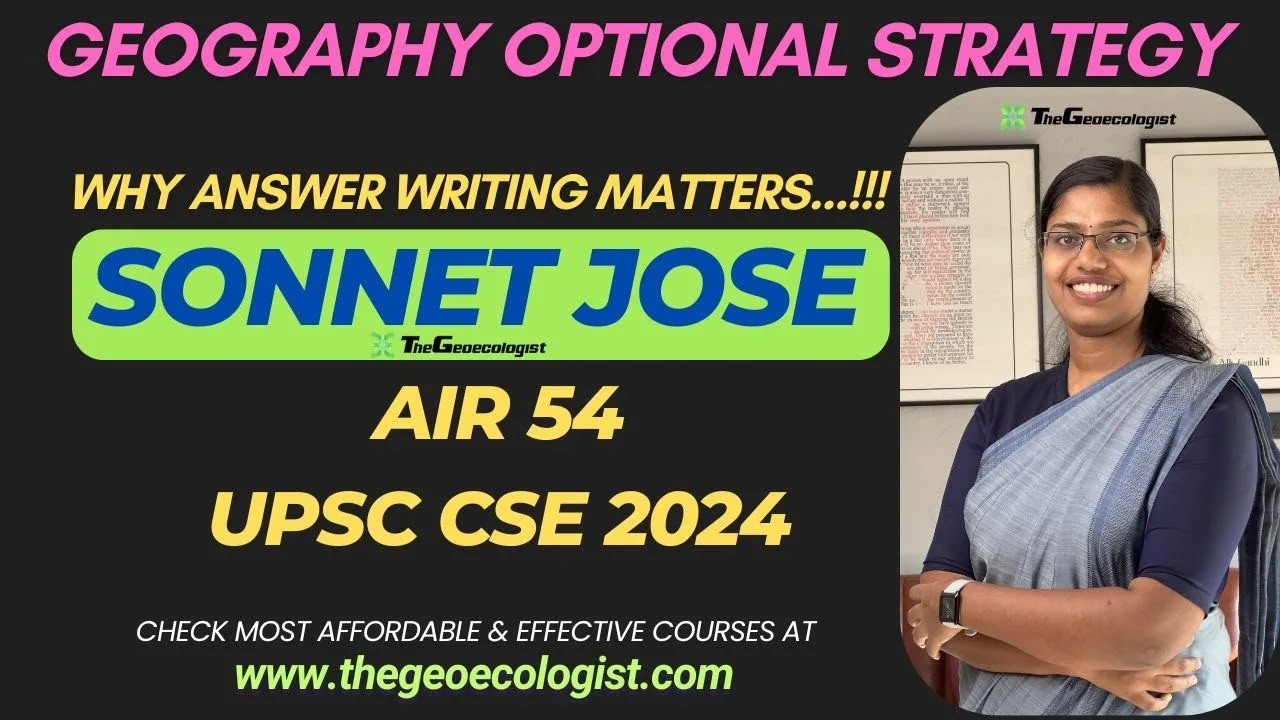
Table of Contents
- Why This Geography Optional Strategy Works: The AIR 54 Blueprint
- The Answer Writing Imperative
- Structuring High-Scoring Answers: The 3-Part Framework
- 1. Introduction (10-15% of word limit)
- 2. Body (70-80% of word limit)
- 3. Conclusion (10-15% of word limit)
- Resource Strategy: The Minimalist Maximum
- Top 4 Mistakes That Cost Marks — And How to Fix Them
- Mistake 1: Treating NCERTs as "Just Basics"
- Mistake 2: Coaching Note Dependency
- Mistake 3: Previous Year Paper Neglect
- Mistake 4: Text-Heavy, Diagram-Light Answers
- Time Management & Revision Architecture
- Daily Schedule (6-8 Effective Hours)
- Weekly & Monthly Cadence
- Mindset Mastery: Lessons from the Topper's Journey
- Battling Self-Doubt
- Current Affairs Integration
- How TheGeoecologist Implements This Strategy
- Frequently Asked Questions
- Is Geography Optional scoring for UPSC CSE 2025?
- How many months are needed to complete Geography Optional?
- Can I prepare Geography Optional without coaching?
- Final Word: Your Geography Optional Strategy Starts Today
The Geography Optional Strategy that propelled Sonnet Jose to All India Rank 54 in UPSC CSE 2024 offers a masterclass in smart preparation. In an exclusive session hosted by Dr. Krishnanand, founder of TheGeoecologist, Sonnet decoded the exact blueprint that helped her secure 300+ marks in Geography Optional. This comprehensive guide distills her insights on answer writing, resource selection, time management, and the mindset required to crack one of UPSC’s most popular optional subjects.
- Answer writing is the single biggest differentiator — practice 2-3 answers daily with weekly mock tests.
- Structure answers with Introduction (10-15%), Body (70-80%), Conclusion (10-15%) using diagrams, flowcharts, and case studies.
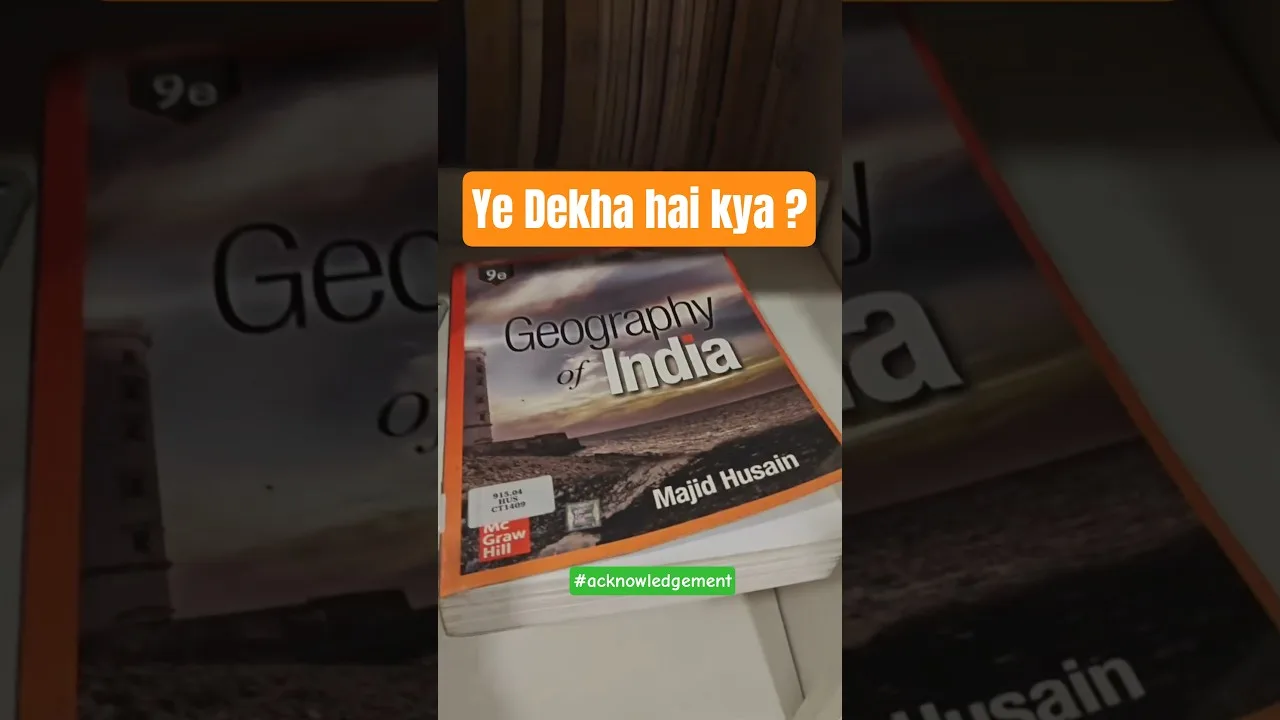
- Core resources: NCERTs (Class 11-12), Savindra Singh (Physical), Majid Hussain (Human), Khullar/Leong (Indian Geography).
- Avoid common pitfalls: ignoring NCERTs, over-reliance on coaching notes, neglecting previous year papers, and writing vague answers without visuals.
- Allocate 60% study time to Optional, maintain 6-8 hours of efficient daily study, and link static concepts to current affairs.
Why This Geography Optional Strategy Works: The AIR 54 Blueprint
Sonnet Jose’s Geography Optional Strategy wasn’t built on endless reading — it was forged through deliberate answer-writing practice. “Mere knowledge isn’t enough; how you present it matters,” she emphasizes. The UPSC examiner evaluates hundreds of scripts daily; clarity, structure, and visual appeal determine whether your answer stands out. Sonnet’s approach prioritizes smart work over hard work: 6-8 hours of focused study trumps 12 hours of passive reading.
The Answer Writing Imperative
Many aspirants accumulate vast knowledge but falter in the exam hall because they lack structured answer-writing skills. Sonnet’s Geography Optional Strategy treats answer writing as a separate skill requiring daily cultivation. She recommends:
- Daily practice: 2-3 answers under timed conditions
- Weekly ritual: One full-length mock test simulating exam pressure
- Feedback loop: Self-evaluation using previous year question papers and model answers
This regimen builds the muscle memory needed to produce coherent, well-illustrated answers within the 7-8 minute per question constraint. The UPSC official notification consistently emphasizes “the candidate’s ability to present knowledge in a clear and concise manner” — a direct validation of this approach.
Structuring High-Scoring Answers: The 3-Part Framework
Every high-scoring answer in Sonnet’s Geography Optional Strategy follows a rigid architecture designed for examiner readability:
1. Introduction (10-15% of word limit)
- Define key terms precisely (e.g., “Plate Tectonics is the theory explaining lithospheric plate movements…”)
- Contextualize with a recent example (e.g., “The 2023 Turkey-Syria earthquake exemplifies transform boundary activity…”)
- One-sentence thesis statement outlining the answer’s trajectory
2. Body (70-80% of word limit)
- Subheadings & bullet points for scannability — examiners award marks for structure
- Diagrams & maps are non-negotiable: Köppen’s climate classification, Weber’s industrial location model, drainage patterns, population pyramids
- Statement + Example + Data triad: Theory → Case study (e.g., Silicon Valley for agglomeration economies) → Government report statistic (Census 2011, IMD, SOE)
- Interlink Paper 1 (Physical/Human) and Paper 2 (Indian Geography) concepts wherever possible
3. Conclusion (10-15% of word limit)
- Summarize 3-4 key takeaways
- Link to contemporary relevance: climate change impacts on monsoon, urban flooding in Bengaluru, Arctic amplification
- Forward-looking statement: policy implication or sustainable development angle
This framework transforms information into insight — exactly what UPSC rewards.
Resource Strategy: The Minimalist Maximum
Sonnet’s Geography Optional Strategy advocates a tight resource list mastered thoroughly over a broad list touched superficially:
| Paper | Core Books | Supplementary |
|---|---|---|
| Paper 1: Physical Geography | Savindra Singh — Physical Geography | TheGeoecologist YouTube explanations, NCERT Class 11 |
| Paper 1: Human Geography | Majid Hussain — Human Geography | Government reports (SOE, NITI Aayog), Economic Survey |
| Paper 2: Indian Geography | D.R. Khullar / G.C. Leong | Census 2011 data, India Year Book, TheGeoecologist map series |
| Foundation (Both Papers) | NCERT Class 11 & 12 (Fundamentals of Physical Geography, India: Physical Environment, Human Geography) | Previous Year Questions (2013-2024) — trend analysis |
The Geography Optional Strategy warns against two resource traps: (1) Ignoring NCERTs — they build the conceptual vocabulary examiners expect, and (2) Over-reliance on coaching notes without cross-referencing standard texts. Sonnet’s rule: “If you can’t explain it using Savindra Singh or Majid Hussain, you don’t own the concept.”
Top 4 Mistakes That Cost Marks — And How to Fix Them
Mistake 1: Treating NCERTs as “Just Basics”
NCERT Class 11-12 Geography textbooks are not stepping stones — they are the bedrock. UPSC frequently lifts definitions, classifications, and map-based questions directly from NCERT language. Sonnet’s fix: Complete NCERTs twice before touching any reference book.
Mistake 2: Coaching Note Dependency
Coaching notes condense information but often strip away the “why” and “how.” The Geography Optional Strategy demands cross-referencing: read a topic in Savindra Singh, then check how the same topic appears in previous year papers, then synthesize your own note.
Mistake 3: Previous Year Paper Neglect
PYQs (2013-2024) reveal repeating themes: climatology (monsoon mechanisms, Köppen), geomorphology (cycle of erosion, plate tectonics), population models, and regional planning. Sonnet’s fix: Maintain a PYQ spreadsheet tagged by syllabus topic; revise monthly.
Mistake 4: Text-Heavy, Diagram-Light Answers
Geography is inherently visual. Answers without sketch maps, flowcharts, or annotated diagrams rarely cross 130/250. The Geography Optional Strategy mandates: every 150-word answer must contain at least one diagram. Practice drawing India’s physiographic divisions, pressure belts, and industrial corridors until they take <30 seconds.
Time Management & Revision Architecture
Balancing GS + Optional is the aspirant’s tightrope walk. Sonnet’s Geography Optional Strategy allocates 60% of daily study hours to Optional because:
- Optional marks are more controllable than GS (predictable syllabus, repeatable patterns)
- High Optional score (300+) compensates for GS volatility
- Geography Optional overlaps ~30% with GS Paper 1 & 3 (environment, disaster management, agriculture, industry)
Daily Schedule (6-8 Effective Hours)
- Morning (2 hrs): New concept study + note-making (one sub-topic)
- Afternoon (2 hrs): Answer writing practice (2-3 questions)
- Evening (1-2 hrs): Map practice / diagram drills / current affairs linkage
- Night (30 min): Quick revision of morning’s concept
Weekly & Monthly Cadence
- Weekly: One full-length test (Paper 1 or Paper 2 alternating) under exam conditions
- Monthly: Revise all important maps, models, and theories; update current affairs linkages
- Pre-Mains (Last 60 days): 3 full-length tests per week; exclusive focus on answer presentation
Mindset Mastery: Lessons from the Topper’s Journey
Sonnet’s Geography Optional Strategy acknowledges the psychological battle:
“Every aspirant faces lows — keep faith in your preparation. Consistency over burnout: study 6-8 hours efficiently, not 12 hours mindlessly. Geography is dynamic — link theories to current events (Arctic amplification, urban floods, changing cropping patterns). UPSC rewards those who think critically!”
Battling Self-Doubt
Imposter syndrome peaks during mock test slumps. Sonnet’s antidote: maintain a “wins journal” — record every improved answer, every diagram mastered, every PYQ solved. Progress is non-linear; trust the Geography Optional Strategy process.
Current Affairs Integration
Static geography comes alive when anchored to news. Examples from Sonnet’s preparation:
- Climatology: IPCC AR6 findings → monsoon variability questions
- Urban Geography: Bengaluru floods 2022/2023 → urbanization challenges, sustainable drainage
- Oceanography: Arctic amplification → impact on Indian monsoon, sea-level rise
- Agriculture: Millet Mission 2023 → crop diversification, nutritional security
This dynamic approach transforms Geography from a memory subject into an analytical toolkit — the hallmark of Sonnet’s Geography Optional Strategy.
How TheGeoecologist Implements This Strategy
Dr. Krishnanand’s platform operationalizes Sonnet’s blueprint through structured offerings:
- Answer Writing Course: Daily questions, model answers, personalized feedback (register via Google Form)
- Geography Optional Comprehensive Course: Full syllabus coverage with diagram banks, map workbooks, PYQ analysis (thegeoecologist.com)
- Free YouTube Content: Concept explanations, map tutorials, strategy sessions (Subscribe: THEGEOECOLOGIST)
The Geography Optional Strategy ecosystem ensures aspirants don’t just consume content — they produce answers.
Frequently Asked Questions
Is Geography Optional scoring for UPSC CSE 2025?
Yes, Geography remains one of the highest-scoring optionals with a predictable syllabus, significant GS overlap (~30%), and abundant resources. Sonnet Jose’s 300+ marks in CSE 2024 confirms its scoring potential when paired with the right Geography Optional Strategy.
How many months are needed to complete Geography Optional?
5-6 months for first reading + note-making (3-4 hrs/day), followed by 2-3 months of answer writing + revision. The Geography Optional Strategy emphasizes: depth over speed — master Savindra Singh and Majid Hussain rather than rushing through multiple books.
Can I prepare Geography Optional without coaching?
Absolutely. Sonnet’s Geography Optional Strategy is coaching-agnostic. Self-study with NCERTs, standard books (Savindra Singh, Majid Hussain, Khullar), PYQs, and TheGeoecologist’s free YouTube content covers 100% of the syllabus. The key is disciplined answer writing practice — not classroom attendance.
Final Word: Your Geography Optional Strategy Starts Today
Sonnet Jose’s AIR 54 isn’t an anomaly — it’s a replicable outcome of the Geography Optional Strategy she shared. The blueprint is clear: minimal resources, maximum answer writing, visual thinking, current affairs integration, and unwavering consistency. Whether you’re a beginner or a repeater, the next step is identical — write one answer today. Then another tomorrow. The rank follows the routine.
Ready to implement this Geography Optional Strategy? Explore TheGeoecologist’s courses, subscribe for free strategy content, and drop your questions in the comments. Your UPSC 2025 Geography Optional journey begins with a single well-structured answer.
Frequently Asked Questions
Yes, Geography remains one of the highest-scoring optionals with a predictable syllabus, significant GS overlap (~30%), and abundant resources. Sonnet Jose's 300+ marks in CSE 2024 confirms its scoring potential when paired with the right Geography Optional Strategy.
5-6 months for first reading + note-making (3-4 hrs/day), followed by 2-3 months of answer writing + revision. The Geography Optional Strategy emphasizes: depth over speed — master Savindra Singh and Majid Hussain rather than rushing through multiple books.
Absolutely. Sonnet's Geography Optional Strategy is coaching-agnostic. Self-study with NCERTs, standard books (Savindra Singh, Majid Hussain, Khullar), PYQs, and TheGeoecologist's free YouTube content covers 100% of the syllabus. The key is disciplined answer writing practice — not classroom attendance.