Blog
Dynamic Equilibrium Theory: JT Hack’s Landform Development Model Explained

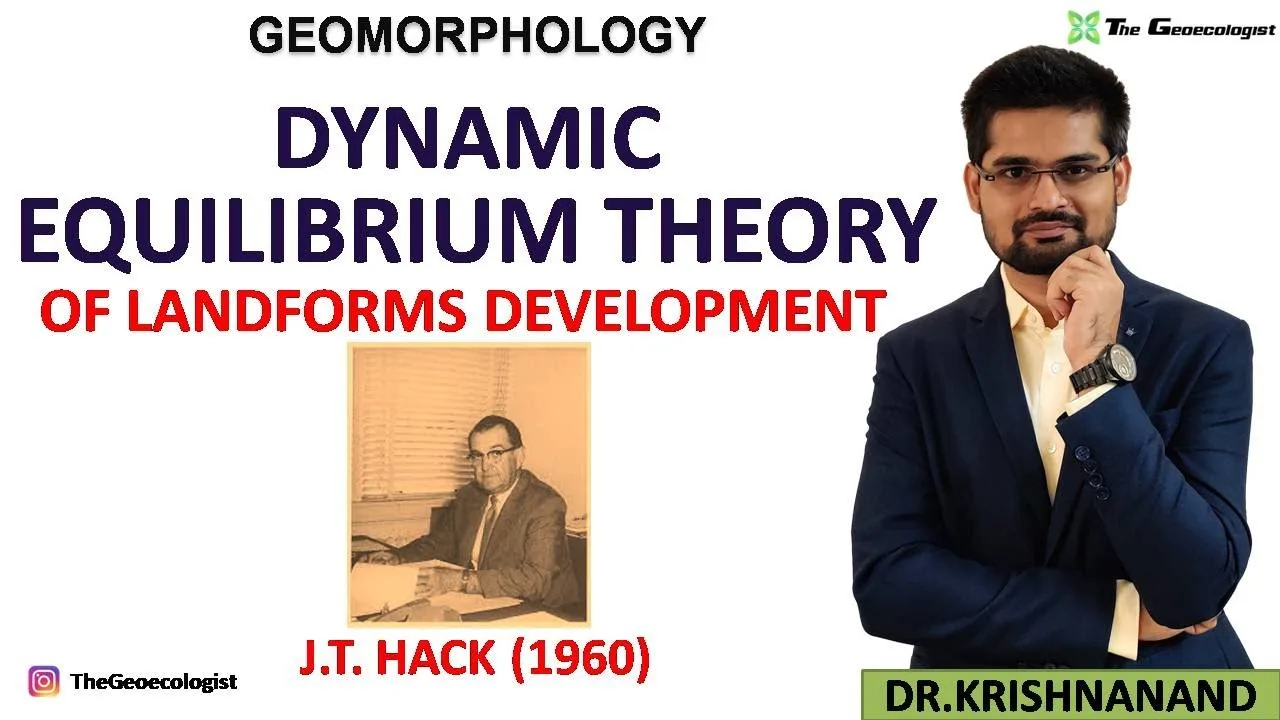
Table of Contents
- Historical Context and Foundations of the Dynamic Equilibrium Theory
- John T. Hack: The Geomorphologist Behind the Theory
- Core Principles of the Dynamic Equilibrium Theory
- 1. Steady-State Equilibrium Between Uplift and Erosion
- 2. Time-Independent Evolution: Rejecting Davis's Stages
- 3. Graded Slope and Channel Concepts
- 4. Feedback Mechanisms and Self-Regulation
- Modern Applications and Relevance in Geomorphology
- Fluvial Geomorphology and River Management
- Hill-Slope Processes and Landslide Hazards
- Tectonic Geomorphology and Mountain Building
- Why the Dynamic Equilibrium Theory is Crucial for UPSC Geography Optional
- Critiques, Limitations, and Evolving Perspectives
- Conclusion
The Dynamic Equilibrium Theory proposed by John T. Hack in 1960 revolutionized geomorphology by introducing a flexible, time-independent framework for understanding landform development. Unlike William Morris Davis’s cyclic model, Hack’s approach emphasizes continuous adjustment between tectonic uplift and denudational processes, offering a more realistic representation of landscape evolution. This article provides a comprehensive analysis of the theory’s principles, modern applications, and its critical importance for UPSC Geography Optional aspirants.
- Dynamic Equilibrium Theory posits a steady-state balance between uplift and erosion.
- Landforms adjust dynamically without fixed evolutionary stages (youth, maturity, old age).
- Feedback mechanisms self-regulate erosion and deposition rates.
- Widely applied in fluvial geomorphology, hill-slope processes, and tectonic geomorphology.
- Essential for UPSC Geography Optional: challenges Davis, explains present-day changes, frequent in Mains.
Historical Context and Foundations of the Dynamic Equilibrium Theory
Before John T. Hack’s seminal 1960 publication, geomorphology was dominated by William Morris Davis’s Cycle of Erosion (1899) and G.K. Gilbert’s Graded Stream Concept (1877). Davis envisioned landscapes progressing through deterministic stages—youth, maturity, and old age—driven by uplift and erosion. Gilbert introduced the idea of a “graded” river profile where sediment transport capacity equals supply. Hack, a research geologist with the U.S. Geological Survey, synthesized these ideas but rejected the rigid temporal sequence. His fieldwork in the Appalachian Mountains and the Colorado Plateau demonstrated that landforms could persist in a quasi-steady state for millions of years, adjusting continuously to external forcings.
John T. Hack: The Geomorphologist Behind the Theory
John T. Hack (1913–1991) was a pioneering American geomorphologist whose work bridged field observation and theoretical innovation. His 1960 paper, “Dynamic Equilibrium in Landform Evolution,” published in the Journal of Geology, laid the groundwork for what is now a cornerstone of modern process geomorphology. Hack’s emphasis on measurable processes—stream incision rates, hillslope diffusion, sediment flux—shifted the discipline from descriptive historical narratives to quantitative, physics-based modeling.
Core Principles of the Dynamic Equilibrium Theory

The Dynamic Equilibrium Theory rests on four interconnected pillars that distinguish it from earlier cyclical models:
1. Steady-State Equilibrium Between Uplift and Erosion
At the heart of Hack’s model is the concept of a steady-state equilibrium. Landforms achieve a dynamic balance where the rate of tectonic uplift (or base-level fall) is matched by the rate of denudation (erosion and sediment transport). This does not imply a static landscape; rather, the form of the landscape (relief, channel gradient, hillslope angle) remains statistically constant over time while material continuously passes through the system. Mathematically, this can be expressed as U = E, where U is uplift rate and E is erosion rate. When external forces perturb this balance—such as a climatic shift increasing precipitation or a tectonic pulse accelerating uplift—the system responds through negative feedbacks to restore equilibrium.
2. Time-Independent Evolution: Rejecting Davis’s Stages
Hack explicitly argued that landforms do not follow a predetermined evolutionary sequence. In the Dynamic Equilibrium Theory, a landscape can remain in a mature, adjusted state indefinitely if boundary conditions are stable. There is no inevitable progression to a peneplain (Davis’s “old age”). This time-independence aligns with modern observations of ancient, low-relief surfaces (e.g., the African Surface) that have persisted for tens of millions of years without reaching a theoretical end stage. For UPSC aspirants, this distinction is a frequent examination differentiator between Davis and Hack.
3. Graded Slope and Channel Concepts
Extending Gilbert’s graded stream, Hack applied the graded condition to entire hillslopes and drainage networks. A graded slope is one where the erosion rate at every point equals the long-term uplift rate, resulting in a stable profile. This requires a delicate interplay between weathering, soil creep, overland flow, and channel incision. Hack’s field measurements in the Shenandoah Valley showed that channel gradients adjust to sediment load and discharge, maintaining a “grade” that minimizes energy expenditure per unit sediment transported—a principle later formalized in the minimum energy dissipation hypothesis.
4. Feedback Mechanisms and Self-Regulation
The Dynamic Equilibrium Theory incorporates negative feedback loops that confer resilience. For example:
- Increased erosion steepens slopes → enhances sediment transport capacity → reduces sediment storage → lowers erosion rates.
- Climate-driven vegetation loss → higher runoff → accelerated incision → base-level lowering → reduced gradient → stabilization.
These feedbacks explain why landscapes often exhibit remarkable stability despite variable forcing. Positive feedbacks (e.g., landslide-induced damming causing upstream aggradation) can create transient disequilibrium, but the system tends to return to a dynamic steady state.
Modern Applications and Relevance in Geomorphology
Since the 1990s, the Dynamic Equilibrium Theory has become the dominant paradigm in quantitative geomorphology, underpinning numerical landscape evolution models (LEMs) such as CHILD, Landlab, and FastScape. Its applications span multiple sub-disciplines:
Fluvial Geomorphology and River Management
River restoration projects routinely use Hack’s graded stream concept to design “reference reaches” that represent dynamic equilibrium under current hydrologic and sediment regimes. The theory informs the Channel Evolution Model (Schumm et al., 1984), which describes how channels adjust through stages of degradation, widening, and aggradation toward a new equilibrium after disturbance. Modern LiDAR and satellite altimetry (e.g., NASA’s ICESat-2) provide high-resolution validation of Hack’s predictions on channel steepness indices (ksn) and concavity.
Hill-Slope Processes and Landslide Hazards
Hillslope diffusion models, rooted in the Dynamic Equilibrium Theory, predict soil thickness and curvature distributions under steady uplift. These models are critical for landslide susceptibility mapping in tectonically active regions like the Himalayas and the Andes. The theory’s feedback framework explains why over-steepened slopes fail, reducing relief and driving the system back toward equilibrium.
Tectonic Geomorphology and Mountain Building
In orogenic belts, the interplay between rock uplift and erosion governs topographic growth. Hack’s steady-state concept is central to the “tectonic aneurysm” hypothesis and the idea of “fluvial incision laws” (e.g., stream power law: E = K A^m S^n). Thermochronology data (apatite fission track, (U-Th)/He) from ranges like the European Alps and the Southern Alps of New Zealand confirm that long-term exhumation rates often match modern erosion rates, supporting dynamic equilibrium over million-year timescales.
Why the Dynamic Equilibrium Theory is Crucial for UPSC Geography Optional
For UPSC aspirants, mastering the Dynamic Equilibrium Theory is non-negotiable. The UPSC Geography Optional syllabus (Paper I, Section A: Geomorphology) explicitly lists “Concepts of landform development: Dynamic equilibrium theory of Hack” as a key topic. Past Mains questions illustrate its weight:
- 2018: “Critically examine the Dynamic Equilibrium Theory of Hack and its relevance in explaining landform development.” (15 marks)
- 2020: “Contrast Davis’s Cycle of Erosion with Hack’s Dynamic Equilibrium Theory.” (10 marks)
- 2022: “Discuss the application of Hack’s theory in understanding fluvial landforms in tectonically active regions.” (15 marks)
Answers that integrate Hack’s feedback mechanisms, graded slopes, and time-independence with modern examples (e.g., Himalayan river adjustment, Deccan Plateau planation surfaces) score highest. Dr. Krishnanand’s Simplified Geomorphology E-Book (available at TheGeoecologist) provides concise, exam-oriented notes on this and other theories.
Critiques, Limitations, and Evolving Perspectives
While the Dynamic Equilibrium Theory is foundational, it faces critiques:
- Scale dependence: Equilibrium may hold at watershed scales (102–104 km2) but break down at hillslope or continental scales.
- Non-stationary climate: Quaternary glacial-interglacial cycles impose forcing timescales (104–105 years) that may be shorter than landscape response times, preventing true steady state.
- Threshold behavior: Some systems exhibit hysteresis or multiple stable states (e.g., bedrock vs. alluvial channels), challenging the single-equilibrium assumption.
Contemporary research integrates stochastic climate forcing, biotic interactions, and human impacts into “dynamic disequilibrium” frameworks, yet Hack’s core insight—that landscapes organize around a balance of forces—remains the null hypothesis.
Conclusion
The Dynamic Equilibrium Theory of John T. Hack transformed geomorphology from a historical science into a predictive, process-based discipline. By emphasizing continuous adjustment, feedback regulation, and the rejection of deterministic stages, Hack provided a framework that aligns with modern quantitative observations and modeling. For students, researchers, and UPSC aspirants alike, this theory remains the essential lens through which to view landform development—not as a linear story of birth, maturity, and death, but as a dynamic, resilient conversation between the solid Earth and the fluid envelopes that shape it.
Frequently Asked Questions
Davis's model proposes a fixed, time-dependent sequence of stages (youth, maturity, old age) leading to a peneplain, while Hack's Dynamic Equilibrium Theory argues that landforms adjust continuously to maintain a steady-state balance between uplift and erosion without a predetermined evolutionary path.
The theory's graded stream concept is used to design reference reaches for river restoration, predicting how channels adjust their gradient and pattern to achieve dynamic equilibrium under current hydrologic and sediment regimes.
It is a core syllabus topic, frequently asked in Mains to contrast with Davis's cycle, explain modern geomorphic processes, and analyze landform development in tectonically active regions like the Himalayas.