Blog
Disaster Management Lecture Series: Earth Day Insights from THEGEOECOLOGIST

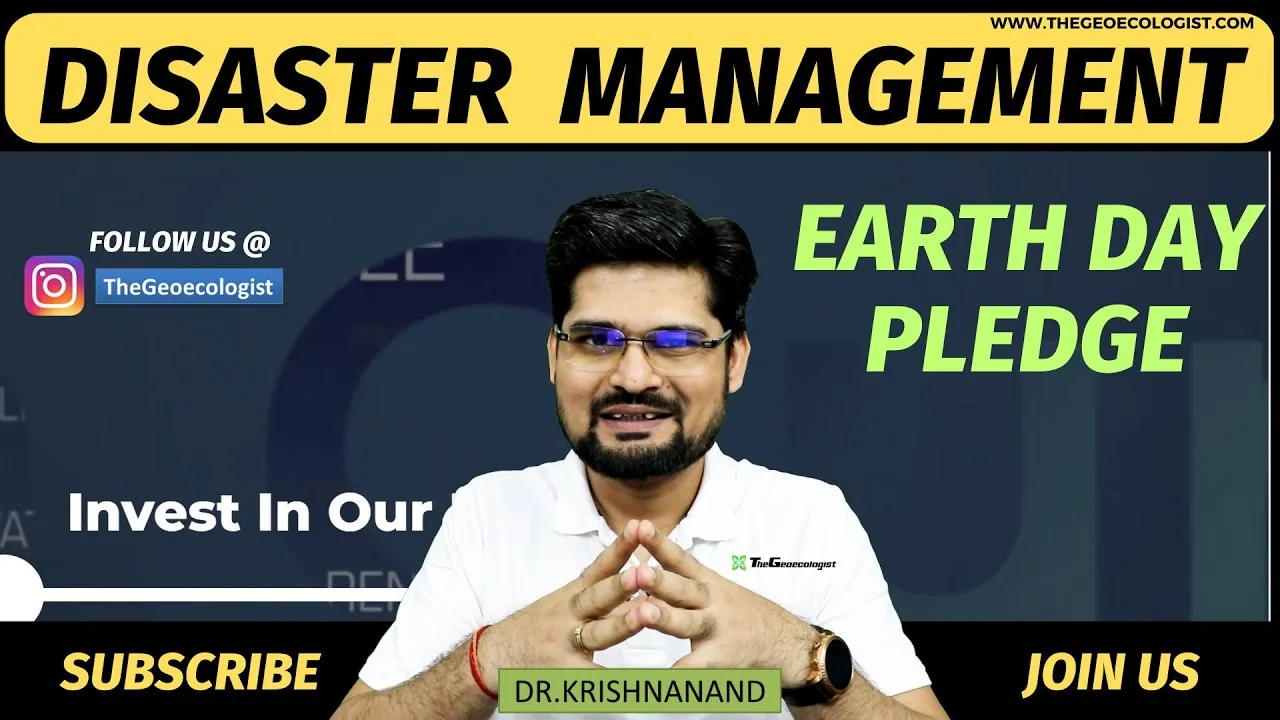
Table of Contents
- Earth Day 2024: Catalyzing Global Environmental Action
- Why Disaster Management Education Matters Now More Than Ever
- Escalating Disaster Trends and Economic Impacts
- The Sendai Framework and Global Policy Architecture
- THEGEOECOLOGIST: Bridging Academic Rigor and Practical Application
- Platform Genesis and Educational Philosophy
- Multi-Channel Content Ecosystem
- Curriculum Deep-Dive: Disaster Management Lecture Series Modules
- Module 1: Scientific Foundations of Geophysical Hazards
- Module 2: Hydro-Meteorological Hazards and Climate Linkages
- Module 3: Risk Assessment Methodologies and GIS Applications
- Module 4: Policy Frameworks and Institutional Mechanisms
- Module 5: Case Studies and Lessons Learned
- Target Audience: Tailored Value Propositions
- UPSC Civil Services Aspirants
- University Students and Researchers
- Professionals and Policy Practitioners
- Interactive Learning: Live Q&A and Community Engagement
- Study Materials and Resource Repository
- Technology Integration: GIS, Remote Sensing, and Early Warning Systems
- Climate Change Adaptation and Disaster Risk Reduction Synergies
- Building Community Resilience: From Knowledge to Action
- How to Join the Disaster Management Lecture Series
- Conclusion: Knowledge as the Ultimate Resilience Tool
The disaster management lecture series launched by THEGEOECOLOGIST for Earth Day 2024 represents a pivotal educational initiative addressing the escalating frequency and intensity of natural hazards worldwide. As climate change amplifies environmental risks, platforms dedicated to geography and environmental education play a crucial role in building societal resilience. This comprehensive program combines scientific rigor with practical policy frameworks, targeting UPSC aspirants, university students, and environmental professionals seeking authoritative knowledge on disaster risk reduction.
- Earth Day 2024 marks the launch of THEGEOECOLOGIST’s specialized disaster management lecture series focusing on geophysical and hydro-meteorological hazards.
- The curriculum covers risk assessment strategies, policy frameworks (Sendai Framework, NDMA guidelines), and real-world case studies including the 2018 Kerala floods and Himalayan landslides.
- Participants gain access to expert-led lectures, live Q&A sessions, and downloadable study materials tailored for competitive examinations like UPSC Geography Optional.
- The program emphasizes GIS applications, climate adaptation, and sustainable development integration for holistic disaster resilience.
- Community engagement through YouTube membership perks, Instagram updates, and website resources creates a continuous learning ecosystem.
Earth Day 2024: Catalyzing Global Environmental Action
Earth Day, observed annually on April 22 since 1970, has evolved from a U.S.-centric environmental teach-in into a global movement engaging over 1 billion people across 193 countries according to EarthDay.org. The 2024 theme “Planet vs. Plastics” underscores the interconnectedness of pollution, climate change, and disaster vulnerability. Plastic waste clogs drainage systems exacerbating urban flooding, while microplastics contaminate ecosystems reducing their natural buffering capacity against hazards.
The disaster management lecture series aligns with this year’s Earth Day mandate by translating abstract environmental concerns into actionable disaster risk reduction competencies. As UN Secretary-General António Guterres emphasized at COP28, “We need to move from disaster management to disaster risk reduction”—a philosophy embedded in THEGEOECOLOGIST’s pedagogical approach.
Why Disaster Management Education Matters Now More Than Ever
Escalating Disaster Trends and Economic Impacts
According to the UN Office for Disaster Risk Reduction (UNDRR), the number of recorded disaster events has increased fivefold over the past 50 years, driven largely by climate-related hazards. The World Meteorological Organization (WMO) reports that weather, climate, and water-related disasters caused USD 4.3 trillion in economic losses between 1970 and 2021. Developing nations bear disproportionate impacts—91% of disaster deaths occur in low- and middle-income countries despite accounting for only 60% of global exposure.
The Sendai Framework and Global Policy Architecture
The Sendai Framework for Disaster Risk Reduction 2015-2030, adopted at the Third UN World Conference in Sendai, Japan, establishes seven global targets and four priorities for action. The disaster management lecture series dedicates modules to each priority: understanding disaster risk, strengthening governance, investing in resilience, and enhancing preparedness. India’s National Disaster Management Authority (NDMA), established under the Disaster Management Act 2005, operationalizes these principles through national guidelines on floods, cyclones, earthquakes, and landslides.
THEGEOECOLOGIST: Bridging Academic Rigor and Practical Application
Platform Genesis and Educational Philosophy
Founded by Krishna Kumar, a distinguished geography educator with over a decade of UPSC mentoring experience, THEGEOECOLOGIST has emerged as India’s premier digital platform for geography and environmental sciences. The platform’s philosophy centers on “conceptual clarity over rote memorization”—a critical differentiator for aspirants tackling the analytical demands of UPSC Geography Optional Paper II (Human Geography) and General Studies Paper III (Disaster Management).
Multi-Channel Content Ecosystem
The disaster management lecture series leverages a synchronized multi-channel delivery model:
- YouTube Channel: Primary lecture repository with chapter-wise playlists, live streams, and community posts
- Website (thegeoecologist.com): Structured course modules, downloadable PDFs, blog articles, and career guidance
- Instagram (@thegeoecologist): Micro-learning reels, infographic summaries, and exam-oriented tips
- Email Newsletter: Curated current affairs updates, previous year question analyses, and resource alerts
Curriculum Deep-Dive: Disaster Management Lecture Series Modules

Module 1: Scientific Foundations of Geophysical Hazards
This foundational module covers plate tectonics, seismicity zones, and volcanic processes with emphasis on the Himalayan seismic gap—a 600km segment between the 1905 Kangra and 1934 Bihar-Nepal earthquakes where strain accumulation suggests a potential Mw >8.0 event. Lectures integrate USGS earthquake data, Indian Meteorological Department (IMD) bulletins, and National Centre for Seismology monitoring protocols.
Module 2: Hydro-Meteorological Hazards and Climate Linkages
Floods, cyclones, droughts, and cloudbursts are analyzed through the lens of monsoon dynamics, Indian Ocean Dipole (IOD), and El Niño-Southern Oscillation (ENSO) teleconnections. The 2018 Kerala floods case study examines 41% excess rainfall in August, dam management controversies, and Western Ghats ecology degradation per the Gadgil Committee Report recommendations.
Module 3: Risk Assessment Methodologies and GIS Applications
Participants master hazard mapping, vulnerability assessment, and capacity analysis using QGIS and ArcGIS platforms. Practical exercises include creating flood inundation models for the Brahmaputra basin and landslide susceptibility zonation for Uttarakhand using AHP (Analytic Hierarchy Process) and frequency ratio models.
Module 4: Policy Frameworks and Institutional Mechanisms
Comprehensive coverage of Disaster Management Act 2005, National Disaster Management Plan (NDMP) 2019, State Disaster Management Authorities (SDMAs), and District Disaster Management Plans (DDMPs). Comparative analysis with Japan’s Disaster Countermeasures Basic Act and USA’s Stafford Act highlights best practices in early warning systems and community-based disaster management.
Module 5: Case Studies and Lessons Learned
Beyond Kerala floods, disaster management lecture series dissects:
- 1999 Odisha Super Cyclone vs. 2019 Cyclone Fani: Evolution of zero-casualty evacuation philosophy
- 2001 Bhuj Earthquake: Reconstruction paradigm shift toward “Build Back Better”
- 2013 Uttarakhand Flash Floods: Glacial lake outburst flood (GLOF) risks and Char Dham highway vulnerabilities
- 2023 Sikkim GLOF: South Lhonak lake outburst and Teesta-III hydropower project impacts
Target Audience: Tailored Value Propositions
UPSC Civil Services Aspirants
The disaster management lecture series directly addresses GS Paper III syllabus topics: “Disaster and disaster management” and “Environmental pollution and degradation.” For Geography Optional, disaster management lecture series covers Paper I (Geomorphology, Climatology) and Paper II (Regional Planning, Contemporary Issues). Previous year question (PYQ) integration ensures exam-oriented preparation—e.g., 2023 GS III Q12 on “Disaster resilient infrastructure” and 2022 Geography Optional Q7(c) on “Landslide vulnerability zonation.”
University Students and Researchers
Undergraduate and postgraduate students in Geography, Environmental Science, Disaster Management, and Urban Planning benefit from research-grade content. disaster management lecture series references peer-reviewed journals like Natural Hazards, International Journal of Disaster Risk Reduction, and Progress in Disaster Science for literature review foundations.
Professionals and Policy Practitioners
Government officials, NGO workers, and private sector resilience officers access modules on business continuity planning, critical infrastructure protection, and climate finance mechanisms (Green Climate Fund, Adaptation Fund) relevant to project implementation.
Interactive Learning: Live Q&A and Community Engagement
A distinguishing feature of the disaster management lecture series is its bi-weekly live Q&A sessions where participants submit questions via YouTube Super Chat, Instagram DM, or email (krishna.geography@gmail.com). Recent sessions addressed:
- “How to correlate Sendai Framework targets with NDMP 2019 for UPSC answer writing?”
- “GIS data sources for landslide inventory mapping in data-scarce Himalayan regions?”
- “Differentiating disaster management vs. disaster risk reduction in policy terminology?”
This interactive model transforms passive consumption into active knowledge co-creation, with Krishna Kumar providing personalized feedback on answer structures, diagram practices, and current affairs integration.
Study Materials and Resource Repository
Channel members unlock a curated resource library including:
- Chapter-wise PDF notes (500+ pages) with diagrams, tables, and mnemonics
- PYQ compilations (2013-2023) with model answers and examiner comments
- Current affairs digests linking recent disasters to static syllabus topics
- Map practice workbooks for hazard zonation, seismic zones, and cyclone tracks
- Glossary of 200+ technical terms with Hindi-English bilingual definitions
The website shop page offers premium e-books: “Disaster Management for UPSC: A Comprehensive Guide” and “GIS Applications in Hazard Mapping: Practical Workbook.”
Technology Integration: GIS, Remote Sensing, and Early Warning Systems
Modern disaster management increasingly relies on geospatial technologies. The disaster management lecture series dedicates extensive coverage to:
- Satellite-based monitoring: INSAT-3D/3DR for cyclone tracking, Sentinel-1 SAR for flood mapping, Cartosat-2 for landslide detection
- Early warning dissemination: Common Alerting Protocol (CAP), NDMA’s SATARK app, IMD’s Mausam app
- Decision support systems: India’s National Disaster Management Information System (NDMIS) and state-level SDMIS platforms
- Community technology: Crowdsourced reporting via Bharat Maps, social media analytics for situational awareness
Practical tutorials demonstrate Google Earth Engine scripts for rapid flood extent mapping and Python libraries (geopandas, rasterio) for hazard data processing—skills increasingly valued in disaster management careers.
Climate Change Adaptation and Disaster Risk Reduction Synergies
The IPCC Sixth Assessment Report (AR6) unequivocally links anthropogenic warming to increased frequency/intensity of extremes. The lecture series explores adaptation-disaster risk reduction (DRR) convergence through:
- Nature-based solutions: Mangrove restoration for cyclone buffering (Sundarbans case study), wetland rejuvenation for urban flood mitigation (Chennai’s Pallikaranai marsh)
- Climate-resilient infrastructure: Coastal regulation zone (CRZ) norms, flood-resilient housing designs (Kerala’s post-2018 reconstruction)
- Risk-informed development planning: Integrating hazard maps into master plans, zoning regulations, and environmental impact assessments (EIA)
This alignment with Sustainable Development Goals (SDGs)—particularly SDG 11 (Sustainable Cities), SDG 13 (Climate Action), and SDG 15 (Life on Land)—positions learners at the forefront of transformative resilience practice.
Building Community Resilience: From Knowledge to Action
The ultimate objective of the disaster management lecture series transcends academic achievement—disaster management lecture series aims to cultivate disaster-aware citizens capable of:
- Conducting household-level risk assessments and preparing family emergency plans
- Participating in community-based disaster management committees (mandated under NDMP at village/ward level)
- Advocating for risk-sensitive land-use planning in local governance forums
- Supporting school safety programs and hospital safety audits as per NDMA guidelines
The platform’s Instagram community regularly features citizen-led initiatives: Mumbai’s ALM (Advanced Locality Management) flood preparedness drills, Odisha’s cyclone shelter management committees, and Ladakh’s artificial glacier (ice stupa) projects for drought resilience.
How to Join the Disaster Management Lecture Series
Accessing the disaster management lecture series involves three tiers:
- Free Tier: Subscribe to THEGEOECOLOGIST YouTube Channel for weekly lecture uploads, shorts, and community posts.
- Member Tier (₹199/month): Join channel membership for ad-free viewing, exclusive live Q&A, member-only PDFs, and priority doubt resolution.
- Course Tier: Purchase structured courses via thegeoecologist.com for lifetime access, test series, and mentorship.
Follow @thegeoecologist on Instagram for daily micro-content and announcements. Email krishna.geography@gmail.com for personalized guidance on course selection.
Conclusion: Knowledge as the Ultimate Resilience Tool
As Earth Day 2024 reminds us of our planetary stewardship, the disaster management lecture series by THEGEOECOLOGIST stands as a beacon of empowered learning. By synthesizing geophysical science, policy wisdom, technological innovation, and community wisdom, it equips a generation to not merely survive disasters but to architect a resilient future. Whether you’re an aspirant chasing India’s toughest examination, a researcher pushing disciplinary boundaries, or a citizen seeking to protect your community—disaster management lecture series offers the intellectual toolkit to transform vulnerability into agency. The Earth does not negotiate with ignorance; it rewards preparedness. Join the movement. Equip yourself with knowledge. Act for the Earth. 🌍✨
Frequently Asked Questions
The series covers scientific foundations of geophysical and hydro-meteorological hazards, risk assessment methodologies including GIS applications, policy frameworks (Sendai Framework, NDMA guidelines), and detailed case studies like the 2018 Kerala floods, 1999 Odisha Super Cyclone, 2001 Bhuj Earthquake, and 2023 Sikkim GLOF.
The program is designed for UPSC Civil Services aspirants (GS Paper III and Geography Optional), university students in Geography/Environmental Science/Disaster Management, researchers needing literature foundations, and professionals in government, NGOs, or private sector resilience roles seeking practical skills in early warning systems, climate adaptation, and community-based disaster management.
Free lectures are available on the THEGEOECOLOGIST YouTube channel. Channel membership (₹199/month) unlocks ad-free viewing, bi-weekly live Q&A sessions, exclusive PDF notes (500+ pages), PYQ compilations, map workbooks, and a technical glossary. Full structured courses with lifetime access and mentorship are available for purchase at thegeoecologist.com.