Blog
Boudeville Growth Center: Understanding Regional Planning Concepts for UPSC Aspirants

Many UPSC CSE aspirants find regional planning theories daunting, especially when encountering concepts like the Boudeville Growth Center and its implications for spatial growth. The sheer volume of terminology, models, and case studies can overwhelm even the most dedicated students, leaving them unsure where to focus their limited study time. A clear, concise resource that breaks down these ideas into digestible points is essential for turning confusion into confidence.
- The Boudeville Growth Center theory explains how certain locations act as engines of regional development.
- Understanding this concept helps answer questions on spatial inequality and policy interventions.
- A well‑structured e‑book can save hours of cross‑referencing multiple textbooks.
- Diagrams and maps improve retention of spatial relationships.
- Aligned with the CBCS syllabus, the right study material directly supports exam success.
Why Regional Planning Concepts Matter for UPSC CSE
Regional planning is not just an academic topic; it appears repeatedly in both Prelims and Mains geography papers. Questions often ask candidates to compare theories, evaluate planning strategies, or interpret maps showing growth poles. Without a firm grasp of foundational ideas such as the Boudeville Growth Center, aspirants risk losing marks on seemingly straightforward questions. The subject also links to current affairs—think of smart city missions, industrial corridors, or backward area programmes—making conceptual clarity vital for interdisciplinary answers.
Boudeville Growth Center: Core Idea and Spatial Growth Theory
The Boudeville Growth Center concept, introduced by French economist François Perroux and later adapted for spatial analysis by Jacques Boudeville, posits that economic development is not uniform across a territory. Instead, certain nodes—growth centers—experience accelerated investment, infrastructure development, and agglomeration economies, which then generate spill‑over effects to surrounding areas. This creates a hierarchical pattern of development where the growth center acts as a pole, pulling resources and talent from its hinterland. In exam terms, you may be asked to explain how a growth center reduces regional disparities or to critique the assumption that benefits automatically trickle down.
Key components of the theory include:
- Inducement Principle: Leading sectors stimulate growth in linked activities.
- Spread and Backwash Effects: Positive spill‑offs (spread) versus possible negative impacts (backwash) on peripheral regions.
- Threshold Levels: Minimum size of market or infrastructure needed to trigger self‑sustaining growth.
These ideas are frequently illustrated with diagrams showing concentric zones of influence, making visual learning a powerful aid.
How the Concept Evolved: From Theory to Practice
While Boudeville’s original formulation was rooted in mid‑20th‑century European industrialization, scholars have since applied the growth center model to diverse contexts—from the Asian tiger economies to African corridor projects. In India, the concept informed the identification of growth poles during the Five‑Year Plans, such as the Delhi‑Mumbai Industrial Corridor (DMIC) and the Bengaluru‑Chennai Expressway zone. Understanding this evolution helps aspirants answer questions that ask for historical continuity or contrast between colonial‑era planning and post‑liberalization strategies.
For a deeper dive into the theoretical origins, see the authoritative overview on regional planning.
Applying Boudeville Growth Center in Indian Regional Planning
Indian exam questions often link theory to specific programmes. For instance:
- How did the identification of growth centers shape the Backward Regions Grant Fund (BRGF)?
- Evaluate the success of the Gujarat International Finance Tec‑City (GIFT) as a modern growth center.
- Discuss the role of growth centers in reducing intra‑state disparities, using the example of Hyderabad’s IT boom.
To answer these, you need to know not just the definition but also the criteria used to select growth centers (population size, industrial base, connectivity) and the typical policy packages offered (tax incentives, infrastructure grants, skill development). A resource that ties these elements together with clear bullet points and maps will let you reproduce answers quickly under exam pressure.
Evaluating Study Resources: What Makes a Good E‑Book?
When searching for a study aid, aspirants should look for:
- Syllabus alignment – explicit mention of CBCS geography units.
- Point‑wise highlighting – enables rapid revision.
- Visual aids – diagrams, maps, and images that explain spatial concepts.
- Concise language – avoids unnecessary jargon while preserving academic rigor.
- Author credibility – subject‑matter expertise, preferably with teaching or research background.
Many generic textbooks dump information in long paragraphs, forcing readers to create their own notes. An ideal e‑book does the heavy lifting, presenting each concept in a ready‑to‑memorize format.
Why Simplified Regional Planning And Development by Dr. Krishnanand Fits the Bill
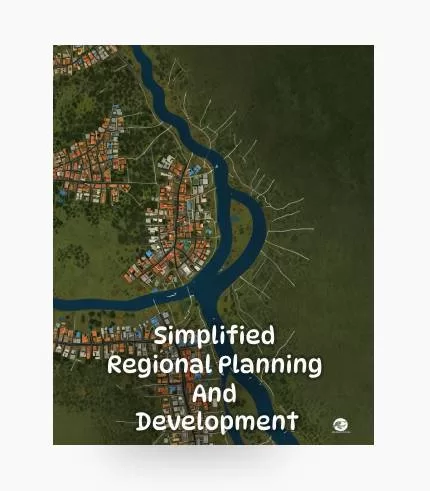
Simplified Regional Planning And Development by Dr. Krishnanand checks all the boxes outlined above. The e‑book is explicitly designed for the CBCS syllabus in geography, making it a direct match for UPSC CSE and undergraduate exams. Each chapter begins with a point‑wise summary, followed by detailed explanations that are enriched with diagrams, maps, and images—exactly the visual support needed to grasp spatial theories like the Boudeville Growth Center. The language is simplified without sacrificing depth, allowing readers to move quickly from basic definitions to application‑level understanding.
Specifically, the chapter on “Types of Regional Planning” includes a dedicated section on growth pole theory, where the Boudeville Growth Center is explained with a labelled diagram showing core, periphery, and spill‑over zones. This targeted treatment means you won’t have to sift through unrelated content to find what you need.
How to Use This E‑Book Effectively for Exam Preparation
To maximize benefit, adopt a three‑step approach:
- Preview: Skim the point‑wise highlights of each chapter to build a mental map of the topic.
- Deep Dive: Read the detailed explanations, paying special attention to the diagrams that illustrate the Boudeville Growth Center and related models.
- Practice: After each section, attempt previous year questions that mention growth centers or regional disparities; compare your answers with the explanations in the e‑book.
Because the e‑book is available in PDF format, you can annotate it on a tablet or print out specific chapters for quick revision before mock tests. The highlighted points serve as ready‑made flashcards for last‑minute review.
Buying Guide and Final Recommendations
If you are struggling with regional planning concepts, investing in a focused resource like Simplified Regional Planning And Development can save you hours of fruitless searching. The price point of ₹249 is modest compared to the cost of multiple reference books or coaching modules that may not cover the Boudeville Growth Center in sufficient detail. Before purchasing, verify that the latest edition includes the CBCS‑aligned content and that the sample chapter (available on the product page) demonstrates the point‑wise format and visual aids described above.
In summary, mastering the Boudeville Growth Center concept is a achievable goal when you have the right study tool. By choosing an e‑book that aligns with the syllabus, uses clear highlighting, and leverages diagrams, you turn a complex topic into a scoring advantage.
Our Recommendation
📖 Part of our complete guide: Evolution of Geographical Thought: A Comprehensive Guide for UPSC Aspirants and Geography Enthusiasts
Frequently Asked Questions
What is the Boudeville Growth Center concept?
The Boudeville Growth Center concept describes how certain locations act as engines of regional development, generating spill‑over effects that promote growth in surrounding areas through agglomeration economies and infrastructural incentives.
How does the e-book Simplified Regional Planning And Development help with UPSC preparation?
The e-book provides point‑wise highlights, diagrams, and maps aligned with the CBCS geography syllabus, making complex theories like the Boudeville Growth Center easy to understand, revise, and apply to exam questions.
Is the Boudeville Growth Center relevant to current Indian planning initiatives?
Yes, the concept underpins policies such as industrial corridors, smart city missions, and backward area grants, where selected growth poles are expected to drive regional development and reduce disparities.