Blog
American School of Geographical Thought -TheGeoecologist

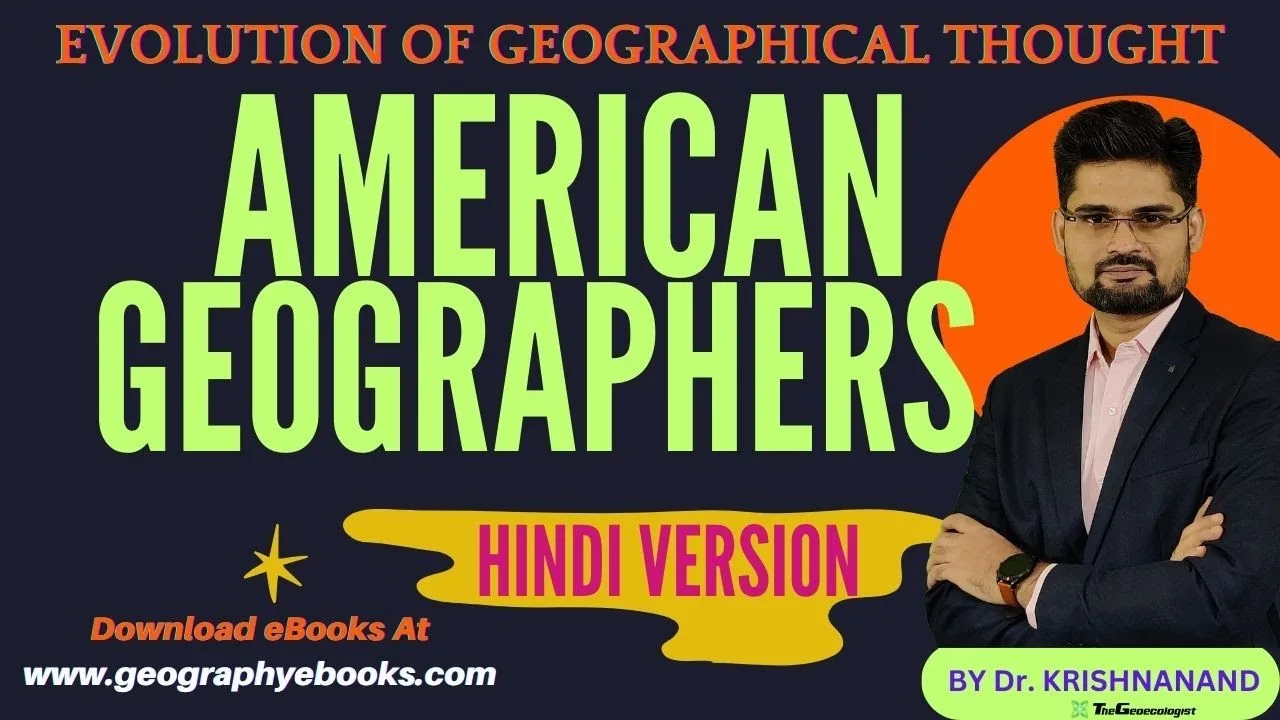
American School of Geographical Thought -TheGeoecologist
The American School of Geographical Thought: Evolution and Impact
🇺🇸 American School of Geographical Thought | TheGeoecologist 🌍
Introduction
The American School of Geographical Thought represents a dynamic and influential tradition that shaped modern geography into a rigorous spatial and analytical science. Emerging in the late 19th and early 20th centuries, it introduced methodological advancements that revolutionized geographical studies, distinguishing it from European traditions. This article explores the historical evolution, key thinkers, and lasting contributions of the American School, offering insights for students, researchers, and geography enthusiasts.
Historical Emergence of the American School
Geography in America developed distinctively due to unique socio-economic and environmental contexts. Early American geographers were influenced by European traditions but soon forged their own path by addressing regional diversity, environmental interactions, and spatial analysis.
Foundational Figures and Contributions
William Morris Davis – Known as the “father of American geography,” Davis pioneered geomorphology through his “Geographical Cycle” theory, explaining landscape evolution through erosion processes. His work laid the groundwork for physical geography.
Ellen Churchill Semple – A prominent advocate of environmental determinism, Semple emphasized how physical environments shape human societies. Though later critiqued, her ideas sparked debates that led to more nuanced perspectives.
Carl O. Sauer – Leading the Berkeley School of Cultural Geography, Sauer argued that human activities transform landscapes, introducing the concept of the “cultural landscape.” His work shifted focus from environmental determinism to human agency.
Richard Hartshorne – In “The Nature of Geography,” Hartshorne defended regional geography, arguing that geography should study areal differentiation—understanding how places differ from one another.
Quantitative Revolutionaries (Edward Ullman, William Bunge, Peter Haggett) – These scholars integrated statistical and mathematical models, transforming geography into a spatial science focused on patterns, distributions, and locational analysis.
Key Concepts and Paradigm Shifts
1. From Environmental Determinism to Possibilism
Early American geography was dominated by environmental determinism, stating that human behavior is shaped by natural surroundings. However, scholars like Carl Sauer and later possibilists argued that humans adapt and modify their environment, leading to new approaches in cultural and human geography.
2. The Quantitative Revolution (1950s-1960s)
American geographers embraced quantitative techniques, incorporating statistics, spatial modeling, and computer-based analysis. This shift:
- Strengthened geography’s scientific credibility.
- Gave rise to urban, economic, and transportation geography.
- Led to innovations like Central Place Theory (Walter Christaller) and Spatial Interaction Models (Edward Ullman).
3. Regional Science and Applied Geography
American geographers pioneered regional science, integrating economics, planning, and spatial analysis to solve real-world problems. This interdisciplinary approach influenced urban planning, resource management, and policy-making.
4. Cultural Ecology & Human-Environment Studies
Sauer’s legacy fostered cultural ecology, examining human adaptation to environments. Later, political ecology emerged, analyzing power relations in environmental issues.
5. Critical and Postmodern Geography
By the late 20th century, American geography saw a shift toward critical theory, feminist geography, and postmodern critiques—challenging traditional spatial science with perspectives on inequality, representation, and power.
Contrast with European Schools
| Aspect | American School | European Schools (German, French, British) |
|---|---|---|
| Focus | Spatial science, quantitative methods | Regional synthesis, human-environment links |
| Methodology | Empirical, data-driven | Descriptive, historical-philosophical |
| Major Themes | GIS, economic geography, urban studies | Landscape studies, social geography |
Modern Relevance
The American School’s legacy continues in:
✔ Geographic Information Systems (GIS) & Remote Sensing – Essential for urban planning, disaster management, and environmental monitoring.
✔ Smart Cities & Spatial Analytics – Location intelligence drives technology and business decisions.
✔ Climate Change & Sustainability Studies – Integrates human and physical geography for environmental solutions.
Conclusion
The American School transformed geography into a spatial, analytical, and interdisciplinary science, merging empirical rigor with practical applications. From Davis’s geomorphology to today’s digital mapping revolution, this tradition remains vital for understanding our complex world.
📺 Subscribe to @TheGeoecologist for more in-depth geographical insights!
🔗 Website: www.thegeoecologist.com
📸 Instagram: @thegeoecologist
📧 Email: krishnanand.5@sharda.ac.in
👍 Like, Share & Subscribe for academic excellence in geography! 🌎
To Download E-Books & Study Material Visit The Shop Page