
Blog
Why the Milky Way Rotates Differently Than You Might Think ! #nasa #universe #space

Why the Milky Way Rotates Differently Than You Might Think ! #nasa #universe #space
Beyond the Spin: Why the Milky Way’s Rotation Defies Simple Physics
Imagine a vast, shimmering pinwheel slowly turning in the cosmic night. Most of us picture galaxies like the Milky Way spinning much like a frisbee, a vinyl record, or even a simple wheel – a solid disc where every point completes one revolution in roughly the same time. It seems intuitive, almost obvious. Yet, the Milky Way bucks this expectation spectacularly. Its rotation is far stranger, far more profound, and it holds a key to one of the universe’s greatest enigmas: dark matter.
The Unexpected Twist: Differential Rotation
If the Milky Way were a solid disc, stars near the galactic center would zip around incredibly fast to keep up, while stars far out on the edges would lumber along. But reality is fundamentally different. The galaxy exhibits differential rotation.
Think of it more like a merry-go-round made of honey, not wood. Stars closer to the dense core orbit the galactic center at much higher velocities, traveling in tighter, faster orbits. Stars farther out, in the galactic suburbs, move significantly slower relative to the center. This isn’t just a mild difference; it’s a stark gradient dictated by gravity. Kepler’s laws, governing planetary motion, apply here too: orbital speed decreases with increasing distance from the dominant central mass.
The Galactic Anomaly: The Mystery of the Outer Stars
Here’s where things get truly intriguing and break the simple model. Our observations, particularly tracking the motion of stars and gas clouds far out in the galactic halo, revealed something shocking. These distant stars weren’t slowing down nearly as much as they should have based on the visible matter we could see – the stars, gas, and dust concentrated in the bright spiral arms and central bulge.
If gravity was the only force at play and the galaxy’s mass was confined to its visible components, stars way out in the galactic suburbs should be moving much slower. They might even be flung off into intergalactic space if their orbits weren’t fast enough. But they weren’t. Measurements consistently showed they were moving too fast.
The Invisible Architect: Dark Matter Emerges
This discrepancy wasn’t an error; it was a clue, a cosmic whisper pointing to something vast and unseen. The explanation that best fits the data is the existence of dark matter. Scientists postulate that the Milky Way, like most galaxies, is embedded in an enormous, roughly spherical halo composed primarily of this mysterious, invisible substance.
This dark matter halo doesn’t interact with light, so we can’t see it directly. Its presence is inferred solely by its gravitational influence. Dark matter doesn’t clump into bright disks; it’s spread diffusely but massively throughout the galaxy, extending far beyond the visible edge. This immense halo provides the extra gravitational pull needed. It tugs on those fast-moving outer stars, giving them the extra speed they exhibit, holding them in orbit around the galactic center despite the vast distances. The visible galaxy, in a sense, is just the bright tip of an iceberg, swimming in a sea of unseen dark matter.
The Galactic Year: Our Grand Orbit
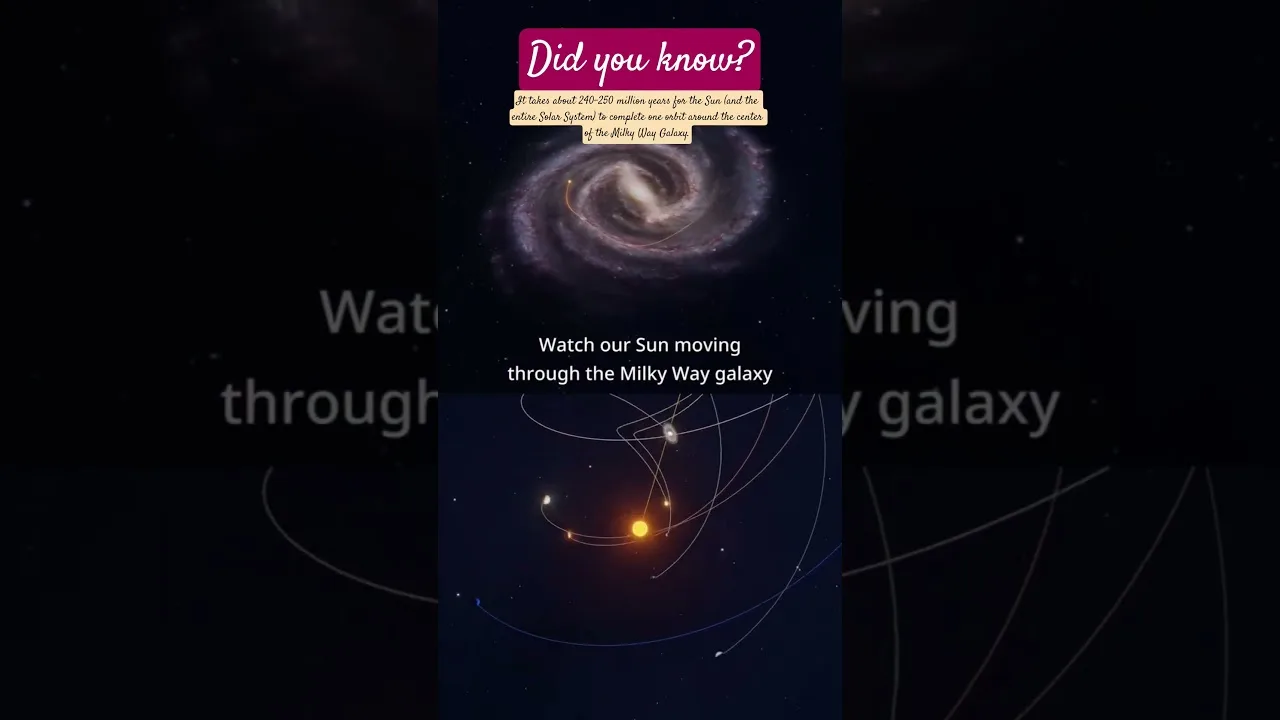
Understanding this differential rotation puts our own place in the galaxy into perspective. Our Sun resides about 26,000 light-years from the galactic center. At its orbital speed, it takes an astonishing 225 to 250 million years to complete just one full circuit around the Milky Way. This immense timespan is aptly named a “Galactic Year” or “Cosmic Year.” It’s a humbling reminder of the vast scales and timescales governing our cosmic neighborhood.
Unveiling the Mystery with NASA and Beyond
How do we know this? It comes from meticulous observation. For decades, astronomers have used telescopes to track the precise motions of stars and gas clouds across the galaxy, measuring their velocities relative to Earth and the galactic center. Advanced computer simulations incorporating complex gravitational physics are crucial models. NASA’s space telescopes and ground-based observatories provide the high-precision data that fuels these models, allowing scientists to map the Milky Way’s rotation curve – the plot of orbital speed vs. distance from center – and confirm the need for dark matter.
So, the next time you gaze at the star-dusted band of the Milky Way stretching across the night sky, remember: It’s not just a beautiful disc. It’s a dynamic, differentially rotating system, a cosmic dance choreographed by not just the light we see, but by the hidden, powerful gravity of an invisible dark matter halo. Its strange rotation isn’t a quirk; it’s a profound message, telling us that the universe we see is only part of a much larger, stranger, and far more mysterious reality. The Milky Way isn’t just spinning; it’s spinning for a reason, revealing a story written in the language of gravity and invisible matter.
nasa #universe #space #MilkyWay #Galaxy #DarkMatter #SpaceFacts #Astronomy #CosmicMystery #ScienceShorts #Astrophysics #DidYouKnow #SpaceExplained #Geoecologist #Astrophysics
To Download E-Books & Study Material Visit The Shop Page