Blog
Walker Circulation: A Complete Guide for Geography Aspirants


Walker Circulation is one of the most critical atmospheric circulation systems that geography students, UPSC CSE aspirants, and climate science enthusiasts must understand thoroughly. Whether you are preparing for university exams or competitive tests, a clear grasp of this east-west atmospheric cell across the tropical Pacific is non-negotiable. Yet, many learners struggle to find a single resource that explains Walker Circulation with the right balance of scientific depth and exam-oriented simplicity.
- Walker Circulation is an east-west atmospheric circulation cell in the tropical Pacific driven by differential heating.
- It plays a decisive role in shaping the Indian monsoon, El Niño–Southern Oscillation (ENSO), and global weather patterns.
- The concept is prescribed in the CBCS syllabus under climatology and is a frequent UPSC question topic.
- A structured, diagram-rich e-book like Simplified Climatology (2025 Edition) by Dr. Krishnanand helps aspirants master this topic efficiently.
- Understanding Walker Circulation requires linking it with sea surface temperature anomalies, pressure systems, and convection cells.
What Is the Walker Circulation?
The Walker Circulation refers to a large-scale atmospheric circulation pattern that operates across the tropical Pacific Ocean. It was first described by Gilbert Walker in 1924 when he identified an east-west seesaw in atmospheric pressure over the Pacific. In its neutral state, warm air rises over the western Pacific near Indonesia and Australia, flows eastward at upper levels, descends over the eastern Pacific near South America, and returns as surface trade winds toward the west. This closed loop of rising and sinking air constitutes the Walker Circulation. According to the National Oceanic and Atmospheric Administration (NOAA), the Walker Circulation is the primary driver of tropical Pacific climate variability and is deeply interconnected with El Niño events. For UPSC and university students, the Walker Circulation is not just a theoretical concept — it is a factual, diagram-based question staple that appears in nearly every climatology paper.
Why Understanding Walker Circulation Matters for Exams and Climate Science
For students, the importance of Walker Circulation spans multiple dimensions. In the UPSC CSE geography optional, questions on atmospheric circulation, monsoon mechanisms, and ENSO frequently demand knowledge of how Walker Circulation operates and how it breaks down during El Niño years. The CBCS syllabus prescribed by universities across India includes climatology as a core paper where Walker Circulation appears alongside Hadley and Ferrel cells. Beyond exams, this circulation system determines rainfall distribution across the Indo-Pacific region. A breakdown of Walker Circulation during El Niño events leads to drought in India and floods in South America. According to research published by the Indian Institute of Tropical Meteorology (IITM), the weakening of Walker Circulation has been linked to increasing monsoon variability over the Indian subcontinent. This makes the topic indispensable for both academic and practical understanding of global climate.
How to Evaluate a Quality Resource on Walker Circulation
Not every textbook explains Walker Circulation in a way that connects theory to exam success. When evaluating a resource, aspirants should look for the following criteria:
Syllabus Alignment
The resource must map explicitly to the CBCS climatology syllabus and UPSC topic lists. Walker Circulation should appear alongside related topics like solar insolation, heat budget, temperature distribution, and lapse rate — not in isolation. A siloed explanation misses the interconnected nature of atmospheric science.
Diagrammatic Clarity
Walker Circulation is inherently a visual concept. The diagram showing rising air in the west, descending air in the east, and the surface trade wind connection must be labeled clearly. Resources that include annotated diagrams, maps showing pressure anomalies, and images of sea surface temperature differences during El Niño and La Niña phases help learners retain information far more effectively.
Point-Wise Descriptions
For exam-oriented students, paragraph-heavy explanations are inefficient. A quality resource presents Walker Circulation in point-wise format with highlighted key terms, making revision quick and targeted. This is especially important during the final months of preparation when time is scarce.
Integration with Related Concepts
Understanding Walker Circulation in isolation is insufficient. The best resources connect it to the Indian monsoon mechanism, ENSO cycles, and global climate change implications. This integrated approach mirrors the way UPSC and university exams frame their questions.
Why Simplified Climatology (2025 Edition) by Dr. Krishnanand Stands Out
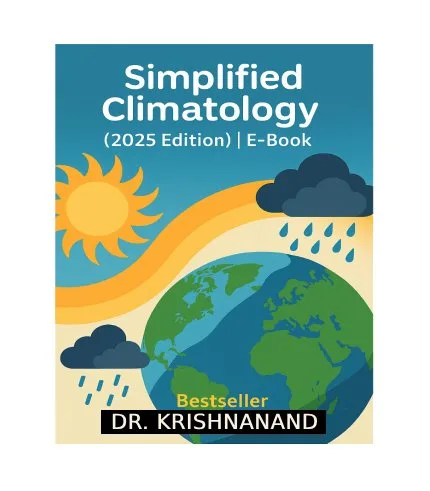
Simplified Climatology (2025 Edition) by Dr. Krishnanand is a purpose-built e-book designed specifically for UPSC CSE aspirants, undergraduates, and geography enthusiasts. The book is on the prescribed CBCS syllabus in geography and covers Walker Circulation within a broader, well-organized framework of climatological concepts. What makes this e-book particularly effective is its point-wise highlighted descriptions paired with diagrams, maps, and images that make the content comprehensive and interesting. The chapter structure begins with an introduction to climatology, proceeds through atmosphere structure, solar insolation, heat budget, and latitudinal heat balance — all building a foundation that naturally leads into atmospheric circulation topics including Walker Circulation. Dr. Krishnanand’s approach of simplifying complex concepts without losing scientific accuracy means that students spending ₹249 on this e-book gain access to a resource that replaces the need to juggle multiple textbooks. The 2025 edition is fully updated with the latest climate science insights, ensuring that aspirants are not studying outdated material. For those preparing for exams where Walker Circulation is a high-frequency topic, this resource delivers targeted, exam-ready content.
How to Use This E-Book Effectively for Walker Circulation Studies
To maximize your preparation of Walker Circulation using Simplified Climatology (2025 Edition), follow a structured approach. First, read the introductory chapters on atmosphere structure and solar insolation to build foundational context. Second, when you reach the sections on atmospheric circulation, focus on the diagrams and maps that illustrate Walker Circulation in both neutral and El Niño states. Third, use the point-wise descriptions for quick revision during the final weeks before your exam. Fourth, cross-reference the Walker Circulation explanation with the monsoon chapters in the same book to understand how the two systems interact. This integrated study method mirrors the analytical depth expected in UPSC MGS answers and university term papers. The e-book’s layout, with clearly marked page references and highlighted key terms, supports both deep reading and rapid revision cycles.
Walker Circulation and the Indian Monsoon Connection
One of the most frequently asked topics in geography examinations is the relationship between Walker Circulation and the Indian monsoon. During normal years, the Walker Circulation supports a strong westward flow of moisture-laden winds across the Indian Ocean, contributing to robust monsoon rainfall over India. However, when El Niño warms the eastern Pacific, the Walker Circulation weakens or reverses, reducing the pressure gradient that drives the monsoon. This is why El Niño years in India are often associated with below-average monsoon rainfall. The reverse is true for La Niña, where a strengthened Walker Circulation enhances monsoon conditions. This direct causal linkage makes Walker Circulation a high-scoring topic in both preliminary and mains examinations. The e-book by Dr. Krishnanand covers this connection within its updated climatology framework, giving students a single, reliable reference point.
Practical Buying Guidance for Aspirants
If you are a UPSC CSE aspirant, a geography undergraduate, or a climatology enthusiast, investing in Simplified Climatology (2025 Edition) at ₹249 is a cost-effective way to gain a comprehensive understanding of Walker Circulation and related atmospheric topics. Before purchasing, verify that the 2025 edition is current and includes the latest updates on climate science. Since it is an e-book, you can access it immediately after purchase and study on any device. The book is particularly valuable for students who find traditional textbooks overwhelming, as Dr. Krishnanand’s simplified approach reduces cognitive load while maintaining academic rigor. For those specifically targeting Walker Circulation in their syllabus, this resource provides a direct, efficient path from confusion to clarity.
Frequently Asked Questions
FAQs on Walker Circulation Study
The following FAQs address common doubts aspirants have about studying Walker Circulation and using the right resources for exam preparation.
What is Walker Circulation in simple terms?
Walker Circulation is an east-west atmospheric circulation cell in the tropical Pacific where warm air rises in the west, flows eastward at high altitude, descends in the east, and returns as surface trade winds. It is a fundamental concept in climatology and a frequent exam topic.
How is Walker Circulation different from Hadley Cell?
The Hadley Cell is a north-south circulation between the equator and subtropics driven by latitudinal heating differences, while Walker Circulation is an east-west circulation across the tropical Pacific driven by zonal temperature contrasts. Both are essential for understanding global atmospheric patterns, but they operate on different planes.
Which book is best for studying Walker Circulation for UPSC?
Simplified Climatology (2025 Edition) by Dr. Krishnanand is a highly recommended e-book for UPSC CSE aspirants. It covers Walker Circulation within the prescribed CBCS syllabus, using point-wise descriptions, diagrams, and maps that make complex atmospheric concepts accessible and exam-ready.
How does Walker Circulation affect Indian monsoon?
When Walker Circulation weakens during El Niño, the Indian monsoon tends to weaken, leading to below-average rainfall. During La Niña, a strengthened Walker Circulation supports above-average monsoon rainfall. This relationship is a key exam question in geography.
Is Simplified Climatology suitable for beginners?
Yes, Simplified Climatology (2025 Edition) is designed for beginners and experienced aspirants alike. Dr. Krishnanand simplifies complex climatology topics including Walker Circulation without compromising scientific accuracy, making it suitable for undergraduates and first-time UPSC aspirants.
Can I study Walker Circulation from free resources online?
While free resources exist, they often lack the syllabus-specific structure, diagrammatic clarity, and integrated exam approach that Simplified Climatology (2025 Edition) provides. For serious exam preparation, a dedicated, curated resource delivers better results than fragmented free content.
Our Recommendation
📖 Part of our complete guide: Evolution of Geographical Thought: A Comprehensive Guide for UPSC Aspirants and Geography Enthusiasts
Frequently Asked Questions
What is Walker Circulation in simple terms?
Walker Circulation is an east-west atmospheric circulation cell in the tropical Pacific where warm air rises in the west, flows eastward at high altitude, descends in the east, and returns as surface trade winds. It is a fundamental concept in climatology and a frequent exam topic.
How does Walker Circulation affect Indian monsoon?
When Walker Circulation weakens during El Niño, the Indian monsoon tends to weaken, leading to below-average rainfall. During La Niña, a strengthened Walker Circulation supports above-average monsoon rainfall. This relationship is a key exam question in geography.
Which book is best for studying Walker Circulation for UPSC?
Simplified Climatology (2025 Edition) by Dr. Krishnanand is a highly recommended e-book for UPSC CSE aspirants. It covers Walker Circulation within the prescribed CBCS syllabus, using point-wise descriptions, diagrams, and maps that make complex atmospheric concepts accessible and exam-ready.