Blog
Simplified Economic Geography: 2025 Edition for UPSC & NET

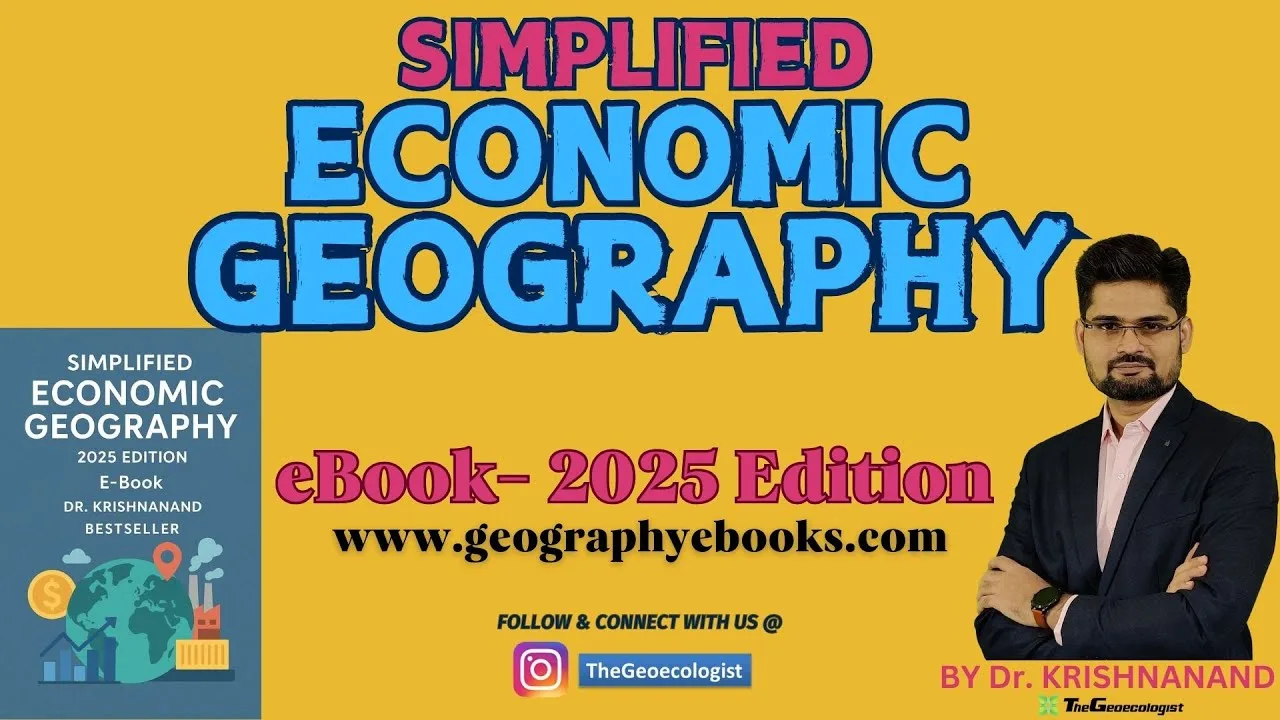
Table of Contents
- Understanding the Simplified Economic Geography Approach
- Pedagogical Philosophy and Learning Outcomes
- Core Theoretical Frameworks: Locational Theories in Depth
- Von Thünen's Agricultural Location Theory
- Weber's Industrial Location Theory
- Lösch's Market Area Theory
- Economic Activities: Sectoral Analysis for Competitive Exams
- Primary Sector: Resource Extraction and Agriculture
- Secondary Sector: Manufacturing and Industrial Development
- Tertiary and Quaternary Sectors: Services and Knowledge Economy
- Global Economic Patterns and Contemporary Relevance
- Trade Dynamics and Global Value Chains
- Resource Distribution and Geopolitics
- Case Studies and Visual Learning Methodology
- Diagrammatic Representation of Theories
- Regional Case Studies with Contemporary Data
- Target Audience and Examination Alignment
- UPSC Geography Optional Aspirants
- UGC NET/JRF Geography Candidates
- State PCS and University Students
- Expert Authorship and Pedagogical Credibility
- Digital Accessibility and Learning Ecosystem
- Acquisition and Support Information
- Conclusion: Strategic Investment in Examination Success
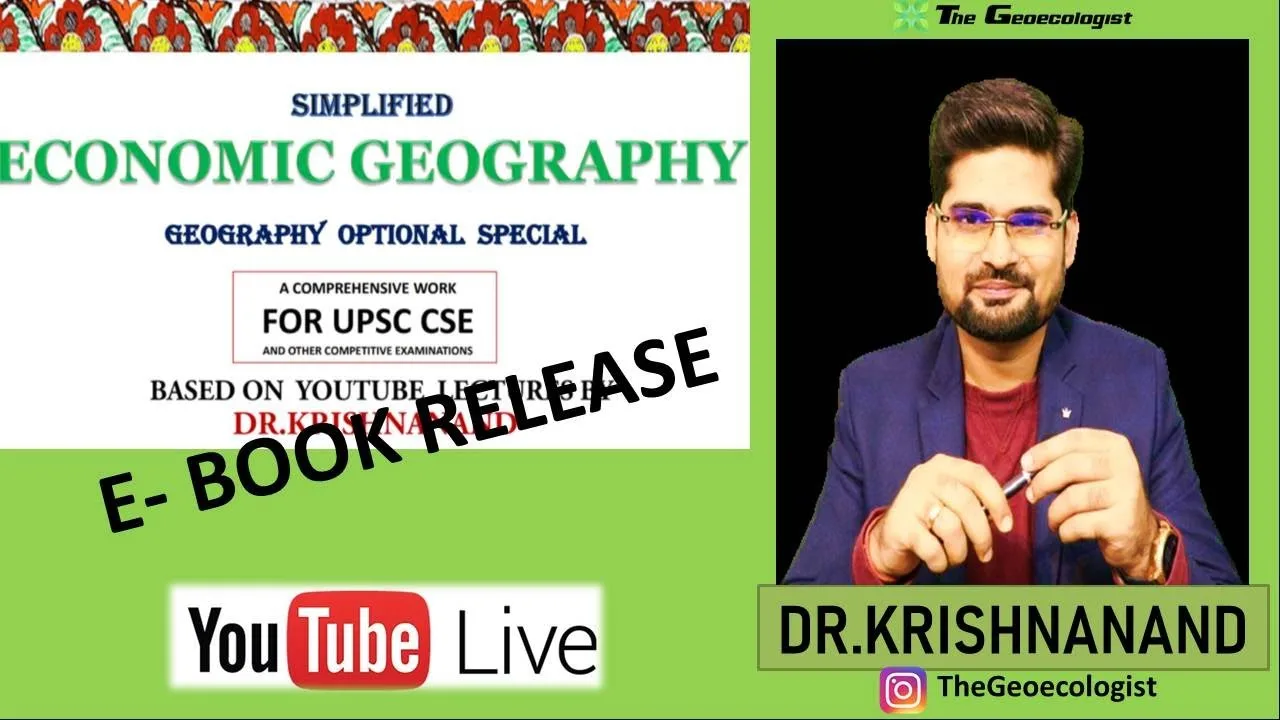
The Simplified Economic Geography 2025 Edition by Dr. Krishnanand has emerged as the definitive resource for aspirants targeting UPSC Geography Optional, UGC NET/JRF, and State PCS examinations. This comprehensive eBook bridges the gap between complex theoretical frameworks and exam-oriented preparation, offering aspirants a structured pathway to master one of the most dynamic sections of the geography syllabus. With updated content aligned to the latest 2025 curriculum, this publication addresses the evolving demands of competitive examinations while maintaining conceptual clarity that has made previous editions bestsellers among geography students across India.
- Comprehensive Coverage: Covers fundamentals, locational theories, economic activities, and global patterns in a single volume
- Exam-Focused Design: Tailored specifically for UPSC, UGC NET/JRF, State PCS, and university geography courses
- Updated 2025 Syllabus: Incorporates latest curriculum changes and contemporary economic geography trends
- Visual Learning Aids: Includes diagrams, tables, and case studies for enhanced retention and recall
- Expert Authorship: Authored by Dr. Krishnanand, recognized authority in geography education
- Digital Accessibility: Available as eBook for instant download and multi-device study
Understanding the Simplified Economic Geography Approach
The Simplified Economic Geography methodology distinguishes itself through a pedagogical framework that prioritizes conceptual understanding over rote memorization. Dr. Krishnanand’s approach deconstructs complex economic geography theories into digestible modules, each building upon foundational principles to develop advanced analytical capabilities. This systematic progression mirrors the cognitive development required for competitive examination success, where aspirants must demonstrate both theoretical knowledge and applied reasoning.
The 2025 edition represents a significant evolution from previous versions, incorporating feedback from thousands of successful candidates who have utilized earlier editions. The revision process involved extensive consultation with subject matter experts, analysis of recent examination patterns, and integration of emerging topics in global economic geography. This iterative improvement cycle ensures the content remains relevant to current examination trends while preserving the core strengths that established the book’s reputation.
Pedagogical Philosophy and Learning Outcomes
The educational philosophy underpinning Simplified Economic Geography emphasizes three interconnected learning outcomes: conceptual mastery, analytical application, and examination readiness. Each chapter follows a consistent structure beginning with theoretical foundations, progressing through worked examples and case studies, and concluding with practice questions modeled on actual examination patterns. This scaffolding approach enables aspirants to develop confidence gradually while building the comprehensive knowledge base required for high-stakes testing environments.
Core Theoretical Frameworks: Locational Theories in Depth
A distinguishing feature of the Simplified Economic Geography 2025 Edition is its exhaustive treatment of classical and contemporary locational theories. These frameworks form the theoretical backbone of economic geography and consistently appear in competitive examinations across all levels. The book provides unparalleled clarity on three foundational theories that have shaped the discipline for over a century.
Von Thünen’s Agricultural Location Theory
Johann Heinrich von Thünen’s 1826 model remains the cornerstone of agricultural geography. The Simplified Economic Geography treatment explores the theory’s four concentric zones of agricultural activity surrounding a central market, examining how transport costs and land rent gradients determine land use patterns. The 2025 edition enhances this classic treatment with contemporary applications, including analysis of how modern supply chains, refrigeration technology, and global trade agreements have modified but not invalidated Von Thünen’s core insights. The book includes updated case studies from Indian agriculture, demonstrating the theory’s relevance to understanding crop patterns in the Indo-Gangetic plain and Deccan plateau regions.
Weber’s Industrial Location Theory
Alfred Weber’s 1909 least-cost theory receives comprehensive treatment with particular attention to its applicability in India’s evolving industrial landscape. The Simplified Economic Geography analysis covers Weber’s three primary location factors—transport costs, labor costs, and agglomeration economies—while introducing modern modifications accounting for government policy incentives, special economic zones, and the Make in India initiative. The 2025 edition includes detailed mapping of industrial corridors such as the Delhi-Mumbai Industrial Corridor (DMIC) and Chennai-Bengaluru Industrial Corridor, illustrating how Weber’s principles manifest in contemporary Indian industrial geography.
Lösch’s Market Area Theory
August Lösch’s 1940 contribution extends locational analysis to market optimization and hexagonal market areas. The Simplified Economic Geography 2025 Edition provides the most accessible explanation of Lösch’s complex mathematical formulations available in any competitive examination resource. The treatment includes step-by-step derivation of hexagonal market areas, analysis of how consumer behavior modifications affect market area boundaries, and application to India’s emerging retail and e-commerce landscapes. This section proves particularly valuable for UGC NET/JRF candidates who encounter theoretical questions on market area analysis.
Economic Activities: Sectoral Analysis for Competitive Exams
The Simplified Economic Geography framework organizes economic activities into the traditional four-sector model while incorporating the emerging quinary sector concept. This classification system aligns perfectly with UPSC and UGC NET syllabus requirements, ensuring aspirants can address questions across the full spectrum of economic geography.
Primary Sector: Resource Extraction and Agriculture
The primary sector analysis covers mining, forestry, fishing, and agriculture with updated statistical data from the Ministry of Statistics and Programme Implementation (MoSPI) 2023-24 reports. The Simplified Economic Geography treatment includes district-level analysis of mineral production, assessment of India’s forest cover changes per the India State of Forest Report 2023, and examination of the Blue Economy initiative’s impact on fisheries. Special attention is given to the critical minerals mission announced in the 2024-25 Union Budget, connecting resource geography to current policy priorities.
Secondary Sector: Manufacturing and Industrial Development
Manufacturing geography receives extensive coverage including the Production Linked Incentive (PLI) schemes across 14 sectors, the National Manufacturing Policy objectives, and the evolving spatial distribution of industries. The Simplified Economic Geography analysis incorporates the 2023 Annual Survey of Industries data, providing aspirants with the latest statistical foundation for answering data-driven questions. The treatment of industrial clusters, from traditional regions like the Hooghly belt to emerging corridors in Tamil Nadu and Gujarat, demonstrates the dynamic nature of India’s industrial geography.
Tertiary and Quaternary Sectors: Services and Knowledge Economy
The services sector, now contributing over 54% of India’s GVA according to the Economic Survey 2023-24, receives proportionate attention. The Simplified Economic Geography 2025 Edition analyzes the spatial dynamics of IT-BPM clusters, financial services concentration in Mumbai, healthcare tourism hubs, and the emerging gig economy geography. The quaternary sector treatment covers research and development establishments, higher education institutions, and innovation clusters, with specific reference to the Anusandhan National Research Foundation established in 2023.
Global Economic Patterns and Contemporary Relevance
Understanding global economic geography is essential for both UPSC Geography Optional Paper II and UGC NET/JRF Paper 2. The Simplified Economic Geography 2025 Edition provides a sophisticated analysis of international trade patterns, global value chains, and the shifting geography of economic power.
Trade Dynamics and Global Value Chains
The book examines how the World Trade Organization’s evolving framework, regional trade agreements like RCEP and IPEF, and the restructuring of global supply chains post-2020 have transformed trade geography. The Simplified Economic Geography analysis includes India’s changing trade partners, the shift from westward to eastward trade orientation, and the strategic implications of the India-Middle East-Europe Economic Corridor (IMEC) announced at the G20 Summit 2023. These contemporary developments are connected to classical trade theories—comparative advantage, factor endowments, and new trade theory—providing aspirants with the theoretical tools to analyze current events.
Resource Distribution and Geopolitics
Critical mineral geography has emerged as a high-priority topic following the global energy transition. The Simplified Economic Geography 2025 Edition provides the most current analysis of lithium, cobalt, rare earth elements, and copper distribution globally, with specific attention to India’s bilateral agreements with Argentina, Chile, and Australia for lithium security. The treatment connects resource geography to the broader geopolitical framework, essential for UPSC Geography Optional candidates addressing questions on resource politics and energy security.
Case Studies and Visual Learning Methodology
A hallmark of the Simplified Economic Geography approach is its extensive use of India-specific case studies and visual aids. The 2025 edition contains over 75 diagrams, 40 tables, and 30 detailed case studies, each designed to serve dual purposes: illustrating theoretical concepts and providing ready-to-use content for examination answers.
Diagrammatic Representation of Theories
Each locational theory is accompanied by step-by-step diagrammatic construction guides, enabling aspirants to reproduce accurate diagrams under examination conditions. The Simplified Economic Geography methodology emphasizes that diagram-drawing is not merely illustrative but analytical—each diagram component represents a theoretical proposition that examiners evaluate. The book includes common diagrammatic errors and how to avoid them, based on analysis of previous years’ examiner reports.
Regional Case Studies with Contemporary Data
Case studies span diverse Indian regions: the transformation of Gujarat’s industrial geography post-2001, Bengaluru’s evolution as a global innovation hub, the agricultural geography of Punjab’s cropping pattern crisis, and Kerala’s service sector-led development model. Each case study in the Simplified Economic Geography 2025 Edition incorporates data from the latest available sources—Census 2011 (with 2024 projections), NSSO rounds, PLFS data, and state economic surveys—ensuring aspirants can cite authoritative statistics in their answers.
Target Audience and Examination Alignment
The Simplified Economic Geography 2025 Edition is meticulously aligned with multiple examination syllabi, making it a versatile resource for diverse aspirant categories.
UPSC Geography Optional Aspirants
For UPSC Geography Optional candidates, the book covers the complete Economic Geography section of Paper II (Human Geography) with depth exceeding the syllabus requirements. The Simplified Economic Geography treatment of topics like “Locational factors of industries,” “World trade patterns,” and “Regional development and planning” provides the analytical depth required for 150-250 word answers. The inclusion of previous year question analysis (2013-2024) with model answer structures makes it an indispensable companion for optional preparation.
UGC NET/JRF Geography Candidates
UGC NET/JRF Paper 2 Geography aspirants benefit from the book’s theoretical rigor and objective-type question bank. The Simplified Economic Geography 2025 Edition includes over 500 MCQs with detailed explanations, categorized by difficulty level and topic. The theoretical treatments of economic geography concepts—particularly the mathematical formulations in locational theories—address the NET examination’s emphasis on conceptual precision. The book also covers the Research Methodology section’s quantitative geography components relevant to economic geography research.
State PCS and University Students
State Public Service Commission examinations increasingly mirror UPSC patterns while incorporating state-specific economic geography. The Simplified Economic Geography framework accommodates this through modular state-specific supplements available on the companion website. For university students pursuing BA/MA Geography, the book serves as a comprehensive textbook covering the UGC-prescribed CBCS curriculum for Economic Geography papers across Indian universities.
Expert Authorship and Pedagogical Credibility
Dr. Krishnanand, the author of Simplified Economic Geography, brings over two decades of geography teaching experience at the university level and extensive involvement in competitive examination coaching. His academic credentials include a Ph.D. in Economic Geography with specialization in industrial location theory, numerous research publications in UGC-CARE listed journals, and service as a subject expert for curriculum development committees. TheGeoecologist platform, which he founded, has mentored over 50,000 geography aspirants since 2015, with consistent top-rankers in UPSC and UGC NET examinations attributing their success to his methodology.
The author’s YouTube channel TheGeoecologist provides free supplementary lectures that complement the eBook content, creating an integrated learning ecosystem. This multi-modal approach—combining structured text, visual lectures, and interactive doubt resolution—represents the cutting edge of competitive examination preparation pedagogy.
Digital Accessibility and Learning Ecosystem
The Simplified Economic Geography 2025 Edition is available exclusively as a digital publication through the official platform, enabling immediate access upon purchase. The eBook format offers advantages particularly valuable for competitive examination preparation: searchable text for rapid revision, adjustable font sizes for extended study sessions, bookmarking and annotation capabilities, and cross-device synchronization. The platform provides lifetime access with free updates for syllabus changes, ensuring the resource remains current throughout the aspirant’s preparation journey.
Complementary resources include chapter-wise mind maps, formula sheets for locational theories, a glossary of 300+ economic geography terms, and a monthly current affairs digest connecting economic geography concepts to contemporary developments. The Simplified Economic Geography ecosystem also includes a Telegram community for peer discussion and direct author interaction, creating a supportive learning environment that extends beyond the book itself.
Acquisition and Support Information
Aspirants can acquire the Simplified Economic Geography 2025 Edition through the official website geographyebooks.com. The purchase process is streamlined with multiple payment options including UPI, net banking, and card payments. Technical support is available via phone at +91 9709646047 and email at krishna.geography@gmail.com. The platform also offers bundle discounts for aspirants purchasing multiple titles from TheGeoecologist catalog, including Physical Geography, Human Geography, and Indian Geography companions.
For aspirants seeking to verify the resource’s alignment with their specific examination requirements, the website provides detailed chapter-wise syllabus mapping documents for UPSC, UGC NET, and major State PCS examinations. Sample chapters are available for preview, allowing informed purchase decisions. The Simplified Economic Geography 2025 Edition comes with a 7-day satisfaction guarantee, reflecting the publisher’s confidence in the resource’s quality and utility.
Conclusion: Strategic Investment in Examination Success
The Simplified Economic Geography 2025 Edition represents more than a study resource—it constitutes a strategic investment in competitive examination success. By consolidating theoretical depth, contemporary relevance, examination orientation, and pedagogical innovation into a single accessible volume, it eliminates the need for multiple fragmented resources. The book’s track record of producing top-rankers, combined with the 2025 edition’s comprehensive updates, positions it as the definitive economic geography resource for serious aspirants targeting UPSC, UGC NET/JRF, State PCS, and university examinations in the 2025-26 cycle.
In a preparation landscape where time efficiency and resource reliability determine outcomes, the Simplified Economic Geography 2025 Edition offers aspirants the confidence that their economic geography preparation rests on a foundation of expert curation, continuous improvement, and proven results. The integration of classical theoretical rigor with contemporary analytical frameworks ensures that aspirants develop not merely examination-specific knowledge but a enduring understanding of economic geography’s relevance to India’s development trajectory and global positioning.
Frequently Asked Questions
Yes, the Simplified Economic Geography 2025 Edition comprehensively covers the entire Economic Geography section of UPSC Geography Optional Paper II (Human Geography) with depth exceeding syllabus requirements, including previous year question analysis (2013-2024) and model answer structures.
The Simplified Economic Geography 2025 Edition includes over 500 MCQs with detailed explanations, categorized by difficulty level and topic, specifically designed for UGC NET/JRF Paper 2 Geography preparation along with theoretical treatments of mathematical formulations in locational theories.
The Simplified Economic Geography 2025 Edition is available as a digital download from geographyebooks.com with immediate access upon purchase. The eBook offers searchable text, adjustable fonts, bookmarking, annotation capabilities, cross-device sync, and lifetime access with free syllabus updates.