Blog
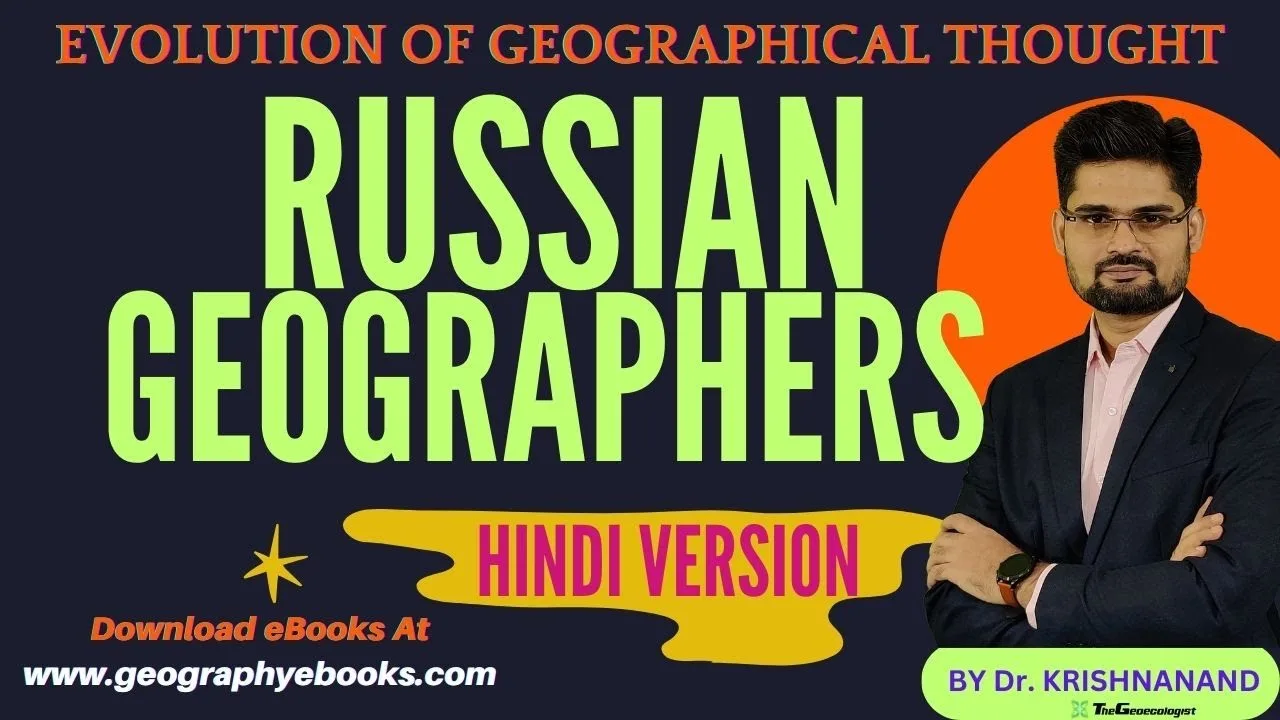
Russian School of Geographical Thought-TheGeoecologist

Russian School of Geographical Thought-TheGeoecologist
Exploring the Russian School of Geographical Thought: A Legacy Shaping Modern Geography
Geography as a discipline owes much of its theoretical and methodological depth to diverse global traditions. Among these, the Russian School of Geographical Thought stands out for its groundbreaking contributions to regional geography, physical geography, and human-environment interactions. This article delves into the core ideas, key figures, and lasting relevance of the Russian School—essential knowledge for UGC NET Geography, UPSC Geography Optional, State PCS, and university-level exams.
Origins of the Russian School
Emerging in the late 19th and early 20th centuries, Russian geography developed distinct philosophies influenced by the nation’s vast territories, climatic diversity, and interdisciplinary scientific traditions. Russian geographers emphasized holistic approaches, integrating physical landscapes, human activities, and socio-political contexts into unified regional studies. This stood in contrast to Western schools that often fragmented geography into narrow sub-disciplines.
Key Contributions of Russian Geographers
1. Regional Geography & Landscape Science
Russian scholars pioneered landscape science (landshaftovedenie), viewing regions as dynamic systems where natural and human elements interact. Key figures include:
- Vasily Dokuchaev (1846–1903): The “father of soil science,” who introduced the concept of natural zones and soil genesis as a product of climate, relief, and biology.
- Lev Berg (1876–1950): Developed the theory of landscape zones, mapping the USSR’s ecological regions based on climate, soil, and vegetation.
2. Physical Geography & Environmental Determinism
Russian geographers advanced the study of physical processes while critiquing extreme environmental determinism:
- Alexander Voyeykov (1842–1916): Explored climate’s role in shaping agriculture and settlement patterns.
- Vladimir Vernadsky (1863–1945): Introduced the biosphere concept, emphasizing Earth as an interconnected living system—a precursor to modern Earth System Science.
3. Human-Environment Interactions
The Russian School emphasized anthropogenic impacts on nature long before Western geography:
- Peter Kropotkin (1842–1921): Advocated for regional self-sufficiency and ecological balance, blending geography with anarchist philosophy.
- Nikolay Baransky (1881–1963): Integrated economic geography with Marxist theory, analyzing spatial inequalities in industrialization.
Contemporary Relevance for Exams
Understanding the Russian School is vital for:
- Regional Analysis: Its focus on landscape units aids in contemporary regional planning and GIS applications.
- Environmental Studies: Concepts like the biosphere and human-environment interdependence underpin sustainability science.
- Critical Geography: Russian critiques of environmental determinism inform debates on climate justice and resource management.
Why Study the Russian School Today?
For aspirants preparing for UGC NET Geography, UPSC Optional, or State PCS, this topic offers:
- Theoretical Depth: Insights into how geography evolved beyond Eurocentric models.
- Interdisciplinary Linkages: Connection to ecology, economics, and sociology.
- Exam-Focused Value: Frequently asked in university and competitive exams.
Boost Your Geography Prep with TheGeoecologist!
📚 Resources:
- Online Courses: Tailored for UPSC/UGC NET Geography at https://thegeoecologist.com.
- Study Materials & eBooks: Access curated content at https://geographyebooks.com.
🔔 Stay Updated:
- YouTube: TheGeoecologist
- Instagram: @TheGeoecologist
- Email: krishna.geography@gmail.com
Keywords: Russian School of Geographical Thought, UPSC Geography Optional, UGC NET Geography, Regional Geography, Physical Geography, Human-Environment Interaction, Vasily Dokuchaev, Vladimir Vernadsky.
Master geography with TheGeoecologist—where tradition meets modern scholarship! 🌍
To Download E-Books & Study Material Visit The Shop Page