Blog
Origin of the Universe: A Comprehensive Geography Guide

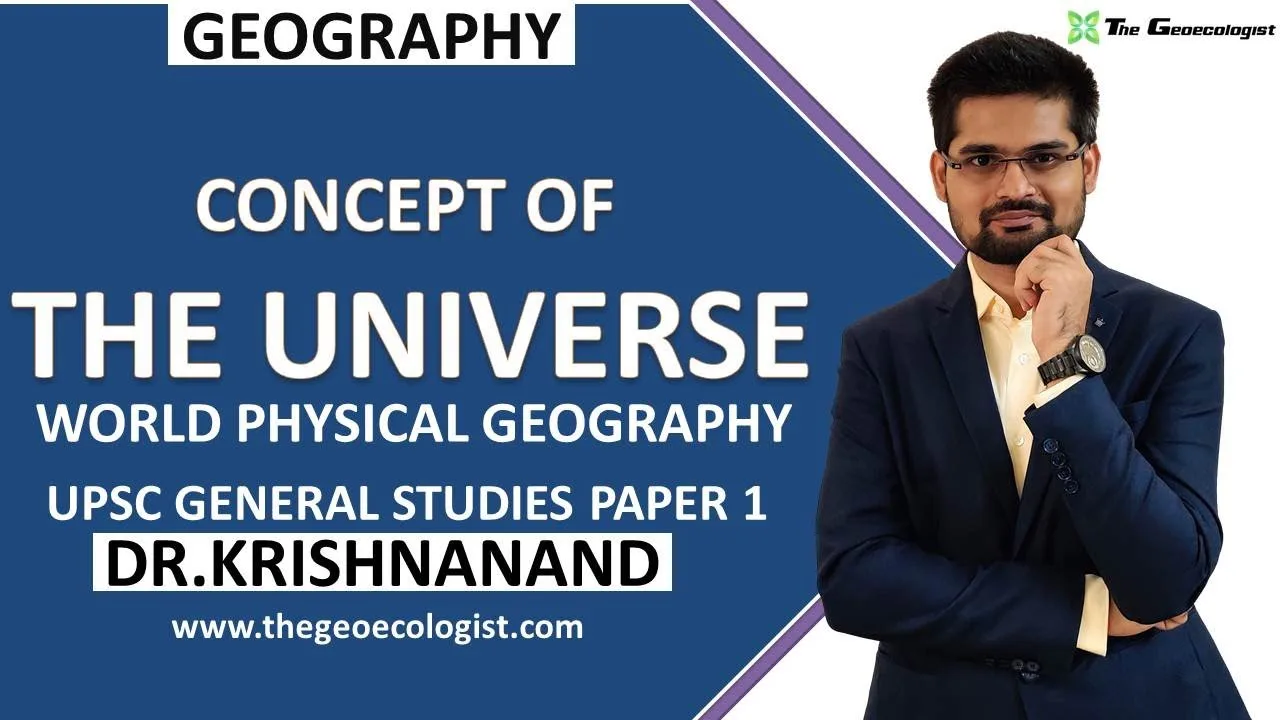
Table of Contents
- The Scientific Foundation of the Origin of the Universe
- The Big Bang Theory and Cosmic Inflation
- Components of the Universe: The Building Blocks of Space
- 1. Galaxies: The Islands of Stars
- 2. Stars and Nebulae
- 3. Dark Matter and Dark Energy
- The Role of Gravity in Cosmic Evolution
- Implications for UPSC and Geography Students
- Summary of Cosmic Evolution
- Conclusion: Why the Origin of the Universe Matters
Understanding the origin of the universe is fundamental to mastering World Physical Geography, especially for students preparing for competitive examinations like the UPSC Civil Services. This detailed guide explores the scientific theories, cosmic evolution, and the various components that constitute our vast cosmos, as explained by Dr. Krishnanand, founder of TheGeoecologist.
- The Big Bang Theory: The most widely accepted scientific model for the birth of the cosmos.
- Cosmic Components: An analysis of galaxies, stars, nebulae, and dark matter.
- Evolutionary Timeline: From the singularity to the current state of the expanding universe.
- UPSC Relevance: Crucial concepts for GS Paper-1 and Geography Optional.
The Scientific Foundation of the Origin of the Universe
The study of the origin of the universe seeks to answer one of humanity’s most profound questions: how did everything begin? In the context of World Physical Geography, we move beyond philosophical speculation into empirical, evidence-based science. The prevailing scientific consensus is the Big Bang Theory, which suggests that the universe began as a singularity—a point of infinite density and temperature—approximately 13.8 billion years ago.
According to research documented by Wikipedia, the universe has been expanding and cooling ever since this initial event. This expansion is not merely movement through space, but the expansion of space itself. For UPSC aspirants, understanding this expansion is key to grasping the formation of large-scale structures in the cosmos.
The Big Bang Theory and Cosmic Inflation
The Big Bang is not an explosion in space, but an expansion of space. In the earliest moments, a period known as ‘inflation’ occurred, where the universe underwent an exponential growth rate. This rapid expansion helped smooth out the distribution of matter, leading to the structured universe we observe today. When discussing the origin of the universe, one must acknowledge the role of cosmic microwave background radiation (CMB), which serves as the ‘afterglow’ of the Big Bang, providing tangible proof of our cosmic beginnings.
Components of the Universe: The Building Blocks of Space
To understand the origin of the universe, we must first identify what it is composed of. The universe is not a void of nothingness; it is a complex web of matter and energy. Scientists categorize these components into several distinct layers.
1. Galaxies: The Islands of Stars
Galaxies are massive systems consisting of stars, stellar remnants, gas, dust, and dark matter, all bound together by gravity. They range from dwarf galaxies to enormous elliptical structures. The distribution of these galaxies provides clues about the early origin of the universe and how gravity acted on primordial matter to create large-scale structures.
2. Stars and Nebulae
Stars are the fundamental units of stellar evolution. Born from the gravitational collapse of gas clouds known as nebulae, stars convert hydrogen into helium through nuclear fusion. This process releases the immense energy that illuminates the cosmos. The lifecycle of a star—from protostar to red giant or supernova—is a direct consequence of the physical laws established during the origin of the universe.
3. Dark Matter and Dark Energy
Perhaps the most mysterious components are dark matter and dark energy. While we cannot see them, their gravitational effects are undeniable. Dark matter acts as a cosmic glue, holding galaxies together, while dark energy is the force driving the accelerated expansion of the universe. Understanding these forces is essential for a complete academic view of the origin of the universe and its ultimate fate.
The Role of Gravity in Cosmic Evolution
Gravity is the architect of the universe. Once the origin of the universe set the stage by providing matter and energy, gravity began the long process of pulling that matter together. This process led to the formation of the first stars, which in turn formed the first galaxies. For students of World Physical Geography, it is vital to recognize that gravity is the primary driver of celestial mechanics.
The interplay between gravity (which pulls matter together) and the expansion of the universe (which pushes it apart) determines the structure of the cosmos. This tension is a central theme in modern astrophysics and a critical topic for GS Paper-1.
Implications for UPSC and Geography Students
For those preparing for the UPSC/IAS exams, the origin of the universe is not just an astronomical topic; it is a fundamental part of the physical geography syllabus. Understanding how the universe began helps students understand the formation of planetary systems, the composition of the Earth, and the chemical evolution of the solar system. Dr. Krishnanand emphasizes that a conceptual clarity of these topics is required to tackle complex questions in the General Studies papers.
As noted in various academic resources like NASA, the study of the cosmos is a multidisciplinary endeavor that combines physics, chemistry, and mathematics. For a geography student, this means understanding how the physical properties of the universe influence the terrestrial environment we inhabit.
Summary of Cosmic Evolution
To recap, the journey from the origin of the universe to the present day involves several key stages:
- Singularity: The initial state of infinite density.
- Inflation: Rapid expansion of space.
- way of cooling: As the universe expanded, it cooled, allowing atoms to form.
- Structure Formation: Gravity pulling matter into stars and galaxies.
- Modern Era: The current state of an expanding universe dominated by dark energy.
Conclusion: Why the Origin of the Universe Matters
The study of the origin of the universe provides the ultimate context for all other branches of science. By understanding the beginning, we can better predict the future of our universe and our place within it. Whether you are a beginner or an advanced student preparing for the UPSC, mastering the components of the universe is an essential step in understanding the physical world. For more in-depth lectures, visit TheGeoecologist to access premium study materials and expert guidance.
Frequently Asked Questions
The Big Bang Theory is the most widely accepted scientific model, suggesting the universe began from a singularity approximately 13.8 billion years ago.
It is a core topic in World Physical Geography, which is part of the GS Paper-1 syllabus and the Geography Optional subject.
The universe consists of galaxies, stars, nebulae, gas, dust, dark matter, and dark energy.