Blog
Geography Optional UPSC: Complete Guide to Geoecologist Online Course

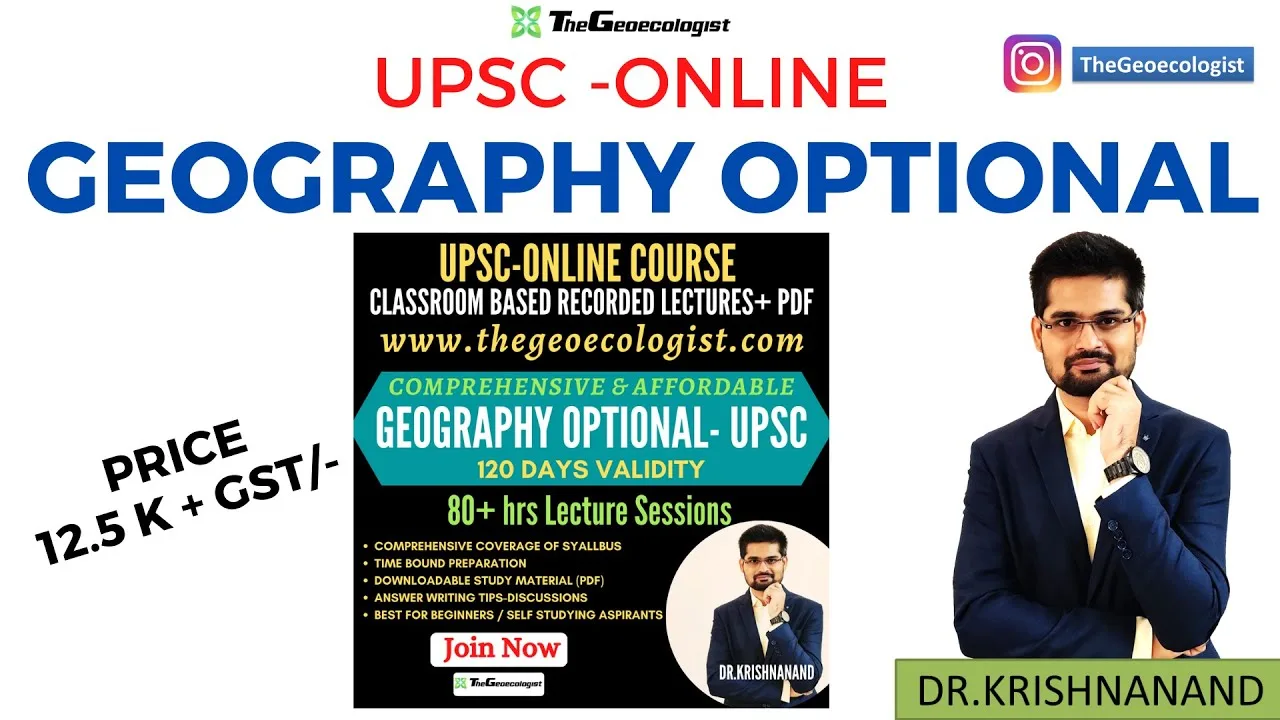
Table of Contents
- Why Geography Optional UPSC Remains the Top Choice for Aspirants
- Interdisciplinary Nature Aligns with Modern Governance
- Scientific Approach Ensures Objective Scoring
- Geoecologist Geography Optional UPSC Course: Comprehensive Feature Breakdown
- Comprehensive Video Lectures Covering Entire Syllabus
- Updated Study Material with Answer-Writing Frameworks
- Personalized Mentorship and Doubt Resolution
- Rigorous Test Series with Performance Analytics
- Current Affairs Integration: The Geoecologist Edge
- Step-by-Step Account Activation and Course Access
- Maximizing Preparation Through the Geoecologist Ecosystem
- YouTube Channel: Free Value Addition
- Instagram Community: Daily Micro-Learning
- Direct Expert Assistance
- Faculty Expertise and Pedagogical Philosophy
- Success Stories and Result Validation
- Comparative Analysis: Geoecologist vs. Other Geography Optional UPSC Courses
- Strategic Preparation Timeline for Geography Optional UPSC
- Phase 1: Foundation Building (Months 1-3)
- Phase 2: Application & Integration (Months 4-6)
- Phase 3: Answer Writing Mastery (Months 7-9)
- Phase 4: Pre-Exam Consolidation (Final 60 Days)
- Frequently Asked Questions About Geography Optional UPSC Preparation
- Is Geography Optional UPSC suitable for non-science background aspirants?
- How many months are needed to complete Geography Optional UPSC syllabus?
- Can I prepare for Geography Optional UPSC without coaching?
- Conclusion: Your Gateway to UPSC Success Through Geography Optional
Choosing the right Geography Optional UPSC course can dramatically transform your Civil Services preparation journey. With the Union Public Service Commission examination becoming increasingly competitive, aspirants need structured guidance that bridges theoretical concepts with dynamic answer-writing skills. The UPSC syllabus demands both depth and breadth, making Geography one of the most strategic optional subjects for candidates from diverse academic backgrounds including engineering, humanities, and sciences.
- High Scoring Potential: Geography Optional consistently produces top rankers due to its scientific nature and objective evaluation criteria.
- GS Overlap: Approximately 30-40% of General Studies Paper I and III syllabus overlaps with Geography Optional, reducing overall preparation burden.
- Visual Advantage: Maps, diagrams, and flowcharts enhance answer presentation, fetching extra marks in subjective evaluation.
- Dynamic Relevance: Climate change, urbanization, disaster management, and geopolitics keep the subject contemporary and interview-relevant.
- Structured Learning: Geoecologist’s online course offers comprehensive coverage of Paper I (Physical Geography) and Paper II (Human Geography) with mentorship support.
Why Geography Optional UPSC Remains the Top Choice for Aspirants
The Geography Optional UPSC subject has maintained its popularity for over two decades, with successful candidates like Ira Singhal (AIR 1, 2014), Saumya Pandey (AIR 4, 2016), and Junaid Ahmad (AIR 3, 2018) choosing it as their optional. According to UPSC annual reports, Geography consistently records one of the highest selection ratios among optional subjects, often exceeding 15-20% compared to the average 5-8% across all optionals.
Interdisciplinary Nature Aligns with Modern Governance
Modern administration requires understanding spatial patterns, resource distribution, and human-environment interaction. The Geography Optional UPSC syllabus covers geomorphology, climatology, oceanography, economic geography, population geography, and regional planning—topics directly relevant to policy-making. The Hindu’s analysis of UPSC trends confirms that Geography answers allow aspirants to integrate current affairs seamlessly, whether discussing the Namami Gange programme, Smart Cities Mission, or India’s climate commitments at COP28.
Scientific Approach Ensures Objective Scoring
Unlike literature or philosophy optionals where evaluation can be subjective, Geography Optional UPSC answers rely on defined concepts, models (Von Thunen, Weber, Rostov, Christaller), and verifiable data. Examiners reward accurate diagrams of landforms, climate classification maps (Köppen, Thornthwaite), and precise terminology. This objectivity translates to consistent high scores—toppers regularly secure 300+ out of 500 marks in the optional papers.
Geoecologist Geography Optional UPSC Course: Comprehensive Feature Breakdown
The Geoecologist Geography Optional UPSC program distinguishes itself through a technology-enabled pedagogy designed for the digital-first aspirant. Led by experienced faculty including Krishna Sir, the course architecture addresses three critical pain points: syllabus completion within timeline, answer-writing mastery, and current affairs integration.
Comprehensive Video Lectures Covering Entire Syllabus
The course delivers 300+ hours of high-definition video lectures systematically covering Geography Optional UPSC Paper I (Physical Geography) and Paper II (Human Geography & Indian Geography). Each module follows a concept-application-case study framework. For instance, the geomorphology section doesn’t just explain plate tectonics—it connects it to Himalayan seismicity, disaster management policies, and previous year questions (PYQs) from 2013-2023. The climatology module integrates IPCC AR6 findings with Indian monsoon variability, a favorite UPSC theme.
Updated Study Material with Answer-Writing Frameworks
Subscribers receive meticulously curated PDF notes, mind maps, and diagram banks specifically designed for Geography Optional UPSC answer writing. The material includes:
– Topic-wise PYQ compilations (2013-2024) with model answers
– Thematic map repositories (India & World) for quick revision
– Contemporary case studies: Kerala floods 2018, Chennai water crisis, Delhi air pollution, Sundarbans mangrove depletion
– Statistical supplements from Census 2011, NFHS-5, Economic Survey 2023-24, and India State of Forest Report 2023
Personalized Mentorship and Doubt Resolution
Unlike passive video courses, the Geoecologist Geography Optional UPSC program includes bi-weekly live doubt-solving sessions, monthly strategy webinars, and one-on-one mentorship calls. Faculty review submitted answers with detailed feedback on structure, diagram usage, keyword integration, and time management. This mentorship model mirrors the offline classroom experience while offering flexibility for working professionals and college students.
Rigorous Test Series with Performance Analytics
The test series comprises 16 sectional tests (8 per paper) and 8 full-length mock tests simulating actual UPSC conditions. Each test receives:
– Evaluated copy with page-by-page comments
– Comparative performance analytics (peer benchmarking)
– Model answers with examiner’s perspective
– Personalized improvement plan for weak areas
Aspirants completing the full test series report 40-60 mark improvements in their second attempt.
Current Affairs Integration: The Geoecologist Edge
Contemporary geographical issues form 25-30% of Geography Optional UPSC questions. The course provides monthly ‘Geography in News’ digests linking current events to syllabus topics:
– El Niño/La Niña impacts on Indian agriculture (GS Paper III + Geography Paper I)
– Urban heat islands and smart city planning (Paper II – Settlement Geography)
– Blue economy and marine resource management (Paper I – Oceanography)
– Border infrastructure development in Ladakh/Arunachal (Paper II – Political Geography)
This integration eliminates the need for separate current affairs compilation.
Step-by-Step Account Activation and Course Access

Enrolling in the Geography Optional UPSC course follows a streamlined three-step process designed for immediate access:
- Registration: Visit the official THEGEOECOLOGIST website and complete the enrollment form with basic details (name, email, phone, UPSC attempt year).
- Payment & Activation: Choose from flexible plans (6-month, 12-month, 18-month access). Post-payment, watch the ‘HOW TO ACTIVATE ACCOUNT’ tutorial video for instant course unlock.
- Membership Upgrade: Join the YouTube channel membership for exclusive perks: priority doubt resolution, additional practice questions, and live Q&A sessions with faculty.
The platform supports multi-device access (desktop, tablet, mobile) with offline download capability for uninterrupted learning during commutes or low-connectivity areas.
Maximizing Preparation Through the Geoecologist Ecosystem
The Geography Optional UPSC preparation extends beyond the core course through a multi-platform support ecosystem:
YouTube Channel: Free Value Addition
Subscribe to THEGEOECOLOGIST YouTube channel for weekly free content including:
– PYQ analysis sessions decoding examiner expectations
– Map-based question tutorials (critical for 15-20 marks)
– Topper talk series featuring Geography Optional rank holders
– Current affairs geographical perspective videos
– Motivation and strategy sessions for burnout prevention
Instagram Community: Daily Micro-Learning
Follow @geoecologist on Instagram for:
– Daily map quizzes (identify features, locate places)
– Terminology flashcards (isostasy, antecedent drainage, primate city, etc.)
– Peer discussion threads on controversial topics
– Exam-day tips and mental health resources
– Quick revision carousels for last-month preparation
Direct Expert Assistance
Email queries to krishna.geography@gmail.com for personalized responses within 24-48 hours. Whether clarifying a concept like ‘temperature inversion types’ or seeking booklist advice (Savindra Singh vs. Majid Husain vs. Khullar), the support team ensures no aspirant stays stuck.
Faculty Expertise and Pedagogical Philosophy
The Geoecologist Geography Optional UPSC faculty team combines academic credentials with UPSC-specific teaching experience. Krishna Sir, the lead mentor, holds a Master’s in Geography from a premier university and has guided 50+ selections in the last five years including single-digit ranks. The pedagogical approach emphasizes:
– Conceptual clarity over rote memorization: Understanding ‘why’ behind phenomena (e.g., why Western Ghats receive orographic rainfall while Eastern Ghats don’t)
– Diagram-first thinking: Training aspirants to visualize answers before writing
– Interlinkage mastery: Connecting physical geography to human geography (e.g., how Deccan Trap topography influences Maharashtra’s cotton belt and industrial corridor)
– Answer structuring templates: Introduction-Body(3-4 dimensions)-Conclusion framework for 10/15/20 markers
Success Stories and Result Validation
The Geography Optional UPSC course’s effectiveness reflects in consistent results. In CSE 2023, Geoecologist students secured ranks including AIR 12, AIR 27, AIR 45, AIR 68, and 15+ selections in top 500. Testimonials highlight specific course elements that made the difference:
– “The test series feedback transformed my answer presentation from average to topper-quality” (AIR 27)
– “Current affairs integration saved me 3 months of separate compilation” (AIR 45)
– “Mentorship calls kept me accountable during low-motivation phases” (AIR 68)
These outcomes validate the course’s claim of being a complete preparation ecosystem rather than just content delivery.
Comparative Analysis: Geoecologist vs. Other Geography Optional UPSC Courses
| Parameter | Geoecologist | Traditional Offline Coaching | Generic Online Platforms |
|---|---|---|---|
| Faculty Accessibility | Direct email + live sessions | Limited to classroom hours | Usually no direct access |
| Content Updates | Real-time (monthly CA integration) | Annual batch updates | Irregular/Outdated |
| Test Series Quality | UPSC-pattern, evaluated copies | Good but batch-dependent | Often automated/peer-reviewed |
| Flexibility | Self-paced + offline download | Fixed schedule, location-bound | Self-paced only |
| Cost Effectiveness | ₹25,000-35,000 (full course) | ₹50,000-80,000 + living costs | ₹10,000-20,000 (limited support) |
The Geography Optional UPSC aspirant must weigh these factors against personal constraints. Working professionals and candidates in remote locations particularly benefit from Geoecologist’s asynchronous learning model with synchronous support touchpoints.
Strategic Preparation Timeline for Geography Optional UPSC
Optimal utilization of the Geoecologist course requires a phased approach:
Phase 1: Foundation Building (Months 1-3)
- Complete Paper I (Physical Geography) video lectures + notes
- Master 50+ essential diagrams (landforms, climate, oceanography)
- Solve 10-year PYQs for each topic immediately after completion
- Join first sectional test to benchmark baseline
Phase 2: Application & Integration (Months 4-6)
- Complete Paper II (Human + Indian Geography)
- Focus on regional case studies (Northeast India, Indo-Gangetic Plain, Deccan Peninsula)
- Integrate current affairs monthly digests into static notes
- Attempt 2 sectional tests per month with thorough review
Phase 3: Answer Writing Mastery (Months 7-9)
- Full-length mock tests every 10 days under timed conditions
- Implement mentor feedback on structure, diagrams, keywords
- Develop personal abbreviation system for quick revision
- Map practice: 5 India + 5 World maps weekly
Phase 4: Pre-Exam Consolidation (Final 60 Days)
- Revise only self-made notes + error log from tests
- Focus on high-yield topics: Monsoon, Soil Types, Population Policies, Urbanization
- Simulate exam day: 3-hour Paper I + 3-hour Paper II with 2-hour gap
- Mental preparation: meditation, sleep hygiene, exam-day logistics
Frequently Asked Questions About Geography Optional UPSC Preparation
Is Geography Optional UPSC suitable for non-science background aspirants?
Absolutely. The Geography Optional UPSC syllabus is designed to be accessible to graduates from any discipline. While physical geography involves scientific concepts, they are taught from first principles. Humanities aspirants often excel in human geography sections (population, settlement, economic, political geography) which constitute 50% of Paper II. The Geoecologist course provides bridge modules for basic scientific concepts.
How many months are needed to complete Geography Optional UPSC syllabus?
With dedicated 3-4 hours daily, the Geography Optional UPSC syllabus can be completed in 5-6 months including revision. Working professionals with 1.5-2 hours daily should plan for 8-10 months. The Geoecologist course’s 18-month access provides ample buffer for individual pacing.
Can I prepare for Geography Optional UPSC without coaching?
Self-preparation is possible but challenging due to the subject’s vastness and answer-writing nuances. The Geography Optional UPSC course adds value through structured sequencing, diagram banks, evaluated test series, and mentorship—elements difficult to replicate independently. However, disciplined aspirants using standard books (Savindra Singh, Majid Husain, Khullar, NCERTs) with PYQ analysis can succeed.
Conclusion: Your Gateway to UPSC Success Through Geography Optional
The Geography Optional UPSC subject offers a rare combination of scoring potential, General Studies overlap, and administrative relevance that few optionals match. Geoecologist’s online course transforms this potential into performance through expertly structured content, rigorous practice, and continuous mentorship. Whether you’re a first-time aspirant building foundation or a repeat candidate seeking mark improvement, the course’s flexibility and depth accommodate diverse preparation stages.
Thousands of aspirants have leveraged this Geography Optional UPSC program to secure their dream services—IAS, IPS, IFS, and central Group A services. The investment in a quality optional course pays dividends not just in optional marks but in enhanced General Studies performance, essay quality, and interview confidence. Visit THEGEOECOLOGIST today to explore course details, watch demo lectures, and take the first step toward mastering Geography Optional for UPSC Civil Services Examination 2025 and beyond.
Your rank awaits. The right guidance makes the journey achievable.
Frequently Asked Questions
Geography Optional UPSC is high-scoring due to its scientific nature, objective evaluation criteria, extensive diagram/map usage, and 30-40% overlap with General Studies papers. Toppers consistently score 300+ out of 500 marks.
The course provides monthly 'Geography in News' digests linking contemporary issues (climate change, urbanization, geopolitics) to syllabus topics, eliminating separate current affairs compilation needs for the optional.
Full-time aspirants need 5-6 months with 3-4 hours daily; working professionals should plan 8-10 months with 1.5-2 hours daily. Geoecologist offers 18-month access for flexible pacing.