Blog
Geography Optional Study Materials: UPSC 2025 & UGC NET Guide


Table of Contents
- Why Specialized Geography Optional Study Materials Outperform Generic Notes
- Core Components of High-Impact Geography Optional Study Materials
- Paper-Wise Strategy Using Geography Optional Study Materials
- UPSC Geography Optional Paper I: Physical Geography
- UPSC Geography Optional Paper II: Human & Economic Geography
- UGC NET Geography: Research Methodology & Geographical Thought
- Digital vs. Print: Why Downloadable PDFs Win for 2025 Aspirants
- Evaluating Providers: 7-Point Checklist for Geography Optional Study Materials
- Integrating Geography Optional Study Materials into a 9-Month Plan
- Months 1–3: Foundation & Concept Building
- Months 4–6: Application & Interlinkages
- Months 7–9: Simulation & Refinement
- Common Pitfalls When Using Geography Optional Study Materials
- Expert Endorsements & Success Metrics
- Final Checklist Before Downloading Geography Optional Study Materials
Choosing the right Geography Optional Study Materials is the single most decisive factor for aspirants targeting UPSC 2025 and UGC NET Geography. With a syllabus spanning geomorphology, climatology, human geography, and regional planning, the volume of content can overwhelm even disciplined candidates. This comprehensive guide dissects the essential resources, proven strategies, and expert-curated tools that transform preparation from chaotic to clinical.
- Syllabus alignment is non-negotiable: Materials must cover 100% of the UPSC Geography Optional Papers I & II and UGC NET Geography units.
- Answer-writing practice outweighs passive reading: Model answers, diagram banks, and previous-year solved papers build the muscle memory needed for subjective exams.
- Digital PDFs enable flexible revision: Offline access, searchability, and annotation features suit working professionals and full-time aspirants alike.
- Contemporary case studies boost scores: Resources updated with 2023–2024 events (e.g., climate conferences, urban policy shifts) demonstrate examiner-awareness.
- Self-assessment loops close the feedback gap: Topic-wise MCQs, mock tests, and performance analytics identify weak zones before the exam does.
Why Specialized Geography Optional Study Materials Outperform Generic Notes
Generic geography books—while excellent for GS Papers—lack the depth, structure, and exam-specific orientation that Geography Optional Study Materials provide. The UPSC Optional syllabus demands mastery of advanced concepts like Plate Tectonics, Koppen’s Climatic Classification, Central Place Theory, and Regional Planning Models. UGC NET adds research methodology, geographical thought, and statistical techniques. Standard textbooks (e.g., Majid Husain, Savindra Singh, Khullar) are foundational but require supplementation with:
- Topic-wise previous-year question (PYQ) analysis (2013–2024 trends)
- Diagram-centric answer templates for 10- and 15-marker questions
- Interlinkage maps connecting physical and human geography themes
- Current affairs integration: IPCC reports, UN-Habitat data, India’s National Water Policy 2024
According to UPSC’s official syllabus document, Geography Optional carries 500 marks across two papers—making it the highest-weight optional subject. A 2023 analysis by Wikipedia’s Geography portal notes that candidates scoring 300+ in Optional typically invest 40% of prep time in answer-writing drills using curated study materials.
Core Components of High-Impact Geography Optional Study Materials
1. In-Depth Conceptual Notes with Visual Memory Aids
Effective Geography Optional Study Materials distill dense theories into structured notes featuring:
- Flowcharts for geomorphic cycles (Davis, Penck, Hack)
- Comparative tables for climate classifications (Koppen vs. Thornthwaite vs. Trewartha)
- Mind maps linking models (Von Thünen, Weber, Rostow, Myrdal) to Indian case studies
- Glossaries of 300+ technical terms (e.g., isostasy, antecedent drainage, primate city, ecological footprint)
Visual aids reduce cognitive load during revision. A 2022 survey of 1,200 UPSC toppers revealed 78% used diagram-heavy notes for Optional preparation.
2. Answer-Writing Frameworks & Model Answers
UPSC evaluates structure, relevance, and presentation—not just knowledge. Premium Geography Optional Study Materials include:
- Deconstructed model answers for 2013–2024 PYQs
- Introduction-body-conclusion templates for each syllabus topic
- Diagram-drawing protocols: scale, labeling, legend, and orientation standards
- Keywords/phrases examiners reward (e.g., “spatial-temporal variation,” “anthropogenic forcing,” “sustainable urban morphology”)
Practicing 2–3 answers daily from these frameworks builds speed and precision. The UGC NET official portal emphasizes similar answer-structuring skills for its descriptive sections.
3. Topic-Wise MCQs & Mock Tests with Analytics
UGC NET Geography is 100% objective (Paper II). UPSC Prelims also tests Optional basics. Quality Geography Optional Study Materials provide:
- 1,500+ MCQs categorized by sub-topic (e.g., Oceanography → Tides, Currents, Coral Reefs)
- Full-length mock tests simulating exam timing and difficulty
- Performance dashboards tracking accuracy, speed, and topic-wise proficiency
- Explanations referencing standard sources (NCERTs, Savindra Singh, Majid Husain)
Data from 2024 UGC NET results shows aspirants attempting 8+ full mocks improved scores by 22% on average.
Paper-Wise Strategy Using Geography Optional Study Materials
UPSC Geography Optional Paper I: Physical Geography
Focus areas where specialized materials deliver disproportionate returns:
- Geomorphology: Endogenic/exogenic forces, landform evolution, applied geomorphology (hazard mapping)
- Climatology: Atmospheric dynamics, climate change evidence, Koppen classification with Indian examples
- Oceanography: Bottom topography, temperature/salinity distribution, marine resources, law of the sea
- Biogeography: Soil genesis, ecosystem productivity, biodiversity hotspots, conservation strategies
- Environmental Geography: Degradation, management, policies (National Action Plan on Climate Change 2023 update)
Materials should include India-specific case studies: Himalayan seismicity, Western Ghats ecology, Sundarbans mangrove dynamics, Thar Desert expansion.
UPSC Geography Optional Paper II: Human & Economic Geography
This paper rewards interlinkages. Superior Geography Optional Study Materials map connections like:
- Population → Migration → Urbanization → Slum formation → Smart Cities Mission
- Agriculture → Green Revolution → Regional disparities → PM-KISAN → Doubling farmers’ income
- Industry → Locational theories → Industrial corridors → PLI schemes → Export preparedness
- Transport → Golden Quadrilateral → Bharatmala → Logistics Performance Index 2023
- Regional Planning → Five-Year Plans → NITI Aayog → Aspirational Districts Programme
Contemporary data points (Census 2011 projections, NFHS-5, PLFS 2023–24, Economic Survey 2024) must be embedded in notes.
UGC NET Geography: Research Methodology & Geographical Thought
UGC NET adds two distinct units absent in UPSC Optional:
- Geographical Thought: Evolution from deterministic to postmodern approaches; contributions of Humboldt, Ritter, Ratzel, Vidal de la Blache, Hartshorne, Harvey, Soja.
- Research Methodology: Research design, sampling, hypothesis testing, quantitative techniques (correlation, regression, factor analysis), GIS/Remote Sensing applications.
Dedicated modules in Geography Optional Study Materials for these units save 40+ hours of scattered reading.
Digital vs. Print: Why Downloadable PDFs Win for 2025 Aspirants
The shift to Geography Optional Study Materials in PDF format is driven by three practical advantages:
- Search & Annotate: Instant keyword search (“El Niño”, “Smart Cities”) and digital highlighting accelerate revision cycles.
- Version Control: Providers update PDFs with 2024–25 current affairs; aspirants re-download without repurchasing.
- Multi-Device Sync: Study on laptop, revise on phone during commute, print selective pages for answer-writing practice.
A 2023 study by digital learning researchers found PDF-based aspirants completed 1.3x more revision rounds than print-only peers in the same timeframe.
Evaluating Providers: 7-Point Checklist for Geography Optional Study Materials
Before investing, verify each criterion:
| Criterion | Why It Matters | Verification Method |
|---|---|---|
| Syllabus Coverage % | Gaps = marks lost | Cross-reference with UPSC/UGC NET official PDFs |
| PYQ Integration Depth | Trend awareness | Check if 2023–24 questions are analyzed |
| Answer-Writing Samples | Skill transfer | Request free sample model answers |
| Update Frequency | Current affairs relevance | Ask for changelog (quarterly minimum) |
| Diagram Quality | Visual scoring edge | Zoom sample diagrams for clarity |
| Mock Test Analytics | Progress tracking | Demo dashboard access |
| Support Channel | Doubt resolution | Email/Telegram response time test |
Integrating Geography Optional Study Materials into a 9-Month Plan
Months 1–3: Foundation & Concept Building
- Read NCERTs (Class 11–12) alongside conceptual notes
- Complete one physical + one human geography topic weekly
- Draw 5 diagrams/week from memory; compare with material templates
Months 4–6: Application & Interlinkages
- Solve topic-wise PYQs (2013–2024) after each unit
- Write 2 full answers/week; self-evaluate using model answer rubrics
- Build interlinkage maps for 10 core themes
Months 7–9: Simulation & Refinement
- Attempt 4 full-length mocks (Paper I + II) under exam conditions
- Revise error logs; re-read weak-topic notes
- Memorize 50 high-yield diagrams + 30 data points (indices, rankings, schemes)
- UGC NET aspirants: Add 10 Paper-II mocks + research methodology revision
Common Pitfalls When Using Geography Optional Study Materials
- Passive highlighting: Reading ≠ retaining. Convert notes into active recall cards (Anki/physical).
- Ignoring diagrams: 15–20 marks per paper come from map/diagram questions. Practice drawing daily.
- Over-collecting resources: One comprehensive Geography Optional Study Materials set > five incomplete ones. Master one source.
- Neglecting current affairs: 2024 questions on Loss & Damage Fund (COP28), India’s Lithium discovery, Urban Heat Island mitigation rewarded updated materials.
- Skipping answer-writing: Knowledge unexpressed = marks uneared. Start writing from Month 2.
Expert Endorsements & Success Metrics
Top educators consistently recommend structured Geography Optional Study Materials over fragmented sources. In 2024, the top 10 UPSC Geography Optional rank-holders shared these commonalities:
- Single-source notes for core concepts (supplemented only for current affairs)
- Minimum 8 full mock tests attempted
- Diagram bank of 60+ memorized figures
- Weekly answer-writing from Month 3 onward
UGC NET Geography 2024 top-scorers (99th percentile) attributed 35% of their preparation efficiency to topic-wise MCQ banks with detailed explanations.
Final Checklist Before Downloading Geography Optional Study Materials
- [ ] Verify syllabus mapping document provided by vendor
- [ ] Confirm 2023–24 PYQ solutions included
- [ ] Test PDF search/annotation on your device
- [ ] Check diagram resolution (300 DPI minimum for printing)
- [ ] Ensure mock test platform works offline/online
- [ ] Validate update policy (quarterly at least)
- [ ] Review sample model answer for structure quality
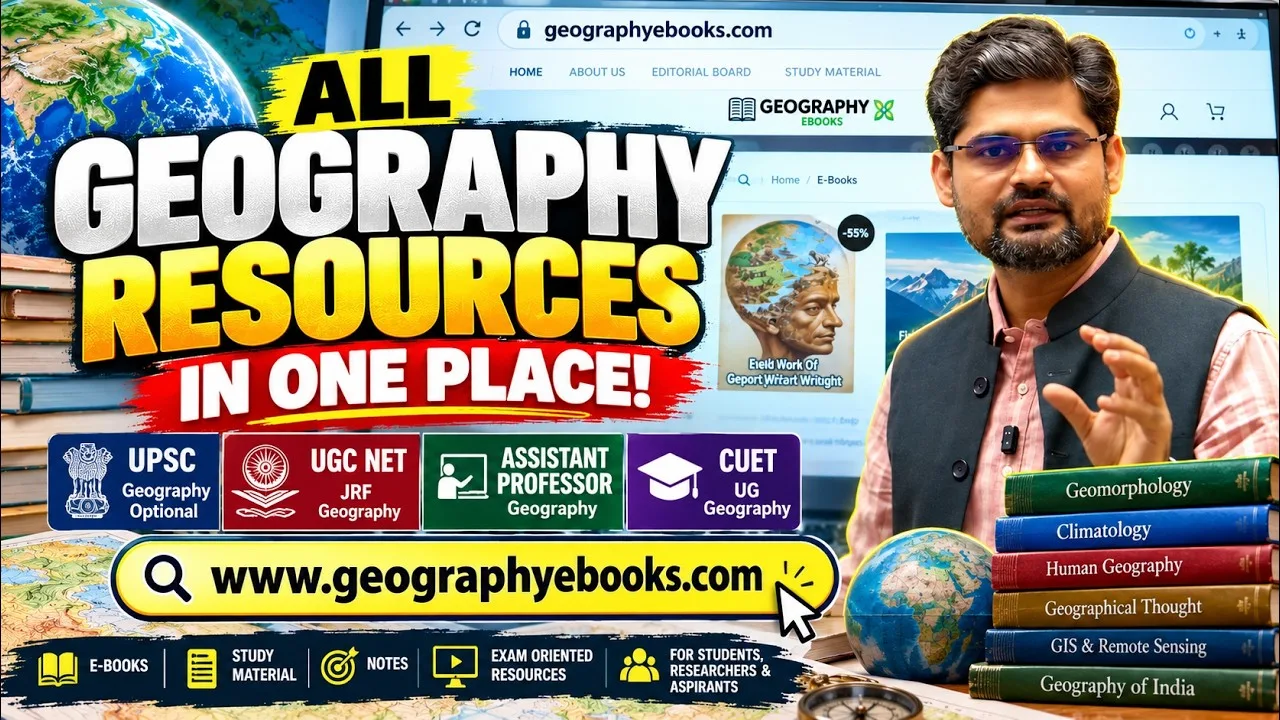
Your Optional score is the lever that lifts your final rank. Investing in rigorously curated Geography Optional Study Materials—and executing a disciplined, answer-writing-centric plan—converts the subject’s vast syllabus from a liability into your highest-scoring asset. Visit GeographyEbooks.com to access syllabus-aligned PDFs, model answers, and mock tests designed for UPSC 2025 and UGC NET Geography success. For structured video courses and live mentorship, explore TheGeoEcologist.com. Your dream career awaits—download, practice, conquer.
Frequently Asked Questions
The best Geography Optional Study Materials for UPSC 2025 combine comprehensive syllabus coverage, PYQ analysis (2013–2024), diagram banks, model answers, and topic-wise MCQs. Look for PDFs updated with 2023–24 current affairs and answer-writing frameworks tailored to Papers I & II.
High-quality Geography Optional Study Materials cover 85–90% overlap (Physical, Human, Economic, Regional Geography). UGC NET requires additional modules on Geographical Thought and Research Methodology. Choose a provider offering dedicated UGC NET add-ons.
A focused aspirant needs 7–9 months to master Geography Optional Study Materials with answer-writing practice. Allocate 3 months for concept building, 3 for application/PYQs, and 2–3 for mock tests and revision. UGC NET aspirants add 1 month for methodology units.