Blog
Geography of Middle East-North African Realm-Geoecologist

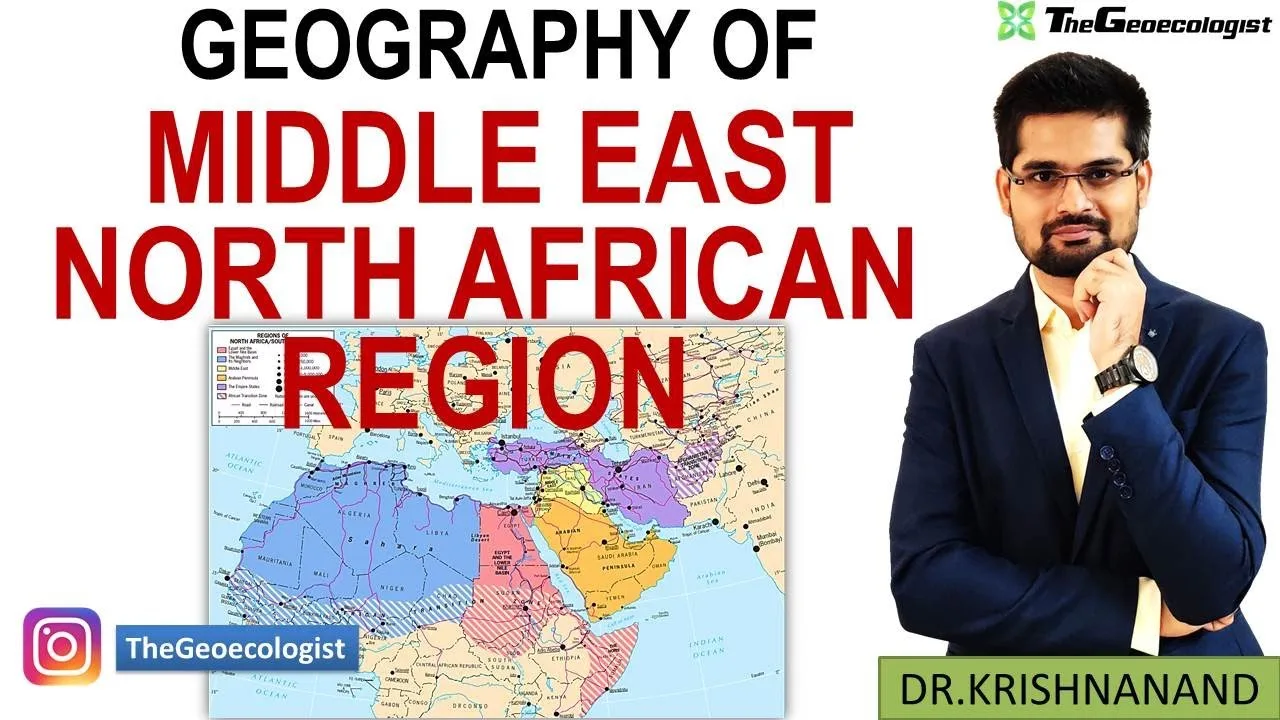
Geography of Middle East-North African Realm-Geoecologist
Exploring the Geography of the Middle East-North African (MENA) Realm: A Comprehensive Guide for UPSC and Competitive Exams
The Middle East-North African (MENA) Realm, spanning from the Atlantic coasts of North Africa to the Arabian Peninsula, is a region of immense geographical, cultural, and geopolitical significance. For UPSC aspirants, geography enthusiasts, and competitive exam candidates, understanding this realm is essential due to its dynamic interplay of physical landscapes, resource distribution, and socio-political complexities. Dr. Krishnanand, founder of TheGeoecologist, simplifies these concepts in his educational video, making it an invaluable resource for mastering this segment of regional geography.
Why Study the MENA Realm?
The MENA region serves as a bridge between Africa, Asia, and Europe, making it a strategic crossroads for trade, culture, and conflict. Its geography shapes global energy markets, political alliances, and environmental challenges—all recurring themes in competitive exams like the UPSC.
Key Geographical Features of the MENA Realm
Physical Geography
- Arid Landscapes: Dominated by deserts like the Sahara (the world’s largest hot desert) and the Arabian Desert, the region faces extreme aridity.
- Mountain Ranges: The Atlas Mountains in North Africa and the Zagros Mountains in Iran influence local climates and human settlements.
- Rivers and Water Scarcity: The Nile, Tigris-Euphrates, and Jordan River systems are lifelines, yet water scarcity remains a pressing issue, fueling socio-political tensions.
Climate
The majority of MENA experiences a hot desert climate (BWh) with minimal rainfall. Coastal areas like the Mediterranean Levant have milder, wetter winters. Climate change exacerbates droughts, impacting agriculture and migration patterns.- Cultural and Human Geography
- Ethnic Diversity: Arabs, Berbers, Persians, Kurds, and other groups contribute to the region’s multicultural tapestry.
- Religion: The birthplace of Judaism, Christianity, and Islam, the region remains deeply influenced by religious traditions and conflicts.
Geopolitical and Economic Significance
Oil and Global Economy
The MENA realm holds over 50% of the world’s proven oil reserves, particularly in Gulf countries like Saudi Arabia, Iran, and Iraq. This “Energy Heartland” shapes global geopolitics, with organizations like OPEC influencing oil prices.Strategic Chokepoints
The Suez Canal, Strait of Hormuz, and Bab-el-Mandeb are critical maritime passages for global trade. Control over these routes has historically sparked international rivalries.- Conflict Zones
From the Arab-Israeli conflict to the Syrian civil war, the region’s instability stems from colonial legacies, sectarian divides, and competition over resources—key topics for UPSC exams.
Challenges and Opportunities
- Water Scarcity: Innovative solutions like desalination in Israel and the UAE highlight adaptive strategies.
- Urbanization: Cities like Dubai and Cairo face pressures of rapid growth, infrastructure demands, and environmental stress.
- Youth Demographics: A young population presents opportunities for economic growth but also risks unemployment and social unrest.
Why Watch Dr. Krishnanand’s Video?
In his lecture, Dr. Krishnanand offers a simplified yet comprehensive analysis of MENA’s geography, tailored for UPSC Geography Optional aspirants. The video breaks down complex topics such as:
- The role of physical features in shaping human activities.
- Geopolitical hotspots and their historical context.
- Economic dependencies on hydrocarbons and diversification efforts.
His approach aligns with exam patterns, emphasizing maps, case studies, and interlinkages between themes—a must-watch for efficient revision.
Boost Your Preparation!
Join Dr. Krishnanand’s YouTube Channel for in-depth lectures and perks:
https://www.youtube.com/channel/UC3–K-h857r2WOUejAGgk8g/join
Follow on Instagram for daily geography insights: @thegeoecologist
Visit the Website: https://thegeoecologist.com/
Conclusion
The MENA Realm’s geography is a mosaic of contrasts—arid deserts and fertile river valleys, ancient civilizations and modern cities, resource wealth and socio-political strife. For UPSC aspirants, mastering this region’s geography is not just about memorizing facts, but understanding its role in shaping global narratives. Dive into Dr. Krishnanand’s video to gain clarity and ace your exams!
middleeast #northafrica #gulfcountries
Keywords: MENA region geography, UPSC Geography Optional, Middle East-North Africa, Geoecologist, Gulf countries, competitive exams.
To Download E-Books & Study Material Visit The Shop Page