Blog
Geography Careers: Complete Guide to Opportunities, Skills & Future Trends

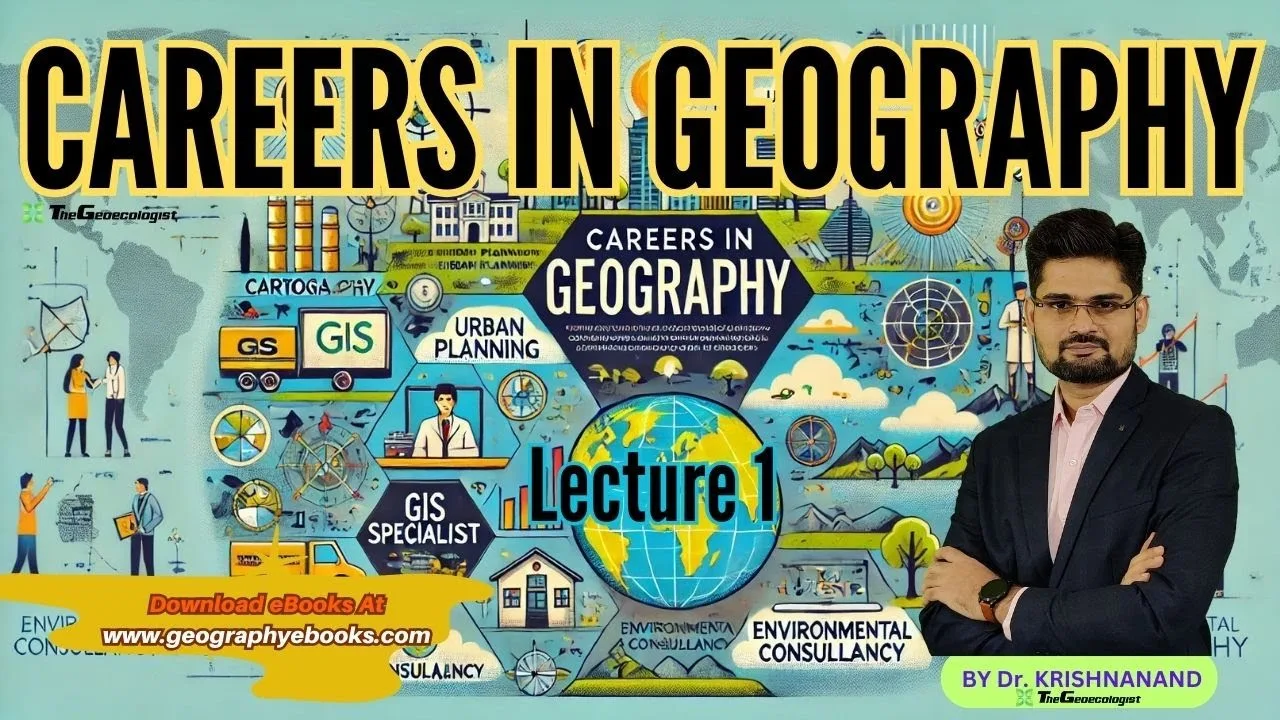
Table of Contents
- Why Choose Geography Careers in the 21st Century?
- Top Career Paths in Geography
- 1. GIS and Remote Sensing: The Technology Frontier
- 2. Urban and Regional Planning: Designing Sustainable Futures
- 3. Government Jobs and Competitive Exams: The Public Service Route
- 4. Research and Academia: Advancing the Discipline
- 5. Interdisciplinary Geography Careers: Beyond Traditional Boundaries
- High-Paying Geography Careers: India vs. Global Markets
- Essential Skills for Modern Geography Careers
- Geospatial Technical Skills
- Analytical and Soft Skills
- Building Experience: Internships, Fieldwork, and Portfolios
- Future Trends Shaping Geography Careers
- 1. Geospatial Artificial Intelligence (GeoAI)
- 2. Digital Twins and 3D Urban Modeling
- 3. Climate Finance and Nature-Based Solutions
- 4. Open Geospatial Ecosystems
- Conclusion: Charting Your Path in Geography Careers
Geography careers offer a dynamic intersection of physical science, social science, and cutting-edge technology, making them one of the most versatile professional pathways in the 21st century. As Dr. Krishnanand of TheGeoecologist emphasizes in his inaugural lecture series, the discipline equips graduates with spatial thinking, data analysis, and problem-solving skills that are increasingly vital for addressing global challenges like climate change, urbanization, and resource scarcity. Whether you are an undergraduate exploring options, a postgraduate specializing in GIS, or a PhD candidate targeting academia, understanding the full spectrum of geography careers is the first step toward a fulfilling professional journey.
- Geography careers span GIS, urban planning, government services, research, and interdisciplinary roles.
- Technical proficiency in GIS, remote sensing, and data analytics significantly boosts employability.
- Competitive exams like UPSC and UGC NET remain primary gateways for public-sector geography careers in India.
- Global demand for geospatial professionals is rising, with high-paying roles in the USA, Canada, and Australia.
- Continuous skill-building, internships, and fieldwork are essential for long-term career growth.
Why Choose Geography Careers in the 21st Century?
The relevance of geography careers has never been greater. According to the U.S. Bureau of Labor Statistics, employment of geographers and cartographers is projected to grow steadily through 2032, driven by the increasing need for spatial data in government, business, and environmental management. The discipline’s unique position — bridging natural sciences and humanities — allows professionals to analyze complex systems holistically. From modeling flood risks in the Ganges-Brahmaputra delta to optimizing supply chains for multinational corporations, the applications are virtually limitless.
Dr. Krishnanand highlights that geography careers are not confined to traditional roles. The rise of Geographic Information Systems (GIS), satellite remote sensing, and big data analytics has created entirely new job categories that barely existed a decade ago. Organizations like ISRO, NASA, ESRI, and the World Bank actively recruit geography graduates for their spatial expertise.
Top Career Paths in Geography
1. GIS and Remote Sensing: The Technology Frontier
Among all geography careers, GIS and remote sensing stand out for their explosive growth and high earning potential. Professionals in this domain work with platforms like ArcGIS, QGIS, ERDAS Imagine, and Google Earth Engine to acquire, process, and visualize spatial data. Key industries hiring GIS specialists include:
- Agriculture: Precision farming, crop health monitoring, yield prediction
- Disaster Management: Flood mapping, earthquake damage assessment, cyclone tracking
- Urban Development: Land-use planning, infrastructure routing, smart city projects
- Environmental Conservation: Deforestation monitoring, wildlife corridor mapping, carbon stock estimation
Entry-level GIS analysts in India typically earn ₹4–7 LPA, while senior geospatial scientists in the US can command $80,000–$120,000 annually. Certifications from ESRI, USGIF, or ISRO’s IIRS significantly enhance credibility in geography careers focused on geospatial technology.
2. Urban and Regional Planning: Designing Sustainable Futures
Urban planners are the architects of livable cities. This geography careers path involves collaborating with municipal corporations, state governments, NGOs, and private consultancies to develop master plans, zoning regulations, and mobility strategies. The Smart Cities Mission in India, launched in 2015, has created thousands of planning positions across 100 selected cities. Globally, the UN-Habitat programme and World Bank urban projects offer international opportunities.
A Master’s in Urban Planning (M.Plan) or Regional Planning, often preceded by a geography bachelor’s, is the standard qualification. Professionals must master tools like AutoCAD, SketchUp, and participatory GIS methods. The Institute of Town Planners, India (ITPI) and the American Planning Association (APA) provide professional accreditation that strengthens geography careers in this sector.
3. Government Jobs and Competitive Exams: The Public Service Route
For millions of Indian aspirants, geography careers in the public sector remain the gold standard. The subject’s overlap with General Studies makes it a strategic optional for the Union Public Service Commission (UPSC) Civil Services Examination. Top rankers frequently credit geography for high scores in both Prelims (environment, ecology, maps) and Mains (GS Paper I, Optional Paper I & II).
Beyond IAS/IPS, geography graduates target:
- Indian Forest Service (IFS): Forest management, wildlife conservation, climate policy
- State PSCs: Deputy Collector, Tehsildar, District Planning Officer roles
- SSC CGL: Statistical Investigator, Assistant Section Officer posts
- RBI Grade B / NABARD: Rural development, agricultural geography applications
Dr. Krishnanand advises integrating current affairs — like the 2023 IPCC Sixth Assessment Report or India’s National Geospatial Policy 2022 — into preparation to stand out in these highly competitive geography careers pathways.
4. Research and Academia: Advancing the Discipline
For those driven by inquiry, geography careers in research offer intellectual autonomy and societal impact. The typical trajectory involves clearing UGC NET/JRF, pursuing a PhD at institutions like JNU, DU, BHU, or IITs, and securing faculty positions. Research funding from DST, ICSSR, UGC, and international bodies (Fulbright, Commonwealth, DAAD) supports fieldwork across diverse terrains — from Himalayan glaciology to Sundarbans mangrove dynamics.
Emerging research frontiers in geography careers include:
- Climate resilience and adaptation planning
- Geospatial AI and machine learning for land-cover classification
- Political ecology of resource conflicts
- Health geography and disease mapping (post-COVID relevance)
Publishing in Scopus/Web of Science indexed journals (e.g., Applied Geography, Geoforum, Progress in Human Geography) is crucial for academic advancement.
5. Interdisciplinary Geography Careers: Beyond Traditional Boundaries
The most innovative geography careers today lie at disciplinary intersections. Environmental consultants with geography backgrounds conduct EIAs (Environmental Impact Assessments) for infrastructure projects mandated under the EIA Notification 2006. Disaster management specialists work with NDMA, SDMAs, and UNDP on risk reduction frameworks aligned with the Sendai Framework 2015–2030.
Tourism geography has evolved into destination management, cultural heritage mapping, and geotourism planning — think UNESCO World Heritage Site management plans for places like Hampi or Khangchendzonga. Meanwhile, geospatial analysts in the private sector serve clients in logistics (route optimization), real estate (site suitability), and insurance (risk modeling). These roles demand fluency in both geographic theory and domain-specific knowledge, making them among the most rewarding geography careers for adaptable professionals.
High-Paying Geography Careers: India vs. Global Markets
Salary benchmarks for geography careers vary significantly by region, sector, and specialization. In India, public-sector roles offer stability, pensions, and prestige, with IAS officers earning ₹56,100–₹2,50,000 (7th CPC) plus allowances. Private-sector GIS roles in Bangalore, Hyderabad, and Pune — hubs for geospatial firms like Cyient, Genesys, and RMSI — pay ₹6–15 LPA for mid-level professionals.
Globally, geography careers command premium compensation. The American Association of Geographers (AAG) 2023 salary survey reports median annual wages of $76,000 for geographers in the US federal government and $85,000 in private industry. Canada’s GIS job market, concentrated in Toronto, Vancouver, and Ottawa, offers CAD 65,000–100,000. Australia’s demand for spatial scientists — listed on the Medium and Long-term Strategic Skills List (MLTSSL) — facilitates permanent residency pathways for qualified migrants.
Multinational organizations like the World Bank, UNEP, WRI, and Esri International recruit globally for geography careers in sustainable development, climate finance, and geospatial innovation. These roles often require advanced degrees, multilingual ability, and field experience in the Global South.
Essential Skills for Modern Geography Careers
Technical competence is non-negotiable for competitive geography careers. Dr. Krishnanand’s lecture underscores these core skill clusters:
Geospatial Technical Skills
- GIS Software: ArcGIS Pro, QGIS (open-source), ArcGIS Online
- Remote Sensing: ENVI, SNAP, Google Earth Engine (GEE) for cloud-based analysis
- Programming: Python (arcpy, geopandas, rasterio), R (sf, terra), JavaScript (Leaflet, Mapbox GL)
- Databases: PostGIS, Spatialite, BigQuery GIS
- Web Mapping: GeoServer, MapServer, custom web apps with React/Vue
Analytical and Soft Skills
- Spatial statistics (Moran’s I, Getis-Ord Gi*, geographically weighted regression)
- Research design: mixed methods, participatory mapping, ethnographic fieldwork
- Science communication: policy briefs, story maps, data visualization (Tableau, Power BI)
- Project management: Agile, stakeholder engagement, grant writing
Micro-credentials from platforms like Coursera (GIS Specialization by UC Davis), ESRI Training, and IIRS-ISRO outreach programmes provide verifiable proof of skills for geography careers aspirants.
Building Experience: Internships, Fieldwork, and Portfolios
Academic credentials alone rarely secure the best geography careers. Dr. Krishnanand stresses the irreplaceable value of:
- Summer Internships: At ISRO centres (NRSC, SAC, IIRS), state remote sensing centres, NGOs (WWF-India, ATREE, CSE), and private firms.
- Fieldwork: Primary data collection — household surveys, GPS traverses, soil/water sampling, drone surveys — builds practical confidence.
- Portfolio Development: GitHub repositories with commented code, ArcGIS StoryMaps showcasing projects, a personal website with case studies.
- Conference Participation: Presenting at IGU, AAG, NAGI, or Indian Geography Congress events expands networks.
Many universities now mandate internship credits. The UGC’s 2023 guidelines for geography careers readiness recommend at least 60 days of industry/research exposure during postgraduate programmes.
Future Trends Shaping Geography Careers
The landscape of geography careers is being reshaped by several megatrends:
1. Geospatial Artificial Intelligence (GeoAI)
Deep learning models (U-Net, DeepLab) applied to satellite imagery automate feature extraction — building footprints, road networks, crop types — at planetary scale. Companies like Orbital Insight, Descartes Labs, and Indian startups (Pixxel, SatSure) are hiring geographers who understand both the data and the domain.
2. Digital Twins and 3D Urban Modeling
Cities like Singapore (Virtual Singapore), Amaravati, and Helsinki are building dynamic digital replicas integrating BIM, IoT sensor feeds, and real-time GIS. This creates geography careers in 3D visualization, simulation, and urban analytics.
3. Climate Finance and Nature-Based Solutions
Carbon credit verification, blue carbon mapping (mangroves, seagrass), and biodiversity offsetting require rigorous spatial monitoring. Geography professionals with MRV (Measurement, Reporting, Verification) expertise are in high demand from carbon registries (Verra, Gold Standard) and climate fintechs.
4. Open Geospatial Ecosystems
The shift toward open data (Copernicus, Landsat, NICFI), open software (QGIS, WhiteboxTools), and open standards (OGC APIs) democratizes access but raises the bar for geography careers — professionals must contribute to, not just consume, these ecosystems.
Conclusion: Charting Your Path in Geography Careers
Geography careers are not a single road but a vast network of pathways — each leading to meaningful impact on how humanity understands and inhabits the planet. Dr. Krishnanand’s lecture series serves as a compass, but the journey requires proactive navigation: mastering tools, seeking mentors, publishing work, and staying curious about the spaces between disciplines. Whether your destination is a district collector’s office in Odisha, a GIS lab in Silicon Valley, a research station in Antarctica, or a community mapping project in your hometown, the foundation remains the same — geographic thinking.
TheGeoecologist’s resources — eBooks at geographybooks.com, courses at thegeoecologist.com, and the YouTube channel — provide structured guidance for every stage. Subscribe, engage, and remember: in geography careers, the map is never the territory; your skills, network, and persistence are the vehicle that covers the distance.
Frequently Asked Questions
The highest-paying geography careers in India include GIS specialists in private geospatial firms (₹10–20 LPA senior roles), urban planners in metro consultancies, environmental consultants for EIA projects, and civil servants (IAS/IFS) with total compensation exceeding ₹1.5–2 Cr over a career including perks. Remote sensing scientists at ISRO centres and faculty at IITs/central universities also command strong packages (₹15–25 LPA with allowances).
While a Bachelor's in Geography with strong GIS coursework and a robust portfolio can secure entry-level GIS analyst roles (₹3–5 LPA), most mid-to-senior positions in reputable organizations prefer or require a Master's (M.Sc./M.Tech in Geoinformatics, Remote Sensing, or GIS). Certifications from ESRI, IIRS, or USGIF can partially substitute for formal degrees in the private sector.
Geography graduates should leverage their subject mastery by choosing Geography as an Optional (high success rate, syllabus overlaps with GS Paper I). Integrate current affairs — climate reports, geospatial policies, disaster case studies — into answer writing. Practice map-based questions daily. Join test series from reputed institutes. Dr. Krishnanand recommends focusing on applied geography (watershed management, smart cities, border issues) for high-scoring answers.