Blog
G.K. Gilbert Geomorphology: Foundational Theories of Landform Development

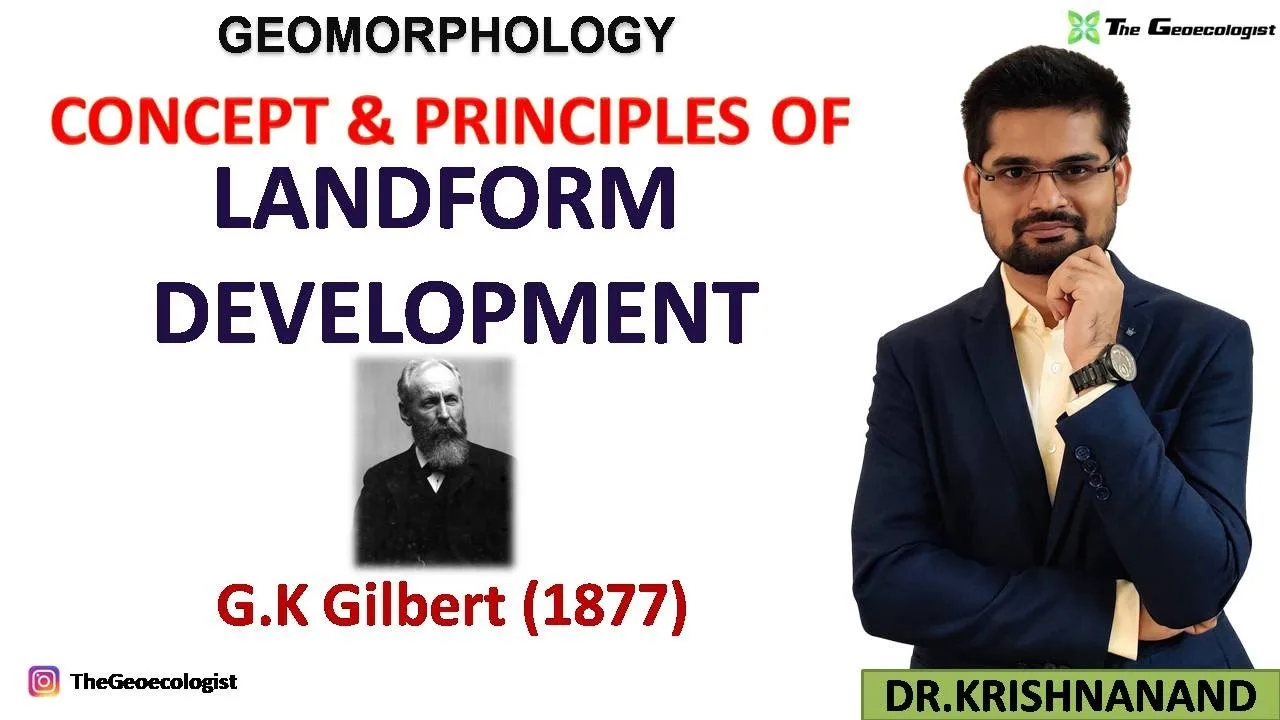
Table of Contents
- Early Life and Scientific Context of G.K. Gilbert
- Core Concepts of G.K. Gilbert Geomorphology
- 1. Dynamic Equilibrium: The Self-Regulating Landform
- 2. Graded Stream Theory: The Equilibrium Longitudinal Profile
- 3. Structure, Process, and Stage: The Explanatory Triad
- 4. Basin and Range Structure: Horst-and-Graben Tectonics
- Gilbert vs. Davis and Penck: Comparative Analysis
- Modern Applications and Relevance of G.K. Gilbert Geomorphology
- G.K. Gilbert Geomorphology in UPSC Geography Optional
- Conclusion
G.K. Gilbert geomorphology represents a cornerstone of modern geomorphological science, establishing principles that continue to shape how we understand landform evolution, river dynamics, and tectonic geomorphology. Grove Karl Gilbert (1843–1918), a pioneering American geologist with the United States Geological Survey (USGS), introduced revolutionary concepts including dynamic equilibrium, graded streams, and the interplay of structure, process, and stage. His work, conducted during the great surveys of the American West (1870s–1890s), laid the quantitative and process-oriented foundation that distinguishes modern geomorphology from its descriptive predecessors. For students, researchers, and UPSC Geography Optional aspirants, mastering G.K. Gilbert geomorphology is essential for analyzing fluvial systems, slope evolution, and basin-range tectonics with scientific rigor. – a key consideration for GK Gilbert geomorphology.
- Dynamic Equilibrium: Landforms self-adjust to maintain stability under changing external forces.
- Graded Stream Theory: Rivers evolve toward a profile where sediment transport capacity equals supply.
- Structure-Process-Stage Triad: Landform evolution depends on lithology, geomorphic processes, and evolutionary time.
- Basin-Range Mechanics: Horst-and-graben structures result from extensional tectonics, not compression.
- UPSC Relevance: Core concepts appear in Paper I (Geomorphology) and Paper II (Indian Geography) of Geography Optional.
Early Life and Scientific Context of G.K. Gilbert
Grove Karl Gilbert was born on May 6, 1843, in Rochester, New York. After graduating from the University of Rochester in 1862, he joined the Wheeler Survey (1871–1874) and later the Powell Survey of the Rocky Mountain Region. In 1879, he became a founding member of the USGS, where he served until his death in 1918. Gilbert’s fieldwork across the Great Basin, Colorado Plateau, and Henry Mountains exposed him to spectacular structural geology and arid-land geomorphology. Unlike his contemporary William Morris Davis, who emphasized historical cycles, G.K. Gilbert geomorphology prioritized process mechanics and quantitative relationships. His 1877 monograph Report on the Geology of the Henry Mountains and 1890 paper Lake Bonneville remain seminal texts. The Wikipedia biography of Grove Karl Gilbert details his extensive contributions to glacial geology, crater formation, and hydraulic mining debris studies. – a key consideration for GK Gilbert geomorphology.
Core Concepts of G.K. Gilbert Geomorphology
1. Dynamic Equilibrium: The Self-Regulating Landform
The concept of dynamic equilibrium is arguably the most enduring contribution of G.K. Gilbert geomorphology. Gilbert observed that landforms are not static features but adjustable systems that respond to perturbations—tectonic uplift, base-level change, climatic shifts—by modifying their geometry until a new steady state is achieved. In his 1914 presidential address to the Geological Society of America, “The Transportation of Debris by Running Water,” he articulated how a river channel adjusts its width, depth, slope, and velocity to transport the sediment load supplied from its basin. If sediment supply increases (e.g., from glacial outwash or human-induced erosion), GK Gilbert geomorphology steepens or widens; if supply decreases, the channel degrades. This negative-feedback mechanism ensures that G.K. Gilbert geomorphology describes a homeostatic system, not a unidirectional cycle. Modern applications include channel restoration design, where engineers use Gilbert’s principles to predict post-dam removal channel adjustments, and landscape evolution models (e.g., CHILD, Landlab) that encode dynamic equilibrium as a governing rule.
2. Graded Stream Theory: The Equilibrium Longitudinal Profile
Gilbert’s graded stream concept, elaborated in his 1877 Henry Mountains report and refined in later works, posits that a river tends toward a longitudinal profile where the energy expended in flowing water is exactly sufficient to transport the sediment load delivered to GK Gilbert geomorphology. A “graded” river has no net erosion or deposition along its course—its slope, discharge, channel geometry, and sediment calibre are mutually adjusted. Key variables in G.K. Gilbert geomorphology include:
- Base level: The lowest level to which a river can erode (ultimately sea level). A fall in base level triggers headward incision; a rise induces aggradation.
- Sediment calibre: Coarser loads require steeper slopes for transport, explaining why mountain streams are steeper than lowland rivers.
- Discharge variability: Floods do the geomorphic work; Gilbert recognized that channel form reflects bankfull or effective discharge, not mean flow.
Disruptions—tectonic uplift, glaciation, dam construction—knock the system out of grade, initiating a wave of incision or aggradation that migrates upstream. This grade adjustment concept underpins modern sequence stratigraphy and fluvial response models. The USGS profile on Gilbert highlights his pioneering use of flume experiments to validate graded-stream mechanics. – a key consideration for GK Gilbert geomorphology.
3. Structure, Process, and Stage: The Explanatory Triad
Gilbert insisted that every landform explanation requires three elements: Structure (lithology, attitude of beds, tectonic framework), Process (weathering, mass wasting, fluvial, glacial, aeolian agents), and Stage (the degree of development toward equilibrium). Unlike Davis’s geographical cycle, which treated stage as a temporal sequence (youth, maturity, old age), G.K. Gilbert geomorphology treated stage as a state variable—a measure of proximity to dynamic equilibrium. For example, a fault-block mountain (structure) subjected to fluvial incision (process) may be in early stage (steep, V-valleys, high relief) or late stage (low relief, broad valleys) depending on the time since uplift and the rock resistance. This triad allows geomorphologists to compare landforms across different climates and tectonic settings by normalizing for structure and process intensity. GK Gilbert geomorphology also foreshadows the “process-form” paradigm that dominates contemporary geomorphology.
4. Basin and Range Structure: Horst-and-Graben Tectonics
Through meticulous mapping in Nevada and Utah, Gilbert deciphered the architecture of the Basin and Range Province. He demonstrated that the alternating mountain ranges (horsts) and valleys (grabens) result from extensional faulting, not compressional folding as previously assumed. In his 1875 report on the Geology of the Eureka District and later syntheses, he showed that normal faults with displacements of thousands of meters bound the ranges, and that valley floors are downdropped blocks filled with alluvium. This insight—that G.K. Gilbert geomorphology links tectonic structure directly to topographic form—founded the subfield of tectonic geomorphology. Modern GPS geodesy confirms that the Basin and Range continues to extend at ~10 mm/yr, validating Gilbert’s inference that the topography reflects active faulting. His work also influenced the interpretation of rift valleys globally, from the East African Rift to the Rio Grande Rift. – a key consideration for GK Gilbert geomorphology.
Gilbert vs. Davis and Penck: Comparative Analysis
The early 20th century saw three competing paradigms: Davis’s geographical cycle (1899), Penck’s morphological analysis (1924), and G.K. Gilbert geomorphology. Davis emphasized time and stage, envisioning a predictable sequence from youth to peneplain under uniform uplift. Penck focused on the ratio of uplift rate to erosion rate (Pflege), allowing multiple end-states. Gilbert, by contrast, rejected deterministic cycles entirely. He argued that: – a key consideration for GK Gilbert geomorphology.
- Equilibrium is dynamic, not a final peneplain.
- Process laws (physics of sediment transport) govern form, not time per se.
- Historical contingency (structure, climate change, base-level history) makes each landscape unique.
While Davis dominated American textbooks until the 1950s, the “quantitative revolution” (Horton, Strahler, Leopold, Wolman) revived G.K. Gilbert geomorphology as the intellectual ancestor of process geomorphology. Today, landscape evolution models synthesize all three: Davis’s stages map to model time-steps, Penck’s uplift-erosion ratio is a boundary condition, and Gilbert’s transport laws (stream power, shear stress) are the engine. – a key consideration for GK Gilbert geomorphology.
Modern Applications and Relevance of G.K. Gilbert Geomorphology
Far from being historical curiosities, Gilbert’s principles drive contemporary research and practice:
- River Restoration: Designing “graded” channels that transport sediment without aggradation or degradation uses Gilbert’s regime equations.
- Hazard Assessment: Post-wildfire debris-flow prediction relies on dynamic-equilibrium concepts—hillslopes adjust to new sediment supplies.
- Planetary Geomorphology: Mars rover teams apply graded-stream logic to interpret paleo-channels in Gale and Jezero craters.
- Source-to-Sink Systems: The Gilbert-inspired “sediment routing system” framework (source, transfer, sink) organizes basin-scale stratigraphy.
- Climate-Tectonic Coupling: Thermochronology and cosmogenic nuclides test Gilbert’s hypothesis that topography reflects the balance between rock uplift and erosion.
The Britannica entry on Gilbert notes his influence on the “New Geomorphology” of the 1960s, which made him the most-cited 19th-century geomorphologist in modern literature.
G.K. Gilbert Geomorphology in UPSC Geography Optional
For Union Public Service Commission (UPSC) Geography Optional candidates, G.K. Gilbert geomorphology is a high-yield topic appearing in both Paper I (Geomorphology section) and Paper II (Indian Geography—river systems, Himalayan tectonics, Peninsular drainage). Typical question patterns include: – a key consideration for GK Gilbert geomorphology.
- Short Notes (10-15 marks): “Dynamic equilibrium in Gilbert’s theory,” “Graded stream concept,” “Structure-Process-Stage triad.”
- Comparative Questions (15-20 marks): “Contrast Davis’s cycle of erosion with Gilbert’s dynamic equilibrium,” “Evaluate Penck’s and Gilbert’s approaches to slope evolution.”
- Applied Questions: “Explain the formation of Basin and Range topography using Gilbert’s fault-block model,” “Apply graded stream theory to explain the longitudinal profile of the Ganga.”
Effective preparation requires: (1) memorizing precise definitions (e.g., “A graded stream is one in which the slope is adjusted so that the stream’s transporting capacity exactly matches the sediment load”), (2) drawing annotated sketches of graded profiles, fault-block mountains, and dynamic equilibrium feedback loops, and (3) linking concepts to Indian examples—Himalayan rivers adjusting to uplift (dynamic equilibrium), Deccan traps’ stepped topography (structure-process interaction), and the Narmada rift valley (Basin-Range analogue). Dr. Krishnanand’s lectures on THEGEOECOLOGIST YouTube channel provide targeted UPSC-oriented explanations of these themes. – a key consideration for GK Gilbert geomorphology.
Conclusion
More than a century after his death, G.K. Gilbert geomorphology remains the bedrock of quantitative earth surface science. His insistence on physical laws, field validation, and systemic thinking transformed geomorphology from a descriptive catalog into a predictive science. Whether modeling landscape response to climate change, designing sustainable river restoration, or preparing for competitive examinations, practitioners return to Gilbert’s core insight: landforms are the visible expression of a dynamic balance between driving forces and resisting materials. As the Anthropocene accelerates rates of base-level change, sediment flux, and hillslope disturbance, the Gilbertian framework—dynamic equilibrium, graded streams, structure-process-stage—offers the most robust lens for anticipating Earth’s topographic future. – a key consideration for GK Gilbert geomorphology.
Frequently Asked Questions
Dynamic equilibrium in G.K. Gilbert geomorphology describes how landforms continuously adjust their geometry—slope, channel dimensions, relief—in response to external forces (tectonics, climate, base level) to maintain a steady state where sediment transport capacity matches supply. It is a negative-feedback system, not a static endpoint.
Gilbert's graded stream theory focuses on process mechanics: a river adjusts its slope and geometry until sediment transport capacity equals sediment supply, achieving dynamic equilibrium. Davis's cycle is a time-dependent historical sequence (youth, maturity, old age) leading to a peneplain, assuming uniform uplift and minimal structural control.
G.K. Gilbert geomorphology is a core topic in UPSC Geography Optional Paper I (Geomorphology) and Paper II (Indian river systems, Himalayan tectonics). Questions frequently test dynamic equilibrium, graded stream concept, structure-process-stage triad, and Basin-Range fault-block models, often requiring comparative analysis with Davis and Penck.