Blog
Dualism in Geography: A Comprehensive Academic Guide

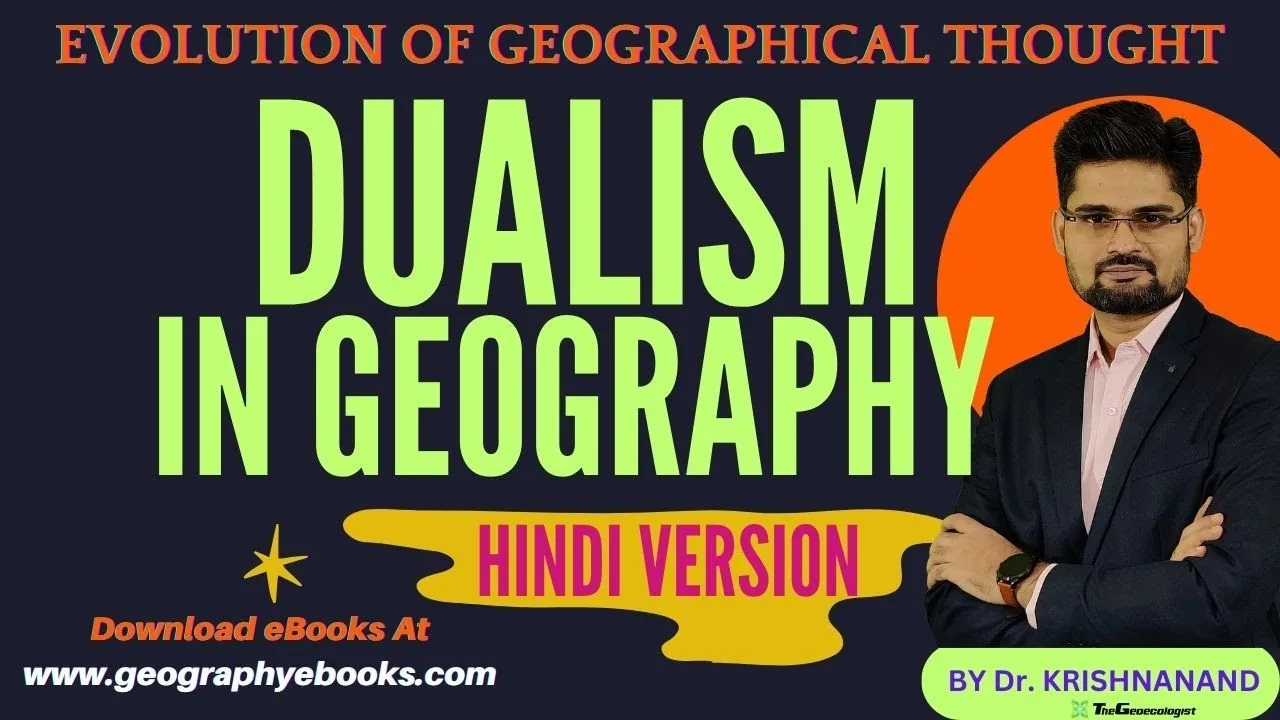
Table of Contents
- Introduction to Dualism in Geography
- The Philosophical Roots of Geographical Dualism
- Key Dimensions of Dualism in Geography
- 1. Physical vs. Human Geography
- 2. Regional vs. Systematic Geography
- 3. Determinism vs. Possibilism
- The Modern Synthesis: Moving Beyond Dualism
- Relevance for Competitive Exams
- Conclusion
Introduction to Dualism in Geography
Dualism in Geography refers to the existence of contrasting perspectives and methodologies within the discipline, creating a framework of competing schools of thought that shape how we interpret the world. Understanding this concept is fundamental for students preparing for high-stakes competitive exams such as the UGC NET Geography, UPSC Geography Optional, and various university-level examinations. As articulated by Dr. Krishnanand, the founder of TheGeoecologist, these debates are not merely academic exercises but are essential to understanding the evolution of spatial sciences.
- Core Concept: The division of geographical thought into contrasting methodologies.
- Major Debates: Physical vs. Human, Regional vs. Systematic, and Determinism vs. Possibilism.
- Academic Importance: Crucial for UGC NET, UPSC, and higher education.
- Modern Synthesis: The shift from fragmentation toward integrated spatial analysis.
The history of geographical thought is marked by the tension between different approaches. When we examine dualism in geography, we are looking at the intellectual struggle to define whether the discipline should be a descriptive science or a predictive one. This tension has driven innovation, pushing geographers to refine their tools and methodologies over centuries.
The Philosophical Roots of Geographical Dualism
At its core, dualism arises from differing viewpoints on how geographical phenomena should be approached. Some geographers focus on the description of unique phenomena (idiographic approach), while others emphasize the search for universal laws and generalizations (nomothetic approach). These contrasting approaches reflect broader philosophical debates found in the broader scientific and humanities sectors, similar to the debates found in philosophy of science regarding empirical observation versus theoretical modeling.
Key Dimensions of Dualism in Geography
To master Dualism in Geography, one must categorize the various forms of dualism that have historically divided the discipline. These divisions are not just historical artifacts; they remain relevant in how we structure research today.
1. Physical vs. Human Geography
One of the most prominent forms of dualism in geography is the division between physical and human perspectives. This split has influenced how resources are allocated in academic research and how curricula are designed globally.
Physical Geography focuses on the natural world. It is the study of natural landscapes, climate patterns, landforms, and complex ecosystems. This branch relies heavily on empirical data, geological time scales, and scientific laws derived from the earth sciences. It seeks to understand the ‘how’ and ‘why’ of the natural environment through quantitative measurement.
In contrast, Human Geography centers on human societies, cultures, economies, and political systems. This branch often adopts interpretive and qualitative methods to understand how humans interact with their surroundings. It bridges the gap between the social sciences and the earth sciences, making geography a uniquely interdisciplinary field.
2. Regional vs. Systematic Geography
The second major axis of dualism in geography concerns the scale and scope of study: Regional versus Systematic approaches.
Regional Geography (The Idiographic Approach) examines specific places or regions. It analyzes the unique characteristics that make a particular area distinct from another. This approach is essential for understanding local identity, local climate variations, and specific cultural landscapes. It prioritizes the ‘uniqueness’ of a place.
Systematic Geography (The Nomothetic Approach) studies specific geographic phenomena (such as climate, vegetation, or population) across the entire globe. The goal is to derive universal principles and patterns that apply regardless of location. By studying these systems, geographers can create models that predict future trends in weather, urban growth, or economic shifts.
3. Determinism vs. Possibilism
Perhaps the most famous debate in the history of the discipline is the tension between Environmental Determinism and Possibilism. This debate explores the extent to which the physical environment dictates human activity.
Environmental Determinism argues that human behavior, culture, and societal development are strictly shaped and limited by the physical environment. For example, early determinists might have argued that tropical climates inevitably lead to certain social structures. This view has been largely critiqued for being overly simplistic and sometimes used to justify colonialist ideologies.
Possibilism suggests that while the environment provides a set of constraints, humans possess the agency and technology to modify their surroundings. Through culture and innovation, humans can create diverse possibilities, effectively overcoming environmental limitations. This perspective emphasizes human ingenuity and the transformative power of technology.
The Modern Synthesis: Moving Beyond Dualism
While traditional forms of dualism in geography remain influential in textbooks, modern geography has moved toward an integrated approach. We no longer view the physical and human worlds as separate entities, but as a single, complex, interacting system.
Today, geographers utilize advanced technologies such as Geographic Information Systems (GIS) and Remote Sensing to bridge these divides. These tools allow for a systematic analysis of large datasets (Systematic) that can be applied to specific local contexts (Regional). Furthermore, the rise of sustainability studies requires a deep integration of physical ecological data and human socio-economic data.
The evolution of dualism in geography has led to a more holistic understanding of the Earth. Instead of seeing a divide between the natural and the social, modern geographers see a web of interconnected processes. This integration is essential for solving global challenges such as climate change, urban sprawl, and food security.
Relevance for Competitive Exams
For students aiming for excellence in exams like the UPSC or UGC NET, understanding these dualisms is critical. Examiners often ask questions that require distinguishing between these approaches. For instance, knowing whether a specific theory falls under the ‘possibilist’ or ‘determinist’ umbrella is a common requirement in advanced geography papers. Mastering dualism in geography provides the conceptual foundation necessary to tackle complex, multi-dimensional questions regarding human-environment interaction.
Conclusion
The concept of dualism in geography reflects the discipline’s rich intellectual history and its diverse methodologies. These debates have not weakened the subject; rather, they have strengthened it by forcing geographers to constantly refine their methods and expand their horizons. By understanding these contrasting perspectives, students can appreciate geography not just as a collection of facts, but as a dynamic, evolving science that is essential for understanding our changing world.
To deepen your understanding of these complex topics, we recommend watching the detailed video lectures by Dr. Krishnanand on TheGeoecologist YouTube channel. For high-quality study materials, E-books, and specialized courses, visit thegeoecologist.com.
Stay updated with the latest geographical insights by following our platforms:
- YouTube: TheGeoecologist
- Instagram: @TheGeoecologist
- Email: krishna.geography@gmail.com
Enhance your academic journey with expert guidance from TheGeoecologist. 🌍📚
Frequently Asked Questions
Physical geography focuses on natural processes and the Earth's natural systems, while human geography focuses on human activities and their impact on the environment.
Environmental determinism is the theory that the physical environment, especially climate and topography, strictly dictates human culture and social development.
Yes, while modern geographers strive for integration (synthesis), the historical dualisms provide the foundational framework for understanding different geographical methodologies.