Blog
CBCS Economic Geography eBook: Simplified Economic Geography (2025 Edition) Guide for UPSC & CBCS Students


Many BA, BSc, and MA geography students searching for a reliable CBCS Economic Geography eBook discover that most available texts either overload with jargon or miss the specific modules outlined in the latest CBCS framework.
- Identify the exact CBCS syllabus requirements for Economic Geography.
- Learn common pitfalls when studying economic geography concepts.
- Discover how to evaluate an eBook for CBCS compliance and exam relevance.
- See why Simplified Economic Geography (2025 Edition) matches the CBCS structure.
- Get practical tips for using the eBook in UPSC CSE and university exams.
Understanding the CBCS Syllabus Requirements for Economic Geography
The Choice Based Credit System (CBCS) prescribed by the University Grants Commission (UGC) outlines a standardized structure for undergraduate and postgraduate geography programmes across India. For the Economic Geography paper, the syllabus is divided into eight core units: nature and scope, measurement of economic development, location factors, primary activities, manufacturing, tertiary‑quaternary‑quinary sectors, industrial regions, and special economic zones. Each unit expects students to grasp definitions, illustrate with diagrams, and apply concepts to regional case studies. A CBCS Economic Geography eBook must therefore map directly to these units, offering point‑wise explanations, highlighted key terms, and visual aids that mirror the prescribed content. Without this alignment, students waste time cross‑referencing multiple sources and risk missing exam‑critical details.
Common Challenges Students Face When Studying Economic Geography
Learners often report three main obstacles when preparing for CBCS‑based Economic Geography exams. First, the terminology is dense—terms like “agglomeration economies”, “footloose industries”, and “quinary activities” appear frequently but are inadequately explained in generic textbooks. Second, the syllabus emphasizes diagram‑based questions; students need clear, labelled maps of industrial corridors, agricultural belts, and trade routes, which many low‑cost PDFs lack. Third, time pressure during UPSC CSE mains and semester exams demands concise revision material; lengthy narratives hinder quick recall. These challenges increase cognitive load and reduce confidence, prompting a search for a targeted CBCS Economic Geography eBook that simplifies without sacrificing depth.
How to Evaluate an Economic Geography eBook for CBCS Compliance
When assessing any digital resource, consider the following checklist: Syllabus Mapping – Does the table of contents mirror the eight CBCS units exactly? Clarity of Presentation – Are concepts broken into bullet points, with bolded keywords and summary boxes? Visual Support – Does the eBook include original diagrams, maps, and images that can be reproduced in answers? Exam Orientation – Are there practice questions, previous year UPSC prompts, and model answers tailored to the CBCS pattern? Edition Currency – Does the version reflect the 2025 syllabus updates and recent data (e.g., GDP growth rates, SEZ policies)? A resource that satisfies these criteria is likely to serve as a genuine CBCS Economic Geography eBook rather than a repackaged generic guide.
Why Simplified Economic Geography (2025 Edition) Aligns with CBCS Standards
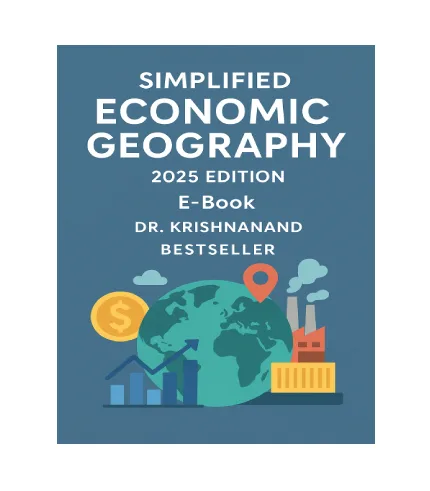
Authored by Dr. Krishnanand, the CBCS Economic Geography eBook titled “Simplified Economic Geography (2025 Edition)” is explicitly designed for the CBCS framework. The eBook’s eight chapters correspond one‑to‑one with the syllabus units: Chapter 1 covers nature and scope, Chapter 2 tackles measurement of economic development, Chapter 3 examines location factors, Chapters 4‑6 detail primary, secondary, and tertiary‑quaternary‑quinary activities, Chapter 7 maps manufacturing regions, and Chapter 8 addresses special economic zones and regional development policies. Each chapter begins with a point‑wise highlighted summary, followed by explanatory paragraphs, and concludes with labelled diagrams and maps sourced from authentic atlases. The 2025 edition incorporates the latest World Bank development indicators, India’s 2024‑25 foreign trade statistics, and recent SEZ notifications, ensuring up‑to‑date relevance. This tight alignment eliminates the need for supplementary notes and makes the eBook a one‑stop solution for CBCS‑mandated Economic Geography.
Practical Tips: Using the eBook for Exam Preparation and Concept Mastery
To maximise benefit, adopt a three‑stage study plan. Stage 1 – Overview: Read the point‑wise summary at the start of each chapter to build a mental map of the unit; spend 10‑15 minutes per chapter. Stage 2 – Deep Dive: Go through the detailed explanations, paying attention to bolded terms and diagram captions; create flashcards for definitions and draw the maps from memory. Stage 3 – Application: Attempt the end‑of‑chapter practice questions (modeled on UPSC and CBCS patterns) and compare your answers with the model solutions provided. For UPSC aspirants, integrate the eBook’s case studies into answer writing practice, linking concepts to current events (e.g., discussing the impact of the Production Linked Incentive scheme on manufacturing regions). Regular revision using the highlighted summaries ensures rapid recall during exams, turning the CBCS Economic Geography eBook into a reliable revision tool.
Where to Get the eBook and What to Expect
The CBCS Economic Geography eBook is available for immediate download from the publisher’s site. Upon purchase, you receive a PDF formatted for both screen reading and printing, with searchable text and selectable diagrams for easy note‑taking. The file size is optimized for low‑bandwidth devices, making it accessible on smartphones and tablets—a crucial feature for students who study on the go. Because the product is delivered digitally, there is no shipping delay, and you can begin studying within minutes of payment. The eBook includes a sample chapter that lets you verify the presentation style before committing to the full version, ensuring confidence in your investment.
Frequently Asked Questions
Is the eBook strictly based on the 2025 CBCS syllabus?
Yes, the content follows the latest UGC‑CBCS guidelines released for the 2025 academic year, covering all eight units of Economic Geography with updated data and case studies.
Can I use this eBook for UPSC CSE preparation as well as university exams?
Absolutely. While the primary focus is the CBCS syllabus, the explanations, diagrams, and practice questions are also aligned with UPSC CSE Geography optional requirements, making it dual‑purpose.
Are there any interactive elements like quizzes or videos?
The current edition provides static PDF content with point‑wise summaries, diagrams, and end‑of‑chapter questions. Interactive quizzes or video lectures are not included in this version.
Further reading: CBCS Economic Geography eBook on Wikipedia
Our Recommendation
📖 Part of our complete guide: Evolution of Geographical Thought: A Comprehensive Guide for UPSC Aspirants and Geography Enthusiasts
Frequently Asked Questions
Is the eBook strictly based on the 2025 CBCS syllabus?
Yes, the content follows the latest UGC‑CBCS guidelines released for the 2025 academic year, covering all eight units of Economic Geography with updated data and case studies.
Can I use this eBook for UPSC CSE preparation as well as university exams?
Absolutely. While the primary focus is the CBCS syllabus, the explanations, diagrams, and practice questions are also aligned with UPSC CSE Geography optional requirements, making it dual‑purpose.
Are there any interactive elements like quizzes or videos?
The current edition provides static PDF content with point‑wise summaries, diagrams, and end‑of‑chapter questions. Interactive quizzes or video lectures are not included in this version.