Blog
Best Environmental Geography Book: Comprehensive Guide for UPSC Aspirants


Many UPSC CSE aspirants struggle to find the Best Environmental Geography Book that balances depth with clarity, especially for the Mains examination where analytical answers are crucial. The subject overlaps with ecology, current environmental policies, and geography fundamentals, making a reliable resource indispensable for scoring well. Without a focused guide, candidates often waste time sifting through fragmented notes or overly dense textbooks that do not align with the UPSC syllabus.
- The Best Environmental Geography Book should provide point‑wise explanations, diagrams, and map‑based illustrations.
- It must cover the CBCS syllabus and include recent developments such as climate change frameworks and biodiversity conventions.
- Practice‑oriented content, including previous year question trends and answer‑writing tips, adds immense value.
- Accessibility in e‑book format allows for easy highlighting, search, and revision on the go.
Why Environmental Geography Matters for UPSC Mains
Environmental Geography is not just a standalone topic; it intertwines with Geography Paper I, Paper II, and even the Essay paper. Questions frequently examine the impact of anthropogenic activities on ecosystems, the functioning of biogeochemical cycles, and the effectiveness of international environmental agreements. A solid grasp of concepts such as ecotones, ecological succession, and ecosystem services enables aspirants to write nuanced answers that fetch higher marks. The Best Environmental Geography Book acts as a bridge between static knowledge and dynamic current affairs, helping candidates link theory with real‑world examples like the Paris Agreement or India’s National Action Plan on Climate Change.
How to Choose the Best Environmental Geography Book for UPSC Mains
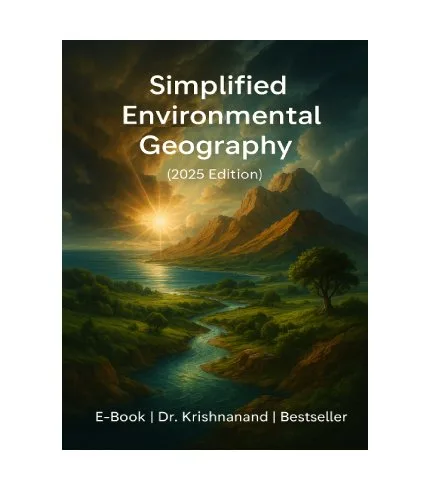
Selecting the right resource involves evaluating several criteria. First, verify that the book follows the latest UPSC syllabus and includes the CBCS‑aligned chapters that universities use. Second, look for visual aids—diagrams, flowcharts, and maps—that simplify complex processes like energy flow in ecosystems or the structure of ecotones. Third, ensure the language is concise yet comprehensive; aspirants benefit from bullet‑point summaries that facilitate quick revision. Fourth, check for inclusion of recent data (post‑2020) on topics such as carbon sequestration, SDG progress, and India’s forest cover reports. Finally, consider the format: an e‑book with searchable text and hyperlinked references saves valuable study time. The Best Environmental Geography Book that meets all these benchmarks is Simplified Environmental Geography (2025 Edition) | E‑Book | Dr. Krishnanand | Bestseller.
Inside Simplified Environmental Geography (2025 Edition): What Sets It Apart
This e‑book is structured exactly as the UPSC expects: each chapter begins with a clear definition, proceeds with point‑wise explanations, and ends with a summary box. Chapter 1 covers ecosystem functioning, detailing energy flow and nutrient cycling with illustrative diagrams. Chapter 2 defines ecology and its attributes, linking directly to the syllabus’s “Definition, Concept and Attributes of Ecology” section. Chapter 3 explores ecosystem structure and classification, supported by maps of major biomes. Chapter 4 delves into principles of ecology—energy flow, nutrient cycling, and population dynamics—using flowcharts that are easy to reproduce in answers. Chapter 5 explains ecotones, ecolines, and edge effects, a frequent source of UPSC questions. Chapter 6 details ecosystem services, linking provisioning, regulating, cultural, and supporting services to real‑world case studies such as the Sundarbans mangrove protection. Throughout the text, highlighted key terms and boxed facts aid quick recall. The inclusion of recent data (2023‑2024) on India’s forest cover, carbon emissions, and biodiversity hotspots ensures the content stays current. Because it is delivered as an e‑book, aspirants can search for terms like “ecotone” or “nitrogen cycle” instantly, making revision far more efficient than flipping through a printed volume.
How to Use This E‑Book Effectively in Your Study Routine
To maximize returns, integrate the e‑book into a three‑phase study plan. Phase 1 (Foundation): Read chapters sequentially, focusing on understanding core concepts; create mind maps for each topic using the diagrams provided. Phase 2 (Application): After completing a chapter, solve related previous year questions and compare your answers with the answer hints given in the summary boxes. Phase 3 (Revision): Use the search function to locate specific terms, review the highlighted points, and attempt to write 250‑word answers without referring to the text—then check for completeness. Additionally, leverage the external links embedded in the e‑book (for example, to the Ecology Wikipedia page) for deeper dives when time permits. Regularly updating your notes with current affairs from sources like PIB or Yojana, and linking them to the concepts in this book, will produce answers that are both analytical and up‑to‑date.
Comparing with Other Popular Environmental Geography Books
Many aspirants consider titles such as “Environmental Geography by Savindra Singh” or “Physical Geography by Majid Husain” for the environmental segment. While these books are comprehensive, they often lack the point‑wise, exam‑oriented formatting that UPSC Mains demands. Savindra Singh’s work, though detailed, is paragraph‑heavy and does not include the CBCS‑aligned chapter breakdown that helps aspirants map directly to the syllabus. Majid Husain’s textbook excels in physical geography fundamentals but allocates limited space to applied environmental topics like ecosystem services or recent climate policies. In contrast, Simplified Environmental Geography (2025 Edition) | E‑Book | Dr. Krishnanand | Bestseller combines syllabus relevance, visual clarity, and up‑to‑date data in a compact, searchable format. The e‑book’s price point (₹249) also makes it accessible compared to higher‑priced print alternatives, offering better value for focused UPSC preparation.
Final Verdict and Buying Guidance
If your goal is to secure a reliable, exam‑specific resource that saves time and enhances answer quality, the Best Environmental Geography Book for UPSC Mains is clearly Simplified Environmental Geography (2025 Edition) | E‑Book | Dr. Krishnanand | Bestseller. Its alignment with the CBCS syllabus, inclusion of diagrams and maps, point‑wise presentation, and recent updates make it a standout choice. Purchase directly from the publisher’s site to ensure you receive the latest 2025 edition with any errata applied. Complement your study with regular answer‑writing practice and current‑affairs integration, and you will find yourself well‑equipped to tackle environmental geography questions with confidence.
Our Recommendation
📖 Part of our complete guide: Evolution of Geographical Thought: A Comprehensive Guide for UPSC Aspirants and Geography Enthusiasts
Frequently Asked Questions
Is Simplified Environmental Geography (2025 Edition) suitable for beginners?
Yes, the book starts with basic definitions and builds up concepts gradually, making it accessible for beginners while still providing depth needed for UPSC Mains.
Does this e-book include recent data on climate change and biodiversity?
The 2025 edition incorporates data up to 2024, including India’s forest cover reports, carbon emission trends, and updates on international agreements like the Paris Accord.
How can I use the diagrams and maps in answer writing?
You can reproduce the simplified flowcharts and label the maps directly in your answers; the point‑wise format helps you recall key elements quickly during the exam.