

Blog
14 Lokas: Ancient Vedic Cosmology and the Geography of Consciousness

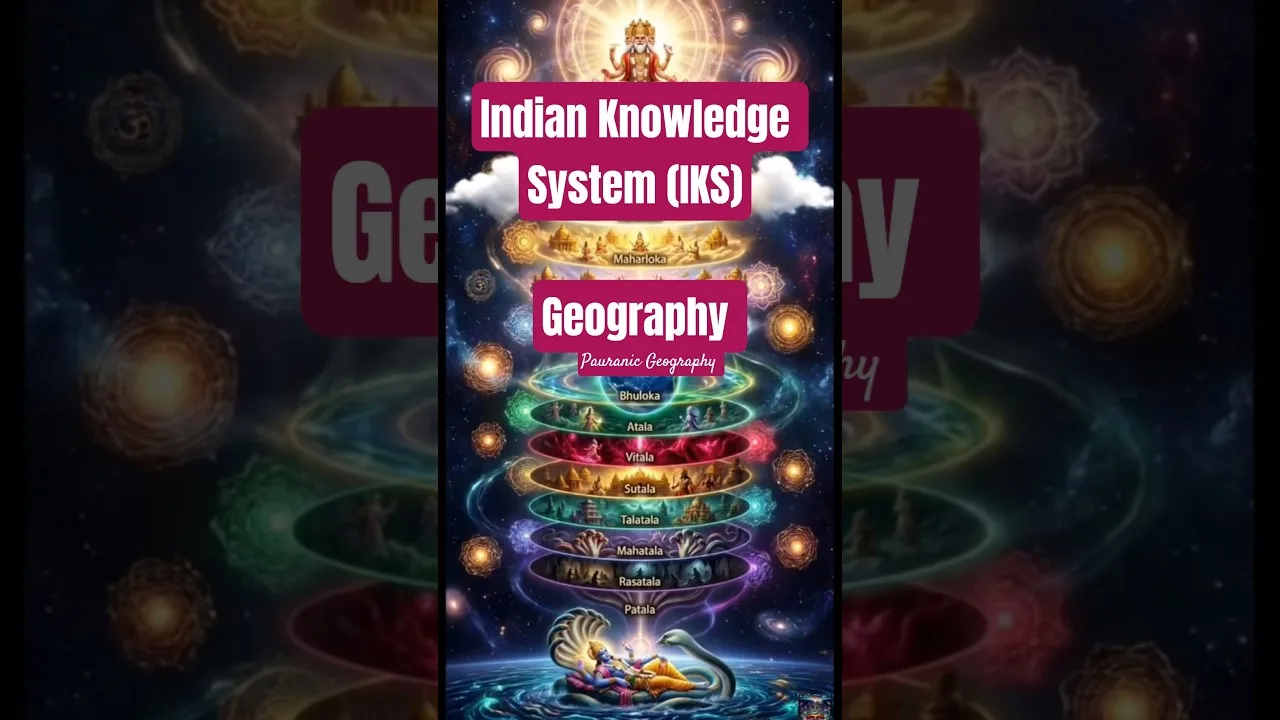
Table of Contents
- What Are the 14 Lokas in Vedic Cosmology?
- The Seven Upper Realms (Urdhva Lokas)
- The Seven Lower Realms (Adho Lokas)
- Cosmic Geography: Mapping Consciousness and Space
- Vertical Geography and the Axis Mundi
- Lokas as States of Consciousness
- Ecological Wisdom in the Nether Realms
- Modern Parallels: Quantum Physics and Multiverse Theory
- Cultural Significance and Sustainable Living
- TheGeoecologist: Bridging Ancient Wisdom and Modern Geography
- Conclusion: Geography as a Journey of Consciousness
The 14 Lokas represent one of the most sophisticated cosmological frameworks in human history, emerging from the vast repository of the Indian Knowledge System (IKS). Unlike modern geography that maps only physical terrain, this ancient Vedic cosmology charts a multi-dimensional universe where space, consciousness, and energy exist as an integrated continuum. The concept appears across foundational texts including the Puranas, Upanishads, and the Mahabharata, offering a vertical geography that extends far beyond Earth’s atmosphere into realms of subtle matter and pure awareness.
- The 14 Lokas form a complete cosmic hierarchy of seven upper realms (Urdhva Lokas) and seven lower realms (Adho Lokas), with Earth (Bhūloka) positioned at the central pivot.
- Each Loka corresponds to a distinct vibrational frequency of consciousness, ranging from dense materiality to pure transcendental awareness.
- This framework integrates astronomy, metaphysics, ecology, and psychology into a single coherent worldview that anticipates modern systems theory.
- Ancient seers described planetary movements, cosmic cycles (yugas), and subtle energy channels (nadis) with precision that continues to intrigue contemporary researchers.
- The 14 Lokas model offers practical implications for sustainable living, environmental ethics, and consciousness studies today.
What Are the 14 Lokas in Vedic Cosmology?
The Sanskrit term loka derives from the root loc (to shine, to perceive), implying “a world of experience” rather than merely a geographical location. The concept of Loka in Hindu cosmology describes fourteen distinct planes of existence arranged vertically along a cosmic axis (Meru or Skambha). This arrangement reflects the fundamental Vedic principle that consciousness and cosmos are inseparable—geography becomes a map of inner evolution as much as outer space.
The Seven Upper Realms (Urdhva Lokas)
The ascending realms represent progressive refinement of consciousness and matter:
- Bhūloka (Earth Plane) — The densest realm, sphere of karma and sensory experience, where humans, animals, plants, and minerals coexist. This is the only realm where liberation (moksha) can be actively pursued through conscious effort.
- Bhuvarloka (Atmospheric Plane) — The intermediate space between Earth and Sun, domain of atmospheric deities (Vayu, Agni), sages, and subtle beings. 14 Lokas governs weather patterns, pranic currents, and the breath-body connection.
- Svarloka (Celestial Plane / Svarga) — The heavenly realm of the Devas (gods), ruled by Indra. Characterized by heightened sensory pleasure, extended lifespans, and the fruits of meritorious karma. The planets and stars reside here as conscious entities.
- Maharloka (Plane of Great Sages) — Abode of rishis who have transcended celestial pleasures but not yet attained final liberation. They survive cosmic dissolution (pralaya) and guide human civilization.
- Janarloka (Plane of Progenitors) — Realm of the mind-born sons of Brahma (Sanaka, Sanandana, Sanatana, Sanatkumara), representing pure intellectual and spiritual potency.
- Tapoloka (Plane of Austerity) — Domain of advanced yogis engaged in deep meditation (tapas), generating the spiritual heat that sustains cosmic order (rita).
- Satyaloka (Plane of Truth / Brahmaloka) — The highest created realm, abode of Brahma the Creator. Here, consciousness approaches identity with Brahman; residents possess near-omniscience and lifespans spanning billions of years.
The Seven Lower Realms (Adho Lokas)
Descending below Bhūloka, these realms are not “hellish” in the Western sense but represent different densities of consciousness and alternative biospheres:
- Atala — Realm of subtle material enjoyment, ruled by Bala (son of Maya Danava), featuring advanced technological and tantric knowledge.
- Vitala — Domain of Shiva as Hatakeshvara, rich in gold and minerals, where yogic power manifests as material abundance.
- Sutala — Kingdom of the benevolent asura king Bali, celebrated for his devotion and generosity; a realm of prosperity without ego.
- Talatala — Realm of the architect Maya Danava, master of illusion (maya) and celestial architecture.
- Mahatala — Abode of the multi-hooded serpent deities (Nagas) like Kaliya, guardians of subterranean waters and esoteric knowledge.
- Rasatala — Domain of the Daityas and Danavas (titanic beings), characterized by immense power and technological sophistication.
- Patala (Nagaloka) — The lowest realm, ruled by Vasuki, the serpent king. Rich in jewels, illuminated by hood-gems of Nagas, featuring vast underground oceans and ecosystems.
Cosmic Geography: Mapping Consciousness and Space
Vertical Geography and the Axis Mundi
The 14 Lokas constitute a true cosmic geography—a spatial model where verticality encodes ontological density. Mount Meru, the cosmic axis, runs through all fourteen realms like a spinal column, connecting the base (Patala) to the crown (Satyaloka). This mirrors the human subtle body (sushumna nadi) with its seven chakras, reflecting the macrocosm-microcosm homology (“Yatha pinde tatha brahmande”).
Ancient texts like the Bhagavata Purana (2.5.40-42) and Vishnu Purana (2.7) provide detailed measurements: each realm spans millions of yojanas (a yojana ≈ 8-13 km), with precise distances between planes. The Hindu cosmological time cycles (kalpas, manvantaras, yugas) govern the duration of each realm’s existence, integrating temporal and spatial dimensions into a unified framework.
Lokas as States of Consciousness
Perhaps the most revolutionary aspect of the 14 Lokas is their psychological correlate. The Yoga Vasishtha and Mandukya Upanishad explicitly map each realm to a state of consciousness:
- Bhūloka ↔ Jagrat (waking state) — gross body identification
- Bhuvarloka ↔ Swapna (dream state) — subtle body, pranic awareness
- Svarloka ↔ Sushupti (deep sleep with bliss) — causal body, seed consciousness
- Maharloka to Satyaloka ↔ Turiya (fourth state) and beyond — progressive self-realization
This means “traveling” to higher Lokas is not physical relocation but consciousness expansion. The geography is both external and internal—a map for spiritual navigation as much as cosmic orientation.
Ecological Wisdom in the Nether Realms

The lower realms (especially Patala and Rasatala) reveal remarkable ecological insight. Far from being “underworlds” of punishment, they are described as vibrant biospheres with:
- Subterranean oceans and aquifers (mirroring modern discovery of deep-Earth water reservoirs)
- Bioluminescent flora and fauna (Naga-mani gems illuminating caves)
- Advanced civilizations living in harmony with geological processes
- Symbiotic relationships between surface and subsurface ecosystems
The Nagas (serpent beings) serve as guardians of water sources, mineral wealth, and ecological balance—a metaphor for the interconnectedness of aquifers, root systems, and planetary health. This anticipates modern deep ecology and geobiology by millennia, positioning the 14 Lokas as an early systems-thinking model for planetary stewardship.
Modern Parallels: Quantum Physics and Multiverse Theory
Contemporary science increasingly resonates with the 14 Lokas framework:
- Multiverse Theory — The many-worlds interpretation (Everett, 1957) and string theory’s landscape of vacua (10^500 solutions) parallel the plurality of realms with distinct physical constants.
- Holographic Principle — The idea that 3D reality projects from 2D information (Susskind, ‘t Hooft) echoes the Vedic concept of Maya projecting worlds from Brahman.
- Panpsychism — The view that consciousness is fundamental to matter (Chalmers, Goff) aligns with Lokas as consciousness-density gradients.
- Dark Matter/Energy — The 95% of universe unaccounted for by standard model may correspond to subtle realms (Bhuvarloka, Maharloka) imperceptible to gross senses.
Physicist Fritjof Capra in The Tao of Physics (1975) and The Dancing Wu Li Masters (1979) documented these parallels extensively. The 14 Lokas offer a conceptual vocabulary for integrating quantum non-locality, observer effects, and entanglement into a coherent worldview.
Cultural Significance and Sustainable Living
For Indian civilization, the 14 Lokas are not abstract philosophy but lived cultural infrastructure:
- Temple Architecture — Hindu temples replicate the cosmic mountain (Meru) with sanctum (Garbhagriha) as Satyaloka, mandapas as intermediate realms, and gopurams connecting to celestial planes.
- Festival Calendars — Celebrations like Mahashivaratri (cosmic dance), Diwali (return of light), and Makar Sankranti (solar transition) enact cosmic geography ritually.
- Ayurveda and Yoga — The three doshas (vata, pitta, kapha) and five koshas (sheaths) map directly to Loka-structures, making health a practice of cosmic alignment.
- Ecological Ethics — Reverence for rivers (Ganga as celestial descent), mountains (Kailash as Meru), and forests (Dandakaranya as sacred grove) derives from Loka-awareness.
This worldview fostered one of history’s most enduring sustainable civilizations. The Arthashastra (4th century BCE) mandated forest reserves, wildlife protection, and water management rooted in the understanding that Earth (Bhūloka) is a living node in a larger cosmic organism.
TheGeoecologist: Bridging Ancient Wisdom and Modern Geography
Today, platforms like TheGeoecologist (https://thegeoecologist.com/) are pioneering the integration of Indian Knowledge System geography with contemporary earth sciences. By decoding the 14 Lokas as a sophisticated geo-philosophical framework, they demonstrate how ancient seers anticipated:
- Earth system science’s holistic approach (atmosphere, hydrosphere, lithosphere, biosphere as interconnected)
- Consciousness studies’ hard problem (subjective experience as fundamental)
- Sustainability science’s need for ethical cosmologies
Their work includes comparative analyses of Vedic cosmology with modern geomorphology, climate science, and planetary boundary frameworks—showing that the 14 Lokas remain a living knowledge system capable of informing 21st-century challenges.
Conclusion: Geography as a Journey of Consciousness
The 14 Lokas invite us to radically expand what we mean by “geography.” No longer confined to mapping rivers, mountains, and political boundaries, geography becomes a cosmic tapestry where every location—from the deepest ocean trench to the farthest quasar—is also a coordinate in consciousness space. This ancient framework, preserved in texts like the Bhagavata Purana, Vayu Purana, and Mahabharata, offers humanity a navigation system for the Anthropocene: a way to situate our planetary crisis within a larger evolutionary arc.
As quantum biology reveals quantum coherence in photosynthesis and avian navigation, and as neuroscience explores non-local consciousness, the boundary between “physical geography” and “consciousness geography” dissolves—precisely as the 14 Lokas always maintained. India’s past, far from being mere mythology, continues to chart the future of knowledge, proving that the most advanced geography is one that maps not just where we are, but who we are becoming.
Frequently Asked Questions
The 14 Lokas are fourteen planes of existence in Vedic cosmology: seven upper realms (Bhūloka, Bhuvarloka, Svarloka, Maharloka, Janarloka, Tapoloka, Satyaloka) and seven lower realms (Atala, Vitala, Sutala, Talatala, Mahatala, Rasatala, Patala), arranged vertically along the cosmic axis Mount Meru.
Each Loka corresponds to a state of consciousness: Bhūloka maps to waking state (jagrat), Bhuvarloka to dream state (swapna), Svarloka to deep sleep (sushupti), and the higher realms to turiya (fourth state) and progressive self-realization. The geography is both cosmic and psychological.
While not empirically proven, the 14 Lokas framework shows striking parallels with modern physics: multiverse theory, holographic principle, panpsychism, and dark matter/energy concepts. Researchers like Fritjof Capra have documented these correspondences extensively in works like The Tao of Physics.
